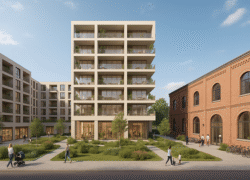
Senior living market in Europe: Demographic shifts and investment opportunities

A new whitepaper by Periskop Living highlights the senior living sector’s emergence as a significant asset class in Europe, driven by demographic changes and evolving investor strategies in an uncertain economic environment.

With an aging population across Europe, the demand for senior housing is poised for robust growth. The whitepaper shows that by 2055, people aged 65 and over will represent nearly 30% of the European Union’s population, up from 21.6% in 2024. Countries like Italy, Germany, France, and Spain are at the forefront of this shift. In Italy, the share of those over 65 is expected to reach around 34%, while Germany’s proportion will rise to 28%, buoyed by continued net immigration.

At the same time, the number of healthy life years—an important metric for assessing the potential need for medical and care support—remains relatively low. In Germany, for example, the average male can expect about 60.7 healthy years, followed by a prolonged period where support services are likely necessary.

From an economic perspective, Germany stands out for its stability. With a GDP per capita of €39,190 and a low unemployment rate of 3.5%, it maintains a strong fiscal position compared to its European peers. Although Germany’s debt-to-GDP ratio is expected to rise to around 85% following the approval of a €500 billion infrastructure fund, it remains below the debt levels of countries like Italy and France.

Germany’s senior living market benefits from this economic stability and a well-regulated care system. The country’s social care insurance covers almost the entire population, supported by a comprehensive funding structure that reduces investment risk. Unlike countries such as France and Italy, where care financing is more fragmented, Germany provides consistent and predictable funding for long-term care.

Real estate investment trends reflect growing interest in senior living. While traditional sectors like offices face uncertainty, alternative assets are gaining traction. In Germany, healthcare real estate transaction volumes rose to €1.3 billion in 2024, benefiting from improving financing conditions following interest rate cuts by the European Central Bank. Senior living properties are increasingly seen as resilient investments offering stable cash flows and lower volatility compared to equities.

The operator landscape for senior living facilities in Germany remains highly fragmented. The ten largest operators account for only about 14% of the market, suggesting significant room for consolidation. Sale-and-lease-back transactions and PropCo/OpCo structures are becoming popular strategies, enabling operators to unlock capital while providing stable rental income to investors.

Another key consideration is the comparison between investing in existing properties versus new developments. Existing senior living properties currently offer more attractive returns and lower risk compared to new builds, which face high construction costs and uncertainties. The cost of materials such as cement and bitumen remains elevated, and the construction industry continues to grapple with a high insolvency rate.

The whitepaper projects a need for an additional 372,000 senior living units in Germany by 2040, alongside the renovation of approximately 100,000 existing units. However, current development plans only cover about 304,000 new units, leaving a supply gap of nearly 168,000. This shortfall highlights a significant investment opportunity.

Regulatory developments are also influencing market dynamics. Some German states are easing building requirements, such as reducing the mandatory single-room quotas, creating a more favorable environment for investors and developers alike.

The German government’s €500 billion infrastructure fund, of which €100 billion is earmarked for social infrastructure, including healthcare, could further bolster the sector. Investments aimed at improving transport, energy, and digital infrastructure are expected to create locational advantages for senior living facilities, particularly in less densely populated regions.

Looking ahead, the senior living sector in Germany and across Europe is positioned to become a critical component of real estate portfolios. It combines demographic resilience with stable economic fundamentals and evolving regulatory support. For investors seeking long-term, secure returns, senior living offers a compelling proposition amid broader market uncertainties.

HIH Invest acquires Cecilienpalais office building in Düsseldorf

HIH Invest Real Estate (HIH Invest) has completed the acquisition of the Cecilienpalais, located at Cecilienallee 10 in Düsseldorf. The office building, constructed in 2010, offers 3,245 square metres of rental space across four storeys and features a natural stone façade. It is nearly fully occupied and includes 60 parking spaces in an underground car park. The property was acquired on behalf of the open-ended special fund ‘Deutschland Selektiv Immobilien Invest II’, though the purchase price has not been disclosed.

Situated along the Rhine in the Rheinboulevard submarket, the Cecilienpalais benefits from a stable and diversified tenant mix, providing consistent cash flow and value preservation. The building’s flexible floor plans and high-quality interior fittings are designed to support strong re-letting potential and broad usability for future tenants.

Daniel Asmus, Head of Transaction Management Office Germany at HIH Invest, noted that the property’s location was a decisive factor in the acquisition. Positioned near the Kennedydamm underground station, the building offers convenient access to local transport networks, with Düsseldorf’s main railway station and city centre reachable within minutes. Cecilienallee also borders Rheinpark Golzheim, a well-known recreational area.

The fund acquiring the property follows a strategy aligned with Article 8 of the EU Disclosure Regulation, focusing on energy-efficient office buildings in prime locations across Germany’s top seven cities and other growth centres. It currently delivers a distribution yield exceeding five percent annually.

Legal and tax due diligence for the acquisition was handled by Hogan Lovells, while Drees & Sommer conducted technical and ESG due diligence. On the seller’s side, CBRE acted as broker, with Clifford Chance managing legal due diligence and Brand Berger responsible for technical due diligence. The IC Immobilien Group served as the local management partner for the seller.

Photo: CBRE, photographer: Holger Peters.

Hungary’s GDP stagnates in first quarter of 2025

Hungary’s gross domestic product (GDP) remained unchanged in the first quarter of 2025 compared to the same period last year, based on unadjusted data. According to seasonally and calendar-adjusted and reconciled data, GDP declined by 0.4% year-on-year and decreased by 0.2% compared to the previous quarter.

From a production perspective, industry recorded a 3.9% year-on-year decline, driven primarily by a 4.6% decrease in manufacturing. The production of electrical equipment contributed most to the contraction, although a slower decline in computer, electronic, and optical products partially offset this trend. Construction output fell by 5.1%, while agricultural output decreased by 0.7%. Services overall expanded by 1.1%, with the strongest growth in education (3.5%), followed by arts and recreation activities (3.1%) and health and social services (2.4%). Retail trade and accommodation and food service activities also recorded moderate increases. By contrast, the information and communication sector and real estate activities experienced slight declines of 0.1% each, and public administration contracted by 1.2%.

Overall, services—particularly wholesale and retail trade—made the largest positive contribution to GDP, while industry and construction weighed on economic performance. The impact of taxes and subsidies on products slightly boosted GDP, while agriculture’s contribution was negligible.

From an expenditure perspective, household final consumption increased by 4.1% year-on-year, contributing positively to GDP. Consumption rose across all product groups, with the largest increase seen in durable goods. Government final consumption grew by 7.3%, while social transfers in kind from the government and non-profit institutions serving households declined. As a result, actual final consumption rose by 3.0%.

Gross fixed capital formation declined by 10.1%, reflecting reduced investment in both construction and machinery and equipment. Overall, gross capital formation fell by 10.3%. Despite this, domestic use increased by 0.4%.

In external trade, Hungary recorded a surplus of 1,237 billion forints at current prices. The volume of exports declined by 0.4%, while imports rose by 0.1%. Exports of goods increased by 0.9%, whereas exports of services decreased by 5.0%. Imports of goods and services rose by 0.7% and fell by 2.7%, respectively.

In quarterly comparison, GDP decreased by 0.2%. Agriculture’s output increased by 4.6%, while industry, services, and construction declined. Household final consumption rose by 0.4%, and government consumption by 1.4%. Gross fixed capital formation decreased by 2.4%. Both exports and imports increased quarter-on-quarter by 1.5% and 1.4%, respectively.

The figures suggest subdued economic momentum at the start of 2025, with consumption providing some support amid declines in investment and industrial output.

Austria’s inflation rate estimated at 3.0% in May 2025

According to a flash estimate released by Statistics Austria, the inflation rate in May 2025 is projected to be 3.0%, slightly lower than the 3.1% recorded in April. Compared to the previous month, prices are estimated to have decreased by 0.1%.

Services continued to be the primary contributor to inflation, with prices rising 4.4% year-on-year, although this represents a slight moderation compared to recent months. Prices for food, tobacco, and alcohol increased by 3.3%, also above the overall inflation rate. In contrast, energy prices rose by 1.3%, held down by lower fuel costs compared to the previous year, despite an increase in electricity prices. Prices for industrial goods recorded a more modest rise of 0.8%. Core inflation, which includes services and industrial goods, was estimated at 3.1% in May.

The flash estimate provides an early indication of the changes in the Consumer Price Index (CPI) based on approximately 80% to 90% of collected price data, although it is subject to revision once full data validation is completed. The final CPI figures for May 2025 are scheduled for release on June 18, 2025.

Statistics Austria also noted that differences exist between the national CPI and the Harmonised Index of Consumer Prices (HICP), mainly due to varying weighting methodologies, with the HICP including expenditure by foreign tourists.

Shell renews long-term lease at DOT Park in Kraków

Shell has renewed its lease agreement at DOT Park in Kraków, securing over 22,800 square meters of office space across three buildings (A, B, and C). The lease marks the largest office transaction in Poland in the first half of 2025 and the largest single office lease recorded in the Kraków market.

Shell, operating in Poland for over 30 years, maintains a significant presence in the country through its network of over 450 fuel stations and its business activities in renewable energy, e-mobility, and business service operations. Shell Business Operations (SBO) has been located at DOT Park since 2015, employing over 5,000 staff who support the company’s global functions in finance, human resources, IT, logistics, and procurement.

Under the new agreement, Shell plans to refurbish its office space to meet the evolving needs of its workforce, including updates to modern workplace standards. Planned improvements include the addition of electric vehicle charging stations and designated parking for electric scooters and bicycles.

Golden Star Estate, the owner of DOT Park, was represented by Marcin Rogala from SRC Law Firm during the lease renegotiation. Shell was advised by Piotr Jeżółkowski (Jeżółkowski i Wspólnicy sp. k.) and Maciej Fielek (Jones Lang LaSalle).

DOT Park, located on ul. Czerwone Maki in southwestern Kraków, consists of five Class A office buildings with a total leasable area of over 44,000 square meters. The complex features cyclist facilities, retail units, and landscaped green areas. It was developed following sustainable construction principles and holds BREEAM certification.

The office park is situated near Jagiellonian University research facilities and several international business institutions. It is accessible by public transport, including ten bus lines and five tram lines, and is near a Park & Ride hub and a direct tram connection to the city center. The Skawina junction of Kraków’s ring road, approximately 4 kilometers away, provides access to Kraków Airport and major cities including Katowice, Warsaw, Rzeszów, and Zakopane.

Other tenants at DOT Park include LuxMed, Webcon, and Ericsson.

UK mergers and acquisitions activity sees rise in value in early 2025

The value of mergers and acquisitions (M&A) involving UK companies increased in the first quarter of 2025, according to provisional data from the Office for National Statistics (ONS). Both inward and outward M&A values reached their highest levels since late 2022, primarily due to a few large transactions rather than an increase in the overall number of deals.

In total, 395 domestic and cross-border M&A transactions resulting in a change of majority ownership were recorded between January and March 2025. This figure is lower than the 497 deals completed in the final quarter of 2024. Monthly transaction volumes fluctuated, with 148 deals in January, a decrease to 103 in February, and a subsequent rise to 144 in March.

Inward M&A—foreign acquisitions of UK companies—reached a provisional value of £19.2 billion, up from £4.0 billion in the previous quarter and marking the highest level since the third quarter of 2022. Notable transactions included the acquisition of DS Smith PLC by International Paper Company (USA), Britvic PLC by Carlsberg A/S (Denmark), and AGS Airports Holding Ltd by the Public Sector Pension Investment Board (Canada).

Outward M&A—UK companies acquiring foreign businesses—was valued at £9.4 billion, a significant increase from £1.8 billion in the previous quarter and the highest level since late 2022. A key transaction was Rio Tinto PLC’s acquisition of Arcadium Lithium PLC (Jersey).

Domestic M&A—deals between UK companies—totaled £2.9 billion, lower than both the previous quarter (£6.4 billion) and the same period last year (£3.2 billion). A major domestic acquisition in the quarter was the Coventry Building Society’s acquisition of The Co-Operative Bank Holdings Limited.

The number of transactions also declined across categories: 167 inward deals were completed in the first quarter, compared to 189 in the previous quarter; 71 outward deals were recorded, down from 77; and 157 domestic deals were completed, a decrease from 231.

The Bank of England’s summary of business conditions for the first quarter noted that firms were facing increasing financial pressures and cautious investment behavior, influencing M&A activity. Although there are signs of improvement in M&A activity, growth remains constrained.

OECD lowers growth forecasts for Czech and global economies

The Organisation for Economic Co-operation and Development (OECD) has revised its growth forecast for the Czech economy, reducing its estimate for 2025 to 1.9% from the previously projected 2.1%. The outlook for 2026 has also been lowered, from 2.5% to 2.2%. According to the OECD’s updated report, uncertainty in trade policy and tariffs, particularly in the automotive sector, remain significant risks to economic performance. In 2024, the Czech economy grew by 1%.

Globally, the OECD downgraded its growth forecast to 2.9% for both this year and next, down from 3.1% and 3.0%, respectively, in its March outlook. The organization attributed the weaker outlook to ongoing trade policy uncertainty, tighter financial conditions, and broader geopolitical tensions.

The OECD noted that economic growth in the Czech Republic will be driven primarily by private consumption, supported by rising real household incomes. However, investment is expected to be constrained by continued trade uncertainty. The report also identified potential risks from escalating geopolitical tensions, including disruptions to supply chains. While the OECD did not specify sources of geopolitical tension in detail, it referenced broader concerns related to recent tariff policies introduced by the U.S. and the ongoing war in Ukraine.

Inflation in the Czech Republic is expected to decline to the Czech National Bank’s 2% target during 2025. Employment growth is forecast to continue, particularly in the services sector.

The report also recommended that the Czech Republic finalize pension system reforms to enhance long-term sustainability. Additionally, it highlighted the importance of developing the capital market and streamlining regulations to facilitate business entry and expansion as a means of supporting investment and economic dynamism.

Founded in 1961, the OECD currently consists of 38 member countries. The Czech Republic joined the organization in December 1995.

On a global scale, the OECD expects slower growth compared to previous projections, warning that further increases in tariffs and retaliatory measures could exacerbate the slowdown and disrupt international supply chains. Last year, the world economy grew by 3.3%, but the OECD now anticipates lower growth rates for major economies, including the United States, Canada, Mexico, and China.

For the United States, the OECD forecasts growth to slow to 1.6% this year from 2.8% in 2024, with 2026 growth projected at 1.5%. In March, the forecasts were higher, at 2.2% for this year and 1.6% for next year.

In the euro area, growth is expected to accelerate slightly, with GDP projected to expand by 1.0% this year and 1.2% next year, consistent with the OECD’s earlier estimates. The euro area recorded 0.8% growth in 2024.

Hungary’s largest speculative warehouse welcomes first tenant

Hungarian fashion brand RETRO JEANS has signed a long-term lease agreement with HelloParks to establish its new central warehouse at the HelloParks Budapest South (Alsónémedi) AN1 facility. The brand will occupy 5,000 square meters in the newly completed logistics hall, which is the largest speculative industrial building developed to date by the Hungarian-owned industrial property developer.

RETRO JEANS, founded in 2001, operates at more than 60 retail locations across five European countries. By relocating to the AN1 facility, the company aims to improve the efficiency of distribution to both retail outlets and online customers. “The strategic location, technical standards, and flexible layout of the new logistics center were key factors in our decision,” said István Barnák, Project Manager at RETRO JEANS.

Located in Alsónémedi, a key logistics hub in the southern Budapest submarket, the 60,000-square-meter AN1 hall offers direct access to major transportation routes including the M0 and M5 motorways and is approximately 20 minutes from Liszt Ferenc International Airport. The facility includes features such as contiguous 15,000-square-meter spaces, a 12-meter clear height, and cross-dock options, making it suitable for logistics providers, courier services, freight forwarders, and e-commerce operations. High power capacity also allows for specialized storage, including refrigerated and pharmaceutical goods. The building has been constructed to meet the BREEAM New Construction Outstanding rating and complies with EU Taxonomy requirements.

“Speculative developments depend on attracting tenants who recognize the long-term value of these facilities. RETRO JEANS is a strong and established brand, and we are pleased to welcome them as the first tenant of this site,” said András Bodahelyi, Senior Business Development Manager at HelloParks.

HelloParks’ total completed industrial portfolio now spans 410,000 square meters across locations in Fót, Páty, Maglód, and Alsónémedi. The company is currently developing two additional halls totaling 88,000 square meters. All HelloParks buildings are developed to meet high sustainability standards, holding either BREEAM Outstanding or Excellent certifications, as well as EU Taxonomy validation.

Czech banking statistics show modest growth and strong loan performance in April 2025

Banking sector data for April 2025 indicate continued stability and modest growth across key segments, according to an analysis by Miroslav Zámečník, Chief Advisor to the Czech Banking Association.

In the household sector, the total volume of consumer loans (excluding overdrafts and credit cards) reached CZK 341 billion in March, reflecting a 0.8% month-on-month increase and 9.1% year-on-year growth. The repayment performance remains strong, with non-performing consumer loans at 4.23%, the lowest share recorded in 23 years.

Mortgage lending has shown a steady recovery, with a 6.2% year-on-year increase in loans for housing, including building savings loans. In April, CZK 26 billion was issued in new mortgage loans (excluding refinancing), and interest rates continued to decline gradually—from 4.78% in January to 4.65% in April. Non-performing mortgage loans decreased to 0.59%, reaching their lowest level since June 2023. This performance continues to place the Czech mortgage market among the best in Europe in terms of repayment discipline.

Among sole traders, April brought further improvement, with the share of non-performing loans dropping to 4.09%, the lowest level in more than two decades. This contrasts with much higher default rates seen historically, even as recently as 2015 when the non-performing loan rate was three times higher.

For non-financial sector companies, interest in borrowing has revived, particularly among domestic private firms, which recorded a nearly two percentage-point increase in loan volumes. In contrast, public sector firms saw continued declines, and firms under foreign control reported only slight month-on-month growth. New loans totaled CZK 27 billion in local currency and CZK 22 billion in euro-denominated loans. Average interest rates for new loans stood at 5.2% for crown loans and 4.4% for euro loans. The share of non-performing corporate loans remains low at 2.56%, indicating a relatively healthy corporate sector in international comparison.

Deposit trends showed that household deposits grew by 5.4% year-on-year in April, with a month-on-month increase of CZK 26 billion, reaching a historical high of CZK 3.721 trillion. Despite low interest rates, households continue to hold over CZK 1.27 trillion in current accounts. Corporate deposits, characterized by more volatility, remained stable year-on-year. Since the summer of 2020, corporate deposits have consistently exceeded loan volumes, reflecting cautious financial behavior amid global economic uncertainty.

Build Europe outlines proposals to improve affordable housing

Build Europe, the association representing EU homebuilders and developers, presented its recommendations for addressing Europe’s housing challenges at the European Housing Forum. Speaking to the European Commission’s Housing Task Force, the association emphasized the need for affordable housing to be delivered efficiently, sustainably, and competitively, with an active role for private developers, particularly small and medium-sized enterprises.

Build Europe proposed six key priorities:
• Investment Framework for Affordable Housing: The association called for an EU investment strategy that supports both ownership and rental housing models. Its A-HOPE proposal, developed with Deloitte and presented to the European Investment Bank, includes measures aimed at promoting homeownership to help adjust the housing supply to family needs.
• Reform of State Aid in Social Housing: Build Europe advocated for state aid to be based on outcomes rather than the type of provider. It recommended that private residential developers focused on serving vulnerable groups should have equal access to public support.
• Taxation Review: Highlighting the impact of high taxation on new homes, Build Europe urged the EU to initiate a housing tax survey to identify best practices and obstacles. The association also proposed tax incentives for primary residences to improve access to affordable housing.
• Strategic Spatial Planning and Urban Renewal: Build Europe warned that rigid No Net Land Take regulations could hinder the delivery of affordable housing. It called for a balanced approach to land use that considers both environmental goals and housing needs, alongside investment in underused urban areas and rural regions.
• Streamlining Permitting Procedures: The association pointed to increasing complexity and delays in building permit processes, particularly for large housing projects. It recommended simplifying and accelerating permitting procedures to provide greater legal certainty for developers.
• Proportional Technical Standards: Build Europe noted that national regulations aimed at promoting sustainability and energy efficiency often add complexity and costs. It proposed a results-based approach that maintains policy objectives while offering greater flexibility and reducing administrative burdens.

Build Europe welcomed the European Commission’s renewed focus on housing and described the dialogue at the Forum as constructive. A follow-up meeting between Build Europe and the Housing Task Force is scheduled during the Build Europe Congress in Gdańsk on June 12, where these proposals will be discussed further.

front page info
LATEST NEWS