Gulf Cooperation Counci inflation remains stable amid global economic volatility

Inflation across the Gulf Cooperation Council (GCC) countries remained largely contained in the first quarter of 2025, despite ongoing global trade disruptions and inflationary concerns in other regions. According to the latest GCC Inflation Update by Kamco Invest, only Saudi Arabia and the United Arab Emirates recorded annual inflation rates exceeding 2% as of March 2025, reinforcing the region’s relative price stability.

The report highlights that while global inflation pressures are easing—supported by stabilizing energy prices, supply chains, and diplomatic breakthroughs in trade—the GCC’s subdued inflation is further anchored by currency pegs to the US dollar and government subsidies in essential sectors like food, housing, and energy.

GCC vs. Global Trends

Compared to broader trends across the Middle East and North Africa (MENA), where average inflation remains significantly higher, the GCC bloc is expected to maintain its disinflationary trajectory through 2025. However, Kamco Invest warns that protectionist trade policies—particularly recently introduced US tariffs—pose risks that could reintroduce upward pressure on prices, particularly in import-dependent economies.

In the United States, inflation eased slightly to 2.3% in April 2025, aided by postponed tariffs and declining service sector price growth. The Eurozone recorded steady inflation at 2.2%, but core inflation rose to 2.7%, indicating continued pressure in goods and services. A similar pattern is visible in the GCC, where inflation data reflects stable price levels but sectoral variations remain.

Country-Specific Highlights
• Kuwait reported an annual inflation rate of 2.3% in April 2025. Key drivers included a 4.6% rise in food and a 4.9% increase in services and miscellaneous goods. Transport costs fell 1.1% year-on-year, helping to moderate overall inflation. Monthly inflation growth was a modest 0.1%.
• Saudi Arabia saw inflation rise to 2.3%, primarily driven by an 8.1% increase in housing-related expenses, notably apartment rents, which jumped nearly 12% year-on-year. Meanwhile, prices for furniture, clothing, and transportation declined.
• United Arab Emirates (Dubai) recorded inflation at 2.3% in April, down from 2.8% in March. The housing group saw a sharp 7% increase, while transport prices declined by 7.6% year-on-year. The IMF projects UAE inflation to average 2.1% in 2025.
• Qatar reported one of the lowest inflation rates at just 0.3% year-on-year in March 2025. Price declines in housing and food offset increases in communication and education. The monthly inflation rate declined by 0.8%.
• Bahrain experienced near-zero inflation at 0.1% in March, making it the lowest among GCC peers. Price drops in housing, recreation, and food were only partially offset by rising communications costs. The IMF expects Bahrain’s inflation to average just 1.0% in 2025.
• Oman recorded 0.5% inflation in March 2025, with notable declines in food prices, especially vegetables and seafood. On a monthly basis, Oman’s CPI fell by 0.4%, supported by ongoing fiscal discipline and rising non-oil exports.

Outlook and Policy Trends

The report underscores that while inflation is a key driver of monetary policy, recent trade tensions could disrupt global expectations. Although both the US Federal Reserve and the European Central Bank had initiated rate cuts in early 2025 in response to softening inflation, uncertainty around global tariffs could delay further easing. While the Fed has kept interest rates steady at 4.25–4.5%, the ECB reduced its rates in April to stimulate demand in a sluggish Eurozone economy.

In the context of food prices, the FAO Food Price Index rose by 1.0% year-on-year in April, though it remains substantially below 2022 peaks. A decline in palm oil prices, due to seasonal factors and increased exports from Southeast Asia, played a key role in moderating global food price pressures.

Regional Inflation Forecasts

Kamco Invest projects that inflation across the GCC will average 1.9% in 2025, consistent with 2024 levels. This compares favorably with the broader Arab world, where inflation is forecasted to drop from 11.4% in 2024 to 7.7% in 2025. Within the GCC, Bahrain, Qatar, and Oman are expected to maintain the lowest inflation rates, ranging from 1.0% to 1.5%.

Conclusion

The report concludes that while inflation in the GCC remains under control for now, external factors—particularly trade frictions and potential shifts in energy prices—will need close monitoring. Policymakers are expected to maintain a cautious stance, balancing the need for economic stimulus with long-term price stability objectives. For now, GCC economies continue to benefit from their relative insulation from global inflationary shocks, a trend that could prove vital amid an increasingly uncertain international environment.

Cheaper mortgages drive return of young buyers, fuel real estate recovery in Slovakia

After a period of stagnation in 2022 and 2023, Slovakia’s housing market is showing clear signs of recovery, driven primarily by falling interest rates and renewed interest from young buyers. According to analysts, the return of buyers under 35 is helping to usher in a new phase of residential real estate activity.

The revival comes as mortgage interest rates continue to decline. Figures from the National Bank of Slovakia show that the average mortgage rate dropped to 3.7 percent in March, with some banks offering rates as low as 3.2 percent. This marks a notable improvement from the 4.2 percent average seen a year earlier.

This shift in financing conditions has translated into a sharp increase in loan activity. In the first quarter of 2025 alone, Slovak banks issued €1.3 billion in new mortgages – a 53 percent increase compared to the same period in 2024. Notably, this figure excludes refinancing, underscoring the strength of new lending and its influence on market demand.

Banks are responding to the renewed interest by simplifying and accelerating the loan approval process, creating a more accessible environment for first-time buyers. As a result, activity among younger clients is on the rise.

“We’re seeing more interest from young people looking to purchase their first home,” said Zuzana Klačanová, owner of UPgreat HOME real estate agency. “Lower mortgage rates have made financing viable for many who were previously excluded from the market.”

These buyers are typically seeking smaller, more affordable homes—such as one- or two-room flats or compact family houses. In contrast to wealthier segments of the market, their purchasing decisions are driven by practical considerations and a need for predictable, long-term affordability.

While demand for larger properties remains subdued, real estate experts expect that could change later in the year if rates continue to stabilise and income levels improve.

However, the positive outlook is tempered by a number of ongoing challenges. Demographic trends point to a shrinking pool of younger buyers over the long term, meaning the current surge in demand may reflect delayed purchases rather than sustained growth.

Another major obstacle is the continued rise in housing prices. The average price of apartments rose by 11.4 percent year-on-year to reach a record €3,041 per square metre, according to NBS data. This increase threatens to outpace the financial capacity of first-time buyers, particularly those without significant savings.

Michal Kremnický, CEO of Finvia Holding, warned that the market could become increasingly dominated by older buyers. “Those in the 35 to 45 age group have more stable incomes, stronger credit profiles, and often apply jointly with a partner. Their preparedness will allow them to remain the driving force behind demand,” he noted.

One notable trend in early 2025 is the growing preference for older apartments over new-builds. Older flats saw a price increase of 6 percent compared to just 3.4 percent for new constructions. This indicates a shift in buyer behaviour toward quicker transactions and properties located in well-established urban areas with existing infrastructure.

“There is a clear preference for affordability,” said Vladimír Kubrický, analyst at the Real Estate Union of the Slovak Republic. “Even buyers with sufficient means often choose older apartments because they offer better value and location benefits.”

Kubrický added that while interest rates may continue to fall modestly, significant further reductions are unlikely. Only smaller banks competing for market share may offer below-average rates.

Although developers and sellers are benefiting from the market’s renewed momentum, the outlook remains cautious. Any sustained revival will hinge on maintaining credit accessibility and curbing the pace of price increases. At the same time, demographic pressures and limited affordable supply may constrain long-term growth.

For now, however, young buyers are once again active in the market, reshaping demand and prompting new considerations for both developers and financial institutions. Whether this momentum can be sustained will depend on how the market adapts to evolving economic and social conditions in the months ahead.

Source: Trend.sk
Photo: ZWIRN, YIT

Tusk calls for full border closure with Belarus and Russia to counter hybrid threats

Prime Minister Donald Tusk has called for the complete sealing of Poland’s borders with Belarus and Russia, citing the need to protect national security and prevent the recurrence of uncontrolled migration. During a parliamentary debate on the government’s resolution to extend restrictions on the right to apply for asylum at the Belarusian border for another 60 days, Tusk emphasized the urgency of safeguarding the border against external threats and smuggling operations.

Tusk stated that one of his government’s first steps was to secure the eastern frontier to prevent a repeat of past border breaches. The current restrictions, introduced in December 2024 and in force until May 26, would be extended as part of a broader strategy to combat illegal migration and respond to what the Prime Minister described as deliberate destabilization efforts by Belarus and Russia.

“This is not just a migration crisis, but a calculated act of hybrid warfare,” said Tusk. He alleged that the governments of Alexander Lukashenko and Vladimir Putin were using migrant flows as tools of pressure, directing them toward Poland, as well as neighboring countries including Finland, Lithuania, and Latvia, in cooperation with smuggling networks.

Tusk underlined the risks faced by Polish personnel stationed at the border, referencing the death of Sergeant Mateusz Sitek, who was fatally wounded near Dubicze Cerkiewne in June 2024. “This conflict has a physical and tragic dimension for our border forces,” he said, insisting that national security must be backed by real and enforceable protections.

To counter the influx of migrants, the government plans to launch an international information campaign targeting countries of origin. The campaign, led by the Ministry of Foreign Affairs, aims to deter prospective migrants by clarifying that illegal border crossings will not result in asylum or settlement in Poland.

The Prime Minister also criticized the previous government’s handling of migration and visa policy. He accused the former administration of enabling widespread abuse through the mass issuance of visas—over half a million in 2023 alone—to individuals from countries considered high-risk for illegal migration. He referred to the scandal as a systemic failure marked by corruption and a lack of oversight. Eleven individuals have been charged in connection with the case.

Tusk denounced what he described as the hypocrisy of his predecessors, claiming they promoted Foreigners’ Integration Centres and later disowned them for political gain. He said the former ruling party created a flawed system, then attempted to shift responsibility once the consequences became politically inconvenient.

Addressing another contentious issue, the Prime Minister criticized the previous administration’s approach to grain imports from Ukraine. He said their failure to control the influx of Ukrainian agricultural products endangered Poland’s domestic market and farmers. In response, the current government negotiated new terms with the European Union, reintroducing pre-war import controls starting 5 June 2025 to safeguard Polish agriculture.

While reaffirming Poland’s continued support for Ukraine in its war against Russia, Tusk stressed that such support must not come at the expense of Polish economic stability. “We will continue to stand with Ukraine, but we also have a duty to protect our own farmers, producers, and consumers,” he said.

Tusk concluded by stating that security, whether in terms of borders, markets, or policy, must be based on action, not declarations. He reiterated his government’s commitment to defending national interests in the face of external and internal challenges.

HelloParks advances sustainability targets in Hungary’s industrial property sector

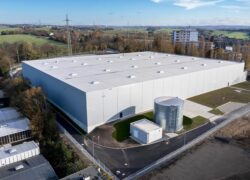
HelloParks has expanded its portfolio of environmentally certified logistics facilities, strengthening its position in Hungary’s green industrial real estate market. As of May 2025, all eight operational warehouses developed by the company comply with the EU Taxonomy requirements for sustainable activities—a first among Hungarian developers.

Since the beginning of the year, HelloParks has added 188,000 square metres of warehouse space certified as BREEAM New Construction Outstanding, the highest rating awarded under the scheme. This brings the company’s total certified space under the Outstanding or Excellent categories to 352,000 sqm. Recent certifications include the PT3 warehouse in Páty, near Budapest, joining PT1 and PT2 in the same location, FT2 and FT6 in Fót, and MG3 in Maglód.

The BREEAM certificates confirm that the buildings meet stringent criteria across energy efficiency, carbon emissions, water and waste management, pollution prevention, biodiversity, and circular economy principles. Only a small proportion—about 3%—of buildings globally meet the Outstanding rating under BREEAM standards.

The company has incorporated a number of energy-efficient and low-impact technologies into its developments, including rooftop solar panels, heat pumps, and smart lighting systems. Electric vehicle charging infrastructure is standard in all completed sites. During construction, HelloParks prioritises the use of ISO 14001-certified materials and achieves selective collection of over 85% of construction waste for recycling.

Innovations in building methods have also played a role in reducing the environmental footprint of HelloParks’ projects. These include the use of fibre-reinforced flooring, low-carbon concrete, and steel reinforcement produced entirely from recycled materials. As a result, the newly completed PT3 warehouse has a lower carbon footprint than the earlier PT1 building, which already met high sustainability standards.

In January 2025, the company began sourcing all electricity for its industrial parks from renewable sources, including both on-site solar generation and certified green energy suppliers. This step, originally targeted for 2028, is part of HelloParks’ broader climate neutrality strategy, HelloZero. The company aims to reduce embodied carbon in new buildings by 25% in 2025 and by 50% by 2030, compared to its earliest projects.

HelloParks’ roadmap for achieving carbon neutrality in the industrial property sector extends to 2035. The developer states that demand for high-performing, energy-efficient facilities continues to grow, as companies increasingly prioritise sustainability in their operational decisions.

Project Review: Bratislava’s Southbank project

The Southbank development, spearheaded by Penta Real Estate, is set to transform the right bank of the Danube River into a vibrant mixed-use neighborhood. Designed by renowned architectural firms Snøhetta and Studio Egret West, in collaboration with local studio Gro Architekti, the project aims to blend urban living with natural landscapes.

The development will encompass approximately 210,000 square meters, featuring a balanced mix of 48% residential and 52% commercial spaces. Plans include around 900 apartments and over 85,000 square meters of office and retail areas. A central feature of the design is the integration of public spaces, referred to as “bowls,” each serving distinct functions such as recreation, culture, and tranquility, interconnected by a promenade along the riverbank.

Environmental considerations are central to the project. The design preserves existing mature trees and incorporates sustainable drainage systems to manage water runoff. Green spaces are set to expand by an additional 32,600 square meters, enhancing biodiversity and providing habitats for local wildlife.

Transportation infrastructure will also see significant improvements. Plans include new tram lines, a pedestrian bridge connecting both sides of the Danube, and a railway halt near Einsteinova Street to facilitate better access to the area.

Construction of the first phase is scheduled to commence in late 2026, with the entire project expected to unfold over the next decade. The Southbank development represents a significant step in Bratislava’s urban evolution, aiming to create a harmonious blend of city life and natural environment.

Penta secures approval from Prague 1 for major development near Florenc and Masaryk Station

The Prague 1 city district has approved a draft agreement with developer Penta, clearing the way for key zoning changes linked to the company’s planned construction on land northeast of Masaryk Station and the Florenc area. The contract, which outlines financial and non-financial contributions from Penta to local authorities, is a prerequisite for modifying the zoning plan. It was approved by Prague 1 councillors on Monday and by city representatives yesterday. Prague 8 officials are expected to review the agreement next.

According to a statement released by Penta, the total value of contributions tied to the agreement exceeds CZK 300 million. These contributions will be divided among Prague 1, Prague 8, and the city of Prague. Prague 1 is set to receive CZK 16 million, of which CZK 10 million will be provided in cash. The remaining CZK 6 million will come in non-monetary form, including CZK 5 million allocated for public improvements to V Celnici Street and CZK 1 million earmarked for Prague 1’s share in the cost of an architectural competition.

Penta has already completed the Masaryčka office complex on part of the land adjacent to Masaryk Station. The newly approved zoning adjustments relate to additional plots located east of the station and to areas around the Florenc bus terminal, which Penta acquired in 2023 along with surrounding properties.

The development plans are based on the results of an international urban design competition organized by Penta in cooperation with the City of Prague. As part of the negotiated contributions, Penta has also committed to transferring ten residential units to the city, building a new kindergarten, and delivering a range of civic infrastructure including green spaces and public artworks.

The zoning changes now await final approval by the Prague City Council, which would enable one of the capital’s most significant urban redevelopments in recent years to move forward.

Source: CTK

Foreign workers help Polish companies navigate labour shortages and financial pressure

As labour shortages and financial strain weigh on Polish businesses, many entrepreneurs are turning to foreign workers to stabilise operations and reduce employment costs, according to a new survey by Keralla Research for BIG InfoMonitor.

The data reveals that nearly half of Polish entrepreneurs now employ at least one foreign national, with around 15% expecting their share of foreign workers to increase over the coming year. The construction and transport sectors are among those most reliant on foreign labour, as local hiring becomes increasingly difficult.

“For one in ten businesses, especially in transport and construction, finding new employees has become a top concern,” said Dr Waldemar Rogowski, chief analyst at BIG InfoMonitor. “The lack of qualified workers in Poland is pushing companies to look abroad—not only to fill vacancies, but also to stay competitive in increasingly challenging markets.”

The situation is particularly acute in firms employing between 50 and 249 people, where 14% reported difficulties in recruitment. Among micro and small enterprises, the problem is present in roughly one in eleven companies.

While foreign employees still make up a minority of the workforce in most firms, the numbers are growing. A quarter of surveyed companies said that foreign nationals now represent between 6% and 50% of their total staff—indicating teams of dozens, even hundreds. Most of these workers occupy operational roles, but their presence is becoming integral to business continuity, particularly in sectors where skilled domestic labour is in short supply.

Labour and Economic Pressures Driving Change

Rising inflation, energy and material costs, and slowing sales are compounding the pressure on companies. More than 38% of entrepreneurs cite inflation and general price increases as the biggest challenge this year, while nearly 30% point to the rising cost of raw materials and energy. Other concerns include maintaining financial liquidity (12%), the need to find new markets (16%), and falling revenues.

In this context, employment costs are also coming under scrutiny. Around 25% of business owners say they consider lower wage expectations to be a key advantage of hiring foreign workers. Additionally, demographic changes are shrinking the pool of working-age Poles. According to Poland’s Central Statistical Office, the number of working-age individuals dropped by more than 175,000 in 2024, falling to just under 22 million and accounting for 58.1% of the total population—down from 60.8% in 2000.

“Foreign workers bring not only manpower but also high levels of motivation and dedication,” Rogowski explained. “That’s increasingly important for employers who report difficulties in finding local candidates with the necessary skills and commitment.”

Payments and Liquidity Remain Persistent Challenges

Beyond recruitment, cash flow continues to hinder many Polish firms. More than 56% of entrepreneurs say that late payments from customers are affecting their financial condition. Nearly 80% report that they have contractors who regularly miss payment deadlines, and 46% of companies with deferred payment terms say they are currently waiting more than a month for invoices to be settled. Almost 30% report delays of up to two months.

These liquidity pressures, combined with demographic and economic constraints, are reinforcing the shift towards more flexible and cost-effective employment models. For many companies, that means relying more heavily on foreign labour.

Concerns About the Future

Not all firms see the trend continuing. Among those forecasting a decline in foreign employment, the most common reasons include rising hiring costs and customer preferences for Polish staff—cited by 27.6% of respondents. One in four companies also expressed concerns over increasing geopolitical instability, which may restrict the cross-border movement of workers.

Nevertheless, for a growing number of Polish businesses—particularly in sectors facing acute labour shortages—foreign workers are proving vital in maintaining productivity and adapting to the evolving demands of the national economy.

Source: BIG InfoMonitor

Czech real estate investment surges in Q1 2025, outpacing entire 2023

The Czech commercial real estate market recorded unprecedented investment activity in the first quarter of 2025, with transaction volumes already exceeding the total for all of 2023. According to data released by Colliers, investment reached EUR 1.48 billion in Q1 alone, surpassing last year’s full-year total of EUR 1.15 billion. The growth was driven by several major transactions, each exceeding EUR 100 million.

“Several significant transactions were finalized in the opening months of the year. While some were long-anticipated, others came as a surprise to the market,” said Josef Stanko, Director of Market Research at Colliers. “The total volume reached EUR 1.48 billion, more than what we saw throughout 2023.”

Among the most notable transactions was the acquisition of Contera/TPG’s industrial portfolio in the Czech Republic and Slovakia. Blackstone, one of the largest real estate investors globally, acquired the Czech portion of the portfolio in a deal worth approximately EUR 370 million.

Another landmark transaction involved the acquisition of Hilton Prague—Central and Eastern Europe’s largest hotel with 791 rooms—by Czech investment group PPF. Valued at over EUR 250 million, it represents the most expensive single-hotel acquisition ever recorded in the region.

Redstone Real Estate Group also completed two high-profile acquisitions in Prague worth over EUR 300 million. The group acquired the Myslbek office and retail complex on Na Příkopě Street from AEW, and Atrium Flora—an established shopping centre with adjoining offices in Prague 3—from G City Europe.

“These deals highlight both the strength of Czech capital and the appeal of the Czech Republic to large international investors,” Stanko noted. Domestic investors accounted for 72% of total investment volume, while Prague alone attracted 70% of all capital deployed in the country during Q1.

Yield Stability Supports Market Activity

The investment surge has been supported by a stable yield environment. At the end of Q1 2025, prime office yields stood at 5.50%, industrial yields at 5.25%, and retail yields ranged from 4.50% for premium shopping centres to 6.25% for retail parks. This consistency has helped align price expectations between buyers and sellers, facilitating deal closures.

Looking ahead, Colliers projects that total real estate investment in the Czech Republic could reach or even exceed EUR 2.5 billion in 2025. Industrial real estate is expected to make up a larger portion of the total than in the previous two years.

Wider Growth Across CEE

The strong investment momentum observed in the Czech Republic was also reflected across the broader Central and Eastern Europe (CEE) region. All major sectors—except residential—posted growth in Q1 2025. The industrial and logistics segment led the way with EUR 800 million in investment, tripling its volume year-on-year and reclaiming the top spot in the regional rankings.

Retail investment increased by 38% compared to Q1 2024, though the pace of growth has slowed amid shifting consumer behaviour and persistent high interest rates. Nonetheless, rising consumer spending continues to support the sector.

The office market recorded a strong rebound, with regional investment volumes more than tripling year-on-year. Notably, the Czech Republic and Bulgaria posted the strongest gains, with year-on-year increases of 618% and 806%, respectively. Meanwhile, the hotel sector saw investment volumes rise nearly ninefold—well above the five-year average—driven in part by transactions like the Hilton Prague acquisition.

Colliers expects total annual investment volumes in CEE to once again exceed EUR 10 billion in 2025, reflecting renewed investor interest and increased transactional activity across the region.

Source: Colliers Czech Republic

EU economy maintains moderate growth amid mixed business and environmental signals

The European Union economy continues on a path of moderate and stable growth, with GDP expanding at a steady pace for the sixth consecutive quarter. This sustained economic activity is supported by historically low and stable unemployment rates and a continued decline in inflation, reflecting an overall resilient macroeconomic environment.

Despite these positive trends, some underlying indicators point to softening momentum. While the number of bankruptcy declarations has declined, economic sentiment has weakened further and the rate of new business registrations has slowed, suggesting caution among entrepreneurs and investors.

Sectoral performance has been uneven. Industrial production showed improvement for the third consecutive month, indicating a gradual recovery in manufacturing. Retail trade remained largely stable, whereas the services sector experienced a contraction in output. On the fiscal front, both the government deficit and gross public debt as a share of GDP declined, signalling a strengthening in public finances across the bloc.

Environmental indicators offered a mixed outlook. Although air pollution levels in EU capitals have fallen, greenhouse gas emissions increased during the reporting period. Monthly electricity consumption across the EU also declined, yet the share of electricity generated from renewable sources unexpectedly dropped, raising questions about the consistency of the transition to cleaner energy.

Overall, the EU economy remains on a modest upward trajectory, but shifting business conditions and environmental challenges underscore the need for continued policy attention to ensure long-term stability and sustainability.

Raising water abstraction charges could ease Spree river shortages, DIW study finds

A recent study by the German Institute for Economic Research (DIW Berlin) and the Technical University of Berlin (TU) suggests that harmonising and raising water abstraction charges in Berlin, Brandenburg, and Saxony could significantly reduce water demand along the Spree River. The researchers estimate that aligning water charges with Berlin’s current groundwater rates could lower demand by up to 16 percent, offering a potential solution to the region’s growing water shortages.

The Spree has long been supported by groundwater pumped from opencast lignite mines in Lusatia. However, with the planned phase-out of lignite-fired power generation by the 2030s, these artificial inflows will cease. The result is a looming water deficit that may intensify competition between agriculture, industry, tourism, municipal services, and environmental needs.

The study examined various pricing scenarios and found that energy producers, industry, and commerce would achieve the largest reductions in water use. According to Claudia Kemfert, head of the Energy, Transport and Environment Department at DIW Berlin, the findings demonstrate that better pricing mechanisms can act as a viable alternative to controversial infrastructure proposals, such as diverting water from the Elbe to the Spree.

Kemfert argues that transferring water from the Elbe would merely shift water scarcity from one region to another, affecting areas such as Hamburg. Instead, she advocates for a shift in political strategy toward sustainable water management through a combination of economic instruments and ecological restoration.

In addition to pricing reforms, the study highlights measures to increase water availability. One recommendation is the renaturation of river floodplains, which could contribute as much as 0.66 cubic metres of water per second to the Spree. This approach is seen as a more environmentally sustainable means of boosting supply without disrupting hydrological balances elsewhere.

Christian von Hirschhausen, another co-author of the study, emphasises the potential benefits of bringing forward the lignite phase-out. Contrary to concerns that an early exit from coal might worsen the water situation, the study suggests it would ease pressure on groundwater systems and support a more sustainable transition. He also notes that water management in Lusatia should be decoupled from the timeline of coal phase-out planning. Continued pumping from former mines, on a transitional basis, could help mitigate the supply gap.

The researchers further suggest that reducing the planned surface area of future opencast mining lakes could conserve water. They warn that as water levels drop, unresolved tensions between competing users will intensify unless addressed proactively. Identifying these distribution conflicts early on will be key to avoiding disputes and ensuring equitable access.

Ultimately, the study positions coordinated demand and supply-side reforms as more effective and sustainable than large-scale water transfers. Policymakers are urged to revise incentive structures, strengthen environmental regulation, and invest in nature-based solutions to manage future water needs in the Spree region.

front page info
LATEST NEWS