Czech Pensions to Rise in January 2026 as Social Security Finances Show Mixed Picture

The Ministry of Labour and Social Affairs has confirmed that pensions in the Czech Republic will increase again from January 2026. Old-age, disability and survivors’ pensions will all be adjusted upward in line with statutory valorization rules, based on inflation in pensioner households.

The average old-age pension will grow by 668 crowns per month, reaching 21,839 crowns. The adjustment will consist of a 240-crown rise in the basic pension and a 2.6 percent increase in the percentage-based component. Labour and Social Affairs Minister Marian Jurečka (KDU-ČSL) emphasized the long-term gains for retirees, noting that just ten years ago the average pension was little more than half of what it will be in 2026. He added that overall, during the current government, pensions have risen by 28 percent. According to ministry estimates, pensions since 2016 have risen by about 18 percent more than prices, meaning real purchasing power for retirees has improved significantly over the past decade.

Jurečka said the government’s pension reform is designed to ensure sustainability of the system, guaranteeing that decent pensions can be paid not only to today’s pensioners but also to future generations. He pointed out that the reform will help protect financing as demographic changes increasingly affect the system.

Financial results from the Czech Social Security Administration underline the challenges. From January to August 2025, social security revenues reached 502 billion crowns while expenditures amounted to 500 billion crowns, leaving a surplus of 2.14 billion crowns. Revenues rose by 7.5 percent year-on-year, while expenditures grew by only 0.6 percent. Within the system, however, results were uneven. Pension insurance recorded a deficit of 5.6 billion crowns by August, according to ministry data, while a more detailed breakdown from the Ministry of Finance showed a larger cumulative deficit of about 9.16 billion crowns at the end of August and 10.18 billion crowns by September.

Sickness insurance presented a different picture, ending the January to August period with a surplus of 7.7 billion crowns. This was largely the result of new employee contribution rates, which boosted revenues by 45 percent compared with 2023. Officials highlighted that the overall success rate of insurance payments remains at 99 percent, which they say demonstrates the stability of the system despite uneven performance across its components.

With pensions at their highest level in the country’s history and reforms underway to strengthen long-term sustainability, the January 2026 increase is being presented as both financial relief for pensioners and evidence that the social security system can withstand the pressures of an aging population.

Starmer’s Government Faces Mounting Strains as Poll Ratings Slide and Ethical Crises Multiply

Prime Minister Keir Starmer’s government, once buoyed by Labour’s sweeping 2024 election victory, is now under sustained pressure from a combination of falling public confidence, economic headwinds and damaging controversies. Fourteen months into office, Starmer finds himself struggling to hold the narrative, with Reform UK consolidating its role as Labour’s principal challenger and fiscal constraints narrowing the government’s room for manoeuvre.

Polling has turned decisively against the prime minister. A YouGov survey in August placed his favourability at minus 44, with barely one in four voters expressing a positive view, while close to 70 percent registered an unfavourable opinion. Only around one in five respondents believe he is doing well as prime minister. This collapse in approval has left Starmer trailing even other embattled Western leaders, and has been accompanied by a perception problem: a University College London Policy Lab poll in July found that just 24 percent of voters feel respected by him, down from more than 40 percent during the campaign. The sense that Labour’s leadership is out of touch is eroding one of the core pillars of Starmer’s electoral appeal.

At the same time, the political map is shifting. Reform UK has surged in local elections and by-elections, securing around 30 percent of the national projected vote share earlier this year and overturning Labour’s majority in the Runcorn & Helsby by-election. This rise has transformed Nigel Farage’s party into Labour’s main rival, displacing the Conservatives in key areas and challenging Labour in working-class constituencies where disillusionment with mainstream politics is pronounced. Analysts say this is no longer a protest vote but a structural realignment of disaffected voters.

Economic pressures are compounding the political challenge. The Office for Budget Responsibility is expected to downgrade its productivity forecasts in the run-up to November’s budget, potentially blowing a hole worth between £9 billion and £18 billion in the government’s fiscal headroom. Such revisions would leave Chancellor Rachel Reeves with limited scope to deliver on Labour’s pledges without raising taxes or scaling back spending commitments. Insiders suggest that restoring frozen thresholds or modest tax rises are on the table, even as Starmer insists the government will maintain its economic discipline.

The government’s difficulties have been amplified by a string of controversies that have raised questions about its judgment and ethical compass. Starmer was forced to dismiss Peter Mandelson as UK Ambassador to Washington after revelations about Mandelson’s past ties to Jeffrey Epstein reignited public anger and scrutiny of the appointment process. Cuts to prison education programmes have triggered criticism that Labour is abandoning its pledge to reduce reoffending through rehabilitation. At the same time, large far-right rallies in London, led by figures such as Tommy Robinson, have put the government under pressure to articulate a clearer strategy for national identity, security and community cohesion, with Starmer promising to confront extremism while defending democratic values.

Experts point to deeper structural problems beyond the immediate headlines. Ipsos polling shows growing public disappointment with Labour’s five central “missions,” particularly in areas such as NHS reform, economic growth and crime, where only small minorities believe the government is delivering. Civil service insiders report frustration at the difficulty of translating mission-led goals into delivery on the ground, warning that Whitehall inertia and risk aversion continue to slow progress. The cumulative effect, analysts argue, is a government that risks losing credibility not only with the electorate but also within its own institutions.

The overall picture is one of a government that entered office promising stability and competence but is now battling a trust deficit on multiple fronts. Falling personal approval for Starmer, a resurgent challenger party, fiscal tightening, and ethical controversies have combined to place Labour in a defensive posture far earlier than anticipated. Unless the government can demonstrate tangible improvements in public services and economic conditions in the months ahead, the window for recapturing momentum before the next general election may close, leaving Starmer vulnerable to both external rivals and internal dissent.

Sources: comp.
Photo: The Labour Party

EU Proposes €1.98 Trillion Budget for 2028–2034 Focused on Security and Growth

The Commission proposed an EU long-term budget of roughly €1.98 trillion in current prices for 2028–2034, equal to about 1.26% of the EU’s average GNI, with €168 billion of that total reserved to repay NextGenerationEU borrowing beginning in 2028. The package reorganises spending around a streamlined architecture. A first pillar—National and Regional Partnership Plans (NRPPs)—would pool cohesion policy, CAP and several other funds into a single planning framework worth about €865 billion, including around €453 billion for cohesion and close to €296 billion for agricultural income support. An additional EU-level “EU Facility” is proposed to support implementation; Commission materials and sector briefs point to an allocation of about €72 billion for this instrument.

A second pillar—Competitiveness, Prosperity and Security—centres on a new European Competitiveness Fund (ECF) that consolidates programmes spanning clean transition, digital, health and defence. Within this pillar, Horizon Europe would be doubled to €175 billion to finance research and innovation from lab to market, while the Connecting Europe Facility (CEF) would total about €81 billion, including ~€17 billion dedicated to military mobility—roughly a tenfold increase on the current cycle. The proposal also lifts EU defence-related spending more broadly, with multiple analyses highlighting a step-change in support for dual-use and frontier technologies.

A third pillar—Global Europe—channels external action through a revamped Global Europe instrument. Commentary from EU policymakers indicates a dedicated €100 billion window for Ukraine’s recovery and accession-linked support, alongside funding for neighbourhood, development and humanitarian priorities.  Administrative expenditure across institutions is separately budgeted, and the proposal keeps overall spending just under €2 trillion while shifting more resources toward competitiveness and security compared with 2021–2027.

On revenue, the Commission pairs the spending redesign with a broadened Own Resources mix to reduce reliance on GNI-based national contributions and to cover the ~€24 billion per year NGEU repayments. The basket under discussion includes a share of ETS proceeds and CBAM revenues, a per-kilogram levy on non-collected e-waste, a corporate contribution (“Corporate Resource for Europe”), and a Tobacco Excise Duty Own Resource (TEDOR) aligned with a forthcoming excise directive review. Stakeholder notes welcome simplification and the additional scale for competitiveness, research and critical infrastructure, but warn that programme bundling must not dilute policy areas that need tailored approaches, and that several proposed Own Resources—TEDOR in particular—could have uneven market impacts without further calibration.

Bottom line: the draft MFF is larger and more security- and competitiveness-oriented than its predecessor, with clearer through-lines from research to deployment and a stronger external pillar. Key negotiation flashpoints are likely to include the exact sizing of individual envelopes within the pillars (notably the EU Facility under the NRPPs), the final design of the new Own Resources, and safeguards ensuring that consolidated instruments preserve the specificity needed for sectors like agriculture and cohesion.

Source: ZPP Brussels and European Commission.

Penny Market Reports Higher Profit and Sales in Czech Republic

Discount retailer Penny Market increased its net profit in the Czech Republic by 27 percent last year, reaching CZK 1.17 billion. According to financial data published in the Collection of Deeds, the company’s total sales rose 11.6 percent year-on-year to CZK 61.9 billion. Penny Market operates in the Czech market alongside supermarket chain Billa, both part of the German retail group Rewe.

By the end of 2024, Penny Market’s Czech network had expanded to 431 stores, adding 11 more compared to the previous year. During the year, the company opened 12 new branches, renovated 25, and enlarged the sales area of four. Employment also grew slightly, with an average of 6,405 people working for the chain compared to 6,202 in 2023. Personnel costs rose by 9.1 percent to CZK 4.6 billion, reflecting higher wages, social contributions, health insurance, and employee benefits.

At group level, Rewe reported revenues of EUR 96.1 billion (around CZK 2.4 trillion at the Czech National Bank’s 2024 average exchange rate), an increase of 4.6 percent from the previous year. The German market accounted for the majority of these sales, generating EUR 66.1 billion.

Performance across Rewe’s Czech subsidiaries varied. While Penny Market delivered growth, Billa Czech Republic posted a net loss of nearly CZK 63 million, reversing its CZK 459 million profit from the year before. However, Billa’s revenues rose 4.5 percent to CZK 35.2 billion.

The Czech discount retail market remains competitive, with Lidl, part of the Schwarz Group, maintaining its lead. Lidl ČR reported a net profit of CZK 3.1 billion on sales of CZK 66.7 billion in its shortened financial year ending December 2023. The company had earned CZK 5.2 billion in profit and CZK 84.4 billion in sales during its previous full financial year.

Penny Market’s results show steady growth over the past five years, with net profit fluctuating between CZK 676 million and CZK 1.17 billion, while sales climbed from CZK 38.7 billion in 2019 to CZK 61.9 billion in 2024.

Source: CTK

RegioJet Orders 34 Hybrid Trains from Škoda Group for CZK 9 Billion

Private rail operator RegioJet will acquire 34 hybrid train units from Škoda Group in a contract worth CZK 9 billion. The new fleet will operate from December 2029 on key routes in northeastern Bohemia, following RegioJet’s victory in the Ministry of Transport’s largest long-distance passenger rail tender to date. The state has committed to pay CZK 11.63 billion for 15 years of operation.

The hybrid units, known as BEDMU (battery electric diesel engine units), are designed for non-electrified lines and can run on both electric power from overhead lines and battery storage. They are also equipped with diesel engines using HVO synthetic fuel to extend range, while reducing environmental impact. According to the companies, the deployment of these trains could cut annual CO₂ emissions by up to 19,000 tonnes. The units are also designed to be convertible into fully battery or fully electric configurations as rail infrastructure develops.

RegioJet plans to introduce the trains on routes from Pardubice to Liberec, Liberec to Ústí nad Labem, Kolín to Rumburk, and Prague to Tanvald and Rumburk. The operator expects journey times to improve significantly, with the Pardubice–Liberec trip shortened by nearly 30 minutes once the trains and track upgrades are in place. The trains will be fully accessible and fitted with modern passenger amenities.

Of the 34 units, 18 will be two-car sets with 120 seats and 16 will be three-car sets with 197 seats. Production will take place in the Czech Republic, and Škoda Group has stated that most suppliers will also be domestic. “This order represents an important step for Czech industry and will strengthen the position of local suppliers in the rail sector,” said Petr Novotný, director at Škoda Group.

The northeast Bohemia region has lagged in rail modernization, with no electrified lines in the Liberec Region and journey times resembling those of the 1930s. RegioJet’s director of strategy, Jiří Schmidt, noted that the company is prepared to support infrastructure development and even participate in public-private partnership (PPP) projects to ensure investments are used effectively.

RegioJet won the tender against competitors Arriva, Czech Railways, and Leo Express, offering the lowest overall price. Daily compensation is expected to exceed CZK 1.99 million, equivalent to about CZK 170 per kilometre. This is around 10–20% higher than Arriva’s current rate, though Arriva operates older rolling stock.

The order underlines both RegioJet’s long-term strategy to expand services and the Czech government’s push to modernize regional rail while reducing emissions.

Source: CTK

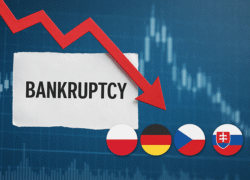
Bankruptcies Rise Across Central Europe, Czechia Records 15% Increase

Bankruptcies among Czech entrepreneurs have risen sharply this year, with 4,265 individuals declaring insolvency from January to August, marking a 15% increase compared to the same period in 2024. According to CRIF – Czech Credit Bureau, the rise translates into 563 more bankruptcies than last year and represents the highest eight-month total since 2021. Over the same period, 4,433 bankruptcy petitions were filed, up 14% year-on-year, as loan repayment morale among entrepreneurs has deteriorated amid faster growth of borrowing than deposits.

In August alone, 505 entrepreneurs declared bankruptcy, 72 fewer than in July and the lowest monthly total this year. The regional breakdown shows the Moravian-Silesian Region leading with 560 cases, followed by Central Bohemia with 514 and Prague with 491. The sharpest year-on-year increases were recorded in Central Bohemia, up 29%, and South Bohemia, up 27%, while the smallest growth was in the Hradec Králové Region, up 4%. On a proportional basis, the Ústí Region reported the highest insolvency risk, with 88 bankruptcies per 10,000 entrepreneurs in the past twelve months, compared to a national average of 58.

Sectorally, the construction industry remained the most affected, followed by trade and manufacturing. Year-on-year, administrative and support services recorded a 45% rise in bankruptcies, while real estate management grew 32% and accommodation and catering 26%. Information and communication was the only sector to report a decline, down 19%. Transport and storage remained among the riskiest industries, alongside construction and hospitality, where bankruptcy levels have consistently been high. CRIF analysts noted that more than two-thirds of bankrupt entrepreneurs had shown no turnover in the period prior to collapse.

The Czech figures fit into a broader regional trend of mounting insolvency pressures. In Poland, more than 3,700 company insolvencies were reported in the first half of 2025, up 17.7% year-on-year, with analysts citing rising costs and tighter financing conditions. In Germany, business insolvencies climbed 12.2% to 12,009 cases in the first half of 2025, while Eurostat data show a 1.7% quarter-on-quarter increase in bankruptcy declarations across the EU in the second quarter of this year. Slovakia and other Central European countries have also recorded rising insolvency filings, reflecting an ongoing normalisation after the pandemic and structural pressures in construction, trade and services.

Although direct comparisons between countries are complicated by different reporting methodologies – some tracking corporate bankruptcies and restructurings, others including sole traders – the directional trend is clear. Across Central Europe, insolvency risks are rising, with vulnerable sectors under strain and regional economies adjusting to higher costs, tighter credit, and uneven demand. For the Czech Republic, the third consecutive annual increase in entrepreneur bankruptcies highlights a fragile business environment that, while not yet at the levels of 2020 and 2021, continues to challenge the stability of small enterprises and the self-employed.

How New Flats Sold in the Summer in Poland

The surge in mortgage applications reported by BIK during the summer holidays has raised questions about whether this trend reflects a real increase in contracts signed and reservations made, or if many buyers are simply testing their creditworthiness ahead of expected interest rate cuts and potentially cheaper mortgages. At the same time, developers and market analysts are watching closely to see if demand for new flats is beginning to strengthen.

Zbigniew Juroszek, President of the Management Board of Atal
Since spring, there has been a noticeable increase in customer interest in flats in new developments, as evidenced by the growing number of enquiries about loans. This is also supported by the cycle of interest rate cuts that began and has continued in recent months. Affordability is increasing, monthly instalments are decreasing, and the supply of properties is high, which is prompting those who are determined to buy to intensify their search. They assume that it is better to do so in such conditions than when demand revives even more and the choice of properties decreases, also as a result of the slowdown in investment.

We are also observing changes in consumer behaviour. Flats in housing estates that are at an advanced stage of construction or ready for occupancy are becoming increasingly popular. We therefore expect customers to become even more active in the autumn due to the expected interest rate cuts and our construction schedule, which predicts that a number of development projects will be completed in the last months of 2025.

Tomasz Kaleta, Managing Director of Sales and Marketing at Develia
BIK data confirms the growing credit activity, which we also see in our sales offices. Since July, we have observed greater interest in purchasing flats among customers using credit, which translates into an increase in the number of enquiries, reservations and transactions. Currently, at Develia, credit buyers account for more than half of sales, which is similar to the level before the interest rate hikes.

The increased customer activity is due, among other things, to lower interest rates and a decline in inflation, which fell below 3 per cent in August, as well as a very large supply of flats. Demand is also supported by property developers, who have launched a record number of flats and are showing greater flexibility in terms of prices and payment schedules.

Mariusz Gajżewski, Head of Sales, Marketing and Communication, BPI Real Estate Poland
We are seeing an increase in lending activity, which is also confirmed by BIK data. However, the share of credit transactions in our offer is relatively small, but we are indeed seeing a revival in financing agreements. Importantly, this is not just an increase in the number of reservations, but actual transactions. Of course, some customers are still assessing their creditworthiness in preparation for possible interest rate cuts, but at the same time, more and more people are making purchasing decisions here and now, without waiting for further changes.

Barbara Marona, Sales Office Manager, Matexi Polska
BIK data shows that in July this year, the number of loan applications increased both year-on-year and compared to June. This trend was also reflected in the sales of our investments in Krakow, where the number of reservations and signed contracts in July was significantly higher than in the previous month. Only in August did we observe a slowdown in customer activity typical for the holiday period. Recently, completed investments have been particularly popular, as customers were able to view selected flats before making a decision.

Joanna Chojecka, Sales and Marketing Director for Warsaw and Wrocław at the Robyg Group
We are definitely seeing a revival on the customer side. BIK data, showing a more than 30% increase in the number of loan applications in July on an annual basis and a 10% increase month-on-month, despite the holiday season, confirm the growing interest in purchasing flats. At Robyg, we also saw increased customer activity in July and August, both in terms of visits to sales offices and the number of reservations and finalised transactions.

Slowly falling interest rates will strengthen demand. We can see that for many of them, the decision to purchase a flat is based on real housing needs and the belief that investing in real estate is still a stable and safe form of capital investment, especially in the long term.

At the same time, we are observing a group of customers who are actively researching their creditworthiness and preparing to buy in the coming months, assuming that with possible interest rate cuts, the availability of financing will improve. This means that the demand potential in the housing market remains high, and many customers are now at an advanced stage of the purchasing process.

Andrzej Gutowski, Sales Director, Ronson Development
We are seeing an improvement in customer activity in the housing market. More and more people are exploring their creditworthiness, while still maintaining a slight expectation of potential interest rate cuts. At the same time, we are seeing that some of these enquiries are actually resulting in the signing of contracts.

At Ronson, a very good July translated into an equally satisfying August, and in addition, on 3 September, the Monetary Policy Council announced another interest rate cut. We therefore expect an influx of new customers and forecast that sales in the second half of the year will be higher than in the first. The increase should be around 5-10 per cent.

Renata Mc Cabe-Kudla, Country Manager at Grupo Lar Polska
We assume that people who were waiting for government loan programmes are no longer counting on them to be implemented, so they are returning to the housing market. They are also counting on interest rates to fall. Hence the increase in the number of loan applications.

Michał Witkowski, Sales Director at Lokum Deweloper
The increase in the number of loan applications is primarily due to the need to finalise the purchase of properties for which development agreements were concluded several or even more than a dozen months ago. Although mortgages in our country remain exceptionally expensive, ranking us in an unenviable second place in the European Union in this respect, the completion of construction and commissioning of investments mean that customers must obtain financing for the purchase of their chosen flat.

We observed growing demand during the summer holiday period. Following the recent interest rate cuts, customers are hoping for further reductions, and thus an improvement in their creditworthiness and lower mortgage costs. As a result, interest in purchasing property has increased, and customers are more willing to sign reservation agreements to check their creditworthiness.

Witold Kikolski, member of the management board of MS Waryński Development S.A.
BIK data confirms the growing interest in mortgages. In July, the number of applications was as much as one-third higher than a year earlier and 10 per cent higher than in June, despite the holiday season. This is a sign that customers are returning to banks more actively, even at the current interest rate level, which is still one of the highest in Europe.

This increase in activity has not yet had a significant impact on the property development market. Some customers are currently testing their creditworthiness in preparation for expected interest rate cuts. For many people, this is a time to check options and compare bank offers, and they will make a purchase decision when financial conditions become more favourable. This is natural behaviour in a market that responds to monetary policy.

We are optimistic – we assume that the prospect of cheaper financing will further strengthen demand in the coming quarters. That is why we are preparing our projects, such as Stacja Ligocka in Katowice and the planned investment in Warsaw’s Mokotów district, with a view to the growing interest of individual customers and families looking for modern flats.

That is why we are consistently developing our offer and launching subsequent stages of our investments to provide customers with a wide choice, both in the popular flat segment and in higher standard projects.

Damian Tomasik, President of the Management Board of Alter Investment
We are seeing greater customer activity in banks and an increase in the number of loan applications, but this is not yet translating proportionally into flat sales. Many customers are checking their creditworthiness in anticipation of further interest rate cuts and cheaper financing. Despite this, July and August saw a higher number of enquiries than in the spring, which shows that demand is gradually recovering. Looking ahead to the coming quarters, we expect that credit decisions will translate into a growing number of transactions.

Source: dompress.pl
Photo: Develia – Morska Vita, Gdynia

Poland Prepares for Major Changes in Labour Inspections

The government has proposed legislation that would significantly expand the powers of the National Labour Inspectorate (PIP), allowing inspectors to immediately reclassify civil law contracts as full-time employment, conduct remote inspections, and impose higher penalties on employers. The changes are expected to reshape employment practices in Poland, particularly in sectors with a high share of non-standard contracts and foreign workers.

According to the PIP 2024 Annual Report, labour inspectors secured benefits for more than 52,400 employees, with outstanding wages and allowances amounting to PLN 158.8 million. Approximately 4,200 workers on civil law contracts also recovered PLN 1.7 million due to violations of the minimum hourly wage. A further 3,200 individuals had their civil law agreements converted into full-time employment contracts.

PIP inspections highlighted persistent irregularities in the employment of foreigners. In 2024, 19.6% of foreigners checked by inspectors were found to be working illegally, compared with 17% in 2023 and 12.8% in 2022. The highest number of violations occurred in construction, manufacturing, administrative services, and transport.

Labour market specialists stress that foreign workers remain essential to Poland’s economy, particularly in industries facing chronic labour shortages. “The work of foreigners contributes directly to GDP growth. Eliminating practices such as undeclared work or under-the-table wages is vital not only for employees but also for the wider economy,” said Krzysztof Inglot, founder of Personnel Service.

The proposed legislation introduces several changes. Inspectors would be able to order the conversion of civil law contracts into employment contracts with immediate effect, bypassing lengthy court procedures. Inspections could also be carried out remotely, while financial penalties for violations would at least double. In addition, inspectors would gain quicker access to data through information-sharing with the Social Insurance Institution (ZUS) and the National Revenue Administration (KAS).

However, legal experts have raised concerns about unclear provisions in the draft law. Monika Mądra-Sokołowska, lawyer and board member at Personnel Service, noted that it remains uncertain how cases will be handled if courts later overturn inspectors’ decisions. “During the time between the inspector’s ruling and a court’s reversal, employers would have treated contractors as employees, paying contributions and benefits. It is not clear whether they could then reclaim those costs if the court disagrees with PIP,” she explained.

Employers are advised to prepare by auditing existing contracts against the Labour Code, establishing appeal procedures, and training HR departments on the new inspection regime. Experts emphasise that advance preparation may help mitigate the risks of sudden reclassification decisions.

The government argues that the reform will improve compliance with labour law, ensure better protection for workers, and strengthen oversight in sectors vulnerable to exploitation. Employers, meanwhile, warn of potential administrative burdens and legal uncertainties that could follow once the law comes into effect.

Source: Personnel Service

Poland Prepares for Major Changes in Labour Inspections

The government has proposed legislation that would significantly expand the powers of the National Labour Inspectorate (PIP), allowing inspectors to immediately reclassify civil law contracts as full-time employment, conduct remote inspections, and impose higher penalties on employers. The changes are expected to reshape employment practices in Poland, particularly in sectors with a high share of non-standard contracts and foreign workers.

According to the PIP 2024 Annual Report, labour inspectors secured benefits for more than 52,400 employees, with outstanding wages and allowances amounting to PLN 158.8 million. Approximately 4,200 workers on civil law contracts also recovered PLN 1.7 million due to violations of the minimum hourly wage. A further 3,200 individuals had their civil law agreements converted into full-time employment contracts.

PIP inspections highlighted persistent irregularities in the employment of foreigners. In 2024, 19.6% of foreigners checked by inspectors were found to be working illegally, compared with 17% in 2023 and 12.8% in 2022. The highest number of violations occurred in construction, manufacturing, administrative services, and transport.

Labour market specialists stress that foreign workers remain essential to Poland’s economy, particularly in industries facing chronic labour shortages. “The work of foreigners contributes directly to GDP growth. Eliminating practices such as undeclared work or under-the-table wages is vital not only for employees but also for the wider economy,” said Krzysztof Inglot, founder of Personnel Service.

The proposed legislation introduces several changes. Inspectors would be able to order the conversion of civil law contracts into employment contracts with immediate effect, bypassing lengthy court procedures. Inspections could also be carried out remotely, while financial penalties for violations would at least double. In addition, inspectors would gain quicker access to data through information-sharing with the Social Insurance Institution (ZUS) and the National Revenue Administration (KAS).

However, legal experts have raised concerns about unclear provisions in the draft law. Monika Mądra-Sokołowska, lawyer and board member at Personnel Service, noted that it remains uncertain how cases will be handled if courts later overturn inspectors’ decisions. “During the time between the inspector’s ruling and a court’s reversal, employers would have treated contractors as employees, paying contributions and benefits. It is not clear whether they could then reclaim those costs if the court disagrees with PIP,” she explained.

Employers are advised to prepare by auditing existing contracts against the Labour Code, establishing appeal procedures, and training HR departments on the new inspection regime. Experts emphasise that advance preparation may help mitigate the risks of sudden reclassification decisions.

The government argues that the reform will improve compliance with labour law, ensure better protection for workers, and strengthen oversight in sectors vulnerable to exploitation. Employers, meanwhile, warn of potential administrative burdens and legal uncertainties that could follow once the law comes into effect.

Source: Personnel Service

Brno Plans Transformation of Špitálka–Radlas into New Urban Avenue

The city of Brno is preparing a major redevelopment of the area between Cejl and Radlas, aiming to turn what is currently a fragmented and hard-to-access district into a modern, livable urban zone with improved transport links, public spaces, and greenery. The plans are outlined in a study commissioned by the Office of the Architect of the City of Brno.

The Špitálka–Radlas area, located east of the historic city core, is marked today by brownfields, sparse streets, and limited green areas. Formerly home to a gas plant, incinerator, and heating plant, the district still contains remnants of industrial heritage. The study proposes transforming these underused spaces into a connected urban quarter, anchored by a new avenue linking Cejl and Masná streets and a tram line leading to the planned main railway station.

According to the study, the redevelopment would strengthen the city’s urban structure, making Špitálka–Radlas a counterpart to established neighborhoods such as Veveří and Černá Pole, while improving connections with Židenice. The plan emphasizes a balanced transport system, with trams playing a central role, complemented by denser pedestrian routes to enhance accessibility.

Green infrastructure is another key element. The proposal highlights the potential of the Svitavy riverbank and the old Židenice railway corridor to serve as green axes, improving the environmental quality of the area. At the same time, the study recommends preserving and adapting industrial-era architecture to give the district a distinctive identity.

The redevelopment framework will guide future zoning changes, detailed planning, and investment preparation. The transformation of brownfield sites is expected to be the cornerstone of the project, supporting Brno’s broader strategy of sustainable urban renewal.

Source: CTK
Images: images are illustrative visualisations of similar new urban avenue projects and do not depict the actual planned development

front page info
LATEST NEWS