Romania’s Modern Retail Sector Expands, But Still Under 5 Million m²

Romania’s modern retail market continues to grow, yet recent industry data suggest it has not quite reached 5 million square metres of leasable retail space. According to a market update in Q3 2025, the latest credible estimate for modern retail stock stands at about 4.75 million m². 

The growth trend remains robust: despite economic headwinds, developers have continued expanding retail infrastructure. According to Colliers, new deliveries and ongoing projects reflect rising demand, especially from non-food retail and discount chains, and a shift toward retail parks and mixed-use formats. 

Still, retail density — the amount of modern retail per capita — remains well below levels seen in several neighbouring countries. This suggests a sizable gap between current supply and potential demand, which may attract further retail investment. 

Given this context, many analysts view Romania as a market with significant upside, especially outside the main metropolitan areas. Smaller cities and regional centres appear as promising candidates for new retail developments in the coming years.

Source: Colliers

Boss Opens Outlet Store at Designer Outlet Kraków

The fashion brand Boss has opened a new outlet store at Designer Outlet Kraków, adding nearly 400 sq m of retail space to the center. The store began operating on 19 November and offers discounted collections from the German brand.

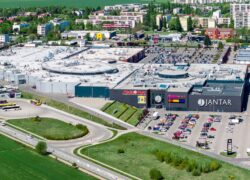
Designer Outlet Kraków, located at 10 Galicyjska Street, offers year-round reduced prices on fashion and lifestyle products. The center sits within a wider retail complex of almost 60,000 sq m that also includes two Atut retail parks. The site covers roughly 15 hectares and is one of the larger retail developments of its type in Poland. It is situated near Expo Kraków and is accessible by public transport.

The new Boss store joins a mix of international labels already present at the outlet center, including Tommy Hilfiger, Calvin Klein, Guess, Swarovski and others. The facility features wide walkways, rest areas, natural-light skylights, a children’s zone and a coworking area, along with nine food and beverage options.

XOOG Operator Moves Into Ambassador Office Building in Warsaw

Hines has finalised a lease agreement with XOOG Operator Sp. z o.o. for office space in the Ambassador Office Building, an asset held by the Hines Poland Sustainable Income Fund (HPSIF). The electricity supplier has taken 600.86 sq m along with six parking spaces under a long-term arrangement.

Rafał Lisak, Director of Asset Management at Hines, said the company is pleased to add XOOG Operator to the tenant mix at the Mokotów property. Maciej Roszkowski, President of the Management Board at XOOG Operator, noted that the decision was linked to the location and the firm’s current growth plans.

The Ambassador Office Building, situated at 34A Domaniewska Street, is a Class A property offering 16,920 sq m of office and retail space. It holds BREEAM certification and provides facilities including parking for around 300 cars, as well as cyclist amenities such as racks, lockers and showers. Ground-floor food outlets and nearby retail and service options contribute to the building’s appeal. The site is also well served by public transport and is close to Chopin Airport and the Westfield Mokotów shopping centre.

Hines was advised in the transaction by the law firm DPPA, while XOOG Operator was represented by BNM Real Estate Sp. z o.o., with Katarzyna Dąbruś acting on its behalf.

Housing Construction in Slovakia Slows Further in Q3 2025 Despite Uptick in New Starts

Slovakia’s housing construction in Q3 2025 remained below the long-term norm despite a slight year-on-year increase in project starts, according to preliminary data from the Statistical Office of the SR.

Nearly 4,200 dwellings were completed in the third quarter, broadly matching last year’s level but down 1.5% year-on-year. Completions for Q3 remain the lowest recorded since 2018 and sit about 6% below the long-term average for the period. The figures are preliminary as the office continues transitioning to a new data source.

Family houses continued to dominate overall housing delivery, though total output remained below the historical norm.

Construction starts improved more visibly. Developers began work on 4,270 dwellings in Q3, a one-third increase compared with the same period in 2024. However, the growth largely reflects the exceptionally low base of Q3 2024, one of the weakest quarters for new starts in recent years. Despite the rebound, new construction remains 17% below the long-term average for the third quarter.

At the end of September, more than 77,000 homes were under construction nationwide, a slight year-on-year decline of 1.4%. Overall construction activity is broadly aligned with the long-term trend.

Across the first nine months of 2025, both completions and starts lagged last year’s results. A total of 11,015 dwellings were completed—down 13.5% year-on-year and 13.1% below the long-term average. Developers launched construction of 11,511 dwellings over the same period, a decrease of 1.6% from a year earlier and 22.1% below the long-term norm.

Slovak Housing Market Sees Sharp Price Growth and Limited Supply in Q3 2025

Slovakia’s housing market recorded another strong quarter in Q3 2025, with prices rising rapidly and construction activity continuing at a measured pace. Official data show that homes across the country became noticeably more expensive, with increases seen in both new-build and older properties. Regional differences persisted, but all parts of Slovakia experienced some level of growth.

Prices for residential property climbed sharply in the three months to September. Compared with the same period last year, the cost of buying a home was more than 13% higher, marking the fastest annual rise in three years. The trend was visible in every region, although the scale varied: while some areas saw increases of around eight to ten percent, others—particularly in central and eastern Slovakia—registered rises above twenty percent. Older housing continued to drive much of the acceleration, though newly built apartments and houses also became more expensive.

Over a longer horizon, the market has shifted significantly. Official statistics show that average sale prices are now more than double those recorded in 2010, with older homes appreciating particularly strongly during that period. This long-term dynamic suggests that buyers have increasingly focused on established housing, while the cost of new development has risen more gradually.

Construction figures for the quarter reveal a market that is active but not expanding aggressively. Slightly over four thousand homes were completed between July and September, a number broadly in line with last year but still below the levels typically seen in earlier years. Developers also began works on just over four thousand units, a figure that appears large at first glance but is inflated by the unusually weak comparison period of 2024. Despite that rebound, the volume of newly launched projects remains well below the longer-term norm. By the end of September, more than seventy-seven thousand homes were still in various stages of construction—roughly the same volume recorded a year earlier.

Across the first nine months of 2025, the pace of completions and construction starts was weaker than in the previous year. Both categories fell into double-digit declines when measured against long-term averages, suggesting that the pipeline of future supply may remain tight.

The broader economic backdrop offered mixed signals. Wage growth continued to outpace inflation, which improved real household incomes modestly. At the same time, borrowing costs remained high compared with earlier periods. Mortgage rates did not rise as sharply as in 2023 and 2024, but they remained a barrier for many households, limiting the extent to which improved earnings could translate into greater purchasing capacity.

What remains unclear from publicly available data is the scale of actual sales activity. While the price statistics reveal what buyers are paying, they do not show how many transactions took place in the third quarter. Without comprehensive figures on sales volumes or mortgage lending tied specifically to property purchases, it is difficult to determine whether demand increased or whether rising prices reflect a constrained supply environment rather than a surge in buying.

Even so, the key indicators that are publicly available paint a picture of a market defined by rising values, limited new construction momentum, and steadily improving incomes. With supply not expanding at the same pace as prices, structural pressures appear to be playing a significant role in shaping conditions across the country. How these pressures evolve will depend largely on future building activity and the trajectory of borrowing costs, both of which remain critical to the balance of Slovakia’s housing market moving into 2026.

Source: Slovak Statistics, SUSR, Nbs and CIJ EUROPE Analysis Team

Most EU Companies Faced Disruptions in Their Global Supply Networks Between 2021 and 2023

A large majority of medium and large companies across the European Union reported difficulties in their international supply structures over the past three years, according to newly published data. The findings show that four out of five firms had to deal with at least one significant obstacle or made adjustments to how they source, produce or distribute goods internationally.

Rising costs were among the dominant pressures. Nearly two-thirds of firms pointed to higher energy-related expenses, while more than half said they were affected by increasing prices for raw materials and other inputs. Many companies also reported that the lingering effects of the COVID-19 period continued to cause operational problems during this timeframe.

Public policy developments added further strain. More than a quarter of businesses said that sanctions related to Russia had a marked impact on their cross-border activities. Close to four in ten firms pointed to challenges linked to meeting environmental rules, noting that new requirements at national or EU level influenced how they structure their international operations.

The results stem from a new EU-wide statistical exercise that examined how companies organise their production and sourcing across borders, building on earlier voluntary surveys carried out in previous years.

Source: EUROSTAT

STRABAG PFS Takes Over Property Management for SICORE and FOX Group Logistics Portfolio

STRABAG Property and Facility Services (STRABAG PFS) has been appointed by SICORE Real Assets together with DFI AM GmbH, part of the FOX Group, to manage a portfolio of newly built logistics properties across four German locations. The mandate covers sites in Rastatt, Neuenburg, Lichtenau and Kandel, with a combined area of approximately 173,400 square metres.

The assets form part of the SICORE German Logistics Impact Fund, which focuses on environmentally responsible logistics developments. All properties are designed to meet the DGNB Gold 2023 certification standard and comply with the KfW 40 energy-efficiency level.

Under the agreement, STRABAG PFS will oversee both technical and commercial management. Its responsibilities include supervision of building systems and external service providers, coordination of construction-related measures and handling warranty-related processes. On the commercial side, the company will manage tenant relations, utility cost allocation and property accounting.

INTREAL Reports Solid Third-Quarter Growth with AuA Reaching €72.7 Billion

INTREAL, the German third-party AIFM specialising in real assets, expanded its assets under administration (AuA) to €72.7 billion by the end of the third quarter of 2025. This marks the first time the company has crossed the €70 billion threshold. AuA rose by €6.1 billion during the first nine months of the year and by 5.8 percent since mid-2025.

The increase in AuA was accompanied by further expansion of the platform. INTREAL oversaw 341 funds at the end of September, 11 more than in the previous quarter and 20 more than at the end of 2024. The number of managed properties rose to 2,888, up by 81 since mid-year and by 154 compared with the end of the last financial year. Staffing also continued to grow, with the company adding ten roles across its offices in Hamburg, Frankfurt and Luxembourg, bringing the total headcount to 555.

INTREAL expects the positive momentum to continue through year-end. Managing Director Camille Dufieux said the rise in activity, particularly in the AIFM services area, reflects investors’ renewed interest in launching new products and reassessing existing portfolios. “Growth momentum increased noticeably during the third quarter,” she said. “Many investors are again developing new fund ideas or choosing to use AIFM services, including switching to INTREAL.”

The Partner Funds division remains the company’s largest segment, with 161 funds and AuA of around €36.6 billion, representing slightly more than half of total assets. While volumes here remained largely stable in Q3, €384 million in new assets were added over the first nine months of the year, and INTREAL welcomed another fund partner during the quarter. This division provides full AIF setup and administration services to asset managers and developers without their own KVG licence.

Most of the third-quarter expansion came from the AIFM services segment, where AuA rose by roughly €4 billion to €36.1 billion. INTREAL delivers reporting, controlling, fund accounting, equity investment management and risk management services for licensed AIFMs within this business line. Managing Director Malte Priester noted that ongoing investment in digital and automated processes has strengthened the unit’s performance, enabling higher efficiency and flexibility for clients.

Poland’s Warehouse property Market Remained Steady

Poland’s warehouse property market remained steady in the third quarter of 2025, with strong tenant activity balancing a slowdown in new construction, according to the latest industry data.

The country’s total modern logistics space reached 36.45 million square metres by the end of September. Developers completed 1.55 million square metres in the first nine months of the year, a clear drop from the same period in 2024. The slower pace reflects a more cautious approach to new building, as companies focus on projects backed by firm tenant interest.

Ongoing construction also remained moderate. Around 1.56 million square metres was being built at the close of the third quarter, noticeably less than a year earlier. Despite the reduced pipeline, the market has avoided any significant imbalance thanks to solid demand from occupiers.

Leasing activity was one of the strongest points of the quarter. Between January and the end of September, companies signed contracts for 4.54 million square metres, almost one-fifth more than a year before. Much of this volume came from retail, logistics and e-commerce operators expanding their operations or renewing existing agreements.

Vacant space remained broadly unchanged. The nationwide rate stood at about 8.2%, suggesting that available buildings continue to be taken up at a healthy pace. Conditions vary by region, but overall availability stayed within comfortable levels for both landlords and tenants.

Rental prices also held steady. Large modern warehouses continued to command €3.60 to €6.00 per square metre per month, depending on location and specification. Analysts see little pressure for change in the near term, given the combination of limited new construction and sustained occupier interest.

With demand proving resilient and construction activity remaining measured, Poland continues to play a central role in the regional logistics network. Market observers expect these trends to support a stable finish to the year.

Source: AXI IMMO, CBRE, JLL and CIJ EUROPE Analysis Team

Catella Investment Management Buys Residential Complex Near Munich

Catella Investment Management GmbH (CIM) has acquired a residential complex in Fürstenfeldbruck, west of Munich, together with Catella Real Estate AG (CREAG). The purchase, made for the open-ended public real estate AIF Catella European Residential (CER), covers three existing U-shaped apartment buildings from 1960 with around 3,400 square metres of living space across 52 units. The site will also accommodate a new residential building with 14 apartments and roughly 1,200 square metres of space, bringing the total to 66 units and 62 parking spaces.

The existing buildings will undergo a full energy-efficient refurbishment aimed at meeting the KfW 55 standard. Planned works include facade insulation using ETICS, balcony upgrades, triple-glazed windows, insulation of the basement ceiling and attic, replacement of doors, renovation of stairwells, and a shift of supply and disposal lines to the exterior. The current heating system will be replaced by a heat pump, and a rooftop photovoltaic system will be installed. The refurbishment is expected to last 12 to 14 months. The four-storey infill building will be constructed to the KfW 40 standard, with completion targeted for the second quarter of 2027.

Michael Keune, Managing Director of CIM, said the acquisition aligns with the strategy of focusing on growth locations offering strong infrastructure and consistent residential demand. “The purchase in Fürstenfeldbruck combines the upgrading of an existing portfolio through the systematic implementation of ESG measures with energy-efficient new construction and exemplifies our strategy to secure long-term, sustainable residential assets for our investors,” he said.

Benjamin Rüther, Head of Fund Management Residential at CIM, pointed to the appeal of the local market. “Fürstenfeldbruck offers an attractive combination of high quality of life, excellent infrastructure, and proximity to the state capital Munich,” he said. He added that local demand trends support long-term investment and noted that modernization measures such as heat pumps and the facade-based “piggyback system” enable upgrades with minimal disruption to tenants. “Maintenance, repair, and inspection are particularly easy to carry out from the outside during the life cycle,” he said.

The complex sits in a residential area dominated by multi-family and single-family homes, with supermarkets, pharmacies, service providers, schools, daycare centres, and medical facilities nearby. The B471 provides quick access to major roads, while the Fürstenfeldbruck S4 station is only a few minutes away and offers a direct link to Munich Central Station.

front page info
LATEST NEWS