Sonar Development completes sustainable office revitalization in Berlin

Sonar Development has successfully completed the revitalization of Chausseestrasse 23 in Berlin-Mitte, transforming the office property into a modern, sustainable workplace. The building, part of an international real estate fund managed by Credit Suisse Asset Management, has been handed over to its new tenant—a public sector institution that has signed a long-term lease.

Ideally located near the ‘Naturkundemuseum’ underground station, the property benefits from excellent public transport connections, including tram and bus lines, and is in close proximity to Berlin’s central railway station, ensuring easy long-distance travel.

Originally built in 1998, the property has been under Sonar Development’s management since 2016. Following the departure of the previous tenant, Vattenfall, in 2021, the company implemented a long-term value-enhancement strategy, focusing on sustainability, modernization, and expansion. The building comprises two interconnected wings—a seven-story west wing and a six-story east wing—linked by a four-story structure that creates two newly designed courtyards.

As part of the refurbishment, Sonar Development completely upgraded the building’s technical systems, modernized all interior spaces, and enhanced the foyer. A key feature of the project was the addition of an extra floor, increasing the total leasable area by approximately 1,500 square meters. The underground car park was also redesigned with a focus on sustainability, incorporating charging stations for electric vehicles and bicycles.

“Our role as a local partner in asset management and transaction advisory for the previous Anglo-Saxon owners highlights the depth of value we create and the trust investors place in us,” said Nick Puschkasch, Managing Partner of Sonar Development.

With the successful completion and handover of Chausseestrasse 23, Sonar Development reaffirms its commitment to revitalizing existing properties through innovative strategies that create long-term sustainable value. The company remains focused on transforming outdated buildings into future-ready assets, ensuring their relevance and efficiency in a rapidly evolving real estate market.

Data4 secures EUR 3.3 billion in funding and appoints new Chief Investment Officer

Data4, a European data center operator and investor, has raised EUR 3.3 billion in funding to accelerate its expansion across Europe and strengthen its market position. The company has also appointed Alexander Oyaert as its new Chief Investment Officer (CIO).

Oyaert, who previously served as a strategic advisor to the Data4 Group’s management board, will now oversee all M&A and financing activities. He played a key role in securing the new financing, which includes EUR 1.1 billion allocated for greenfield investments and acquisitions. His appointment marks a crucial step in Data4’s strategic growth, particularly as it expands into new markets, including Poland, where it is developing a data center campus in Jawczyce, near Warsaw.

The newly secured capital will fuel Data4’s rapid expansion, allowing the company to scale operations across its core European markets. The Polish data center market is expected to triple in capacity and surpass 500 MW by 2030, with nearly half of that capacity dedicated to artificial intelligence services.

“We are already seeing the first results of Alexander’s work – securing this key funding to drive our expansion is a major achievement. The data center sector in Europe, including Poland, is growing dynamically, and this financing will allow us to expand our Warsaw campus and invest in future projects,” said Adam Ponichtera, Director of Data4 Poland.

With a finance degree from the University of St. Gallen and an engineering background from the Free University of Brussels, Oyaert brings a wealth of experience from leading financial firms, including Morgan Stanley and Brookfield Asset Management, where he served as Vice President in the Infrastructure Department.

“I am excited to support Data4 in continuing its success and strengthening its leadership position in the European data center market. With €3.3 billion in funding, we are well-positioned to drive growth in one of the fastest-growing sectors of real estate and critical infrastructure,” said Oyaert.

Beyond his business expertise, Oyaert also co-founded a non-profit organization focused on improving the quality of paramedic services in Belgium.

“We are delighted to welcome Alexander as our new CIO. His solid experience in the banking sector will help accelerate our expansion and develop innovative fundraising strategies,” added Olivier Micheli, CEO of Data4 Group.

Data4’s first Polish campus, located in Jawczyce near Warsaw, spans four hectares and will ultimately consist of four facilities with a total power allocation of 60 MW. The first data center, delivering 8 MW of power and covering 2,200 sqm, was commissioned in 2023.

With its latest round of financing, Data4 is set to reinforce its position as a key player in Europe’s data center sector, leveraging its strong financial backing and experienced leadership to drive future growth.

Castlelake and Niam Credit launch EUR 1 billion Nordic real estate Financing venture

Castlelake L.P., a global alternative investment manager specializing in asset-based private credit, and Niam Credit, a leading credit provider in Northern Europe, have announced a strategic partnership to deploy €1 billion in real estate financing across Sweden, Norway, Finland, and Denmark.

The initiative aims to address growing demand for flexible, tailored financing solutions as traditional bank lending declines due to regulatory constraints. The partnership will provide capital for acquisitions and refinancings across various real estate asset classes, offering an alternative to conventional loan structures.

As its inaugural deal, Castlelake and Niam Credit have successfully closed a NOK 1.9 billion (€165 million) financing transaction for a portfolio of more than 30 prime properties in central Oslo. The portfolio includes residential, commercial, and medium-stay assets.

Pontus Sundin, CEO of Niam Credit, highlighted the significance of the collaboration: “This partnership marks Niam Credit’s first joint venture, combining our deep regional expertise with Castlelake’s global investment capabilities. Our first project in Oslo underscores our ability to support leading sponsors with substantial capital and bespoke financing solutions, particularly in Norway’s challenging lending market.”

Eduardo D’Alessandro, Partner at Castlelake, emphasized the strategic importance of the venture: “Our collaboration with Niam Credit is designed to deliver critical financing solutions tailored to the Nordic market. This venture aligns with our long-term commitment to providing investors with access to high-quality real estate opportunities across Europe.”

Castlelake has been active in European asset-based opportunities since 2006, investing over €7.2 billion and financing or acquiring more than 8,000 assets across 18 countries.

Photo: Eduardo D’Alessandro, Partner at Castlelake and Pontus Sundin, CEO of Niam Credit

Romania expands as regional logistics hub with major investments

Romania’s industrial and logistics real estate market continued to expand in 2024, with new deliveries totaling approximately 400,000 square meters, bringing the country’s total stock to 7.4 million square meters, according to Colliers’ annual report. Increased interest from international and local investors, alongside major transactions such as the expansion of retailers LPP and Deichmann, reinforces Romania’s status as a strategic distribution hub for Southeastern Europe. While the long-term outlook remains strong due to a competitive labor force and ongoing infrastructure modernization, short-term economic and political uncertainties could slow the pace of expansion.

Lease agreements covered around 620,000 square meters in 2024, marking a 20% decline from the near-record levels of the previous year. However, according to Victor Coșconel, Partner, Head of Leasing, Office & Industrial Agencies at Colliers noted that this figure does not fully capture the market’s dynamics, as a substantial portion of leasing activity—including contract renewals and direct deals—remains unreported. Despite this decrease, the leasing volume still surpasses pre-pandemic levels when annual activity remained below 500,000 square meters. CTP and WDP continue to dominate the market, controlling two-thirds of the total stock, but other developers have become increasingly active. The entry of renowned German and American developers, such as Garbe and Hillwood, as well as growing investments from local players, signal a positive long-term market trajectory.

The share of leased spaces allocated to production increased significantly, representing one-third of all transactions for the second consecutive year. This marks a shift from the 10-15% recorded in previous years. However, many manufacturing companies still prefer to own their operational spaces rather than lease them, shaping the long-term structure of the market.

While Bucharest and its surrounding areas accounted for more than half of all industrial and logistics space leases in 2024, this share is lower than the decade-long average. Regional centers are becoming increasingly attractive for industrial and logistics operations, and in the long run, Bucharest’s dominance is expected to decline as other cities in Romania capture more investor interest.

Despite a national vacancy rate of around 5%, which limits tenants’ negotiating power, rents have stabilized. A built-to-suit (BTS) warehouse in a prime location now leases for €4.5–5 per square meter, up from under €4 per square meter before 2021, reflecting a significant market shift.

The largest transaction of the year was the expansion of fashion retailer LPP, which leased 42,000 square meters of warehouse space in northern Bucharest, bringing its total footprint to over 130,000 square meters and making it one of the largest tenants in Romania. Additionally, footwear retailer Deichmann pre-leased a 20,000-square-meter warehouse in Bucharest, which will be transformed into a regional distribution center. Auto parts manufacturer Federal Mogul signed a sale and leaseback agreement with WDP for its 19,000-square-meter factory in Ploiești, while an important FMCG distributor inaugurated its first temporary warehouse covering 10,000 square meters in MLP Bucharest West. Meanwhile, GXO completed the first phase of its project at the end of the year for retailer Trendyol, aiming at 50,000 square meters. Both transactions were facilitated by Colliers.

These transactions reflect the ongoing evolution of the Romanian logistics market and reinforce its role as a regional distribution hub for Southeastern Europe and, in some cases, for the entire Central and Eastern European region. The rapid improvement of infrastructure and full accession to the Schengen Area in 2025 further enhances Romania’s attractiveness for logistics investments. The country continues to benefit from its competitive labor costs, which remain the lowest in the EU relative to productivity in sectors such as transport and warehousing. Even after wage increases over the past decade, Romania remains competitive on both a European and global scale, drawing an increasing number of companies looking to expand their regional footprint.

Infrastructure modernization remains a key driver of economic growth and industrial development. Following a record-breaking 2024, which saw 1,200 kilometers of express roads completed, Romania aims to reach 2,000 kilometers by 2030. Over 600 kilometers of highways and express roads are currently under construction, with another 700 kilometers in the planning phase. The completion of major projects such as the Sibiu-Pitești and Iași-Târgu Mureș highways will significantly enhance connectivity and attract new investments.

Romania’s long-term potential remains strong due to its competitive workforce, strategic location, and ongoing infrastructure investments. However, its current stock of industrial and logistics spaces, expected to reach 8 million square meters by the end of 2025, still lags behind countries like Poland, which has four times the volume. Expanding to 11-12 million square meters by the end of the decade is a realistic target. In the short term, economic and political uncertainties could slow the pace of expansion, but large-scale transactions and strategic investments could drive positive market surprises, ensuring continued momentum for Romania’s logistics and industrial real estate sector.

Source: Colliers Romania
Photo: WDP Bucharest and Victor Coșconel, Partner, Head of Leasing, Office & Industrial Agencies at Colliers


Average Czech mortgage rate drops slightly to 5.11% in February, lowest since 2022

The average mortgage rate in the Czech Republic edged down slightly at the start of February, decreasing by 0.02 percentage points to 5.11%, its lowest level since spring 2022. This data, released by the Swiss Life Hypoindex, reflects the average mortgage offer rate for loans covering 80% of a property’s value.

According to Jiří Sýkora, mortgage analyst at Swiss Life Select, the current trend aligns with predictions of a slight decline or stagnation in rates at the beginning of the year. “New mortgage deals can be arranged with rates approximately three-quarters of a percentage point lower for certain fixations and estimated property values. However, there are still offers on the market with double-digit rates,” he noted.

Sýkora anticipates a more significant drop in mortgage rates in the coming months, as banks introduce spring special offers featuring reduced interest rates.

Market experts highlight the importance of actions taken by major mortgage lenders, including Česká spořitelna, ČSOB, and Komerční banka. “Competition among banks is a key factor that could drive mortgage prices lower. While some banks have already made modest cuts, the impact could be more significant if other players follow suit,” said Tom Kadeřábek, head of the Swiss Life Select product department.

Rising mortgage rates pose challenges for households whose fixed-rate loans are set to expire this year. Many borrowers secured rates around 2% five years ago, while today’s average is approximately 5%. In 2020, mortgage rates hovered around 2.4% in early months and dipped to around 2% by December. The difference in interest rates now translates into thousands of crowns in additional monthly payments.

For instance, a CZK 3.5 million mortgage with an 80% loan-to-value ratio and a 25-year term at the current 5.11% rate results in a monthly installment of CZK 20,692 in February. Compared to February 2024, when the average rate was 5.6% and the monthly installment stood at CZK 21,703, borrowers today save more than CZK 1,000 per month.

Source: CTK

Czech court rejects NKL Agency’s lawsuit in Žofín Palace lease dispute

The District Court for Prague 1 has dismissed a lawsuit filed by the NKL Agency against the Prague 1 City Hall regarding an amendment to the lease agreement for Žofín Palace. NKL Agency spokesperson Karolína Šnejdarová confirmed the ruling to the Czech News Agency.

The legal dispute revolves around the lease of the historic palace, with Prague 1 asserting that the contract expired on December 31, 2024, while NKL Agency maintains that it exercised its renewal option and extended the lease for another ten years. Despite the court ruling, the agency refuses to vacate the premises and continues to organize events.

“The court ruled in the first instance that Prague 1 was not obligated to sign an amendment extending the contract with NKL Agency, confirming that the lease agreement officially ended on December 31, 2024,” Šnejdarová stated.

However, NKL Agency argues that the ruling did not examine whether the renewal option was properly exercised, focusing instead on whether the city district was required to sign a contract amendment specifying rent. “We will await the written reasoning and consider our next legal steps, including a likely appeal,” said NKL Agency’s legal representative, Kolářová.

The agency also confirmed it will not vacate Žofín for now. “Last week, Prague 1 informed us that it had filed an eviction lawsuit, which will determine whether the lease was legally extended. We have not yet received an official summons,” Kolářová added.

Meanwhile, Prague 1 is preparing for a smooth transition to a new tenant, expected to be the Zátiší Group, as decided by the municipal council.

The long-running lease dispute over Žofín Palace has been a controversial issue for Prague 1. The lease was previously extended by the ODS-led city hall just before the 2010 municipal elections. Subsequent extensions, including a proposed ten-year renewal ahead of the 2018 elections, were met with opposition and ultimately rejected.

Source: CTK
Photo: Žofín Palace

Sheraton Hotel set to anchor Ostrava’s future tallest skyscraper

The Ostrava Towers Complex, set to become the tallest building in the Czech Republic, will feature a Sheraton hotel from the Marriott International chain, following a recently signed agreement between the RT TORAX Group, the project’s investor, and the global hotel brand. The development team is also in discussions with service providers and advancing preparations for the high-rise construction.

The landmark project, located in the Slza area near Forum Nová Karolina, emerged from an international architectural competition, with the winning design by Danish studio ADEPT. Construction is slated to commence in 2029, with the towers expected to be completed and operational by 2032. The complex will consist of two towers, with the Sheraton hotel, a restaurant, wellness center, and other premium services housed in the lower one.

Jindřich Vaněk, spokesman for RT TORAX, confirmed that negotiations with the Sheraton brand followed several months of discussions between investors and international hotel operators. “The Ostrava Towers Complex is progressing rapidly. We are finalizing agreements with service operators and working with technical experts on key aspects such as structural integrity, foundation planning, and energy efficiency,” stated Tomáš Häring, founder of RT TORAX.

In parallel with the architectural and investment aspects, RT TORAX is conducting a traffic study to assess the project’s impact on Ostrava’s infrastructure. The findings will be submitted to the city’s Transport Department for review.

Mayor Jan Dohnal (Together) emphasized the city’s active role in ensuring that the skyscraper harmonizes with Ostrava’s urban fabric. “We are not only interested in the building’s architectural prominence but also in how it integrates into the daily life of the city. The transport connectivity, its relationship with surrounding public spaces, and its accessibility for residents are crucial aspects,” he said.

Dohnal also underscored the importance of attracting a five-star hotel to Ostrava. “Our city has long lacked a high-end hotel that can accommodate international guests for major events and festivals. The inclusion of a Sheraton hotel within this new city landmark is a significant development,” he added.

The Ostrava Towers Complex has undergone multiple revisions since its inception. Initially, the project featured only one tower, but later iterations expanded the vision into a dual-tower design. While some city officials previously criticized the project as unnecessary, the recent developments signal a major step forward in positioning Ostrava as a modern urban hub with world-class hospitality and business infrastructure.

Source: CTK
Photos: RT TORAX

Companies founded in the early 1990s among the most stable in the Czech market

Companies established in the early 1990s have proven to be the most economically stable in the Czech market, particularly those with an annual turnover exceeding CZK 30 million, according to an analysis by CRIF – Czech Credit Bureau. Recognizing business stability as a key factor for economic success, CRIF has introduced two new certification programs, TOP Stable Company and Stable Company, aimed at distinguishing reliable businesses from those with weaker financial standings.

The certifications are based on the CRIBIS Index, which evaluates companies using nine financial ratios derived from their two most recent financial statements. Additionally, non-financial factors such as foreclosures, unpaid debts, VAT non-compliance, and insolvency proceedings influence the final rating. “Our assessment helps businesses minimize risk when selecting partners without the need for exhaustive registry checks. This certification serves as an assurance that a company is financially stable and free from outstanding liabilities,” explained Petr Kučera, Executive Director of CRIF – Czech Credit Bureau. To qualify, businesses must also have no records in the Central Register of Executions or AML sanction lists.

The CRIBIS Index assigns 10 stability grades, with companies rated a1 to b2 receiving the TOP Stable Company certification, indicating exceptional financial strength. Of the 45,555 companies with annual turnovers exceeding CZK 30 million, 25% meet the highest stability standards.

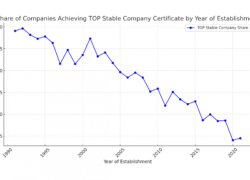
Data reveals that companies founded between 1991 and 1995 show the greatest financial resilience, with 40% of businesses from this period receiving the top certification. Specifically, two-fifths of firms founded in 1992 meet the highest criteria, followed by 1991 (39%) and 1993 (38%). “The longevity of these companies demonstrates their strong competitive position and ability to maintain market stability over time,” noted Pavel Finger, a member of the CRIF Board of Directors.

Conversely, companies founded after 2004 exhibit lower financial stability, with the percentage of firms meeting top criteria declining from 32% in 2004 to just 15% in 2021. Finger attributes this to increased market competition and regulatory changes following the Czech Republic’s EU accession. Businesses established in the last decade show the lowest stability levels—only 23% of companies founded in 2015 meet the strictest requirements, while for 2020-founded businesses, the figure drops to just 14%.

Regionally, Vysočina emerges as the top-performing region, with 35% of its companies receiving the highest ratings. Close behind are Ústí nad Labem and Hradec Králové, both at 34%. At the other end, Prague has the lowest percentage of stable companies (24%), likely due to higher market competition and dynamic economic conditions. However, Prague remains the dominant business hub, with 17,000 firms generating over CZK 30 million in turnover, representing 36% of all assessed companies.

Sector-wise, the mining and quarrying industry has the highest proportion of financially stable companies, with 42% meeting the top criteria. This sector also boasts one of the lowest bankruptcy rates and a strong asset-to-liability ratio, with loans accounting for just 18% of company deposits.

Conversely, the real estate management sector ranks lowest, with only 15% of firms qualifying for top stability rankings. Many real estate businesses operate with high debt levels, as borrowed funds exceed deposits by 79%, making them more vulnerable to financial instability.

Source: CRIF – Czech Credit Bureau

Revetas Group completes sale of Park Center Sofia to TSH Investment

Revetas Group has successfully finalized the sale of Park Center Sofia to TSH Investment, a joint venture between Trinity Capital AD and HUS Invest AD. The financial terms of the transaction remain confidential.

Eric Assimakopoulos, Founding & Managing Partner at Revetas, emphasized the significance of the sale, highlighting the company’s role as a strategic investment manager since acquiring the shopping center in 2014. “During our tenure, we navigated multiple challenges, from the Global Financial Crisis and COVID-19 to inflation and debt restructuring, while successfully preserving and enhancing the asset’s value for our investors. This transaction marks not only a financial achievement but also a testament to the impact Park Center Sofia has had on the local community over the past two decades as Bulgaria’s first modern shopping mall,” he stated.

Vlad Dragoescu, CEE Head of Portfolio Management at Revetas, described the deal as the culmination of over two years of strategic planning and complex negotiations. “Through senior debt restructuring and innovative deal structuring, we transformed challenges into opportunities. This successful exit reinforces our momentum as we look forward to further milestones in 2025,” he added.

Opened in spring 2006, Park Center Sofia holds a historical position as Sofia’s first modern shopping mall, spanning 22,000 sqm of gross leasable area (GLA) across two underground and four above-ground levels. Strategically located at the intersection of Arsenalski and Cherni Vryh boulevards, the center continues to be a key retail destination, featuring a mix of leading local and international brands.

Legal advisory services for the transaction were provided by Schoenherr for the seller and Kinstellar for the buyer.

Crescon begins construction of Zahrádky 1000 mountain apartments in Pec pod Sněžkou

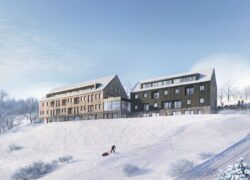
Developer Crescon has officially launched the construction of Zahrádky 1000, a premium mountain apartment complex situated directly on the Zahrádky ski slope in Pec pod Sněžkou. The project, set for completion by the end of 2026, will feature 33 fully furnished apartments, offering luxury living, investment potential, and year-round recreational opportunities.

The development is replacing an outdated six-story chalet with a modern, architecturally integrated residence designed by Labor13 Studio. The new rustic-style complex, comprising two interconnected buildings, is tailored to blend seamlessly into the Krkonoše mountain landscape. Construction work is set to begin in Q3 2025, following the demolition of the existing structure, which is dependent on weather conditions. Ječmínek Construction Company has been selected as the general contractor.

The Zahrádky 1000 residence offers a mix of 1+kk to 4+kk apartments, most of which will include loggias or terraces, while selected units will feature pre-installed sauna connections. High-quality materials such as wooden flooring and large-format tiles will be standard. The apartments will be heated via energy-efficient underfloor heating powered by gas boilers.

Designed as both a luxury holiday home and a profitable investment, the apartments are expected to yield an annual return of 6% to 9%, factoring in both rental income and property appreciation. The rental management will be handled by a local hotel operator, ensuring professional service and high occupancy rates throughout the year.

Radek Zábrodský, Director of Crescon, highlighted the growing demand for high-quality accommodation in mountain resorts, citing Pec pod Sněžkou as one of the Czech Republic’s most sought-after destinations. He noted that rental occupancy remains high year-round, driven by both winter sports and summer tourism. Investors can anticipate a 3% to 4% rental yield at 40%–60% occupancy, with property values in the Krkonoše region growing at an annual rate of 3% to 5%, outperforming even Prague’s real estate market.

Residents and visitors will enjoy a range of shared facilities, including a wellness area with a sauna, relaxation space, and whirlpool, as well as a communal lounge with panoramic views of Sněžka. Additional features include a ski and bike storage room, private cellars, and a reception area. During winter, the onsite manager will provide transport services for residents.

front page info
LATEST NEWS