Thursday, 17 September 2026
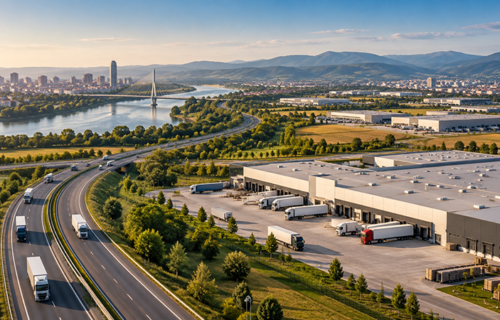
Belgrade remains the centre of Serbia’s modern logistics property market, but industrial development is increasingly spreading beyond the capital as manufacturers, logistics operators and developers establish facilities along the country’s principal transport and production corridors. The change does not mean that Belgrade is losing its position. The capital continues to offer Serbia’s largest concentration of modern warehouse stock, occupiers and professional developers, supported by access to the country’s largest consumer market and important motorway connections. What is changing is the amount of industrial activity taking place elsewhere.
Novi Sad and the wider Vojvodina region, Niš and southern Serbia, and the industrial areas around Kragujevac and central Serbia are becoming more relevant to the development market. Locations along the main motorway network are also attracting projects as companies look beyond the traditional Belgrade logistics zone for land, manufacturing capacity and distribution facilities. Professional market research during 2026 points to continuing development activity and stable occupier demand. Serbia’s industrial vacancy rate was around 4.3% during the second quarter, having declined from approximately 5.8% in Q1, while the development pipeline remains substantial. Earlier market estimates indicated around 256,000 sqm of industrial and logistics space scheduled for development during 2026.
Individual projects demonstrate how that expansion is spreading geographically. Novi Sad has attracted new production development, while Niš and Jagodina have secured occupiers for modern industrial facilities. Development activity is also visible around Merošina near Niš and in other regional manufacturing locations. Major industrial developers are responding by building networks rather than concentrating exclusively on the capital, with development platforms extending across locations including Novi Sad, Kragujevac, Jagodina, Niš and Sombor.
Manufacturing is an important part of this transformation. Serbia’s regional industrial property market is not developing purely because retailers and logistics companies require additional warehouses. Production investment can generate an entire chain of property requirements around a factory, including suppliers, component storage, distribution, third-party logistics and supporting businesses. This creates an opportunity for regional markets to develop beyond individual factories and owner-occupied industrial sites.
Once enough companies operate within a location, developers have greater justification for constructing buildings before a tenant has been secured. That transition towards speculative and multi-tenant development is particularly important for the creation of a deeper commercial property market. However, industrial construction alone does not make a location an institutional real estate investment market. A manufacturing company building its own factory may be economically significant without creating an asset that can subsequently be traded between property investors.
For institutional capital to become more active outside Belgrade, regional markets need a larger stock of professionally developed buildings occupied under leases that provide predictable income. Investors also need evidence of achievable rents, tenant demand, occupancy levels and transaction pricing. Perhaps most importantly, they need confidence that an asset purchased in a regional Serbian city can eventually be sold to another investor.
This is where Belgrade retains a substantial advantage. Its greater stock of modern buildings, deeper occupier base and longer history of professional development provide investors with considerably more information when assessing risk and value. Regional Serbia is still developing that evidence.
Novi Sad benefits from its position within Vojvodina, motorway connectivity and an established manufacturing economy. Niš provides access to southern Serbia and important transport routes towards Bulgaria and North Macedonia. Kragujevac has a strong industrial base, while Jagodina and other locations along the central motorway corridor can serve both production and distribution requirements. These markets should not necessarily be viewed as competitors for the title of Serbia’s second logistics capital. They perform different economic functions and serve different occupier bases, and their collective development may ultimately be more important than determining which individual city ranks behind Belgrade.
Infrastructure will play a decisive role. Motorway access, rail connections, labour availability, power capacity and proximity to manufacturing clusters increasingly influence where industrial occupiers locate. As Serbia improves transport connections and attracts further production investment, property development is likely to follow those economic corridors.
The next stage will be determined by whether regional development produces a sufficiently broad leasing market. A handful of large build-to-suit projects can establish an industrial location, but a functioning investment market requires repeated leasing activity across multiple occupiers and buildings. For property investors, that distinction is crucial. Regional Serbia may offer cheaper land and potentially higher returns than established Belgrade logistics locations, but those advantages have to be weighed against thinner transaction markets and fewer comparable investment deals.
Serbia’s logistics geography is therefore becoming more diverse, but the transformation is still underway. Belgrade remains the country’s dominant institutional logistics market while regional cities are building the industrial activity that could eventually support alternatives. The important question is no longer whether logistics and manufacturing development can take place outside the capital. It already is. The next test is whether those projects can create enough modern leased property, recurring occupier demand and transaction liquidity to turn Serbia’s emerging industrial corridors into markets that institutional investors are prepared to enter.
Source: CIJ.World Research & Analysis Team