Russian Strikes Near Poland Put NATO Preparedness Under Closer Scrutiny

Russian attacks on transport infrastructure in western Ukraine have moved within kilometres of Poland, increasing security concerns along NATO’s eastern frontier and renewing debate over how Warsaw and its allies should respond without allowing military rhetoric to run ahead of events.

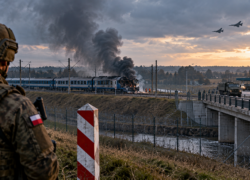
A Russian drone struck the locomotive of a passenger train at Yahodyn in western Ukraine on 13 September, around two kilometres from Polish territory. Passengers were evacuated and no casualties were reported. In a separate incident nearby, another Russian drone hit a truck close to Poland, temporarily disrupting operations at the Yahodyn-Dorohusk border crossing. Russia said its operations were directed against railway infrastructure involved in transporting military cargo from European countries.

The railway attack attracted additional attention because another train carrying former British Prime Minister Boris Johnson, former Swedish Prime Minister Carl Bildt and European security advisers had travelled through Yahodyn shortly beforehand. Ukraine’s state railway operator suggested that the diplomatic train could have been the intended target, although this has not been independently established. Former CIA director David Petraeus was aboard another train at the station when the drone struck.

The incidents underline the strategic importance of western Ukraine’s connections with Poland. Border crossings, railways and roads in the region provide important routes for humanitarian assistance and military equipment entering Ukraine from its Western partners. This makes transport infrastructure close to NATO territory increasingly exposed as Russia attempts to disrupt Ukraine’s supply network.

For Poland, the distinction between proximity and direct attack remains essential. The locomotive was struck inside Ukraine, not on Polish territory, and the incident was therefore not an attack against NATO. Nevertheless, repeated Russian military activity so close to the frontier increases the possibility of accidents, miscalculation and further escalation.

Polish Prime Minister Donald Tusk responded by bringing senior government and security officials together to assess the situation. Warsaw has become increasingly concerned that Russian military and hybrid activity could create more direct security problems for Poland as the war continues close to its borders.

Foreign Minister Radosław Sikorski has adopted a more assertive position. He has argued that NATO possesses a major advantage over Russia in air power and suggested that the alliance could defeat Russia relatively quickly in the event of a direct attack. He has also argued that European military capabilities would remain substantial even without full American involvement. These are strategic assessments rather than established predictions about how a future conflict would develop.

Europe has a much larger economic base than Russia and possesses sophisticated military technology, but economic scale and equipment numbers alone do not determine the ability to sustain a prolonged conflict. Ammunition production, logistics, air defence, intelligence, industrial capacity and political willingness would all become critical in a major confrontation.

For Poland, practical preparedness is therefore more important than predictions about how quickly Russia might be defeated. Investment in air and missile defence, surveillance, ammunition, military mobility and resilient transport and energy infrastructure strengthens deterrence while reducing the risks created by a war taking place immediately beyond the country’s eastern border.

Russia should neither be portrayed as an unstoppable military power nor treated as an opponent Europe could overcome without substantial costs. The more important objective is to ensure that Moscow sees any direct attack against NATO territory as carrying military, economic and political consequences far greater than any potential gain.

The strikes around Yahodyn demonstrate how physically close the war has moved to NATO territory. They do not mean that Russia and NATO are at war, but they reinforce the need for European governments to prepare for possible escalation without presenting such an outcome as inevitable.

For Poland in particular, credible deterrence will ultimately depend less on declarations about what NATO could do to Russia and more on demonstrating what Russia would encounter if it crossed the alliance’s border: prepared armed forces, protected infrastructure, adequate military supplies and allies capable of responding together.

Source: WEI

Hungarian Economy Returns to Growth in H1 2026 as Consumption Strengthens

Hungary’s economy returned to firmer growth during the first half of 2026, supported by stronger household spending, expanding services and an improvement in industrial activity. Inflation fell substantially, helping restore consumer purchasing power, but investment and construction remained weak and the labour market showed some signs of softening. GDP increased by 1.7% during the first six months compared with H1 2025. The economy expanded by 0.8% during the first quarter compared with the final three months of 2025 and by a further 0.5% in Q2. Compared with a year earlier, GDP was 1.7% higher during both quarters, confirming that economic activity had strengthened following an extended period of weak performance.

Services provided the largest contribution to second-quarter growth. Activity across the sector increased by 1.9% year-on-year and contributed around 1.1 percentage points to the overall increase in GDP. Industry also improved, expanding by 3.7%, while manufacturing output was 2.7% higher than a year earlier. Agriculture moved sharply in the opposite direction, declining by 12.4%, while construction was 0.3% lower. Household demand became an increasingly important source of growth during H1, as lower inflation allowed improvements in income to translate more directly into purchasing power after several years in which rapidly rising prices placed substantial pressure on household budgets.

Retail figures reflected this improvement. Sales volumes increased by 4.5% during January-June compared with the first half of 2025. In June alone, calendar-adjusted retail sales were 3.0% higher year-on-year. Non-food sales increased by 5.1% and food retail by 1.8%, while automotive-fuel sales declined slightly. Industry also recorded a stronger first-half performance, with production increasing by 2.4% between January and June compared with H1 2025. Export sales from industry increased by 2.8%, while domestic industrial sales declined by 2.5%, illustrating the continuing importance of international demand to Hungarian manufacturing.

June industrial production was 10.1% higher than a year earlier before adjustment for working days. Once the difference in working days was taken into account, growth was 4.1%. Production nevertheless declined by 1.4% compared with May, demonstrating that the industrial recovery remained uneven from month to month. Several manufacturing segments performed more strongly during the first half. Transport-equipment production increased by 3.8%, while computer, electronic and optical manufacturing recorded considerably stronger expansion. Manufacturing order books were also higher at the end of June than a year earlier, providing a more supportive starting point for activity during the second half.

Investment remained one of the weakest parts of the economy. Gross fixed capital formation was 4.8% lower in Q2 than a year earlier, showing that stronger consumption, services and industrial activity had not yet developed into a broad recovery in capital expenditure. Construction presented a similarly difficult picture. Output across the first six months was 0.7% below its level in H1 2025. In June, construction activity declined by 1.2% year-on-year before adjustment and by 3.9% compared with May. Building construction was 5.5% lower than a year earlier, while civil engineering increased by 5.6%. The future development pipeline also showed signs of weakness, with new construction contracts signed during June substantially below their level a year earlier and the total stock of outstanding contracts slightly lower than in June 2025.

Housing development provided a more positive signal. Hungary completed 6,278 new dwellings during the first six months of 2026, 22% more than during H1 2025. Building permits and simplified declarations covered 16,588 planned homes, representing an increase of 29%. Budapest accounted for 2,224 completed dwellings during the first half, also 22% more than a year earlier. Residential development in the capital remained highly concentrated, however, with a relatively small number of districts responsible for the majority of new housing completions.

Inflation declined considerably during the first half and became an important source of support for household purchasing power. Consumer prices were 1.7% higher in June than a year earlier and were unchanged compared with May. Price developments varied considerably between different categories. Food prices increased by only 0.2% year-on-year in June, while services were 4.0% more expensive. The difference indicates that Hungary’s earlier inflation shock has eased substantially, although price pressure remains present in parts of the domestic economy.

The labour market remained relatively tight but weakened slightly. Average employment during April-June stood at approximately 4.63 million people, around 28,000 fewer than during the corresponding period of 2025. The employment rate among people aged between 15 and 64 nevertheless remained around 75%. Approximately 214,000 people were unemployed in June, producing an unemployment rate of 4.4%. Hungary therefore continued to maintain relatively low unemployment despite modestly lower employment and ongoing restructuring within parts of industry.

Foreign trade remained another important component of the economy. Hungary exported goods worth approximately €14.9 billion in June and imported around €13.6 billion, resulting in a monthly trade surplus of approximately €1.3 billion. Export volumes increased more strongly than imports compared with a year earlier, although differences in working days influenced the annual comparison. The combination of stronger industrial exports and weak capital formation highlights the unusual balance within Hungary’s current economic recovery. The country has attracted substantial automotive, battery, electronics and related manufacturing investment in recent years, and the wider economic impact will increasingly depend on new capacity progressing into sustained production and exports.

The Hungarian National Bank expects GDP to increase by approximately 2.0% across 2026 before growth accelerates to around 3.0% in 2027. Its June outlook anticipates average inflation of approximately 1.8% this year. The European Commission’s earlier assessment is slightly more cautious, projecting GDP growth of approximately 1.8% during 2026 and 2.1% in 2027. Its forecast puts average inflation at 3.2% this year, with the difference partly reflecting the timing and assumptions underlying the respective projections.

Public finances remain a significant risk to the outlook. The European Commission expects Hungary’s government deficit to reach approximately 6.2% of GDP during 2026, compared with 4.7% in 2025. Public debt is forecast to increase to around 75.1% of GDP this year and 76.8% in 2027. For Hungary’s commercial property sector, the first-half economic environment has improved but remains mixed. Stronger household spending provides a better backdrop for retail property, while recovering industrial production and exports support manufacturing and logistics activity. Increased housing completions and permits also point towards renewed activity in parts of the residential market.

Weak capital formation and construction remain important constraints. Businesses are still cautious about committing to investment, while weaker construction contracts could translate into a thinner development pipeline if current conditions persist. This creates a market in which demand may improve before development activity fully recovers. Hungary entered the second half of 2026 with growth more firmly established than during the preceding period of stagnation. Household spending has strengthened, services are expanding, industry has improved and inflation has fallen substantially. Investment, construction and public finances remain the principal weaknesses. The durability of the recovery will depend on whether stronger consumption and industrial activity can eventually encourage renewed private investment and whether Hungary’s substantial manufacturing capacity translates into sustained production and exports.

Source: CIJ.World Research & Analysis Team

The Concept Appoints Vladimir Pilca as CEO

The Concept, an integrated real estate consultancy and brokerage platform operating in Romania and Poland, announces the appointment of Vladimir Pilca as CEO.

His mandate will focus primarily on strengthening the company’s operations in Romania, expanding its portfolio of projects and clients, growing its business in Poland, and preparing the company’s entry into new regional markets. At the same time, Vladimir Pilca will oversee the executive team and the implementation of the performance objectives established at group level.

Under the new leadership structure, Daniel Tudor, the company’s Founding Partner, will take on the role of President of the Board, focusing on strategic direction, the development of institutional partnerships, and supporting the group’s regional expansion.

To date, the company has provided advisory services for the commercialization and investment positioning of more than 130 residential developments, comprising over 6,000 apartments.

“This appointment does not represent a change in direction, but rather the natural evolution of an organization that has reached a higher level of complexity. The Concept already has clear processes, measurable objectives, an established management team, and a proven operating model across relevant projects. Vladimir brings the experience required to scale this platform, maintain operational discipline and execution quality, and, at the same time, accelerate the company’s expansion in Romania and across the region,” said Daniel Tudor, President of the Board & Founding Partner, The Concept.

UNIQA Real Estate Expands Beyond Group Capital with New Institutional Investment Business

UNIQA Real Estate Management is opening its property investment platform to outside investors, marking a shift from managing real estate primarily for UNIQA Group to also handling capital from international institutions and large family offices. Germany and Austria will provide the initial focus for attracting investors.

The Vienna-based company currently manages approximately €3 billion of real estate assets and has around five decades of experience in the sector. Under the expanded strategy, external investors will be able to participate through investment funds, dedicated mandates and transactions involving groups of investors, depending on their capital requirements and investment objectives.

The new activity will use the same investment and property management infrastructure that UNIQA Real Estate has developed for the insurance group’s portfolio. The company covers both strategic investment decisions and the ongoing management of assets, allowing it to oversee properties through different stages of ownership.

UNIQA Real Estate’s existing portfolio comprises more than 200 properties with over one million sqm of leasable space. It includes offices, retail properties, hotels and residential assets, ranging from historic buildings in Vienna to modern commercial developments.

Geographically, the portfolio is concentrated in Austria and several Central and Eastern European markets. UNIQA Real Estate currently has property exposure in Czechia, Slovakia, Hungary, Poland and Romania, providing the new external investment business with an established presence across some of CEE’s principal real estate markets.

Thomas Erdmann, Managing Director of UNIQA Real Estate Management, said the company intends to make the regional expertise accumulated through its own portfolio available to investment partners. The strategy will focus not only on acquiring properties but also on managing and improving them throughout the investment period.

The expansion gives UNIQA Real Estate a new source of capital beyond the insurance group’s own property allocations. It also positions the company more directly within the institutional real estate investment-management market, where international investors increasingly use local or regional operating platforms to access individual European markets.

UNIQA Group has operations in 14 countries and serves more than 18 million customers. Its established network across Central and Eastern Europe provides the real estate division with local market infrastructure that can now also be used for investments backed by external capital.

The change represents a significant development for UNIQA Real Estate’s business model. Rather than remaining primarily an internal property manager for an insurance group, the company is positioning its €3 billion platform as an investment partner for institutional capital seeking exposure to Austria and CEE.

Norblin Factory Reaches Full Occupancy Five Years After Reopening

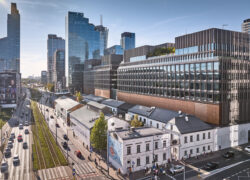
Five years after reopening, Norblin Factory has developed into a fully occupied mixed-use destination in Warsaw, combining offices with restaurants, retail, services, entertainment and cultural facilities. The Capital Park development now attracts around 500,000 visitors each month, while more than 3,000 people work at the complex.

Capital Park acquired the former industrial site on Żelazna Street in 2008. The following years were devoted to design, planning procedures and conservation arrangements before construction started in November 2017. After 46 months of redevelopment, Norblin Factory reopened in September 2021, completing a 13-year process from acquisition to operation.

The complex provides more than 41,000 sqm of office space alongside almost 24,000 sqm devoted to other commercial and cultural uses. Its offices were fully leased before construction was completed, with occupiers including Allegro, Japan Tobacco International, ISS and SEB Bank. Puzzle Office and Beyond Office provide flexible workspace within the development.

Leasing the remaining areas took longer, particularly as the final stage of construction coincided with the Covid-19 pandemic and disruption across the retail and hospitality markets. Capital Park subsequently continued developing the tenant mix, and the non-office component has now also reached full occupancy.

Food and beverage has become one of the property’s largest uses outside the offices, occupying almost 10,000 sqm across 38 concepts. Food Town covers approximately 3,200 sqm in five historic halls and accommodates 24 food operators and five bars. The wider offer includes Piano Bar and the 1,400 sqm MOXO restaurant and music venue.

Entertainment and leisure uses have further broadened the property’s role. KinoGram and its event facilities occupy around 3,500 sqm, while BioBazar covers approximately 2,000 sqm. Smart Kids Planet operates across 1,600 sqm and Art Box Experience has around 800 sqm. More than 2,000 sqm is also occupied by health and beauty businesses.

The industrial history of the site remains integrated into the development. The Norblin Factory Museum incorporates 10 historic buildings and almost 50 pieces of former manufacturing machinery and equipment, together with a collection of more than 400 silver-plated objects connected with production at the former factory.

Cultural programming has also become a regular part of the property’s operation. Since 2021, 240 Wednesday Jam Sessions have been organised, while the Summer Stage has hosted more than 470 music and DJ performances since its introduction in 2022. Other activities include theatre, concerts, dance events and programmes for families.

Five years of operation have demonstrated the management challenges associated with combining offices, restaurants, retail, entertainment and cultural facilities within a single development. Each use has different operating hours, servicing requirements and visitor patterns, requiring more active coordination than a conventional single-use commercial property.

With both its office and non-office components now fully occupied, Norblin Factory has moved beyond the initial redevelopment and leasing stages. Its next phase will depend increasingly on the management of its different functions, tenant performance and its ability to maintain visitor activity throughout the working week and weekends.

Greek Economy Maintains Growth in H1 2026 as Employment Strengthens

Greece maintained its economic expansion during the first half of 2026, supported by improving employment, industrial activity, tourism and continued investment. Growth remained relatively steady despite weaker conditions across parts of Europe, although rising inflation emerged as a more significant challenge for households and businesses towards the end of the period. The economy expanded by 0.3% during the second quarter compared with the first three months of the year and was 1.9% larger than in Q2 2025. This followed continued expansion during the opening quarter, leaving Greece with positive growth through the first six months of 2026.

Investment remained an important part of the economic picture, supported by European funding, infrastructure programmes and private-sector projects. Greece continues to deploy substantial resources through EU-backed programmes, although the contribution from these funds is expected to become less significant as the current funding cycle approaches completion. Consumer demand also continued to support economic activity, but the improvement was relatively modest. Household finances benefited from stronger employment, while renewed increases in living costs, particularly those associated with housing and energy, placed additional pressure on purchasing power.

Industrial activity provided another positive element during the first half. Production increased by 1.1% year-on-year in June, while output across January to June was 3.3% higher than during the corresponding period of 2025. The increase provided an additional source of economic activity alongside Greece’s larger services and tourism sectors. Retail activity also remained positive, with inflation-adjusted retail sales 1.9% higher in June than a year earlier, although sales volumes declined compared with May after seasonal adjustment. This suggests that consumer activity continued to expand on an annual basis while showing some loss of momentum towards the end of H1.

The labour market recorded further improvement. During the second quarter, employment increased compared with the same period of 2025, while the number of unemployed people declined. The quarterly unemployment rate fell to 7.9%, compared with 8.6% in Q2 2025. Monthly figures similarly showed unemployment declining towards the end of the first half, with the seasonally adjusted rate standing at around 8% in June, substantially below its level a year earlier. The continued improvement represents an important structural change for an economy that experienced exceptionally high unemployment during the decade following the sovereign debt crisis. The tighter labour market is also creating new challenges, with employers in sectors including tourism and construction increasingly facing difficulties finding workers.

Inflation became one of the principal economic concerns during H1. Consumer prices were 4.4% higher in June than a year earlier, compared with annual inflation of 2.8% in June 2025. Housing-related expenses were among the areas experiencing particularly strong price increases. The category covering housing, water, electricity, gas and other household fuels increased by 10.6% year-on-year in June, while food and non-alcoholic beverages were 2.7% more expensive. Higher accommodation and energy costs are particularly relevant for the property market. Improving employment supports housing demand, but rising rents, utilities and other household expenses can simultaneously increase affordability pressures, particularly in Athens and locations experiencing strong tourism and residential demand.

International trade presented a mixed picture. During the second quarter, exports of goods and services increased by 2.2% year-on-year in real terms, while imports grew by 3.7%. Goods exports performed more strongly, increasing by 6.6%, while exports of services declined by 1.7%. The difference between export and import growth illustrates one of the continuing characteristics of the Greek economy. Stronger domestic demand and investment generate additional imports, leaving the country exposed to movements in international energy and commodity prices even as export capacity improves.

Tourism remained an important source of economic activity as the summer season gathered momentum. In June, Greek hotels, campsites and other short-stay accommodation establishments recorded approximately 5.58 million arrivals and 24.06 million overnight stays. Arrivals increased by 1.3% compared with June 2025, while overnight stays were 1.4% higher. International visitors remained responsible for the majority of tourism activity, accounting for around 82% of arrivals and almost 90% of overnight stays during June. The relatively moderate increase in visitor numbers also points towards a changing tourism investment story, with future growth in hotel revenues and property values likely to depend increasingly on accommodation quality, pricing, season extension and visitor spending rather than simply continued rapid increases in arrivals.

Greece’s economic outlook remains positive, although higher inflation has made the environment more complicated. The European Commission expects GDP to increase by approximately 1.8% across 2026 following growth of 2.1% during 2025, before moderating to around 1.6% in 2027. Inflation is expected to average approximately 3.7% during 2026 as higher energy costs continue to affect households and businesses. Investment supported by European funding is expected to remain an important contributor to economic activity during the year.

Greece’s public finances have also improved substantially compared with the conditions that defined the country during the sovereign debt crisis. The European Commission expects the general government balance to remain positive during 2026, with a surplus of approximately 0.8% of GDP. Public debt remains high but continues to decline relative to the size of the economy, with the Commission expecting the debt ratio to fall from approximately 146.1% of GDP in 2025 to 140.7% in 2026 and around 134.4% in 2027.

For Greece’s commercial property sector, the first-half economic picture remains broadly supportive. Improving employment can strengthen occupier and consumer demand, continued tourism activity supports hotels and hospitality property, and higher industrial production provides a more favourable environment for logistics and manufacturing-related facilities. There are nevertheless significant constraints. Higher inflation is reducing some of the benefit households receive from stronger employment, while rising energy and accommodation costs are increasing pressure on consumers. Development economics also remain sensitive to construction, financing and operating costs.

Greece entered the second half of 2026 with economic growth intact, unemployment continuing to decline and industrial and tourism activity providing support. At the same time, inflation has returned as a more prominent challenge and the economy remains exposed to external energy costs and international economic conditions. The longer-term question is whether Greece can maintain its current growth rate as the contribution from European recovery funding gradually diminishes. Sustained private investment, higher productivity and continued expansion of the country’s productive economy will become increasingly important if the improvement recorded during recent years is to continue beyond the present investment cycle.

Source: CIJ.World Research & Analysis Team

Industrial Growth Is Making Development-Ready Land a Strategic Gulf Asset

The Gulf’s industrial property expansion is beginning to move beyond a simple question of warehouse availability. Strong occupier demand continues to support logistics markets in Saudi Arabia and the United Arab Emirates, but the next stage of development may depend increasingly on something more fundamental: how much land can actually accommodate new industrial activity within a commercially useful timeframe. This distinction matters because the Gulf does not suffer from a physical shortage of land. The constraint is much narrower. Manufacturers and logistics companies need sites where they can secure approvals, connect to sufficient electricity and other utilities, move freight efficiently and begin construction without waiting years for surrounding infrastructure. Land meeting all of those conditions is considerably less abundant than undeveloped territory.

Saudi Arabia demonstrates the issue particularly clearly. Riyadh, Jeddah and the Dammam metropolitan area entered the second half of 2026 with industrial and logistics occupancy above 90%. Modern facilities remained difficult to secure in several established locations, helping maintain upward pressure on rents. These conditions are encouraging additional development, but constructing more buildings alone may not resolve the imbalance. New supply first requires appropriate sites, and those sites need infrastructure capable of supporting the businesses expected to occupy them.

Riyadh presents perhaps the most obvious example. The capital’s expanding population and economy are increasing the volume of goods moving through the metropolitan area, while manufacturing and localisation policies are adding another source of industrial demand. Companies serving this market need distribution facilities positioned so that trucks can reach customers efficiently rather than simply inexpensive plots somewhere outside the city. That gives established industrial corridors an important advantage. Their value derives not only from location but from the infrastructure and commercial ecosystem that have developed around them. Roads, utilities, neighbouring businesses, labour accessibility and established industrial permissions can significantly reduce the time required to bring new facilities into operation.

Jeddah has a different advantage. Its large metropolitan economy is combined with access to one of Saudi Arabia’s principal Red Sea gateways. For importers, manufacturers and distributors, the ability to connect maritime trade with western Saudi consumption makes appropriately located industrial sites particularly valuable. Saudi Arabia’s ambition to expand domestic production makes the question more important. By Q2 2026, the Kingdom had approximately 13,600 industrial establishments. Further manufacturing growth will require considerably more than conventional storage buildings. Factories can need substantial electricity, water, specialist infrastructure, environmental approvals and access suitable for heavy vehicles. Some industries also require specific separation distances or planning conditions. The number of locations capable of satisfying all these requirements can therefore be significantly smaller than the amount of nominal industrial land.

This is where industrial property begins to resemble infrastructure investment. A developer acquiring residential land primarily considers planning, construction costs, market demand and sales or rental values. Industrial developers must consider those factors alongside power capacity, freight movements, utility networks and the technical requirements of prospective occupiers. A failure in any one of these areas can undermine the commercial value of an otherwise well-positioned site.

The UAE shows how valuable an established industrial ecosystem can become. Dubai has spent decades building connections between ports, airports, roads, free zones, warehouses and international trading businesses. Jebel Ali sits at the centre of that network, creating an industrial and logistics environment whose value extends well beyond individual buildings. Dubai South adds another dimension by combining logistics, aviation-related infrastructure and substantial development capacity. Together, these locations demonstrate that industrial competitiveness depends not merely on providing plots but on creating networks through which businesses can move goods, employees and capital efficiently. This helps explain why modern industrial accommodation in Dubai continues to attract strong demand. During Q2 2026, industrial rents remained higher than a year earlier despite continued development activity. The market therefore still provides evidence that occupiers are competing for suitable space in established locations.

Abu Dhabi is developing through a somewhat different mechanism. Its industrial expansion is closely connected to efforts to increase manufacturing and diversify economic activity. Government-backed programmes encouraging domestic production, investment and industrial development can generate property requirements extending from factories to warehouses, offices and employee accommodation. For investors, manufacturing demand can be particularly attractive because production facilities are often more difficult to relocate than ordinary storage operations. A company that has installed machinery, secured specialist utility connections and integrated itself into a local supply chain has greater physical commitment to a location than an occupier using a relatively standard distribution warehouse.

This can encourage industrial clustering. A major manufacturer creates demand from suppliers, maintenance businesses, transport companies and other service providers. Those companies then create additional demand for nearby industrial property, strengthening the economic importance of the wider district. Control of development-ready land consequently becomes strategically important. Across the Gulf, substantial industrial territory is managed through economic zones, port authorities and government-backed development organisations. The speed at which new supply can emerge therefore depends partly on infrastructure programmes and land-allocation decisions rather than property prices alone.

This can make the response to rising rents slower than it initially appears. Higher warehouse rents create an incentive to build, but new projects still require suitable sites and infrastructure. Electricity networks may need reinforcement, roads may require expansion and planning permissions must correspond with the intended industrial activity. Power deserves particular attention as the Gulf attempts to attract more sophisticated manufacturing. Conventional warehouses generally have relatively straightforward electricity requirements. Automated distribution, temperature-controlled facilities and advanced manufacturing can require significantly greater capacity. Some industrial operations may therefore select locations partly according to the certainty and scale of the power connection available.

This could gradually influence industrial land values. Two apparently similar plots may have very different development potential if one can support an energy-intensive occupier immediately while the other requires substantial network investment before construction becomes commercially viable. Road and port access create similar differences. Being geographically close to a port does not necessarily make a site an efficient logistics location. Freight must be able to move between the port, warehouse, factory and customer without excessive congestion or operational restrictions.

These considerations broaden the Gulf industrial investment story beyond Saudi Arabia and the UAE. Oman offers a substantially different proposition. Rather than competing primarily through scarcity, the country has the potential to use the availability of industrial territory connected to strategically located ports. Sohar, Salalah and Duqm provide different combinations of maritime access, industrial development and space for expansion. For certain manufacturers, this can be compelling. Businesses focused on international supply chains may place greater value on shipping access, operating costs and room for future expansion than on being located immediately beside the Gulf’s largest metropolitan populations.

Oman’s challenge is ensuring that available land translates into commercially competitive industrial capacity. A large plot has limited significance if utility connections, transport infrastructure or operating procedures prevent a company from using it efficiently. The investment case therefore depends on the quality of infrastructure surrounding the land rather than its quantity alone. Bahrain represents almost the opposite situation. Its limited geographic size restricts the amount of land available for industrial expansion, but its position provides manufacturers and distributors with access to the much larger Saudi economy. Established industrial areas can combine serviced sites with proximity to port infrastructure, the airport and the road connection into Saudi Arabia. For occupiers serving both Bahrain and eastern Saudi Arabia, that can compensate for the country’s relatively small domestic market.

The comparison reveals that Gulf cities are increasingly competing through different industrial advantages. Riyadh offers access to Saudi Arabia’s largest urban economy. Jeddah combines a major consumer market with Red Sea trade. Dubai provides an established international logistics network. Abu Dhabi links industrial property with a broader manufacturing strategy. Oman can offer port-related expansion capacity, while Bahrain provides a compact base with direct access towards Saudi Arabia. This diversity matters to institutional investors because industrial assets should increasingly be assessed according to the infrastructure supporting them rather than warehouse specifications alone.

An existing logistics estate with additional serviced land may, for example, have greater long-term potential than a fully developed property with no room for expansion. If demand strengthens, the first asset can potentially add buildings without repeating the entire land-acquisition and infrastructure process. Older industrial estates could also become increasingly interesting. Buildings can become obsolete while the infrastructure underneath them retains considerable value. A dated warehouse occupying a well-connected industrial site may therefore offer redevelopment potential that is not obvious from its existing rental income.

This creates an important distinction between scarcity of buildings and scarcity of development capacity. High warehouse rents eventually encourage developers to construct more space. Increasing the supply of properly zoned industrial sites with sufficient infrastructure generally takes much longer. Governments across the Gulf have the financial capacity to change that equation. New economic zones, roads, ports and utility networks can create industrial locations where none previously existed. Investors should therefore avoid assuming that today’s scarcity will automatically persist for a decade.

The more important question is where infrastructure investment will arrive next and whether it will create viable alternatives to today’s established industrial districts. That makes industrial land analysis increasingly forward-looking. Investors need to understand not only current rents and occupancy but planned road connections, port expansion, utility capacity, economic-zone development and manufacturing policy. These factors can determine where future industrial demand can physically be accommodated.

The regional logistics market is therefore entering a more complex phase. Saudi Arabia and the UAE continue to demonstrate strong demand for modern facilities, while Oman and Bahrain provide alternative industrial propositions within the wider Gulf economy. At the same time, manufacturing ambitions are increasing the technical requirements placed on industrial locations. For property investors, the implications are significant. The most strategically valuable industrial sites may increasingly be those where companies can expand without waiting for infrastructure to catch up.

Warehouse rents will remain an important measure of current market strength. But over the longer term, another set of questions could matter more: who controls the land, what can legally be built there, how much power is available, how quickly goods can reach a port or motorway, and when a new occupier can realistically begin operating. As Gulf economies build larger manufacturing and logistics sectors, the answers to those questions will increasingly determine where industrial property value is created. The next major opportunity may therefore lie beneath the warehouse itself: in the connected, permitted and operationally usable land on which the region’s industrial expansion depends.

Source: CIJ.World Research & Analysis Team

Belgrade Office Vacancy Hits 4.5% as Leasing Activity Slows

Belgrade’s office market is sending two apparently conflicting signals. Modern buildings have very little available space and prime rents continue to rise, yet companies signed considerably less office space during the second quarter of 2026 than they did a year earlier. Office take-up reached approximately 33,400 sqm during Q2, reflecting a quieter leasing period compared with the same quarter of 2025. At the same time, the citywide vacancy rate stood at only around 4.5%, leaving occupiers with relatively few immediate choices when searching for alternative premises.

Part of the explanation lies on the supply side. Only about 6,000 sqm of new office space was completed during Q2, meaning there was little fresh stock available to accommodate companies considering relocations or expansion. In a market where existing modern buildings are already highly occupied, limited new construction can restrict leasing activity even when companies remain interested in moving. Lease renewals have consequently become an important part of the market. For companies already occupying good-quality offices, extending an existing agreement can be more practical than searching for another building offering the right combination of location, specification, size and price.

This means low vacancy and relatively weak leasing activity do not necessarily contradict each other. They may, in part, be different consequences of the same shortage of suitable space. The situation is particularly important in Belgrade’s better office locations, where modern buildings continue to attract occupier attention. Companies are increasingly selective about workplace quality, efficiency and accessibility, making headline citywide vacancy less useful as a measure of how much genuinely desirable office space is available.

This preference is creating a widening distinction between newer offices and older buildings. Prime properties can benefit from limited availability and stronger tenant demand, while ageing stock faces a different challenge. A building may technically provide vacant space without necessarily meeting the standards companies now expect from their workplaces. Prime rents have responded to these conditions, reaching approximately €19 per sqm per month. Rising rents alongside subdued leasing provide another indication that scarcity rather than rapidly expanding occupier requirements is influencing the market.

However, Belgrade is approaching a significant supply test. Approximately 139,000 sqm of office space was under construction during Q2, representing a substantial addition compared with the limited amount delivered during the quarter. Close to 60% of this pipeline is concentrated in the CBD, where available space remains particularly scarce. As these projects are completed, the market should gain a clearer picture of underlying occupier demand.

If new Grade A buildings lease quickly, it would suggest that current take-up figures have been constrained partly by a shortage of appropriate space. If absorption proves slower, the new supply could instead reveal that companies have become more cautious about expanding their office footprints. Hybrid working is likely to form part of that discussion, but it should not be treated as the sole explanation. Greater flexibility, more efficient layouts, economic uncertainty and tighter control of occupancy costs can all influence corporate requirements.

At the same time, companies that reduce their overall footprint can still demand better offices. A business moving from a larger older property into a smaller modern building may occupy fewer square metres while increasing the quality of its workplace. Such behaviour would strengthen demand for prime buildings without necessarily producing large increases in overall leasing volumes.

This creates an important challenge for owners of secondary offices. As new projects increase the amount of modern space available, older buildings may have to compete through refurbishment, more flexible leasing arrangements or lower rents. The current 4.5% citywide vacancy rate therefore hides potentially significant differences between individual properties and locations.

For developers, the timing of the pipeline will be equally important. Belgrade currently has enough scarcity to support prime rents, but the arrival of approximately 139,000 sqm of space currently under construction could alter the balance between landlords and occupiers. How quickly that space is absorbed will determine whether today’s shortage persists or begins to ease.

Belgrade’s office market is therefore not simply experiencing weak leasing or strong occupancy. Both conditions exist simultaneously. The city has very little immediately available modern office space, while companies are becoming increasingly selective about when, where and how much space they lease. The next wave of office completions should provide the clearest indication yet of what is driving the market. If occupiers move rapidly into the new projects, Belgrade’s subdued leasing figures may prove to have been largely a consequence of insufficient supply. If they do not, the city could discover that exceptionally low vacancy has been concealing a deeper change in corporate demand.

Source: CIJ.World Research & Analysis Team

German Economy Returns to Growth in H1 2026 as Exports Strengthen

Germany’s economy showed clearer signs of improvement during the first half of 2026, expanding in both quarters as stronger exports helped lift overall activity. The recovery remained uneven, however, with industrial production showing limited progress, household spending barely increasing and construction continuing to face difficult conditions.

Real GDP increased by 0.4% during the first quarter compared with the final three months of 2025 and expanded by a further 0.3% in Q2. Compared with a year earlier, economic output was 0.8% higher during the first quarter and 1.0% higher in the second. The improvement follows several years of weak economic performance, with Germany contracting in 2023, recording little change in 2024 and achieving only modest growth during 2025.

International trade was an important contributor to the stronger first-half performance. Exports of goods and services increased by 3.7% year-on-year in real terms during Q2, while imports rose by 2.5%. Goods exports increased by 5.0%, supported by stronger activity across areas including chemicals, electronics, electrical equipment and other transport equipment.

Across the first six months of 2026, Germany exported goods worth approximately €816.6 billion, an increase of 3.7% compared with H1 2025. Imports grew by 4.4% to €711.6 billion, leaving a trade surplus of around €105 billion. June was particularly strong, with seasonally and calendar-adjusted goods exports reaching approximately €139.3 billion, 0.9% above May and 6.6% higher than a year earlier.

The improvement in international demand is particularly important for Germany because manufacturing remains a major component of the economy. German industry has spent several years adjusting to higher energy costs, changing global supply chains, weak demand in important markets and substantial restructuring within the automotive sector.

Industrial production nevertheless remained subdued at the end of H1. Output increased by only 0.2% between May and June and remained 0.1% below its level in June 2025. Across April to June, production was 0.7% higher than during the preceding three-month period, indicating some improvement without signalling a broad industrial rebound.

Manufacturing orders provided a somewhat stronger indication of potential future activity. New orders increased by 3.1% between May and June and were 6.5% higher than a year earlier. Large individual contracts contributed significantly to the headline result, however, and when these were excluded, orders declined by 0.5% from May.

The difference between stronger orders and relatively flat production highlights the incomplete nature of Germany’s manufacturing recovery. Demand has strengthened in parts of industry, but this has not yet translated into sustained growth across the wider manufacturing base.

Domestic consumption also remained restrained. Private household spending increased by just 0.1% during the second quarter compared with Q1 and was only 0.1% higher than a year earlier. Consumer demand therefore contributed relatively little to the improvement in the overall economy during the first half.

Construction continued to face difficult conditions. Investment in construction was lower than a year earlier during Q2, extending the challenging environment for residential and commercial development. Building costs, financing conditions and uncertainty surrounding project economics have continued to restrict new development activity.

Inflation increased during the spring before moderating towards the end of H1. Consumer prices were 2.9% higher year-on-year in April and 2.6% higher in May before annual inflation eased to 2.3% in June.

Energy prices increased by 3.4% year-on-year in June, considerably below the 10.1% rise recorded in April and the 6.6% increase in May. Motor fuels nevertheless remained 11.3% more expensive than in June 2025. Food prices increased by only 0.4%, while services were 3.1% more expensive. Inflation excluding food and energy stood at 2.5%.

German companies were also dealing with higher costs for imported products. Import prices increased by 6.1% year-on-year in June, while export prices rose by 3.5%. Higher energy and intermediate-product costs were important contributors to the increase in import prices, maintaining pressure on businesses dependent on international supply chains.

Germany’s public finances are simultaneously undergoing a significant shift as the government increases expenditure. The general government deficit reached approximately €71.3 billion during the first six months of 2026, around €36.6 billion more than during the corresponding period of 2025. The H1 deficit was equivalent to 3.1% of GDP.

Government revenue increased during the first half, but expenditure rose considerably faster. Higher public expenditure is expected to provide increasing support to the economy as Germany directs additional resources towards infrastructure, defence and other investment programmes.

This change in fiscal policy could become increasingly important for economic activity during the coming years. Greater spending on transport networks, energy infrastructure, defence capacity and modernisation has the potential to generate additional demand at a time when private-sector investment remains cautious.

The European Commission expects the German economy to expand by approximately 0.6% across 2026 following growth of only 0.2% during 2025. Growth is forecast to strengthen to around 0.9% in 2027 as higher public expenditure and gradually improving domestic conditions provide additional support.

Greater government spending will also affect Germany’s fiscal position. The Commission expects the budget deficit to reach approximately 3.7% of GDP during 2026, while public debt is projected to increase from around 63.5% of GDP in 2025 to approximately 65.8% this year.

For Germany’s commercial property sector, the economic environment has improved compared with the prolonged period of stagnation, although the first-half figures do not yet indicate a strong cyclical recovery. Higher exports and improving manufacturing orders provide a better backdrop for industrial and logistics property, while additional infrastructure and defence expenditure could support property demand in regions benefiting directly from new investment.

The weakness in construction is also becoming increasingly relevant to the property market. Reduced development activity could restrict future additions to modern building stock in some locations, particularly where financing costs and development economics have already resulted in projects being delayed or cancelled.

Germany entered the second half of 2026 with economic conditions stronger than a year earlier. GDP expanded during both quarters, exports increased and manufacturing orders improved. At the same time, industrial output remained broadly flat, household consumption barely grew and construction continued to struggle.

The next stage of the recovery will depend on whether the improvement spreads more widely through the domestic economy. Stronger consumer demand, private investment and industrial production would provide clearer evidence that Germany is moving beyond several years of weak performance. For now, H1 2026 represents progress, but the recovery remains uneven and increasingly dependent on the combination of international demand and higher public expenditure.

Source: CIJ.World Research & Analysis Team

Primark Moves Beyond Store-Only Model with Sheffield Fulfilment Deal

Primark is preparing to introduce home delivery across Great Britain, marking a significant shift for a retailer that has built its business around physical stores and for years resisted the economics of delivering low-priced fashion directly to customers.

The move is being supported by a £90 million transaction involving a highly automated distribution facility in Sheffield. Debenhams Group has agreed to transfer the site’s automation equipment and assign its lease to Primark Stores Limited. The consideration comprises £76.5 million payable on completion and a further £13.5 million when vacant possession is provided.

The Sheffield facility extends to approximately 615,000 sq ft and will provide Primark with substantial infrastructure for processing online orders. The investment represents an important change in the retailer’s property requirements, adding dedicated fulfilment capacity alongside its extensive network of high-street and shopping-centre stores.

Primark has been building its digital operations gradually, including the expansion of Click & Collect across Great Britain. The retailer now believes developments in its own digital capabilities and changes in the economics of online shopping provide an opportunity to generate additional profitable sales through delivery. A date for the introduction of the service has not yet been announced.

The company is not moving away from physical retail. Stores will remain at the centre of Primark’s strategy, with delivery providing customers with another way of accessing its products. The result will be a more integrated model in which shops and distribution infrastructure increasingly work together rather than operating as separate channels.

The strategic change comes during a softer trading period. Primark expects comparable sales to decline by around 3% in its fourth quarter. Performance differs considerably between markets, with the UK and Ireland expected to record a 0.4% increase while continental European comparable sales are forecast to fall by 4.3%. Total Primark sales are nevertheless expected to increase by approximately 2% for the full financial year, supported partly by expansion of the store network and franchise operations.

Online fashion businesses have also changed consumer expectations around convenience, delivery and returns. Primark’s decision indicates that maintaining very low product prices no longer necessarily requires remaining outside home delivery, particularly as fulfilment technology and customer charging structures evolve.

For the property sector, the Sheffield transaction illustrates the increasingly close relationship between retail and logistics real estate. Primark will continue investing in stores while simultaneously requiring sophisticated distribution infrastructure capable of serving customers directly.

The change is particularly notable because Primark was one of Europe’s largest retailers to remain committed to a predominantly store-based purchasing model. Its move into home delivery suggests that even value retailers with large physical estates are having to reconsider how stores, warehouses, automation and digital sales fit together as shopping behaviour continues to evolve.

front page info
LATEST NEWS