


GCC banking sector posts strong Q1 2025 results amid global uncertainty

The banking sector across the Gulf Cooperation Council (GCC) began 2025 on a solid footing, achieving record-high profits despite facing pressures from declining interest rates, subdued revenue growth, and persistent global economic uncertainties. According to the latest GCC Banking Sector Report – Q1 2025 by Kamco Invest, listed banks across the region posted a combined net income of USD 15.6 billion in the first quarter of the year. This marks a 7.1% increase compared to the previous quarter and an 8.6% rise year-on-year.

Profit Growth Despite Revenue and Margin Pressure

The sector’s total revenues stood at USD 34.6 billion—the highest on record—although quarter-on-quarter growth was marginal at just 0.04%. The subdued growth in revenues was mainly due to declines in Kuwait and Oman, which were offset by stronger performance in the UAE, Qatar, and Saudi Arabia.

Net interest income, which accounts for a large portion of total revenues, declined for the first time in two years. It fell by 1.7% quarter-on-quarter to USD 22.8 billion, largely reflecting the interest rate cuts implemented in the second half of 2024. The GCC region, closely tied to U.S. monetary policy, had followed the Federal Reserve in easing rates, leading to a decline in lending yields.

Despite the overall decline in net interest income, Saudi and Qatari banks posted modest gains. Saudi banks reported a 1.9% quarterly increase, bringing their total to USD 7.9 billion, while Qatari banks recorded a 0.8% rise to USD 3.5 billion. Other markets showed marginal contractions.

Strong Non-Interest Income and Lower Costs Drive Earnings

Non-interest income remained a key support for overall profitability, rising 2.2% to USD 11.8 billion. This marks the fourth consecutive quarter of growth in this category. The UAE banking sector contributed the most to the increase, followed by Qatar and Saudi Arabia. Non-interest income growth was driven by higher fee income, trading gains, and service-related revenues.

Operating expenses fell by 4.3% to USD 13.6 billion after a notable spike in Q4 2024, improving the sector’s cost-to-income ratio to 40.0%. UAE, Saudi Arabia, and Kuwait led the decline in expenses, while Qatar saw a small increase. The improvement in cost efficiency further bolstered profitability during the quarter.

Lending Activity Expands Across the Region

Total gross loans for the sector reached USD 2.25 trillion, up 3.6% from the previous quarter and 12.5% year-on-year. This represents the strongest quarterly lending growth in almost four years, largely driven by economic expansion in non-oil sectors and continued infrastructure investment across the region.

Saudi Arabia led lending growth with USD 801.5 billion in loans, a 5.5% quarterly increase. The UAE followed with 3.2% growth, while Qatar posted a 3.6% increase. Lending also grew in Oman and Bahrain, though at more moderate rates. Kuwait was the only GCC country not to register a quarter-on-quarter rise in loans.

Sector-wise, the most significant increases in credit allocation were seen in construction, real estate, healthcare, education, and transport, especially in Saudi Arabia, aligning with national development plans such as Vision 2030.

Deposit Growth Outpaces Lending

Customer deposits rose by 5.1% during the first quarter to reach USD 2.65 trillion, setting a new record. This growth outpaced the expansion of lending, leading to a slight decrease in the aggregate loan-to-deposit ratio, which dropped from 82.4% to 81.6%.

The UAE posted the highest quarterly deposit growth at 6.7%, followed by Qatar at 6.1% and Saudi Arabia at 4.8%. Saudi Arabia, however, continues to have the highest loan-to-deposit ratio at 95.5%, indicating tighter liquidity conditions compared to the UAE, which recorded the lowest ratio at 67.3%.

Risk Costs Ease as Impairments Drop

Loan loss provisions saw a substantial 33% decline from the previous quarter, falling to USD 2.1 billion. This brought the region’s cost of risk down to 0.45%. The UAE recorded the largest drop in impairment charges, partly due to reversals at some of the major banks. Qatar and Saudi Arabia also saw decreases in provisions, while Kuwait posted a 14.8% quarter-on-quarter increase to USD 237.9 million.

The reduction in provisions points to improved asset quality and favourable credit conditions. It also contributed significantly to overall earnings growth during the quarter.

Margins and Profitability Metrics

Despite earnings growth, the sector’s net interest margin (NIM) declined slightly to 3.10% from 3.14% in the previous quarter. UAE banks maintained the highest NIM at 3.34%, while other markets posted slight declines due to the lower interest rate environment.

Return on equity (RoE) for the sector came in at 13.6%, just below the 13.7% reported in Q4 2024. UAE banks continued to lead with a RoE of 16.6%, followed by Saudi Arabia and Qatar. Total shareholder equity across the region rose by 0.8% to reach USD 453 billion.

Broader Economic Context and Outlook

The sector’s strong performance comes despite a complex global backdrop marked by trade tensions, uncertain monetary policy paths in major economies, and inflation volatility. The anticipated delay in further U.S. rate cuts could weigh on interest margins for GCC banks in the coming quarters.

Nevertheless, the macroeconomic environment in the region remains broadly supportive. The International Monetary Fund projects average nominal GDP growth of 3.5% across the GCC in 2024, with Saudi Arabia, the UAE, Qatar, and Bahrain leading the way. Continued diversification away from oil dependence, coupled with large-scale infrastructure investment, is expected to sustain credit demand and banking activity.

Conclusion

The GCC banking sector demonstrated resilience and adaptability in the first quarter of 2025, overcoming challenges posed by lower interest income and global market uncertainties. Strong non-interest income growth, cost reductions, and improved asset quality enabled banks to deliver record earnings.

As the year progresses, the sector is expected to face headwinds from interest rate dynamics and global financial volatility. However, stable domestic conditions, continued credit expansion, and regulatory reforms provide a sound foundation for future growth. The outlook for the remainder of the year suggests a continued focus on operational efficiency, strategic lending, and prudent risk management to maintain performance in a changing environment.
Outlook for Poland’s Investment Land Market in 2025: Gradual Recovery and Increased Selectivity

The Polish investment land market in 2025 is expected to focus on regaining stability rather than delivering high-profile transactions. Although recent months have seen more deals reach completion, these are typically preceded by thorough assessments by buyers, reflecting a more cautious and analytical market environment.

The current revival in investment activity does not signal a return to the intensity seen in 2021 and 2022. Factors such as the absence of government support programmes, inconsistent planning policies, and restrictive lending practices continue to shape a selective and measured approach by investors and financial institutions.

Today’s market is characterised by project-specific capital deployment. Demand is concentrated around segments with strong fundamentals, including private rental sector (PRS) developments, urban logistics, mixed-use schemes in regional cities, and residential construction, which continues to attract considerable interest.

Local Capital and Regional Investment Activity

After a prolonged period of market hesitation, many investors are actively exploring opportunities again. While some signs of optimism have returned, the overall investment landscape remains more restrained. A higher volume of transactions is anticipated in the second half of 2025.

Although Western European capital is expected to play a larger role, current activity is primarily driven by investors from neighbouring countries such as the Czech Republic, Germany, and the Baltic states. Polish private investors—many of whom are not directly linked to development firms—are also playing an increasingly prominent role, contributing to a more stable and diversified market structure.

At Walter Herz, we have seen growing interest in pooled capital initiatives. Recently, we raised over PLN 50 million from private individuals for land acquisition projects. Acting as transaction advisors, we take on responsibilities related to regulatory and planning procedures, while providing transparency and clarity to our investors. Our current land portfolio in cities such as Warsaw, Poznań, and the Tri-City reflects growing demand from both institutional and private investors.

Global Factors and Shifting Investment Priorities

Recent developments in global trade, particularly tensions between major economies, have influenced Poland’s land investment market. Poland continues to attract interest due to its relatively stable economic outlook and strategic geographic location. Warehouse space, data centres, energy storage sites, and other commercial uses are once again under active review by investors.

Ongoing trade disputes—especially between the U.S. and China—are driving changes in global supply chains. This has contributed to an increase in enquiries for logistics space in Poland, including interest from Chinese firms seeking alternative locations for European operations.

Despite these global uncertainties, Poland remains an appealing option for foreign investors. The country’s forecasted GDP growth of 3.4% for 2025–2026 and ongoing inflows of foreign direct investment position the market as a relatively safe and stable environment for land-related capital placements.

Residential development land and agricultural plots with conversion potential are particularly in demand, especially in areas with high urbanisation prospects. However, concerns persist around the unpredictability of planning policies and permitting timelines, which continue to affect investment feasibility.

Market Activity and Transaction Trends

Investors from Turkey and the Mediterranean region are showing growing interest in the Polish market. These groups typically pursue smaller, lower-risk projects, often prioritising price competitiveness. In recent weeks, Walter Herz has completed four sale transactions in Warsaw, demonstrating consistent market activity even amid cautious sentiment.

Planning Reform and Legislative Outlook

Planning and regulatory changes are playing an increasingly important role in shaping investor behaviour. One of the persistent challenges in Poland is the limited coverage of local spatial development plans (MPZP), which currently apply to only 30–40% of the country. As a result, many developers must rely on administrative zoning decisions (WZ), which are often unpredictable and time-consuming.

Recent government efforts to implement General Plans have been accompanied by repeated revisions and delays, creating further uncertainty. For the land investment market to gain clarity and momentum, there is a need for simplified, transparent, and digitalised planning and permitting procedures.

Reforms to Poland’s construction law could support market growth, particularly by removing the requirement for environmental decisions in low-impact projects—such as logistics and service facilities—which often face lengthy delays. Establishing a clear classification of investments exempt from environmental review could streamline the approval process.

Other proposed solutions include nationwide digitisation of land and mortgage registers and the introduction of a centralised “white paper” listing investment-ready land parcels. Removing the requirement for ministerial approval when converting lower-grade agricultural land (Class IV and V) into development sites could also improve the pace and efficiency of land transactions.

Conclusion

The outlook for 2025 points to a steady but cautious recovery of Poland’s investment land market. While global economic factors and domestic planning constraints continue to influence the pace of activity, selective investor interest remains strong—particularly in projects with clear market demand. Continued legislative reform and administrative simplification will be essential for unlocking the full potential of this sector.

Author: Emil Domeracki, Partner, Board Member, Land Development Advisory, Walter Herz

CitySpace expands Rondo 1 location as part of tenth anniversary

CitySpace is marking its tenth year in operation by expanding its original location at Rondo 1 in Warsaw. On 1 September 2025, the flexible office operator will open an additional floor—1,500 square metres on the 12th floor—adding to the existing space on the 10th floor and bringing the total area at the site to 3,000 square metres.

The new level includes 38 small offices accommodating between 1 and 11 workstations, three conference rooms, three focus rooms, a game room, and two kitchens. In total, the extension will provide 180 additional workstations. The central feature of the space remains the atrium on the 10th floor, which extends visually through four storeys and continues to serve as a key element of the overall design.

The expansion reflects CitySpace’s long-term association with Rondo 1, where it began operations in 2015. The office design was developed by Fruit Orchard under the direction of architect Kasia Miastkowska, who has worked on several CitySpace locations including MidPoint, Novo, and the CitySpace Forum, which is currently under development. The interior incorporates natural materials and a subdued colour palette intended to support focus and well-being, referencing both biophilic design elements and the building’s architectural style.

Rondo 1 is a LEED Gold-certified high-rise, also recognised under the Well Health & Safety standard. It has consistently recorded strong occupancy within the CitySpace portfolio, with an average rate exceeding 90%. In 2024, it achieved an 88% score in the company’s Customer Loyalty Rating survey.

The new space is designed for small to mid-sized businesses seeking a quiet, well-equipped working environment. It is particularly suited to companies using hybrid work models, offering a balance between collaborative and focused work.

CitySpace currently operates 12 locations across Poland, with over 30,000 square metres of flexible office space in five major cities. Pre-leasing for the new Rondo 1 space is underway, with early tenants able to secure preferred terms and office selection.

Swiss Life Asset Managers extends lease with UWV at Bright Offices Amsterdam

Swiss Life Asset Managers has extended its lease agreement with the Dutch employee insurance agency UWV at Bright Offices Amsterdam, strengthening the long-term presence of its largest tenant. The renewed lease covers approximately 38,000 square metres across Buildings C and D of the office complex, located in the western part of Amsterdam. This follows a separate lease extension signed last year for 5,750 square metres in Building A.

UWV, an independent public body under the Dutch Ministry of Social Affairs and Employment, employs nearly 21,900 people and provides services and support to job seekers and employees throughout the Netherlands.

As part of the lease extension, Swiss Life Asset Managers and UWV have agreed on a package of environmental upgrades aimed at aligning the property with the goals of the Paris Climate Agreement. Planned measures include the installation of rooftop solar panels, the adoption of green electricity through power purchase agreements, and the implementation of demand-controlled CO₂ ventilation systems. These initiatives are expected to result in annual greenhouse gas savings of approximately 480 tonnes of CO₂.

Gabriel Müller, Asset Manager at Swiss Life Asset Managers in Germany, stated that the agreement reflects both parties’ long-term commitment and enhances the sustainability and appeal of the property for current and future tenants.

In addition to technical improvements, the agreement includes the redesign of shared spaces in Building A and the central plaza. Scheduled to begin in 2025, the updates will introduce more green areas to improve biodiversity and support a modern work environment. Planned features include outdoor meeting spaces and flexible indoor areas designed for informal gatherings and collaborative work.

These upgrades aim to improve both the environmental performance and functional quality of Bright Offices, supporting its continued role as a workplace hub for public sector services in Amsterdam.

Czech industrial real estate market sees signs of recovery amid delayed projects

The Czech industrial real estate market showed encouraging activity in the first quarter of 2025, with gross realised demand rising above the five-year average. Although the pace of new completions remains below average, a significant volume of projects is under active construction, suggesting a potential rebound in supply during the year.

According to the latest market survey by Colliers, 155,900 m² of new space was completed in Q1 2025—slightly above last year’s Q1 but still 17.6% below the five-year average. However, over 1.6 million m² is now under construction, with 646,700 m² scheduled for completion this year. An additional 551,000 m² is in shell & core condition, ready to be completed once tenants are secured. These buildings could be delivered within three to six months following lease agreements. Shell & core space has grown significantly, increasing by 51% year-on-year.

In total, the Czech industrial property market now comprises approximately 12.44 million m² of space, marking a 4.7% increase compared to the same period last year. Alongside projects currently under construction, there are also 2.6 million m² of projects with full permits awaiting tenants, and another 2.8 million m² in advanced stages of the permitting process. The total volume of planned space now stands at approximately 5.4 million m², up 16.5% year-on-year.

The official vacancy rate remained unchanged for the third consecutive quarter at 3.1%. However, including space in shell & core condition, the adjusted vacancy rate reaches 6.8%, which is higher than some neighbouring markets. Subleases by logistics companies also contribute to untracked vacancy levels, although exact figures remain difficult to quantify.

Total leasing activity reached 511,600 m² in the first quarter, surpassing the five-year average. Much of this was driven by renegotiations rather than new leasing activity. Net take-up accounted for just 38% of the total volume. The largest transaction was a lease renegotiation involving 147,000 m² by a logistics company at Prologis Park Prague-Jirny. Other notable deals included a 40,000 m² pre-lease by Linde Wiemann at Industrial Park Nymburk and a 31,900 m² lease renegotiation by DHL Supply Chain at Panattoni Park Cheb.

Logistics companies were the dominant tenant group in Q1, representing 62% of activity. Manufacturers accounted for 23%, and the remaining 15% came from distributors and other users.

Rents remained stable during the quarter. Prime industrial rents ranged between €7.00 and €7.50 per square metre per month, unchanged for three quarters. Office rents were between €9.50 and €12.50 per square metre per month, with service charges typically falling between €0.75 and €1.00. However, tenants are seeing improved leasing terms, with landlords offering more generous incentives across regions.

External risks remain a factor in the market’s outlook. Trade tensions between China and the United States, as well as uncertainty surrounding transatlantic tariffs, have not yet had a direct impact. However, the outlook for the German economy—the Czech Republic’s main trading partner—is becoming less certain, with no growth forecast for 2025. This could contribute to a more cautious economic climate in the Czech Republic. The International Monetary Fund has already revised its GDP forecast for the country downward.

Despite these risks, there is continued investor interest in smaller markets like the Czech Republic, which are perceived as offering more stable returns compared to larger, more volatile economies. A slower external environment may even drive domestic investment, especially in infrastructure and industrial capacity, as companies seek to diversify supply chains and reduce dependence on major economies.

Former Karstadt property in Hamburg to house parts of Wandsbek district office

On 23 May 2025, ISZ Immobilien Service Zentrum GmbH, part of Hamburg’s tax authority, and Union Investment signed a long-term lease agreement for the former Karstadt department store property at Wandsbeker Markt. The agreement paves the way for relocating parts of the Wandsbek district office to this central site. The 20-year lease covers around 11,400 square metres of space, with occupancy planned by 2029.

The building, which is partially protected as a historic structure, will be repurposed to accommodate approximately 370 employees from various departments, including basic social security, the youth welfare office, general social services, and social space management. The redesign also includes an open front-office area for public services and the creation of modern workspaces across roughly 10,500 square metres.

The lease is subject to the approval of Hamburg’s city parliament, which will now review the agreement.

Finance Senator Dr Andreas Dressel welcomed the development, describing it as a practical solution for revitalising a key site in Wandsbek. He noted that the repurposing of the former department store helps secure the future of a well-known property in Hamburg’s largest district.

Thorsten Baer, Deputy Head of the Wandsbek district, highlighted the collaborative approach to planning the new workspace. He stated that the decision to adapt an existing structure, rather than build a new one, is both efficient and beneficial for employees and the public. He also noted the site’s central location and public transport access as key advantages.

Union Investment, which owns the Karstadt property and the neighbouring QUARREE Wandsbek, views the project as part of a wider redevelopment plan. The goal is to establish a mixed-use urban area combining housing, offices, services, retail, and a new event and dining hall.

According to Christian Born, who oversees office leasing at Union Investment, the cooperation with ISZ and the district office resulted in the creation of flexible and sustainable office space. Project manager Ronald Behrendt emphasized the significance of the district office’s decision, pointing to the value of rethinking urban properties through adaptive reuse.

Construction activity at the site is set to begin in summer 2025 with the demolition of an existing car park and work on the building’s historic façade. Completion of the entire redevelopment is expected by the end of 2028.

Photo: Union Investment

Sky Hall brings music and culture to Spektrum Tower in central Warsaw

Svitlo Concerts, an international organizer known for candlelit music events, has established a new venue, Sky Hall, on the 28th floor of Spektrum Tower in Warsaw. Since February 2025, this cultural initiative has added a new layer of functionality to the centrally located office building, which is part of Globalworth’s portfolio.

Sky Hall is part of a broader trend in which office buildings are being adapted for mixed-use purposes, integrating cultural and social spaces into commercial environments. The venue accommodates up to 150 guests and offers panoramic views of the city skyline from its two terraces. It hosts frequent concerts, typically in the afternoons and evenings, with a repertoire that includes popular music, jazz, and classical piano performances.

Spektrum Tower, situated at ul. Twarda 18 in the heart of Warsaw’s business district, is one of the city’s most prominent high-rise buildings. It stands 128 meters tall, with 35 above-ground floors, and is distinguished by its glass façade and contemporary architectural design. In addition to offering modern Class A office space, it holds a BREEAM In-Use v6 certificate at the Excellent level, underscoring its focus on sustainability and energy efficiency.

The building includes a range of amenities such as a bicycle parking area, accessibility features for people with disabilities, modern access control, and mobile services through the GlobalworthAPP. Its integration of a cultural venue like Sky Hall reflects Globalworth’s strategy of enhancing urban office spaces with additional functions that cater to city residents and office users alike.

According to Marta Lewińska, Asset Management & Leasing Manager at Globalworth Poland, the inclusion of Svitlo Concerts contributes to making the building a space that remains active beyond standard working hours, accessible not only to office tenants but also to the wider public.

Evgenii Kryvin of Svitlo Concerts described the Warsaw venue as a significant milestone for the company, combining music and atmosphere in a unique urban setting. Since opening, more than 100 concerts have been held at Sky Hall, positioning it as a potential key location in the concert series’ European network.

Karimpol International develops Vydrovka Office Center in Prague Karlín

Karimpol International is currently developing the Vydrovka Office Center on Pobřežní Street in Prague 8 Karlín, directly opposite the Hilton hotel. The project is scheduled for completion at the end of 2027 and will offer a total of 6,623 square meters of gross leasable area (GLA). Designed by Pata & Frydecký Architects, the building aims to comply with BREEAM Excellent certification standards, EU taxonomy requirements, and ESG principles.

The site, historically home to the Vydra & Bohuslav factory and warehouse in the early 20th century, is undergoing redevelopment to align with modern sustainability standards. The eight-storey building will include 428 square meters of ground-floor retail space and 6,195 square meters of office space. Tenants will have access to 450 square meters of outdoor terraces spread across four levels, including a 268-square-meter rooftop terrace with views over Karlín, the Old Town, and Prague Castle.

The Vydrovka Office Center is situated in a well-established business area with convenient access to public transportation, including the Florenc metro and tram station. The development will provide 96 underground parking spaces, including electric vehicle charging stations and facilities for cyclists. Interiors are expected to be ready for occupancy from January 1, 2028.

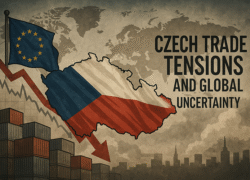
Czech Banking Association lowers economic growth forecast amid trade tensions and global uncertainty

The Czech Banking Association (CBA) has revised its economic outlook for the Czech Republic, projecting GDP growth of 1.7% for 2025 and a moderate increase to 2.0% in 2026. This marks a downward adjustment from the February forecast, which had anticipated growth of 2.1% this year and 2.4% next year. Economists attribute the revised outlook primarily to escalating global trade tensions, particularly the anticipated imposition of U.S. tariffs on European goods, which are expected to average 12% in 2026. These tariffs are forecast to reduce Czech GDP by 0.8 percentage points over two years.

Despite this, the Czech economy entered 2025 with slightly stronger momentum than initially anticipated. Labour market conditions remain stable, and inflation appears to be under control, limiting the need for aggressive monetary or fiscal intervention. Real wages are expected to return to pre-pandemic levels in 2026.

Consumer price growth is forecast to slow to 2.3% in 2025 and 2.2% in 2026. Nominal wages are expected to rise by 5.9% this year and remain below 5% next year. This supports real wage growth of 3.5% in 2025 and 2.7% in 2026, a slightly more optimistic trajectory than earlier forecasts suggested. The labour market is expected to remain stable, with unemployment rising only modestly to 4.2% in 2025 before easing slightly to 4.1% in 2026.

The Czech National Bank (CNB) is likely to continue reducing its key interest rates gradually. One more rate cut to 3.25% is expected this year, followed by a further decline to 3.0% in 2026. The forecast for the koruna exchange rate suggests modest strengthening from CZK 25 per euro at the end of 2025 to CZK 24.7 by the end of 2026, supported by interest rate differentials and weakening of the U.S. dollar.

In the broader European context, the eurozone is expected to grow by only 0.9% in 2025 and 1.2% in 2026, with Germany in particular facing stagnation. As a result, the European Central Bank is forecast to cut its refinancing and deposit rates more aggressively than previously assumed, to 1.9% and 1.75% respectively by the end of the year.

The CBA poll also revealed divided expectations regarding inflationary and disinflationary pressures stemming from global trade disruptions, with half of economists expecting some disinflation in Czech prices as a result of the U.S.–China tariff conflict.

The composition of economic growth in the Czech Republic is expected to rely increasingly on domestic consumption. Household consumption rose 2% year-on-year in 2024 and is projected to increase by 3% in 2025 and 2.5% in 2026. Government spending, supported by defense investments and the electoral cycle, will also contribute, with a 2.5% increase expected in 2025 following a flood-related 3.3% increase in 2024.

Fixed investment remains weak due to uncertainties linked to global trade and structural challenges such as high energy prices and international competition. A recovery in private investment is not expected until 2026. Export growth is also projected to remain subdued, rising just 1.5% in 2025 and 3% in 2026—lower than previously forecast—partly due to earlier frontloading of U.S.-bound shipments and weakening global demand.

While inflationary pressures from energy and fuel prices have eased, core inflation remains elevated due to persistent service sector wage growth and high rents. Consumer price inflation is expected to remain slightly above the CNB’s target, with core inflation forecast at 2.6% in 2025 and 2.3% in 2026. As a result, the CNB is likely to maintain a cautious approach to further interest rate cuts.

Despite mild economic growth, the structure of credit activity is evolving. Mortgage lending and consumer loans have stabilized near long-term averages, while corporate credit growth has slowed slightly. Credit to households is projected to grow over 6% this year and next, with business loans rising just over 5%. Deposit growth is expected to decelerate to below 6% this year and under 5% in 2026, reflecting slower lending growth and a decline in household savings.

The fiscal outlook has improved, with last year’s government deficit narrowing to -2.2% of GDP, ahead of expectations. A modest deterioration to -2.3% is forecast for 2025 and 2026, driven by increased defense spending and the political cycle. Government debt is projected to rise to 44.8% of GDP in 2026, still well below the EU average.

Overall, while the Czech economy is set to continue its recovery, it will do so at a slower pace than initially expected, shaped by global trade disruptions, a shift toward consumption-led growth, and continued structural challenges in investment and productivity.

OTTO WULFF sells residential project “Quedlinburger Straße 10” in Berlin-Charlottenburg

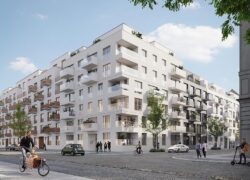
OTTO WULFF has completed the sale of its residential development project “Quedlinburger Straße 10” in Berlin-Charlottenburg to a German family office. The transaction marks another significant milestone for the long-established company in the capital’s residential market.

The project, developed by OTTO WULFF Projektentwicklung GmbH, is located on a 3,354-square-metre site in the Mierendorff Island area of Charlottenburg. Once completed, it will comprise 129 modern residential units along with 17 parking spaces in an underground garage. The development is designed as a closed perimeter block, allowing it to integrate seamlessly into the surrounding urban fabric.

The architectural concept has been designed by the firms KSP Jürgen Engel Architekten and Rohdecan Architekten, featuring a clear geometric structure, refined facade treatments, and generous courtyard areas that enhance the project’s aesthetic and functional appeal.

A strong emphasis has been placed on sustainability. The project is being developed in accordance with version 3.1 of the NaWoh quality seal criteria and is also certified with the state-level Quality Seal for Sustainable Building (QNG), reflecting a commitment to high environmental and building performance standards.

The location offers excellent infrastructure, situated close to the Spree River and Charlottenburg Palace Park. Residents will benefit from access to public transport, schools, shopping facilities, and various recreational options, all within walking distance.

In addition to residential space, the development includes communal areas and two landscaped courtyards. Completion is scheduled for early 2027, with construction progressing on track. The sale of “Quedlinburger Straße 10” reinforces OTTO WULFF’s strategic presence in the Berlin housing market and its continued focus on high-quality urban development.

front page info
LATEST NEWS
