Poland advances offshore wind energy with Baltic Towers launch

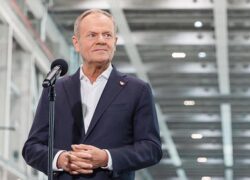
Prime Minister Donald Tusk visited the soon-to-be-operational Baltic Towers facility in Gdańsk, set to become the largest and most advanced offshore wind tower factory in Europe. Production at the site is scheduled to begin next week, marking a significant step in Poland’s strategy to expand renewable energy and enhance national energy security. The investment is expected to create 500 specialized jobs and strengthen domestic manufacturing capabilities within the offshore wind supply chain.

Baltic Towers was established in 2023 as a joint venture between the Polish Industrial Development Agency (ARP) and Spain’s GRI Renewable Industries. This Polish-Spanish collaboration was designed to support the development of offshore wind energy in the Baltic Sea and position Poland as a leading player in the European wind sector. The factory is located on Ostrów Island in Gdańsk and will reach full production capacity by the end of November 2026, with the capability to produce over 150 wind turbine towers annually.

During the visit, Prime Minister Tusk emphasized the strategic importance of domestic involvement in such projects, stating that if Poland is to be a European leader in offshore energy, it must produce critical components locally. He highlighted the investment’s alignment with national interests, including energy affordability, technology development, and employment.

The project also reflects Poland’s growing presence in the global offshore wind sector. According to the Wind Industry Hub Foundation, Polish workers already account for 3% of the global offshore wind workforce. As the third-largest wind energy market in the EU, behind only Denmark and Germany, Poland benefits from favorable conditions such as steady wind speeds, shallow waters, low salinity, and minimal social or environmental conflict.

Baltic Towers’ CEO Jakub Wnuczyński noted that the offshore wind sector is highly demanding, and Poland’s ability to deliver key components locally enhances the resilience and independence of its supply chain. The new facility will reduce risks for offshore projects by securing domestic production of vital infrastructure.

Wojciech Balczun, President of ARP, stressed the importance of public-private cooperation in executing complex industrial projects. He expressed confidence in Poland’s capacity to support its economy through such strategic ventures, stating that the country possesses the tools needed to strengthen local industry and contribute to broader economic development.

Prime Minister Tusk also addressed broader security considerations, noting that the government will work to safeguard infrastructure investments, including military dimensions, amid rising concerns over potential sabotage activities in the Baltic region. His visit began with a stop at the Naval Operations Center in Gdynia, where he discussed security issues with defense officials, including monitoring activities near undersea energy cables connecting Poland and Sweden.

The Baltic Towers project is a milestone in the development of Poland’s offshore wind industry and illustrates the country’s growing ambition to secure a leadership position in the European energy transition.

Czech office market remains driven by domestic investors amid low foreign interest

The Czech office real estate market continues to be dominated by domestic investors, with international capital largely absent from major transactions in recent years. Since early 2021, there has been no significant acquisition of a Prague office building by a foreign investor, reflecting a broader shift in investment preferences and structural market factors.

Several conditions contribute to this trend. High office occupancy levels in Prague have kept vacancy rates low and helped the market avoid the sharp price corrections seen in many Western European countries following the pandemic. At the same time, foreign investors have shown limited interest in the Czech market, citing factors such as the absence of the euro, geopolitical concerns stemming from the war in Ukraine, and complicated permitting procedures that slow down the development of new projects.

“The main reason domestic capital continues to dominate the Czech office market is the comparable investment returns available in other regions,” said Radek Procházka, Managing Partner at Prochazka & Partners. “Foreign funds can often achieve similar returns in their home markets and have increasingly shifted their focus to sectors such as industrial and logistics properties.”

The last notable international acquisition occurred in 2021 when Germany’s Deka Immobilien purchased the Parkview office building from Skanska. Since then, domestic buyers have driven market activity.

In terms of development, Brno currently shows more momentum than Prague. Only around 24,000 square metres of new office space is expected to be completed in the capital this year—well below historical averages. This slowdown reflects ongoing challenges such as high construction costs, tougher financing conditions, and shifting investor priorities toward industrial and residential segments.

The office vacancy rate remains stable at around 8%, supporting landlord leverage and contributing to rent increases, particularly in prime locations. Tenant mobility is limited, with contract renegotiations accounting for more than half of all leasing activity in 2024. This reflects a constrained supply and a preference among occupiers to extend existing leases.

New large-scale office deliveries in Prague are not expected until 2027–2028, suggesting that the market will continue to see modest development activity in the near term.

Source: Prochazka & Partners

BIK: Mixed signals in Poland’s credit market in April 2025

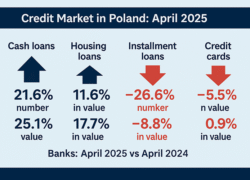
In April 2025, the Polish credit market showed mixed trends across various loan segments, according to data released by the Credit Information Bureau (BIK). While cash and housing loans continued to expand, installment loans and credit card activity recorded declines.

Growth in Cash and Housing Loans

Compared to April 2024, the number of cash loans granted rose by 21.6%, and their total value increased by 25.1%. The average cash loan reached PLN 26,864, up 2.9% year-on-year. Analysts attribute this growth to high-value loan consolidation, where borrowers combine multiple liabilities into a single loan, often with extended terms or lower interest rates, enhancing affordability.

The housing loan segment also showed recovery, with the number of loans increasing by 11.6% compared to April 2024, and by 3.7% from the previous month. In value terms, housing loans rose 17.7% year-on-year and 5.7% month-on-month. The total value reached PLN 8.13 billion, a level not seen since 2021, excluding the months influenced by the government’s “Safe Loan 2%” program. The average housing loan amount was PLN 436,870, representing a 5.5% increase over the year.

Sharp Decline in Installment Loans

Installment loans saw a significant decline. The number of such loans dropped by 26.6%, and their value fell by 8.8% compared to April 2024. The average installment loan, however, rose to PLN 2,275, an increase of 24.3% year-on-year. According to BIK Chief Analyst Prof. Waldemar Rogowski, the drop in volume is partly due to a reduction in low-value transactions linked to buy-now-pay-later (BNPL) conversions from the non-banking to banking sector, a process that has now slowed. While high-value loans for major purchases helped offset the decline, the outlook for this segment remains uncertain amid economic and political uncertainty.

Credit Card Activity Dips

In April 2025, the number of credit cards issued fell by 5.5%, although the value of credit card limits increased slightly by 0.9%. Over the January–April period, the number of credit cards issued declined by 6.2% year-on-year, while the value rose by 3.8%.

January–April 2025 Summary

Over the first four months of 2025, cash loans remained the only category showing growth in both volume and value. The number of cash loans rose 25.1%, and their value surged by 35.6%. In contrast, installment loans declined 28.6% in volume and 11.5% in value. Housing loans fell 17.3% in volume and 14.9% in value. Credit card issuance also declined.

Credit Quality Improves

The BIK credit quality indices for all four credit products showed improvement year-on-year and month-on-month. According to Prof. Rogowski, credit quality remains at a safe level and continues to improve. He cautioned, however, that while classic credit risk remains contained, legal risks related to both housing and consumer loans pose a growing concern for the banking sector.

Overall, the April 2025 credit market data reflects strong consumer demand for cash and housing loans, subdued activity in installment and credit card lending, and continued improvements in credit quality. The market’s future direction may hinge on further interest rate changes and the broader economic climate.

EU unemployment reaches historic low in 2024

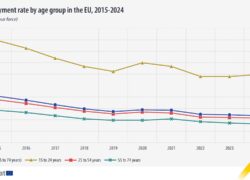
The unemployment rate in the European Union reached a record low in 2024, with just 5.9% of people aged 15 to 74 out of work. This marks the lowest annual unemployment rate recorded since the data series began in 2009, according to the latest figures from Eurostat.

Long-term unemployment also dropped to its lowest level in the available time series, falling to 1.9% of the labour force. This measure reflects individuals who have been unemployed for 12 months or more.

Despite this overall improvement, long-term unemployment remained relatively high in certain countries. Greece reported the highest rate at 5.4%, followed by Spain (3.8%) and Slovakia (3.5%). In contrast, the lowest long-term unemployment rates were seen in the Netherlands (0.5%), Malta (0.7%), and Czechia, Denmark, and Poland (each at 0.8%).

Youth unemployment, however, continued to pose challenges. Among individuals aged 15 to 24, the unemployment rate rose slightly to 14.9% in 2024, an increase of 0.4 percentage points from the previous year.

Unemployment rates for older age groups showed modest declines. For those aged 25 to 54, the rate dropped to 5.4% (down 0.1 percentage points), while the rate for those aged 55 to 74 declined to 4.1% (down 0.2 percentage points).

Overall, the EU labour market showed signs of continued resilience in 2024, with improvements across most categories and historic lows in both general and long-term unemployment.

Source: Eurostat

Construction prices in Poland increase in March 2025 across all categories

According to Statistics Poland’s latest report on construction and assembly work prices, March 2025 saw a general increase in costs across the Polish construction sector. The findings, based on data collected from construction entities, show that prices for nearly all observed types of works and construction categories rose compared to the previous month.

The total price index for construction and assembly production increased by 0.5% in March. All subcategories of activity recorded growth:
• Building construction: +0.5%
• Civil engineering structures: +0.4%
• Specialist construction works: +0.4%

Price indices for selected construction and assembly works also showed upward movement:
• Timber roof structures: +0.8%
• Sanitary installations: +0.7%
• Insulation and painting: +0.6%
• Masonry and external cladding: +0.5%

Construction costs for various building types experienced similar growth. For instance:
• Detached single-family houses without basements: +0.5%
• Multi-family residential buildings (4 and 5-storey): +0.5%
• Multi-level garages: +0.4%
• Production halls: +0.4%

Road construction projects also saw moderate price increases:
• Expressways (Class “S”): +0.5%
• District urban roads (Class “G”): +0.5%
• Motorways and local streets: +0.4%

In bridge construction, prices rose slightly compared to February 2025:
• Road viaducts with monolithic reinforced concrete: +0.5%
• Flat slab bridges and T-beam viaducts: +0.4%

The report also confirms that all observed building types experienced price growth. This includes residential, commercial, industrial, and public-use facilities. These price indices serve multiple functions beyond tracking inflation. They are used for adjusting investment costs, valuing contractual work between investors and contractors, recalculating cost estimates, and verifying bids in public tenders.

Overall, the March 2025 report underscores a consistent trend of moderate construction cost inflation, affecting both material and labour-intensive works, with implications for developers, investors, and policymakers alike.

Czech Senate approves pension fund investment in housing sector

Pension funds in the Czech Republic will soon be permitted to invest in the housing sector, following Senate approval of a legislative amendment linked to the government’s broader housing support initiative. The bill, which is now pending presidential signature, also includes several measures intended to bolster residential development and improve housing market functionality.

Under the new rules, pension funds will be allowed to invest up to 20% of their total assets in housing-related projects. This can be done through real estate funds or legal entities such as special purpose vehicles (SPVs), which may issue bonds that pension funds can purchase. However, investments in any single SPV or qualified investor fund will be limited to 10% of a pension fund’s assets.

According to Aleš Poklop, president of the Czech Association of Pension Companies, the amendment will not only enhance portfolio diversification for pension scheme participants but will also contribute to the expansion of the local housing market. Finance Minister Zbyněk Stanjura (ODS) previously estimated that pension fund investments could reach up to CZK 9 billion by the end of this year and CZK 20 billion within five years, potentially resulting in the construction of thousands of new housing units.

The legislation also introduces a tax incentive for cooperative housing members. Taxpayers who are members of a housing cooperative will be allowed to deduct interest payments on loans taken out by the cooperative from their income tax base, provided they contribute to these payments and the interest is properly allocated to members. This provision was added through an amendment supported by Minister Stanjura and ODS MP Jiří Havránek.

Another key change in the legislation is a provision aimed at expediting the eviction process for illegally occupied apartments. The law introduces a court-ordered eviction mechanism designed to give landlords more efficient legal recourse when tenants fail to vacate a property at the end of a lease term. The government stated in its explanatory memorandum that the measure should encourage long-term rental agreements by improving legal certainty for property owners.

Additionally, the amendment includes a rule allowing housing cooperatives and owners’ associations to suspend services to unit owners who default on payments for at least three months, provided certain conditions are met.

The legislative package forms part of the government’s ongoing effort to address housing shortages and improve market access, particularly by leveraging private capital to stimulate residential construction.

Source: CTK

Garbe Industrial Real Estate tops out 16,000 sqm logistics facility in Rüdenhausen

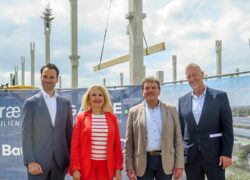
Garbe Industrial Real Estate GmbH has marked the topping-out of its logistics project in Rüdenhausen, Bavaria, approximately 35 km east of Würzburg. The 16,000 square metre development is progressing on schedule and is expected to be completed in the fourth quarter of 2025. The project is being developed in partnership with BentallGreenOak (BGO), with a total investment of approximately €25 million.

The new facility is being built on a 31,000 square metre site that previously housed a garden centre. Garbe acquired the brownfield plot from Terrae Immobilien GmbH and, as co-developer, managed the establishment of planning rights and the preparation of the construction site, including demolition of existing structures and floor refurbishment.

The logistics building will feature approximately 15,000 square metres of hall space and storage mezzanine, in addition to around 1,000 square metres of office space. It will include 12 dock levellers and two ground-level sectional doors to facilitate truck loading and unloading. The property has been designed to accommodate two separate tenants. General contracting for the construction has been awarded to List Bau München.

Sustainability features are central to the design. The building is being developed in line with ESG standards, with the aim of securing certification under the German Sustainable Building Council’s Gold Standard. A rooftop photovoltaic system is planned to provide renewable energy, while parts of the roof will be greened. The building will be heated using air-source heat pumps. Biodiversity initiatives include installing nesting boxes for birds and bats both in the outdoor area and on the building façade.

Located near the A3 motorway and just one kilometre from the Wiesentheid junction, the logistics site offers direct access to major transport routes connecting Frankfurt am Main and Nuremberg. The property is intended primarily for medium-sized enterprises seeking modern logistics and warehouse space in the Würzburg economic region.

Garbe Industrial Real Estate is also planning a second logistics development in Rüdenhausen. Construction of the 19,000 square metre project is expected to begin in the third quarter of 2025.

Develia reports PLN 65.2 million net profit in Q1 2025 amid lower revenues

The Develia Group posted a net profit of PLN 65.2 million in the first quarter of 2025, down from PLN 84.4 million in the same period of 2024. Sales revenue for the quarter reached PLN 253.5 million, reflecting a 37% year-on-year decline, primarily due to a lower volume of apartment handovers.

From January to March, the developer sold 951 residential units, slightly below the 1,038 units sold in the corresponding period last year. A total of 524 apartments were handed over during the quarter, representing a 12% decrease year-on-year. According to the company, the majority of deliveries are scheduled for the final quarter of 2025, with full-year handover targets set between 2,900 and 3,100 units.

Gross profit from development activities for the first quarter stood at PLN 79.2 million. EBITDA reached PLN 47.5 million, while adjusted EBITDA was PLN 49.6 million. The group’s return on equity (ROE) declined to 3.65% from 5.16% in Q1 2024.

As of the end of March, Develia held PLN 682.5 million in cash and short-term financial assets, down from PLN 840.6 million at the end of 2024. Financial liabilities amounted to PLN 893.2 million, compared to PLN 915.0 million at year-end 2024.

Joint venture projects, particularly those conducted with Grupo Lar Polska, had a significant impact on results. In Q1 2025, 30% of all units handed over were part of these joint ventures. The profit contribution from joint ventures amounted to PLN 13.3 million, a reversal from a PLN 0.7 million loss in the same period last year. These results are not included in sales revenue or EBITDA due to equity accounting.

In terms of development activity, the group’s most active projects during the quarter included Aleje Praskie and Bemowo Vita in Warsaw, Traugutta Vita and Orawska Vita in Wrocław, and Południe Vita and Przemyska Vita in Gdańsk. Other ongoing developments included Centralna Vita and City Vibe in Kraków and Królowej Jadwigi in Poznań.

In April 2025, Develia signed a preliminary agreement to acquire 100% of Bouygues Immobilier Polska for EUR 66.5 million (approx. PLN 283.6 million). The acquisition would expand Develia’s pipeline by adding approximately 1,300 apartments currently under construction or preparation and a further 2,800 units on land under preliminary agreements. The transaction is expected to close by 30 June 2025, subject to approval from the Office of Competition and Consumer Protection (UOKiK). Develia plans to finance the purchase with its own funds, with a potential option for refinancing through bank credit.

In commercial real estate, Develia is preparing for the sale of Arkady Wrocławskie, with demolition of the existing facility already underway. The transaction is planned to conclude by the end of August.

The group is also expanding its presence in alternative residential segments. In January, Develia acquired land at Orląt Lwowskich Square in Wrocław for PLN 40.6 million, where it plans to develop a purpose-built student accommodation (PBSA) facility with approximately 600 rooms and two commercial units. Construction is scheduled to begin in 2026, with completion targeted for 2028.

To support its financial strategy, Develia issued PLN 160 million in 4-year bonds in February 2025, with an interest rate based on WIBOR 3M plus a margin of 2.4%.

Vice-President Paweł Ruszczak noted that the financial performance in Q1 reflected the timing of deliveries and highlighted the group’s strong liquidity position, which enables it to fund strategic acquisitions. He also confirmed the management board’s recommendation to distribute PLN 265.5 million in dividends, equivalent to PLN 0.58 per share, marking the highest dividend in the company’s history.

HelloParks expands sustainable warehouse portfolio to 352,000 sqm in Hungary

HelloParks has expanded its portfolio of sustainable industrial properties in Hungary, reaching a total of 352,000 square metres of certified space. All of the company’s warehouse buildings now meet the criteria of the EU Taxonomy for environmentally sustainable economic activities, marking a first for logistics developers in the country.

As of May 2025, HelloParks has added 188,000 sqm of industrial space certified BREEAM “Outstanding” in the New Construction category, bringing the total certified stock to include six warehouses across its parks in Páty, Fót, and Maglód. The latest certification was awarded to the PT3 warehouse at Budapest West – Páty. All eight of the company’s operational facilities now meet both BREEAM Outstanding or Excellent standards and EU Taxonomy requirements under Regulation (EU) 2020/852.

The EU Taxonomy certification confirms that HelloParks’ developments meet sustainability standards related to climate change mitigation, energy efficiency, pollution control, water and biodiversity management, and circular economy principles. These classifications are becoming increasingly relevant for companies and investors seeking to align with long-term environmental objectives.

The certification process was supported by ABUD Engineering, EY denkstatt, and Realiscon. According to the developer, only a small percentage of buildings worldwide meet the BREEAM Outstanding criteria, which evaluate sustainability across a building’s lifecycle, from material sourcing to long-term operation.

The PT3 warehouse features construction innovations that have reduced its carbon footprint compared to previous developments. These include the use of fibre-reinforced industrial flooring, recycled steel for reinforcement, and low-carbon concrete. HelloParks reports that over 85% of construction waste was selectively collected and recycled during development, and that ISO 14001-certified materials were used throughout the process.

Operational buildings are equipped with solar panels, heat pump-based HVAC systems, and smart lighting. Outdoor areas include electric vehicle charging stations, and tenants can access additional services through HelloParks’ mobile application.

As part of its broader ESG strategy, HelloParks has committed to a 2035 climate neutrality roadmap. This includes reducing embodied carbon in its new developments by 25% in 2025 and by 50% by 2030, relative to its initial projects. Since January 2025, the company has covered 100% of its electricity demand with energy from renewable sources, including on-site solar generation and certified green energy providers.

HelloParks plans to continue expanding its portfolio of environmentally certified logistics properties in Hungary, with sustainability as a core element of its development model.

WING delivers fourth logistics hall at East Gate PRO Business Park in Fót, north of Budapest

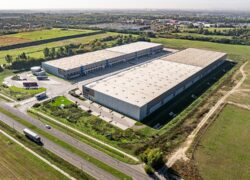
WING has completed the fourth logistics hall at East Gate PRO Business Park in Fót, north of Budapest. The newly delivered building, identified as Hall B2, adds 9,000 square metres of leasable industrial space and is occupied by the Hungarian subsidiary of Packeta Group, a parcel logistics company active in Central and Eastern Europe.

The project was carried out under a built-to-suit (BTS) pre-lease arrangement, with construction executed by Weinberg ‘93 Építő Kft. and financing provided by UniCredit Bank. The facility has received a “Very Good” rating under the BREEAM certification system, aligning with the park’s existing sustainability standards.

Packeta’s new Hungarian hub has been designed to meet specific operational needs. The hall includes expanded office space, cross-docking infrastructure, a heat pump-based climate control system, and enhanced logistics areas. According to WING, the building was developed in close coordination with the tenant to ensure functional suitability for current use and anticipated growth.

East Gate PRO Business Park is strategically located at the junction of the M0 and M3 motorways and is accessible via public and private transport. The park now comprises four completed halls, with plans for a total of six buildings and approximately 60,000 square metres of leasable industrial space.

WING Industrial, the logistics and industrial development division of WING Ltd., focuses on delivering customised facilities to meet tenant requirements. The East Gate PRO expansion is part of the company’s broader effort to support logistics infrastructure in the northern Pest region.

front page info
LATEST NEWS