
225-metre outdoor art gallery unveiled around Dornych construction site in Brno

The perimeter fencing around the Dornych construction site near Brno’s main railway station has been transformed into an open-air gallery stretching 225 metres. Over the past several days, thirty street artists from the Czech Republic, the Netherlands, and New Zealand have painted the solid barrier surrounding the site. The initiative was organised by the developer Crestyl in collaboration with the local association Panto Graff. The project required more than 1,800 cans of spray paint to cover the extensive OSB board wall.

The public can participate in selecting the best artworks by voting through the Streetart.Dornych Instagram account until 15 September. The top three artists will receive materials for future work valued at CZK 40,000 and an opportunity to create a special piece on the construction fence in Úzká Street.

Viktor Peška, sales and marketing director at Crestyl, explained that the goal was to avoid standard advertising fencing and instead enhance the site visually, involve the local community, and reduce the risk of non-artistic graffiti.

Ondřej Vítek, chairman of Panto Graff, described the project as a collaborative effort between Panto Graff, Crestyl, and construction firm GEMO, turning a previously grey wall into a canvas for artists. Each artist was assigned a space measuring 7.5 by 1.85 metres. All artworks were required to relate to the themes of the local area, Brno, trains, or construction.

Artists participating in the project include wosk, oliver, furie, pauser, guilty, spord, silver, trip, ding, rwek, 8Rox, mello, scim, noee, lotr, maroko, tofee, veud, keim, duroy, rhak, inlove, part, optik, miser, traum, robot, dose, and sklon. GEMO, alongside Crestyl and Panto Graff, also contributed to the initiative.

The Dornych project itself involves the redevelopment of the former department store area into a mixed-use space covering 25,000 square metres. The plan includes six smaller buildings that will accommodate the NYX Hotel Brno with 170 rooms, 186 rental apartments, and approximately 50,000 square metres of offices, restaurants, shops, and services. Notable tenants will include the EUC clinic, offering medical services and two pharmacies across 6,000 square metres, and Scott.Weber Workspace, which will establish the largest flexible office and co-working centre in the South Moravian Region on 5,200 square metres, including facilities for 600 employees and a private terrace of 500 square metres. The development will also feature 5,000 square metres dedicated to restaurants, bars, and cafés.

The buildings will range from seven to eight floors and include underground parking. The project will integrate with the existing street network and the underpass beneath the railway station, creating a link between Brno’s historic city centre and the planned South Quarter. The total investment exceeds seven billion Czech crowns. The project’s architectural design is led by international firm MTDI, headed by Marek Tryzybowicz, in cooperation with Brno’s Arch.Design studio. RUBY Project Management is overseeing the entire development process, while GEMO is handling demolition, excavation, and structural works.
GCC Fixed Income Market Faces Shifts Amid Global Uncertainty

The Gulf Cooperation Council (GCC) fixed income market is navigating a complex landscape in 2025, shaped by global monetary policy shifts, geopolitical tensions, and evolving investor sentiment, according to the latest GCC Fixed Income Market Update from Kamco Invest.

Global Volatility Shapes Outlook

Global debt markets hit record highs in the first half of 2025, with issuances reaching $6.4 trillion despite an 8% quarter-on-quarter drop in Q2. High-grade issuances dominated, while high-yield activity remained flat. Notably, green bond issuances fell to a three-year low of $267.7 billion in the first half.

In the U.S., treasury yields have fluctuated, with the 10-year yield declining from May highs of 4.6% to around 4.3% by July. The Federal Reserve remains cautious on rate cuts, with decisions hinging on the inflationary impact of new tariffs. Meanwhile, Europe has moved in the opposite direction, with the European Central Bank cutting rates four times this year to support a slowing economy.

GCC Market Adapts to Global Dynamics

GCC central banks largely mirror U.S. monetary policy due to currency pegs, though Kuwait, whose dinar is pegged to a basket of currencies, has charted a more conservative path. While other GCC nations cut rates by 100 basis points in 2024, Kuwait opted for a modest 25-basis-point cut.

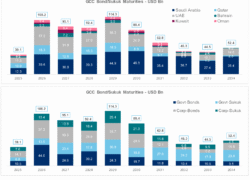
Economic prospects in the GCC remain supported by resilient non-oil sectors and stable oil prices around $70 per barrel. However, the region faces significant debt maturities. Sovereign and corporate maturities across the GCC are projected to total nearly $449 billion between 2025 and 2029, with Saudi Arabia leading at $166 billion.

Issuances Decline, But Outlook Remains Solid

Primary market issuances in the GCC totaled $100.3 billion in H1-2025, a 22% drop from the same period in 2024. Government issuances halved to $36.6 billion, while corporate issuances rose to $63.7 billion, partially offsetting the decline. Sukuk issuance saw a sharper contraction, falling nearly one-third to $39.4 billion.

Country-wise, the UAE posted slight growth in issuances, while Saudi Arabia, Qatar, and Oman witnessed significant declines. Saudi issuers remained dominant, accounting for half of the region’s issuance despite a steep year-on-year decrease.

Green instruments maintained momentum in the region, with $8.7 billion issued in H1-2025. Saudi Arabia led the segment with $5.6 billion in green debt, underscoring the region’s gradual pivot toward sustainable financing.

Rate Cuts Expected to Shape Second Half

Looking ahead, Kamco Invest forecasts that GCC central banks will likely mirror any U.S. Federal Reserve rate cuts later this year. Issuance volumes are anticipated to pick up in the second half, as issuers seek to lock in lower rates amid growing expectations of monetary easing.

Moreover, Kuwait has announced plans to issue $6 billion in bonds on international markets, which could further bolster regional issuance figures.

Despite near-term headwinds from global economic shifts and geopolitical tensions, the GCC fixed income market appears poised to maintain stability, underpinned by robust sovereign credit profiles and steady economic fundamentals.

Churchill Square adopts drone technology for facade cleaning

The method of cleaning building facades and windows is undergoing significant changes, with drones beginning to replace traditional suspended platforms and chemical-based cleaning solutions. This new approach has the potential to reduce costs by nearly half, improve safety conditions for workers, and lower environmental impact. The trend has started to appear in the Czech Republic, including in historic city areas where commercial buildings owned by Českomoravská Nemovitostní (ČMN), such as Churchill Square and Mezi Vodami, are being cleaned using drone technology.

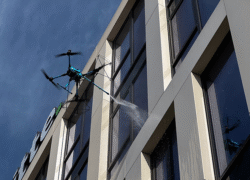
The cleaning process involves drones spraying demineralized water heated to 70°C, which removes dirt without relying on aggressive chemicals. This method is particularly suitable for historic buildings where chemical cleaning agents could damage delicate plasterwork or building materials.

Petra Vondrová, Senior Property Manager of the Churchill building, noted that her team is always exploring new ways to enhance services. After learning about drone-based cleaning, they decided to test it on the Churchill building due to its large facade surface area. According to Vondrová, the results were positive, with tenants expressing satisfaction and passersby taking an interest in the operation of the drones.

Cost efficiency is one of the main advantages of using drones, as the process requires fewer workers and can be carried out more quickly than traditional methods. Dita Lawn, Senior Property Manager at the Mezi Vodami building, explained that initial reservations about the technology were quickly overcome once they observed its effectiveness and cost benefits, allowing for future investments in other innovations.

Safety is another significant factor influencing the move towards drone cleaning. Traditional methods involving workers suspended at height carry inherent risks, whereas drone operations involve a team of just two individuals—a pilot and a safety technician—reducing potential hazards and associated costs.

Environmental considerations also play a role, especially in historic city areas where maintaining the integrity of building materials is crucial. The absence of harsh chemicals in the drone cleaning process helps prevent damage to facades, making it an appropriate solution for sensitive sites.

Encouraged by the successful pilot cleaning, ČMN plans to implement drone cleaning technology across other properties in its portfolio. CBRE, which also took part in the testing phase, has begun introducing the method in some of its own buildings.

Although drone-based facade cleaning is not yet a standard practice, companies such as ČMN are helping to increase its adoption. The combination of environmental benefits, reduced costs, and improved safety suggests that drone technology could play a larger role in building maintenance in the years to come.

Rafał Mazurczak appointed President of the Management Board at CitySpace

CitySpace, part of the Echo Group, has announced a leadership change with Rafał Mazurczak taking over as President of the Management Board. Mazurczak, who is also a member of the Management Board and Chief Operating Officer at Echo Investment, succeeds Lisa Zettlin, who led CitySpace for nearly seven years. Zettlin will now head the Archicom Fit-Out Centre.

Mazurczak has been with the Echo Group since 2000 and joined the Management Board of Echo Investment eight years ago, where he has been responsible for commercial projects. Commenting on his new role, he stated that CitySpace’s strong market position is built on initiatives focused on tenant comfort and that the company will continue to prioritize delivering high-quality office spaces.

The management transition aligns with the broader strategic objectives of the Echo Group, which aims to maximise the expertise of experienced leaders across its businesses while maintaining the distinct identity of each brand.

Under Lisa Zettlin’s leadership, CitySpace developed a unique brand identity, incorporating the work of Polish artists into its office spaces and introducing new interior design trends. Zettlin’s next role will be to oversee the Fit-Out Center Archicom, a new company in the group’s portfolio, as Archicom expands its offerings in interior finishing and design services.

CitySpace operates 12 locations across Poland’s five largest cities, catering to both growing businesses and established corporations that require flexibility and modern facilities. The company’s offices are situated in contemporary, BREEAM-certified A-class buildings and feature high-speed internet, advanced IT infrastructure, and access to shared spaces such as meeting rooms and kitchens. The facilities are available to tenants around the clock, providing professional work environments tailored to the current needs of employees.

Trade tensions push up Medicine prices, German pharmaceutical sector faces uncertainty

Threatened tariffs and proposed price caps on medicines in the United States are creating mounting challenges for Germany’s pharmaceutical industry, which relies heavily on exports to the US, its most significant single market. The American market currently accounts for around 23 percent of all German pharmaceutical exports. Nicole Bludau, Risk Services Manager at international credit insurer Atradius, warns that exports could decline by as much as 35 percent if the trade dispute escalates. Such developments could drive up medicine costs, hinder research efforts, and cause drug shortages.

While the pharmaceutical industry has traditionally been one of Germany’s more resilient economic sectors, new US tariff policies threaten to disrupt this stability. If negotiations fail and tariffs on medicines and pharmaceutical products take effect as planned on 1 August, significant price increases are expected in Germany. The extent of the price hikes will depend on the level of the imposed tariffs. According to Nicole Bludau, companies will be forced to implement substantial cost-cutting measures to offset rising costs. In a more optimistic scenario, drug prices could increase by around 10 percent if US tariffs reach 20 percent and pharmaceutical firms manage to reduce their costs by half. However, in a worst-case scenario involving 50 percent tariffs, medicine prices could rise by as much as 30 percent.

Bludau also noted that higher prices could further strain supply chains, particularly if health insurers are unwilling or unable to cover increased costs. She emphasized that the situation goes beyond a simple trade conflict between nations and instead exacerbates existing challenges faced by health insurance providers, ultimately impacting patients.

A steep drop in US exports of up to 35 percent would significantly affect revenues for German pharmaceutical companies, especially those focused on research and development. Lower profits would limit resources available for investment in innovation, potentially weakening Germany’s position as a key pharmaceutical hub and jeopardizing long-term supply security. Bludau pointed out that some pharmaceutical manufacturers are exploring options to relocate operations abroad to mitigate rising costs, but this approach carries risks, as much of their research funding remains tied to Germany. A shift away from the domestic market could therefore deepen research deficits.

Although major pharmaceutical distributors currently feel resilient, medium-sized companies with strong exposure to the US market are facing growing pressure. Atradius has placed a substantial proportion of firms in the sector under heightened monitoring. Nicole Bludau indicated that, while the industry does not yet show signs of widespread imbalance, certain companies may need to brace for significant revenue losses if the proposed US trade measures come into effect. She added that reports of payment defaults remain limited for now, though this could change rapidly if trade tensions intensify.

Author: Atradius

Develia acquires Bouygues Immobilier Polska for EUR 65.9 million

Develia has completed the acquisition of 100 percent of the shares in Bouygues Immobilier Polska, the Polish branch of the French property developer Bouygues Immobilier, for EUR 65.9 million, equivalent to approximately PLN 279.4 million. The transaction expands Develia’s portfolio of residential projects and strengthens its land bank in Warsaw, Poznań, and Wrocław, further supporting the company’s growth strategy in Poland’s residential real estate market.

The acquisition follows Develia’s purchase of Nexity’s Polish subsidiaries over the past two years and contributes to the company’s goal of exceeding annual sales of 4,500 residential units by 2028. Andrzej Oślizło, CEO of Develia, stated that the acquisition of Bouygues Immobilier Polska is a significant step in implementing the firm’s strategic plans, particularly in Warsaw, which remains Poland’s largest and most stable residential market with considerable potential for future growth. Oślizło noted that the transaction coincides with the completion of the sale of Arkady Wrocławskie, enabling Develia to reinvest the proceeds into its residential development segment, which offers attractive returns.

Bouygues Immobilier Polska has been active in the Polish market since 2001, employing approximately 80 staff and completing over 9,500 residential units and commercial spaces across 70 projects. By the end of 2024, the company had around 1,300 units under development or in planning, with a further 2,800 units secured through preliminary agreements. The majority of these projects are located in Warsaw, accounting for about 71 percent of the total planned residential area, with Poznań representing 13 percent and Wrocław 16 percent. Current projects include Viva Cité, Lumea Estate, and Neo Praga in Warsaw, Vilda Arte in Poznań, and Vivre in Wrocław.

Karol Dzięcioł, a member of Develia’s management board, commented that the acquisition significantly increases the scale of Develia’s operations and diversifies its project portfolio in districts with strong investment potential, such as Bemowo, Ursus, and Włochy in Warsaw, as well as in Poznań and Wrocław. He added that Develia would focus on the integration of Bouygues Immobilier Polska in the coming months, leveraging experience gained during the successful integration of Nexity’s Polish operations in 2023.

The transaction was financed through Develia’s own funds, with an option for future refinancing via a bank loan. Approval for the acquisition was granted by Poland’s Office of Competition and Consumer Protection (UOKiK) prior to its completion.

Develia acquires Bouygues Immobilier Polska for EUR 65.9 million

Develia has completed the acquisition of 100 percent of the shares in Bouygues Immobilier Polska, the Polish branch of the French property developer Bouygues Immobilier, for EUR 65.9 million, equivalent to approximately PLN 279.4 million. The transaction expands Develia’s portfolio of residential projects and strengthens its land bank in Warsaw, Poznań, and Wrocław, further supporting the company’s growth strategy in Poland’s residential real estate market.

The acquisition follows Develia’s purchase of Nexity’s Polish subsidiaries over the past two years and contributes to the company’s goal of exceeding annual sales of 4,500 residential units by 2028. Andrzej Oślizło, CEO of Develia, stated that the acquisition of Bouygues Immobilier Polska is a significant step in implementing the firm’s strategic plans, particularly in Warsaw, which remains Poland’s largest and most stable residential market with considerable potential for future growth. Oślizło noted that the transaction coincides with the completion of the sale of Arkady Wrocławskie, enabling Develia to reinvest the proceeds into its residential development segment, which offers attractive returns.

Bouygues Immobilier Polska has been active in the Polish market since 2001, employing approximately 80 staff and completing over 9,500 residential units and commercial spaces across 70 projects. By the end of 2024, the company had around 1,300 units under development or in planning, with a further 2,800 units secured through preliminary agreements. The majority of these projects are located in Warsaw, accounting for about 71 percent of the total planned residential area, with Poznań representing 13 percent and Wrocław 16 percent. Current projects include Viva Cité, Lumea Estate, and Neo Praga in Warsaw, Vilda Arte in Poznań, and Vivre in Wrocław.

Karol Dzięcioł, a member of Develia’s management board, commented that the acquisition significantly increases the scale of Develia’s operations and diversifies its project portfolio in districts with strong investment potential, such as Bemowo, Ursus, and Włochy in Warsaw, as well as in Poznań and Wrocław. He added that Develia would focus on the integration of Bouygues Immobilier Polska in the coming months, leveraging experience gained during the successful integration of Nexity’s Polish operations in 2023.

The transaction was financed through Develia’s own funds, with an option for future refinancing via a bank loan. Approval for the acquisition was granted by Poland’s Office of Competition and Consumer Protection (UOKiK) prior to its completion.

Prague 10 secures future of Mountain Hotel Ten on Černá hora

The City District of Prague 10 has taken steps to resolve the future of the Mountain Hotel Ten on Černá hora near Jánské Lázně, a facility that has long faced financial challenges and operational difficulties. Through its joint-stock company PRAHA 10 – Májetková, a. s., the district has arranged for the hotel to be leased to the sports club SK Slavia Praha, aiming to ensure continued use of the property while alleviating its economic burden.

The new lease agreement will run from 1 September 2025 to 31 May 2027, with SK Slavia Praha paying an annual rent of CZK 2 million excluding VAT. This arrangement marks a financial turnaround for the city district, which previously incurred significant losses from the hotel’s operation each year due to high running costs and declining technical conditions.

Earlier efforts to lease the property included a tender launched in August 2024, offering a minimum annual rent of CZK 1.99 million excluding VAT, which attracted no bids. Subsequent discussions led to an agreement with SK Slavia Praha, which committed to operating the hotel under commercially viable conditions.

Martin Valovič, Mayor of Prague 10, described the Mountain Hotel as a legacy property with historical value but noted its longstanding status as an economic burden. He expressed satisfaction with the new agreement, emphasizing that the facility remains accessible to local children and senior residents, who will continue to benefit from stays under the same financial and organisational terms as before.

The hotel, situated at a considerable distance from Prague, requires specialized operational expertise and significant upkeep. Under the new lease, SK Slavia Praha intends to invest around CZK 1 million into upgrading the building’s equipment and facilities to improve visitor comfort.

Jiří Vrba, Chairman of the Board of SK Slavia Praha, said that managing the Mountain Hotel offers an opportunity to expand the club’s activities for both members and the broader public. He highlighted existing collaborations with Prague 10 in areas such as senior sports and children’s camps and welcomed the chance to build on these partnerships through the new project.

Both Prague 10 and SK Slavia Praha indicated that further discussions are planned to explore the hotel’s long-term future. Their shared objective is to maintain public access to the Mountain Hotel for sports events, school trips, and recreational stays for seniors, while securing investments necessary for essential repairs and upgrades to the property.

Source: Prague 10

Garpa signs lease for logistics property in Lüneburg under construction

Garden furniture manufacturer Garpa will relocate its operations to a new logistics property being developed by Garbe Industrial in Lüneburg, Lower Saxony. The lease agreement was finalised while the facility is still under construction, just weeks after the topping-out ceremony.

Garpa, based in Escheburg near Hamburg, has leased the entire property, which offers approximately 20,200 square metres of space. The company plans to use the facility for storage, assembly, and repair of garden furniture. The lease is set to commence on 1 October 2025.

Maik Zeranski, Member of the Executive Board at Garbe Industrial, noted that securing a full lease during the construction phase reflects the quality of the project and the suitability of the chosen location. The investment volume for the property is around EUR 27 million.

The new logistics building is situated on a 33,000 square metre site in the Gewerbepark Ost, close to Lüneburg harbour and the Elbe canal. Garpa’s lease includes nearly 17,400 square metres of hall space, approximately 2,200 square metres of warehouse space, and about 600 square metres designated for offices. The facility will feature a narrow-aisle racking system, 17 dock levellers, and two ground-level sectional doors to support loading and unloading operations. Additionally, the site will provide parking for 55 cars and five trucks.

Maik Zeranski expressed confidence in Garpa as a tenant, noting that the company’s high-quality garden furniture aligns well with the nature of the property. Garpa, which has been in business for over 45 years, specialises in manufacturing and selling premium chairs, tables, loungers, and other outdoor furniture, produced in selected factories. The products will be stored and assembled at the Lüneburg site before being distributed to customers in Germany and neighbouring countries.

The location offers good transport connectivity via the B216 and B209 roads, linking Lüneburg to the A39 motorway and further connecting to Hamburg and other key routes along the A1 and A7 motorways. Garpa Managing Director Hauke Petersen stated that the company was attracted by both the strategic location and the high quality of the new facility, which meets the requirements for the firm’s anticipated growth. The move will see Garpa transferring its warehouse operations from Geesthacht to Lüneburg.

Sustainability features prominently in the design of the new logistics property. Plans include installing a rooftop photovoltaic system with a peak output of around 1.7 megawatts to generate renewable energy. Heating will be provided by air-source heat pumps instead of fossil fuels. Garbe Industrial aims to achieve certification for the building under the Gold Standard of the German Sustainable Building Council.

Panattoni expands into data centre development with senior appointments

Panattoni has announced the establishment of a new data centre development initiative spanning Europe, the UK, India, and the Middle East. The move includes the formation of a dedicated data centres team and the appointment of four experienced professionals to senior roles.

The new team will be led by Richard Wellbrock, who has been named Managing Director, Data Centres. Wellbrock has more than 25 years of real estate experience, including nearly two decades focused on data centre development. Previously, he served as Chief Commercial Officer at Colt Data Centre Services (DCS), where he was involved in delivering large-scale data centre campuses across Europe and Asia and contributed to the company’s growth from 100 megawatts to 1 gigawatt of capacity. His tenure included participation in a $1.5 billion joint venture with Mitsui.

Joining Wellbrock are Nick Parker as Head of Capital Deployment, John Belton as Head of Development, and Paul Terry as Infrastructure Director for the data centres business.

Nick Parker was formerly Global Senior Director of Asset Management at Colt DCS, overseeing more than €5 billion in capital deployment strategies and supporting transactions involving approximately 250 megawatts of capacity. He was also involved in structuring joint ventures and investment strategies in regions including India, Japan, and Europe.

John Belton, who brings around 40 years of experience in engineering and data centre development, previously served as Global Senior Director of Development at Colt DCS, managing a global development portfolio with a pipeline capable of delivering over 1 gigawatt of IT load.

Paul Terry, who held the role of Global Director of Development Infrastructure at Colt DCS, was responsible for overseeing infrastructure design and delivery, including utility and technology programs, from land acquisition through to project completion.

All four executives will be based in London and report to Robert Dobrzycki, CEO and co-owner of Panattoni Europe, UK, Middle East, and India.

Robert Dobrzycki commented that the company’s move into data centres represents an important step, noting the role of data centres as critical infrastructure for modern economies. He highlighted the extensive experience that the new team brings to Panattoni’s operations.

Richard Wellbrock said that Panattoni’s experience in large-scale development provides a strong foundation for the new data centre initiative. He expressed plans to expand the business across Europe, the UK, India, and the Middle East, with a focus on serving hyperscale operators, cloud providers, and enterprise customers.

Panattoni’s entry into the data centre sector builds on its experience in delivering over 23 million square metres of industrial and logistics space across Europe.

front page info
LATEST NEWS