Sunday, 20 September 2026
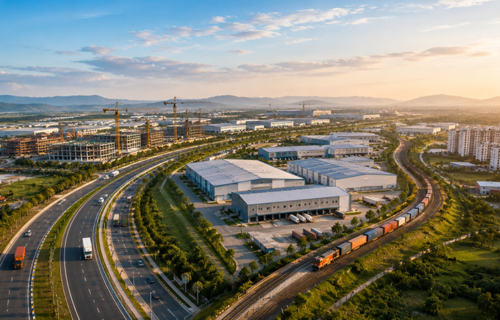
India’s ambitious programme of industrial corridor development is transforming far more than the country’s manufacturing sector. Large-scale investments in transport infrastructure, logistics parks and planned industrial zones are reshaping where factories are built, how goods move across the country and where investors are directing capital.
For decades, India’s economic growth has been driven primarily by services, while manufacturing has faced challenges including fragmented infrastructure, high logistics costs and uneven industrial development. Today, both the central and state governments are seeking to change that picture through integrated industrial corridors designed to connect production centres with highways, rail freight networks, ports and airports.
The impact extends well beyond manufacturing. Commercial property, logistics, housing and land markets are all evolving as industrial activity expands into new regions.
Infrastructure Becomes the Foundation for Growth
India’s industrial strategy is increasingly centred on infrastructure rather than individual factory developments. New industrial corridors combine dedicated freight routes, expressways, modern logistics facilities and utility infrastructure to create locations where manufacturers can operate more efficiently.
This integrated approach reduces transportation times, improves supply chain reliability and lowers logistics costs, making new industrial locations more attractive to domestic and international businesses.
The National Industrial Corridor Development Programme (NICDP) now encompasses dozens of industrial projects across multiple economic corridors, reflecting its growing importance within India’s long-term manufacturing strategy.
Manufacturing Is Moving Towards Planned Industrial Hubs
Industrial corridors are encouraging companies to relocate from scattered manufacturing locations to purpose-built industrial zones offering reliable access to transport, electricity, water and digital infrastructure.
Rather than developing isolated factories, businesses are increasingly choosing integrated industrial parks where suppliers, manufacturers, logistics providers and supporting services operate within the same ecosystem.
This clustering effect improves efficiency, encourages collaboration across supply chains and makes regions more attractive to future investment.
As additional industrial nodes become operational, new manufacturing centres are emerging beyond India’s traditional industrial regions, helping diversify economic activity across the country.
Property Markets Benefit from Industrial Expansion
One of the most immediate effects of corridor development is rising demand for land surrounding new industrial zones.
As manufacturers, logistics companies and commercial developers compete for strategically located sites, land values often increase well before industrial projects reach full capacity.
The impact extends beyond industrial land. Residential developments, retail centres, offices, hotels and supporting services frequently follow as employment opportunities attract new workers and businesses.
This pattern has been observed in established industrial regions as well as emerging markets where infrastructure investment is creating entirely new commercial districts.
Warehousing Demand Continues to Rise
The expansion of manufacturing is also strengthening India’s logistics property market.
Modern factories require efficient distribution networks capable of supporting both domestic consumption and exports. As a result, demand for Grade A warehouses, distribution centres and logistics parks continues to grow alongside industrial development.
Manufacturing has become one of the largest drivers of warehouse leasing activity, reflecting the increasing integration of production facilities with modern supply chains.
Developers are responding by expanding logistics parks near industrial corridors, freight terminals and major transport routes to reduce delivery times and improve operational efficiency.
Institutional Investors See Long-Term Potential
Industrial real estate has become an increasingly attractive asset class for institutional investors.
Pension funds, sovereign wealth funds, private equity firms and global real estate investors are allocating more capital towards logistics parks, industrial developments and income-producing manufacturing assets.
The appeal lies in the sector’s long-term growth prospects, supported by expanding manufacturing activity, rising domestic consumption and government policies aimed at strengthening India’s position as a global production base.
As industrial property becomes more standardised and professionally managed, investment vehicles such as Real Estate Investment Trusts (REITs) and infrastructure funds may play a larger role in financing future developments.
Corridor Development Is Creating New Urban Centres
The influence of industrial corridors extends well beyond factory construction.
As employment opportunities increase, demand also grows for housing, schools, healthcare facilities, retail centres and commercial services. Many industrial locations are gradually evolving into mixed-use urban centres where people can both work and live.
This creates opportunities for residential developers alongside industrial and logistics investors, contributing to broader regional economic development.
In several emerging markets, infrastructure investment is acting as the catalyst for entirely new urban growth corridors that combine manufacturing, logistics and residential communities.
Challenges Remain
Despite strong momentum, industrial corridor development continues to face several challenges.
Large infrastructure projects require substantial investment and long implementation periods, while land acquisition and environmental approvals can delay construction. Coordination between central and state governments also remains essential to ensure transport links, utilities and industrial zones are delivered simultaneously.
In addition, sustained success will depend on developing skilled workforces, improving urban services and ensuring that supporting infrastructure keeps pace with industrial expansion.
Maintaining environmental sustainability and balancing industrial growth with responsible land use will also become increasingly important as new corridors develop.
Building India’s Next Industrial Economy
Industrial corridors are becoming one of the defining features of India’s long-term economic strategy.
By combining modern transport infrastructure with planned industrial development, the country is creating new locations capable of supporting manufacturing, logistics and export growth on a much larger scale.
For the real estate sector, these projects represent more than infrastructure investment. They are reshaping land values, driving warehouse development, attracting institutional capital and creating entirely new property markets.
As additional corridors become operational over the coming decade, they are expected to play an increasingly important role in determining where businesses invest, where people live and how India’s commercial real estate landscape continues to evolve.
Source: © CIJ.World India Research & Analysis Team