Saturday, 19 September 2026
Europe’s plan to tighten waste exports is opening a wider debate over the future of the region’s recycling industry, with recyclers warning that restricting access to overseas buyers could leave European operators with more material than domestic manufacturers are prepared to use.
The European Commission has published its preliminary assessment of non-OECD countries seeking permission to continue receiving certain non-hazardous waste from the EU after new rules become applicable in May 2027. Thirty-two countries have applied, including major international recycling markets such as India, Malaysia, Indonesia, Vietnam, Pakistan, Thailand and several countries in the Western Balkans.
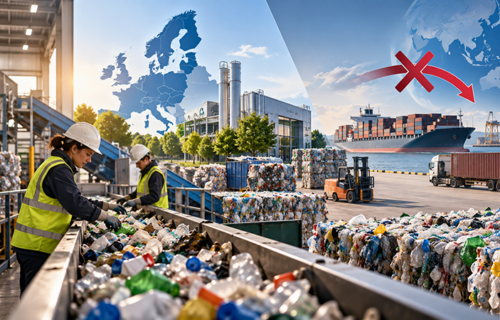
Under the new system, exports of relevant non-hazardous waste to non-OECD countries will generally be possible only where the destination and particular waste streams have been approved. Plastic waste faces an earlier change, with exports from the EU to non-OECD countries prohibited from 21 November 2026.
The European Commission argues that the tighter system is needed to ensure that material leaving the EU is handled under appropriate environmental conditions rather than transferring the environmental consequences of European consumption to countries with weaker waste-management systems. Parts of the recycling industry agree with the objective of ensuring high treatment standards but dispute how some materials are being assessed and warn about the economic consequences of losing international markets.
The disagreement is particularly significant for metals. Recycling Europe, which represents recycling companies and national industry associations, has criticised the Commission’s preliminary approach to ferrous and non-ferrous metal waste. It argues that recyclable metals should not be treated in the same way as materials presenting greater environmental risks and that restrictions should reflect the actual characteristics of individual waste streams and the capabilities of receiving facilities.
India has become an important part of the dispute. The country is a substantial purchaser of European metal scrap and has applied to remain eligible to receive waste under the new regime. Depending on the final Commission decision, some European metal shipments to India could be prevented from May 2027.
The issue exposes competing interests within Europe’s industrial economy. Metal recyclers need customers willing to purchase the secondary raw materials they recover, while European metal producers have an interest in retaining greater quantities of scrap within the region as feedstock for domestic manufacturing.
Recycling Europe estimates that approximately four-fifths of the recycled metals produced by its industry are already sold within Europe, with the remaining volumes exported. The organisation argues that overseas markets provide an outlet for material that European manufacturers currently do not consume.
Restricting those markets would therefore not necessarily cause European industry to purchase the additional material. If domestic demand remains insufficient, recyclers argue that larger surpluses could accumulate, putting downward pressure on recovered-material values and reducing the profitability of collecting, sorting and processing waste.
The debate comes as the European recycling industry is already facing difficult economic conditions. Parts of the plastics recycling sector have experienced plant closures and weaker demand, with operators citing high energy costs, competition from cheaper imports and insufficient demand for European recycled materials.
This complicates the assumption that stricter export rules will automatically generate investment in new recycling plants. Europe may retain more material within its borders, but new processing capacity will only be commercially sustainable if there are manufacturers prepared to purchase the recovered materials at viable prices.
For the property sector, this distinction is important. Waste policy can create a requirement for additional collection, sorting, storage and processing infrastructure, but regulation alone does not guarantee that new facilities will attract investment.
Recycling plants are specialised industrial assets requiring appropriate zoning, environmental approvals, transport access and, in many cases, substantial electricity connections. Their economics depend not only on the quantity of waste available but also on energy prices, processing costs and the value of the materials produced.
The debate over aluminium illustrates the complexity. European producers have supported policies intended to retain more scrap within the EU, arguing that recycled aluminium is an important raw material for lower-carbon production. Recyclers have been more cautious about restricting exports because international buyers provide competition for the material they sell.
The Commission recently stepped back from a separate proposal that could have restricted aluminium scrap exports. The decision followed opposition from recyclers and came amid wider EU trade negotiations with India. The latest waste shipment proposals have nevertheless reopened the question of how much access European recyclers will have to the Indian market.
Türkiye occupies a different position because it is an OECD member and is therefore not covered by the general prohibition applying to non-OECD destinations. Instead, the Commission is separately assessing whether plastic waste exported there is being managed appropriately. Türkiye received around 510,000 tonnes of EU plastic waste in 2025, making it the largest OECD destination for these shipments.
The emerging regulatory structure therefore divides Europe’s external waste markets into different categories. Some non-OECD countries may remain authorised for particular non-hazardous materials, others could lose access to EU waste streams, while OECD countries will remain subject to monitoring and possible intervention where environmental concerns arise.
For Europe’s industrial property market, the outcome could influence where future recycling investment is located. If more material remains within the EU and manufacturers increase their use of secondary raw materials, demand could grow for modern sorting, recycling and resource-recovery facilities close to industrial centres.
If European demand fails to expand sufficiently, however, restricting exports could instead put pressure on existing recycling businesses. Lower recovered-material prices and growing inventories would weaken the investment case for new processing facilities precisely when Europe is seeking to develop a more circular industrial economy.
The dispute therefore goes beyond environmental regulation. It concerns the relationship between waste policy, international trade, manufacturing demand and the infrastructure required to process Europe’s discarded materials.
The Commission’s final decisions will determine which non-OECD markets remain accessible and for which materials. For investors and developers, the more important longer-term question is whether Europe can create a sufficiently competitive market for recycled materials to support the additional infrastructure that tighter export rules are intended to encourage.