M1 Zabrze expands retail offering with new tenants and store upgrades

The M1 Zabrze shopping centre, managed by EPP, has recently expanded its retail offering as part of a broader strategy to meet the evolving expectations of value-conscious consumers. This follows the late-2024 opening of one of Poland’s first ATAC Hiper Discount by Auchan hypermarkets within the centre.

In the first half of 2025, M1 Zabrze added several new tenants, including the city’s largest HalfPrice store. The off-price retailer occupies nearly 2,100 sqm and offers a wide selection of fashion, sporting goods, homeware, pet accessories and international snacks. This addition was accompanied by the arrival of fashion retailers Greenpoint, Top Secret and Reporter, as well as jewellery brand VERONA.

Several existing stores have also undergone expansion or refurbishment. The Rossmann drugstore was modernised in line with its latest retail concept, and Sinsay reopened in a larger format offering an expanded selection across fashion, homeware and pet products. Sports retailer 4F is expected to open a new and larger-format store by the end of the summer.

In total, the recent retail changes involved nearly 4,000 sqm, representing over 5% of the shopping centre’s leasable area.

The retail updates align with EPP’s stated goal of catering to consumers who seek value and variety. According to the centre’s management, there is a growing preference for retail environments that support product discovery and price comparison, without compromising quality.

Beyond retail, M1 Zabrze is also promoting educational and leisure activities. Until the end of November, visitors can explore Kosmopark, a science-focused exhibition featuring over 40 interactive zones. The display includes a planetarium, virtual space expeditions, and workshops for children focused on space and science themes.
Poland’s property investment market holds steady in H1 2025

Poland’s commercial real estate market recorded stable performance in the first half of 2025, maintaining investment volumes on par with the same period last year. According to Avison Young’s latest market report, the total investment volume reached approximately €1.7 billion, spanning 63 transactions across all major asset classes. The industrial sector dominated the landscape, drawing the largest share of capital and registering the most high-profile transaction of the period.

The report highlights a shift in the profile of active investors. Institutional players remain cautious, constrained by falling asset valuations and global economic uncertainties. In contrast, private and domestic capital has become more prominent, with Polish investors contributing 14% of total volume and executing deals averaging €13 million. This trend is particularly notable in the residential and office segments.

The industrial and logistics sector continued its strong momentum, accounting for 40% of overall investment volume and setting a new benchmark for large-scale deals in the region. The most significant transaction was the €253 million sale and leaseback of two logistics facilities by window manufacturer Eko-Okna to U.S.-based REIT Realty Income Corporation—the largest such deal ever recorded in Central and Eastern Europe. Despite this standout transaction, the remaining 11 industrial deals all remained below the €80 million mark. Three portfolio deals were also closed during the period. Overall, the sector’s year-on-year performance nearly doubled, underscoring its status as a key engine of growth in Poland’s property market.

In the office market, investor activity remained selective but consistent, with a total investment volume of €411 million across 23 transactions. More than half of this activity occurred outside of Warsaw, reflecting growing interest in regional office markets. Polish investors were responsible for over one-third of the capital deployed in the office segment. While core capital remained relatively subdued, there was increased interest in value-add and core-plus opportunities, particularly in locations where pricing expectations between buyers and sellers have converged. Among the notable core deals were Wronia 31 and Plac Zamkowy in Warsaw, as well as High5ive I&II in Kraków.

Retail investments totalled €322 million across 20 deals in the first half of the year. Retail parks and convenience centres proved the most attractive to investors, representing 59% of the retail volume. The Czech-based investor My Park made its debut in the Polish market with the acquisition of the 10-asset A Centrum portfolio. Redevelopment activity also played a significant role, with the sale of Arkady Wrocławskie to Vastint and CH Glinki in Bydgoszcz to Redkom Development. Avison Young represented the sell-side in both transactions.

The residential sector, particularly private rented sector (PRS) investments, saw a total volume of €223 million. Of this, €150 million was focused on three PRS projects in Warsaw, with AFI Europe closing two deals and Syrena RE acquiring one asset from Xior Student Housing. In Gdańsk, NREP completed three co-living acquisitions, supported by advisory services from Avison Young. The PRS segment continues to consolidate, with the majority of existing stock held by Resi4Rent, Vantage Rent, and Fundusz Mieszkań na Wynajem. Resi4Rent also leads in terms of pipeline development.

Looking ahead to the second half of 2025, Avison Young notes that current market conditions remain favourable for buyers. With interest rate cuts on the horizon, yields are expected to compress, making this a potentially opportune time to invest. Mid-cap investors are expected to remain active across all asset classes, while core capital may return more assertively once broader economic stability is restored.

Auchan Krasne Shopping Centre adds new family amenities and leisure spaces

Nhood Services Poland has expanded the amenities at the Auchan Krasne Shopping Centre, introducing new family-friendly features aimed at improving comfort and enhancing the overall customer experience. The improvements include the reopening of the modernised Grycan café and the launch of a free outdoor playground for children.

The changes are part of a broader strategy led by Nhood Services Poland, which manages the centre on behalf of its owner, Ceetrus Polska. The focus is on evolving commercial facilities into multipurpose spaces that serve local communities while also aligning with sustainability principles.

The Grycan café and ice cream parlour reopened in July with a refreshed design that reflects the brand’s latest concept. Located near the indoor play area, the café now offers a more open layout and seating that encourages relaxation and social interaction. Soft furnishings, greenery, and an updated menu contribute to a welcoming atmosphere, particularly for families.

In June, Nhood introduced a new outdoor playground adjacent to the shopping centre. Designed with safety and accessibility in mind, the playground features swings, a carousel, slides, and other attractions in a landscaped area next to a public transport stop. The space includes seating for parents and has received full safety certification.

Auchan Krasne Shopping Centre has served the region for nearly twenty years, offering a range of retail options, including fashion, cosmetics, home goods, and an Auchan hypermarket. As part of its property and asset management responsibilities, Nhood also runs community-focused programmes at the centre, including workshops and theatre events aimed at families with children.

EU considers regulation of third-party litigation funding

Third-party litigation funding (TPLF), though still uncommon in Poland, has begun to gain ground, with a number of litigation funds already active in the market. Despite this development, there is currently no dedicated regulation at the national level. However, recent moves by European institutions suggest that this may soon change.

TPLF involves an external entity financing legal proceedings in which it has no legal stake, in exchange for a share of the awarded compensation. This arrangement is typically used by specialised litigation funds and aims to support parties lacking the financial means to pursue costly legal action.

According to Olga Gerlich and Marcin Rudnik from the dispute resolution team at Wolf Theiss in Warsaw, litigation funding can enhance access to justice by levelling the playing field in legal disputes. However, it also introduces certain risks, including potential conflicts of interest. Funders may exert influence over litigation strategy or limit the funded party’s ability to settle or withdraw claims.

Concerns have also been raised about the proportion of proceeds funders are entitled to receive and the extent to which these arrangements should be disclosed in proceedings. In some instances, especially in group claims involving small consumer interests, the funder and legal representatives may receive most of the compensation, leaving little benefit for the actual plaintiffs.

These concerns are reflected in a recent report published by the European Commission on 21 March 2025. The report, spanning 700 pages, analyses TPLF regulation across EU Member States and several non-EU jurisdictions. It follows a 2022 European Parliament resolution urging the Commission to investigate responsible litigation funding practices and to consider regulatory measures.

As part of its findings, the Commission included a draft directive outlining potential regulatory approaches. These include licensing and supervision of funders, transparency requirements, limits on funders’ influence, and rules on contract terms. The study also mapped how existing national laws align with the proposed framework.

In most EU countries, including Poland, the only TPLF-related provisions are found in laws implementing the Directive on Representative Actions. In Poland’s case, this includes requirements for disclosing funding agreements and assessing their influence on proceedings—though these measures currently apply only to consumer class actions.

Interviews conducted during the Commission’s research revealed that 58% of stakeholders support some form of regulation, with 29% favouring an EU-wide framework. Only 13% opposed regulation altogether.

The European Commission’s findings indicate a fragmented regulatory environment, which may hinder competition, transparency, and predictability in litigation funding. It remains to be seen how the European legislature will proceed, but further regulatory efforts are expected.

The global TPLF market was valued at USD 17.5 billion in 2024, with Europe accounting for 25% to 30%. Projections suggest the market could grow to over USD 67 billion by 2037.

Forte Partners begins construction of office component for U•Center 3

Forte Partners has started construction on the office section of U•Center 3, the final phase of its mixed-use development located on Calea Șerban Vodă in Bucharest. The building permit was issued at the end of June, with the residential portion of the project expected to begin in 2026.

U•Center 3 will include 12,500 sqm of office space, 1,700 sqm of retail area, and 200 apartments. The buildings will have a mid-rise structure, featuring two basement levels, a ground floor, and six upper floors, with the top two floors set back. This configuration aligns with the area’s existing urban planning profile.

The development continues the U•Center project, which began in 2019 and includes two completed office buildings, both fully leased and certified to LEED Platinum and WELL Core Platinum standards. The third phase will maintain similar sustainability targets, including certification under LEED, WELL, GRESB, and Access4you.

The office building will feature several energy-efficient technologies such as biophilic design, rainwater reuse systems, automated lighting responsive to natural daylight, and HVAC systems powered by heat pumps using low-impact refrigerants. The building will operate entirely on electricity, with no gas connection, and is designed to meet nearly Zero Energy Building (nZEB) standards.

Forte Partners plans to finalize the details of the residential portion later this year, with construction scheduled to begin in the first half of 2026. The overall project includes amenities such as a supermarket and café, and benefits from nearby metro and surface transport connections, as well as proximity to Tineretului and Carol Parks.

GARBE Industrial and Partners sell logistics property in Bitterfeld-Wolfen to Clarion Fund

GARBE Industrial, in partnership with BREMER Projektentwicklung and the Quakernack Group, has completed the sale of a logistics centre located in Bitterfeld-Wolfen to a fund managed by Clarion Partners Europe. The transaction price has not been disclosed.

Situated within the Technologiepark Mitteldeutschland, the logistics facility was developed in three phases and provides approximately 125,000 square metres of lettable space on a 222,000 square metre plot. The centre is currently leased to tenants from the automotive sector.

The property is positioned near the A9 motorway, offering transport links to Leipzig, Berlin, Nuremberg, and Munich. The buildings are equipped with air-source heat pumps and a rooftop photovoltaic system with a capacity of 4.5 MW. The project is targeting Platinum certification from the German Sustainable Building Council (DGNB).

Legal, tax, and transaction advisory services for the joint venture were provided by Norton Rose Fulbright, HLB Stückmann, and Logivest Stuttgart GmbH.

CA Immo sells stake in Eggarten residential development

CA Immo has finalized the sale of its stake in the Eggarten-Siedlung residential development project in northern Munich. The buyer is a group of shareholders from its joint venture partner, Büschl Unternehmensgruppe. This move aligns with CA Immo’s strategic objective to focus on high-quality A-class office properties in prime urban locations.

The Eggarten joint venture was established in 2016, with both CA Immo and Büschl contributing land in the Eggarten-Siedlung area. The project envisions a large-scale residential district featuring approximately 1,850 housing units, nearly half of which are intended as subsidised housing. The plans also include public amenities such as a primary school, childcare facilities, garages, retail outlets, and restaurants, spread across a total gross floor area of 228,000 sqm. Sustainable features like a local heating system powered by groundwater are also part of the proposed development.

“With the sale of our stake in the Eggarten-Siedlung project company, we are continuing to implement our strategy of concentrating on premium office assets,” said Keegan Viscius, CEO of CA Immo. “Proceeds from transactions like this will support reinvestment in our development pipeline, meet liquidity needs, or fund select external investments that offer attractive returns.”

Producer prices in the Czech Republic show minor monthly changes, broader annual trends continue

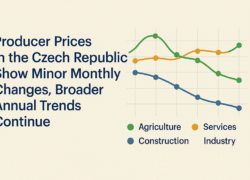
Producer price developments across key economic sectors in the Czech Republic in June 2025 were marked by marginal monthly fluctuations, while broader annual trends reflected ongoing inflationary pressure in some areas and a continuing decline in others, particularly in industry.

Agricultural producer prices edged down by 0.1% compared to May, though they remained significantly higher on an annual basis, up by 13.4%. Industrial producer prices recorded a 0.2% decline month-on-month and were down 0.7% year-on-year, marking the fifth consecutive month of decline. Meanwhile, construction work prices dipped by 0.3% compared to May but remained 2.9% higher year-on-year. Service producer prices in the business sector fell slightly by 0.1% month-on-month and rose by 4.2% over the year.

In agriculture, prices for oilseeds, cereals, and eggs decreased month-on-month, while fresh vegetables, cattle, pigs, poultry, and milk posted gains. Compared to June 2024, the strongest annual increases were recorded for fruit, oilseeds, cereals, and eggs. Prices for potatoes and pigs declined.

The decline in industrial producer prices was primarily driven by reductions in the energy and chemical sectors, as well as motor vehicles. Some price increases were seen in refined petroleum products and metals. Annually, prices in energy, chemicals, and coal dropped, while food-related categories, especially dairy and preserved meats, rose. Prices for durable and non-durable consumer goods, as well as capital goods, posted moderate annual increases, while energy prices fell 5.4% year-on-year.

Construction prices followed a mixed pattern, with work costs estimated to have fallen slightly month-on-month, while material costs rose slightly. Over the year, construction work prices were up nearly 3%, with materials showing a 1.1% annual increase.

In services, the most notable monthly declines were seen in the audiovisual and employment service sectors, while small increases were observed in programming, consultancy, and management services. On an annual basis, notable increases were recorded in advertising, security, employment services, and logistics-related services.

Across the European Union, preliminary Eurostat data for May 2025 showed a 0.6% month-on-month decrease in industrial producer prices for the EU27. The sharpest declines were reported in Bulgaria, Greece, Croatia, and Finland. Compared to a year earlier, prices rose by 0.4% across the EU, with Bulgaria, Greece, and Hungary leading in annual growth. The Czech Republic posted a 0.8% annual decline.

New orders in Slovak industry fall over 4% in May 2025

The volume of new industrial orders in Slovakia continued to decline in May 2025, recording a year-on-year decrease of 4.3% to EUR 5.69 billion, according to data from the Statistical Office of the Slovak Republic. This marked the second consecutive month of contraction, with the rate of decline accelerating from April’s 0.8% drop.

On a month-on-month basis, seasonally adjusted data showed a 5.9% decline in new orders compared to April 2025.

Seven out of the twelve monitored industrial sectors reported lower order volumes compared to May 2024. The most significant contribution to the overall decline came from the automotive sector—specifically the manufacture of motor vehicles, trailers, and semi-trailers—which dropped by 5.2%. This segment accounts for nearly half of total industrial orders.

Further declines were noted in the manufacture of metal structures (excluding machinery and equipment), down by 12%, and in electrical equipment production, which also fell by 12.1%.

Conversely, several sectors recorded year-on-year growth in new orders. Notable increases were seen in the manufacture of machinery and equipment not elsewhere classified (up 3.6%), other transport equipment (up 33.9%), and computer, electronic, and optical products (up 5.3%).

The continued contraction in new industrial orders suggests ongoing challenges in key manufacturing sectors, despite selective growth in some high-tech and capital goods categories.

Eurostat: EU Inflation Accelerated in June, Czech Republic Also Records Increase

Consumer price inflation in the European Union rose slightly in June 2025, reaching an annual rate of 2.3 percent, up from 2.2 percent in May, according to the latest figures released by Eurostat.

In the Czech Republic, inflation also picked up, rising to 2.8 percent in June from 2.3 percent the previous month. These figures are based on harmonised data, which allows for cross-country comparisons within the EU and may differ from national statistics reported by individual member states, such as the Czech Statistical Office (ČSÚ).

For comparison, EU-wide inflation stood at 2.6 percent in June of last year, while the Czech Republic recorded a rate of 2.2 percent at the same time.

Source: CTK

front page info
LATEST NEWS