Sunday, 20 September 2026
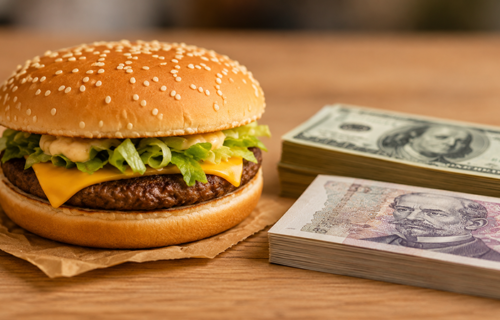
The Czech koruna remains undervalued against the US dollar according to the latest edition of The Economist’s Big Mac Index, although the gap has narrowed compared with previous years as the Czech currency has strengthened.
Based on prices collected in mid-July, the index suggests the koruna is 12.6% below the level implied by purchasing power parity. A Big Mac costs CZK 115 in the Czech Republic compared with US$6.22 in the United States. Using burger prices alone, the implied exchange rate would be CZK 18.49 per US dollar, compared with the market exchange rate of around CZK 21.16 at the time of the survey.
The latest reading represents a modest increase in the koruna’s estimated undervaluation from 10.2% recorded in the January edition of the index.
Published twice a year by The Economist, the Big Mac Index is an informal measure of purchasing power parity that compares the price of the same product across different countries. While it provides a simple way of illustrating relative currency valuations, economists generally view it as an indicator rather than a precise measure because local wages, taxes, operating costs, exchange rate movements and consumer demand all influence retail prices.
Analysts note that the performance of the US dollar during the first half of 2026 has been shaped by changing economic and geopolitical conditions. The dollar weakened at the beginning of the year as markets anticipated lower US interest rates and assessed the impact of trade policy uncertainty. More recently, renewed geopolitical tensions and higher energy prices have strengthened demand for the US currency as investors sought relatively safer assets.
The comparison also highlights differing inflation trends. While the price of a Big Mac increased in both countries over the past year, official consumer inflation remained considerably lower in the Czech Republic than in the United States, indicating that restaurant pricing does not always move in line with broader inflation measures.
Among neighbouring Central European currencies, the Polish złoty was assessed as being close to the Czech koruna in terms of valuation against the dollar, while the Hungarian forint remained more deeply undervalued at approximately 14.8%.
Globally, the Japanese yen continued to rank among the world’s most undervalued major currencies, reflecting Japan’s relatively accommodative monetary policy and long period of low inflation.
At the opposite end of the ranking, the Swiss franc remained the most overvalued currency against the US dollar according to the index, followed by the Uruguayan peso and the Norwegian krone. Several other currencies, including the euro, British pound, Swedish krona and Danish krone, were also assessed as trading above their purchasing power parity values.
Although the Big Mac Index is widely regarded as a light-hearted economic indicator, it continues to provide a useful illustration of long-term differences in purchasing power and currency valuation, while highlighting how market exchange rates can diverge from the relative cost of everyday goods across different economies.
Source: CTK