Central Europe reshapes VAT policies: Romania joins regional trend with real estate tax hike

Romania will raise its standard VAT rate from 19% to 21%, eliminating previous reduced rates of 9% in favor of a new flat under EUR 120,000 value. However, a transitional measure allows homebuyers to still access the 9% VAT rate for new residential units under 120 square meters and priced below RON 600,000, provided they sign a pre-contract and pay at least 20% in advance by July 31, 2025, with the final sale contract concluded by July 31, 2026. This change reflects a broader trend among Central European countries to streamline VAT systems and reduce tax exemptions.

In neighboring Slovakia, the government implemented a VAT increase from 20% to 23% at the beginning of 2025, modifying reduced rates as well. The Czech Republic simplified its VAT system in July 2025 by merging its two reduced bands into a single 12% rate, while also introducing new rules that affect how VAT applies to real estate transactions. Hungary, in contrast, has retained its favorable 5% VAT on new residential units, extending this reduced rate through at least the end of 2026 to support housing affordability.

These fiscal adjustments have had mixed effects. In Slovakia and the Czech Republic, higher VAT rates have increased the cost of real estate services, prompting concerns about affordability and sector resilience. Hungary’s strategy to preserve its 5% rate has helped cushion housing prices in a market already grappling with inflation and construction delays. Poland has kept its VAT rates stable but introduced clearer definitions that impact how developers apply VAT to housing, aiming to improve compliance and transparency.

In Romania, the upcoming tax increase is expected to have a significant impact on the residential real estate market. Analysts suggest that the higher VAT could raise the total cost of a standard three- to four-room apartment in Bucharest by tens of thousands of euros, making home ownership increasingly difficult for average buyers. Developers are reportedly exploring ways to fast-track transactions to help customers lock in the lower 9% VAT rate before the deadline. However, the new rate could ultimately slow housing demand and shift the focus of development toward rental properties, a trend that has already gained traction in Poland, Hungary, the Czech Republic, and Slovakia over the past decade.

Overall, the shift in VAT policy across the region is reshaping housing markets. While the goal is often to increase public revenues and simplify tax systems, the outcome in each country depends on how such changes balance fiscal consolidation with housing accessibility and economic growth. Romania’s decision is in line with regional fiscal tightening but could bring significant challenges unless offset by support mechanisms for both developers and buyers.


EU construction production increases in May 2025

Construction production in the European Union increased slightly in May 2025, according to the latest report released by Eurostat. Compared with April 2025, seasonally adjusted production in the construction sector rose by 0.2% in the EU and 0.1% in the euro area. On an annual basis, production was up by 0.7% in the EU and 1.3% in the euro area compared with May 2024.

The modest monthly growth in May was driven primarily by an increase in building construction, which rose by 0.3% in the EU and remained stable in the euro area. In contrast, civil engineering output declined by 0.4% in the EU and by 0.1% in the euro area.

Among the member states with available data, the largest monthly increases in construction production were observed in Slovenia (+5.0%), Slovakia (+4.5%), and Hungary (+3.9%). On the other hand, the biggest declines were recorded in Belgium (-4.2%), Sweden (-3.8%), and France (-1.4%).

Looking at the annual comparison with May 2024, building construction was up by 1.3% in the euro area and 0.9% in the EU. Civil engineering also increased by 1.2% in the euro area and 0.2% in the EU.

The report highlights a continuation of a slow recovery trend in the European construction sector following earlier volatility. However, results vary significantly between member states, reflecting diverse national economic conditions and construction market dynamics.

Austria’s greenhouse gas emissions decrease by 6.4% in 2023

Austria recorded a significant 6.4% year-on-year reduction in greenhouse gas (GHG) emissions in 2023, amounting to a total of 69.9 million tonnes of CO₂ equivalents. This marks a substantial drop from the 74.6 million tonnes recorded in 2022, and places emissions 1.1% below pre-pandemic levels in 2019, according to provisional data published by Statistics Austria.

The reduction in emissions was largely driven by notable declines in the energy supply sector, which cut its emissions by 16.8%, and the industrial sector, which saw a 7.3% decrease. The energy sector’s reduction is attributed primarily to a significant drop in the use of natural gas and coal for electricity and heat production. Industry emissions were impacted by a decline in energy-intensive manufacturing output.

The transport sector, which has historically been the largest source of emissions in Austria, posted a modest 1.6% reduction in 2023. Although this sector still accounts for approximately 30% of total emissions, the drop suggests a slight improvement in fuel efficiency and potentially increased adoption of alternative mobility solutions.

Emissions from households and the services sector fell by 4.5%, reflecting reduced heating requirements due to milder winter temperatures and continued improvements in building energy efficiency. Emissions from agriculture remained relatively stable with a slight increase of 0.3%, while the waste management sector recorded a modest decline of 1.4%.

Austria’s total GHG emissions for 2023 were 3.6 million tonnes below the average level for the years 2015 to 2021, highlighting a potentially sustained downward trend. The data reflect emissions from sectors covered under the EU Effort Sharing Regulation (non-ETS) as well as those subject to emissions trading (ETS), with both contributing to the overall decline.

Source: OECD

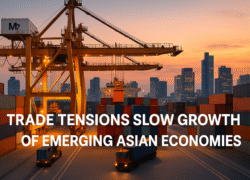
Trade tensions weigh on growth prospects for emerging Asian economies

Emerging Asian economies are beginning to feel the impact of escalating global trade tensions, with growth projections revised downward in several countries across the region, according to economic data and policy briefings released in July 2025.

After a period of strong post-pandemic recovery, many of Asia’s developing markets are now contending with slowing exports, weaker investment inflows, and mounting pressure on currency stability. The cooling global demand and increased use of tariffs, particularly by major economies like the United States and China, have disrupted key supply chains and led to rising uncertainty among manufacturers and investors alike.

In its latest regional update, the Asia Development Outlook indicated that while countries such as Vietnam, Indonesia, and the Philippines continue to show positive growth, the pace has moderated compared to earlier forecasts. Economies that are heavily dependent on exports, such as Malaysia and Thailand, are seeing more pronounced effects from reduced international demand and logistical bottlenecks.

One of the key concerns flagged by analysts is the decline in foreign direct investment in sectors tied to global trade. Investment in export-oriented manufacturing has slowed considerably, with multinational firms reconsidering expansion plans due to geopolitical risks and shifting trade policies. Meanwhile, capital flight and pressure on local currencies have forced several central banks in the region to intervene or revise interest rates to stabilize their economies.

The slowdown also affects regional integration efforts and the performance of trade blocs such as the Regional Comprehensive Economic Partnership (RCEP), as member countries attempt to shield domestic industries from external shocks. Despite efforts to diversify trade partners and promote intra-Asian commerce, the overall growth outlook remains fragile amid tightening global financial conditions and an unpredictable policy landscape.

Experts warn that unless the international trade environment stabilizes, emerging Asian economies may need to rely more heavily on domestic consumption and structural reforms to sustain growth. Policymakers across the region are now balancing short-term measures to support export sectors with longer-term strategies aimed at improving resilience and competitiveness.

Food prices continue to rise in Slovakia despite lower VAT on basic items

Food prices in Slovakia continue to climb, even though the value-added tax (VAT) on basic food items was reduced from 10% to 5%. The opposition has raised concerns that the government’s efforts to combat inflation are having limited effect, with consumers still facing higher costs at the checkout.

Drawing on data from the Statistical Office, the opposition highlighted that prices for several staple foods have increased year-on-year. Bread rose by 1.2% in May, cheese by 8.6%, and butter saw a significant 24% increase. Even items subject to the reduced 5% VAT have shown price volatility, while other foods taxed at the standard 19% or 23% rates have also surged. Mineral water rose by 6.1%, and egg prices jumped nearly 30%. New taxes, including a sugar tax, have contributed to sharp rises in fruit prices, with raspberries up between 26.6% and 44.6%.

Although government representatives have claimed that food inflation is under control, the opposition points to both statistical data and everyday consumer experience to argue otherwise. They suggest that new fiscal policies, including the financial transaction tax and higher VAT on many goods and services, may be indirectly contributing to price increases across the retail food sector.

In June, food and non-alcoholic beverage prices were again affected by broader inflationary pressures. Despite assurances from the Ministry of Finance that increased VAT revenues would support the state budget, updated forecasts indicate that tax collection may fall short of earlier expectations.

Critics argue that Slovakia lacks a comprehensive analysis of the food supply chain—from production to retail—which could help identify the true drivers of price increases. With Slovak households spending on average 21% of their budgets on food and beverages, the impact of rising prices is felt most acutely by low-income families.

Source: TERAZ

U.S. tariffs weigh on imports, but global trade adjusts and persists

While U.S. tariffs have led to a significant decline in imports from China and Canada, international trade continues to function through redirection and adaptation, according to the latest economic commentary from the Institute of Financial Policy (IFP) under the Slovak Ministry of Finance.

U.S. imports from China dropped nearly 42% year-on-year in May, amounting to a nominal decline of $14.5 billion. This figure represents roughly 0.4% of annual U.S. imports and 0.1% of China’s GDP. Imports remained subdued in June, down more than 16% compared to the same period last year. Despite this, China’s overall exports continued to grow by an average of just over 5% in May and June, suggesting that Chinese exporters are finding alternative markets or routing products through third countries to circumvent tariffs. However, export volumes to the EU have recently stagnated, prompting China to shift more attention to other Asian markets.

At the same time, the weakening of the U.S. dollar has yet to yield a positive effect on the country’s trade balance. A lower dollar typically helps domestic production by making imports more expensive and exports more competitive. Since the beginning of the year, both the euro and the Japanese yen have strengthened against the dollar by more than 8%. This shift has not curbed the growth of European and Mexican exports to the U.S., which continue at a stable pace.

Despite a temporary improvement in April, the U.S. trade deficit remained high in May. Analysts suggest that the ongoing dollar depreciation, coupled with growing uncertainty, could lead to a slowdown in imports from Europe. The sharp weakening of the dollar in recent months may reflect a loss of investor confidence in U.S. fiscal policy. This is evidenced by the recent divergence between interest rates and exchange rates, as well as a disconnect between the performance of stock markets and bond yields.

Traditionally, countries offering higher bond returns attract more capital, thereby strengthening their currencies. U.S. bonds still offer higher interest rates than their European counterparts, yet the dollar continues to lose ground. This contradicts the usual pattern seen during global market volatility, where the dollar acts as a safe haven.

The IFP concludes that recent developments, including persistent budget deficits and fiscal strategies viewed as unsustainable, are undermining investor trust and contributing to the dollar’s weakness, even in the context of rising U.S. interest rates.

Source: TERAZ

Slovak Post cancels plan to close hundreds of branches, confirms franchise shift in rural areas

Slovak Post has officially refuted claims that it plans to close hundreds of post office branches across the country. In response to criticism from opposition party Progressive Slovakia (PS), the company confirmed that only 26 regional branches will cease operations, alongside 29 district branches, which will be replaced by upgraded facilities offering extended services and improved accessibility.

“The Slovak Post will not close hundreds of branches,” said spokeswoman Eva Peterová. “We’ve been transparent for weeks about the closure of 26 regional and 29 district branches. These will be replaced by branches with longer opening hours, more service windows, improved access via public transport, and better parking options. The new locations will be within 850 meters to 3.5 kilometers of the original branches.”

Peterová added that rural branches will not be closed but instead gradually converted into franchises, with discussions underway in cooperation with local municipalities.

The company highlighted that many traditional post office functions, such as paying pensions, bills, or sending parcels, are now handled by postal delivery personnel. Additional services, including online shipment processing, parcel redirection, and delivery rescheduling, are available through the Slovak Post’s website and mobile app.

Slovak Post pointed out that its services remain accessible in nearly 2,000 municipalities that have never had a physical post office. The company noted a shift in public behavior, with fewer people visiting branches in person as more customers turn to delivery services, couriers, and digital tools.

The opposition PS had warned that beyond the closures in regional and district centers, further branch shutdowns in rural areas would force residents to travel long distances to access basic postal services. The party criticized the plan, arguing it would reduce service accessibility in smaller communities.

Slovak Post maintains that the reorganization is aimed at modernizing services and improving efficiency without reducing access for customers.

Source: TERAZ.SK

Over 10% of Polish courier firms listed as debtors, industry debt tops PLN 106 million

The Polish courier sector continues to expand, fuelled by rising e-commerce demand and changing consumer habits. According to the latest data from the Register of Debtors BIG InfoMonitor and the BIK database, however, this growth is not without financial strain. Despite handling more than 1.2 billion parcels annually and generating nearly PLN 13.7 billion in revenue in 2024, over 10% of courier companies are now listed as unreliable payers, with overdue liabilities surpassing PLN 106 million.

Figures show a slowdown in the rate of debt accumulation compared to previous years, but the total value of arrears still rose by 3.3% year-on-year as of May 2025, and by nearly 42% over the past five years. Much of the financial pressure stems from rising operational costs, such as fuel and infrastructure investment, alongside stagnant income. The average net revenue per parcel has remained around PLN 11 for years, while consumer expectations for free shipping continue to mount.

Although Poland’s courier industry is dominated by a few major operators accounting for over 99% of total revenues, thousands of small subcontractors operate under these brands. For these smaller firms, the average outstanding debt of PLN 58,456 can significantly impact liquidity and long-term viability.

Waldemar Rogowski, Chief Analyst at BIG InfoMonitor, notes that even minor payment delays can trigger broader cash flow disruptions across the KEP (courier, express, and parcel) sector. A notable portion of industry debt also originates from unpaid invoices owed by clients. Rogowski emphasizes the importance of proactive risk assessment, including the use of business information services to vet partners and respond early to warning signs.

Looking ahead, the Office of Electronic Communications (UKE) projects courier volumes will exceed 1.65 billion shipments by 2027, driven primarily by continued growth in e-commerce. While volume growth may put pressure on margins, operators that actively manage liquidity and mitigate payment risks are well positioned to benefit from the sector’s overall expansion.

Source: BIG InfoMonitor

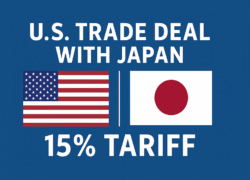
Trump announces trade deal with Japan including 15 percent tariff

On Tuesday evening, U.S. President Donald Trump announced the conclusion of a new trade deal with Japan. The agreement includes a 15 percent tariff on Japanese goods imported into the United States and outlines plans for Japan to invest $550 billion in the U.S. economy. As part of the deal, Japan will also open its market to a range of American products, including passenger vehicles, rice, and agricultural goods.

Trump made the announcement on his social media platform Truth Social, referring to the outcome as a “massive deal” that will strengthen U.S.–Japan relations and create “hundreds of thousands of new jobs” in the United States. He emphasized the enduring nature of the partnership between the two countries.

While Trump did not specify tariff changes on Japanese automobiles—one of Japan’s key export categories—Japanese public broadcaster NHK reported that both countries agreed to reduce the previously proposed 25 percent tariff on Japanese car imports to 12.5 percent. Combined with the existing 2.5 percent tariff, this results in a final duty of 15 percent. Reuters confirmed the details through five separate sources.

The announcement marks the most notable agreement in a string of bilateral trade negotiations the U.S. has been pursuing in recent weeks. Earlier this month, Trump had threatened to impose 25 percent tariffs on imports from both Japan and South Korea unless new terms were reached by August 1.

Trade in goods between the U.S. and Japan amounted to nearly $230 billion last year, with Japan posting a $70 billion surplus. According to the U.S. Census Bureau, Japan ranks as the fifth-largest U.S. trading partner.

Japanese Prime Minister Shigeru Ishiba welcomed the agreement, stating that the final duty level was the most favorable among countries with trade surpluses with the U.S. However, Ishiba faces mounting political pressure following his coalition’s loss of its majority in the upper house in recent elections. Local media reports suggest he may announce his resignation before the end of August.

Japanese government envoy Ryosei Akazawa traveled to Washington on Monday to negotiate the final terms. Trump’s announcement followed Akazawa’s meetings at the White House and with U.S. Commerce Secretary Howard Lutnicko and Treasury Secretary Scott Bessent. After the talks concluded, Akazawa posted “#Mission completed” on social media.

The announcement had an immediate impact on financial markets. Japan’s Nikkei 225 index rose nearly four percent before market close. Shares in major Japanese automakers, including Toyota and Honda, recorded double-digit gains. The yen initially strengthened against the U.S. dollar but later weakened amid reports of Ishiba’s possible resignation.

Economists interviewed by Reuters noted that the 15 percent tariff represents a more favorable outcome for Japan than earlier scenarios threatened by the U.S. administration. The agreement, they said, could help Japan avoid slipping into a recession.

Source: Reuters

Seventy years on, Warsaw’s Stalin-era skyscraper remains a source of debate

Seventy years after its official opening, the Palace of Culture and Science in central Warsaw continues to provoke mixed emotions among Poles. The iconic structure, a towering gift from Soviet leader Josef Stalin during Poland’s time under Soviet influence, still stands as a symbol of a complex and contested history, reports Reuters.

When the palace was completed in 1955, it was seen as a display of Soviet dominance, with its imposing height and visibility from kilometers away. Originally named after Stalin, it served as a visual statement of power in the heart of the capital.

“If you place such a massive building in the center of the city, visible from 30 kilometers away, you’re making a statement,” said Dorota Zmarzlak, a member of the palace’s board. She noted, however, that younger generations tend not to associate the building with its original political symbolism.

After the fall of communism in 1989, Poland removed many Soviet-era monuments and renamed numerous streets. Yet the palace remained, even as political figures like Radosław Sikorski, now Poland’s foreign minister, called for its demolition as early as 2007.

Over the decades, the building has been repurposed as a cultural venue. It has hosted concerts, political events, exhibitions, and fashion shows. Performers like Andrea Bocelli and José Carreras have appeared on its stage. When the Rolling Stones performed there in 1967, tensions erupted into riots—an unusual event during the communist era.

For some, the palace holds personal significance. Zygmunt Kowalski, an 89-year-old retired railway worker, moved to Warsaw just a month after the palace opened. He recalls taking his daughter to swim in its pool and attending concerts and films there. “Everything can be demolished, but this should stay,” he said. “Let it serve as a reminder of what once was. Future generations will understand that communism existed here.”

Today, the palace houses four theaters, a cinema, several museums, and regularly hosts exhibitions. Its concert hall is currently undergoing renovation.

Younger residents increasingly view the palace as a key part of the city’s identity, rather than as a Soviet relic. “For me, it’s a symbol of Warsaw,” said Karol Los, a 23-year-old student. “I think young people see it completely differently than the older generation.”

Others see architectural and historical value in the structure. Valerij Shcherbak, a 32-year-old architect from Ukraine, praised its detailed design and ongoing popularity with visitors. “This is history, and we must respect it,” he said, noting that many Soviet-era buildings in Ukraine have been lost. “What happened in the past should be preserved, not erased.”

Source: CTK

front page info
LATEST NEWS