Obermeyer Helika appoints Ing. Pavel Subally as new TECH & BIM Manager

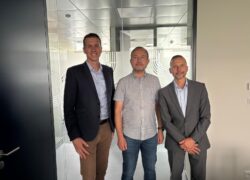
Obermeyer Helika has announced the appointment of Ing. Pavel Subally as its new TECH & BIM Manager. The move is part of the company’s ongoing focus on strengthening its capabilities in Building Information Modeling (BIM) and integrating modern technologies into project delivery.

Subally joins Obermeyer Helika with several years of practical experience, most recently from YIT Slovakia, where he worked extensively with the Dalux Common Data Environment (CDE) platform to support digitalisation efforts in construction processes. He began his professional career as a Revit modeler at Compass studio in Bratislava and progressed to roles in construction engineering and BIM project management.

A graduate of the Brno University of Technology in civil engineering, Subally has also gained international experience through an internship at TCA Architects in California and a study program at the Technical University of Riga.

At Obermeyer Helika, Subally will be responsible for advancing BIM implementation, improving project documentation workflows, and supporting internal process development. He noted that the role represents a significant step in his career and emphasized the company’s long-standing presence in the market. His focus will include not only project execution but also exploring how emerging trends and methodologies can be meaningfully integrated into the company’s operations.

Obermeyer Helika has been active in the architecture, engineering, and consulting sectors for over 35 years and continues to adapt its practices in line with technological developments in the construction industry.

Student housing in Prague reaches full capacity ahead of fall semester

Zeitraum Student Housing has reported full occupancy across all four of its student accommodation campuses in Prague for the upcoming fall semester. With a total of 450 beds now booked, the high demand reflects both a growing student population and evolving expectations for student housing in the city.

Applications for accommodation began increasing in late February and early March, quickly filling all available spaces. According to Zeitraum’s director, Zdena Noack, students are increasingly seeking housing options that go beyond basic furnishings, with many now prioritising modern design, comfort, and access to services such as round-the-clock reception, maintenance, and communal areas for both study and social activities.

Zeitraum operates student residences in Karlín, Holešovice, and Žižkov, offering a mix of private and shared rooms. Each location is connected to public transport and provides amenities including study areas, communal kitchens, high-speed internet, laundry facilities, and welcome starter packs. These facilities are designed to meet the expectations of today’s student demographic, which values functionality alongside quality of life.

Despite the strong demand, Prague continues to face a broader shortage of student accommodation. The gap between supply and demand affects both public and private housing providers. The issue is particularly acute for students seeking modern facilities that meet current lifestyle and academic needs.

Zeitraum has plans to expand its network in Prague and other cities, but acknowledges that individual providers cannot resolve the overall shortfall alone. Noack emphasized the need for coordinated investment at the national level to increase capacity and raise the standard of student housing across the country.

For students looking to secure accommodation, early planning remains essential. Zeitraum recommends arranging housing for the fall semester no later than March, and for the spring semester by October. Delayed booking often results in limited availability and less desirable options. Early preparation is increasingly becoming a critical part of the student admission process.

Wilo joins APES as supplier of energy-efficient technologies inCzechia

WILO CS, s.r.o., the Czech branch of global pump manufacturer Wilo SE, has joined the Association of Energy Service Providers (APES). The company becomes the 35th member of the association and joins the group of technology partners contributing to energy performance contracting (EPC) in the Czech Republic.

Operating in the Czech market since 1994, Wilo CS is part of the German family-owned Wilo SE, a company with over 150 years of experience in pump technology. One of its founders is credited with inventing the circulation pump. The company has a long-standing presence in the Czech Republic and is known for its technical solutions aimed at improving energy efficiency.

Wilo CS has been active in EPC projects for several years. Its pump systems have been used in various public buildings and institutions, including the Municipal House, the Rudolfinum, Bohnice Psychiatric Hospital, and the Valdice and Pankrác prisons, helping to improve energy performance and reduce operating costs.

According to Jan Cidlinský, director of Wilo CS, the company’s contribution extends beyond technology supply to include energy efficiency consulting. He noted that understanding client needs is essential for delivering effective solutions.

The company’s membership also brings added value to APES in terms of sustainability expertise. Wilo’s main production facility in Dortmund is carbon-neutral, and the Czech branch is working toward similar environmental goals. APES chairman Miroslav Marada noted that Wilo’s practical experience with pumps in EPC projects will be a useful asset to the association.

Wilo joins other APES technology partners such as Colmark, Hoval, Lamberga, and Systherm, contributing to the association’s efforts in promoting energy-efficient technologies and sustainable building solutions.

New mural at Norblin Factory pays tribute to Wola’s industrial past

A mural titled “Wola Fabr.” has been unveiled on the eastern wall of a historic building at the Norblin Factory in Warsaw’s Wola district. Created by graphic designer and local historian Jarosław Zuzga, the artwork highlights the district’s industrial history through a visual composition of historical logos and trademarks from former factories and workshops that once operated in the area.

Covering 33.5 square metres, the mural is installed on a structure dating back to the 1920s–1930s, which previously served as a measurement and laboratory facility until the Norblin Factory ceased operations in 1981. The graphic elements are arranged within an outline of the modern Wola district, forming a visual map that connects past industrial activity with present-day urban development.

Zuzga, who has documented the district’s history through his blog Okno na Warszawę and his book “Wola. People and Stories,” describes the work as more than a visual homage. He sees it as a narrative about the workers and industries that shaped Wola and a reflection on the evolution of a district still undergoing transformation.

The mural was commissioned as part of the Norblin Factory Museum’s cultural programme and produced by the Warsaw-based studio IDEAMO, known for public art and cultural installations. It is the fourth large-format mural on the premises. Previous works include:
• A mural inspired by Edward Dwurnik’s “Norblin Works” painting, created on the southern wall of the former metallurgical laboratory, in collaboration with the Edward Dwurnik Foundation.
• A piece by Pola Dwurnik on level -1 of the Plater building, referencing historical factory products.
• A mural based on a painting by Tytus Brzozowski, located on level -2, depicting the Norblin Factory and the city in a stylized, architectural form.

The unveiling of “Wola Fabr.” took place under the honorary patronage of Krzysztof Strzałkowski, Mayor of Wola District, who welcomed the initiative as a meaningful contribution to preserving the area’s heritage.

The project aligns with the Norblin Factory Museum’s broader goal of presenting Warsaw’s industrial legacy through preserved machinery, archival materials, and architectural restoration.

Globalworth Poland introduces WasteTracker system across 11 office buildings

Globalworth Poland has implemented the WasteTracker system in 11 of its office properties as part of its efforts to improve waste management and align with circular economy principles. The initiative is aimed at enhancing data accuracy, operational efficiency, and sustainability performance across its portfolio.

Developed by a technology start-up, WasteTracker is an intelligent system that monitors and documents waste streams by weight. It combines a weighing terminal, employee access cards, and an analytical platform, enabling detailed tracking of waste generation and sorting. The tool is intended to support tenants in managing their waste output more effectively and in setting measurable sustainability goals.

In the first quarter of 2025, 2,188 waste registrations were recorded across the 11 properties—an average of 24 entries per day. The system currently supports 215 registered tenants and allows access for 377 companies, indicating a relatively high level of engagement with the tool.

According to Globalworth Poland, the adoption of WasteTracker supports the company’s compliance with new regulatory frameworks, including the Corporate Sustainability Reporting Directive (CSRD). The system provides detailed metrics on waste composition and volume, which can be used by tenants for environmental, social, and governance (ESG) reporting and internal sustainability planning.

From an operational perspective, the system allows for the analysis of waste streams by type, helping companies to adjust their practices and set targets aligned with waste reduction and recycling strategies. Globalworth has also engaged in educational efforts with tenants and managers to raise awareness about sustainable waste practices.

The project reflects the company’s broader approach to sustainable property management. According to Globalworth representatives, there are plans to extend the WasteTracker system to additional buildings within its portfolio.

The initiative has been acknowledged by sector professionals as a step toward standardising responsible waste management in office buildings. Regular monitoring of waste not only supports environmental goals but also contributes to reducing landfill use, operational costs, and carbon emissions, while encouraging greater tenant participation in sustainable practices.

German hotel property market shows signs of recovery, values surpass pre-pandemic levels

The German hotel investment market showed a notable recovery in the first half of 2025, with transaction volumes exceeding those of the previous four years. Investor activity increased among both domestic and international players, supported by improving hotel performance indicators and steady growth in overnight stays. Despite ongoing global economic and political uncertainties, the sector’s fundamentals contributed to renewed confidence.

In 2024, Germany recorded 496 million overnight stays, marking the fourth consecutive year of growth. Rising occupancy rates across the country’s hotel sector were driven by a combination of domestic tourism, major events, trade fairs, and the European Football Championship. However, many hotel operators continued to face financial pressure due to elevated operating costs.

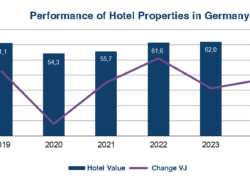
Hotel revenue performance improved considerably in 2024, approaching pre-pandemic levels. This recovery was reflected in the overall value of hotel assets. According to an assessment by Union Investment and bulwiengesa, the value of the investment-relevant hotel portfolio (excluding new developments) rose by 1.5 percent. The average value per hotel room increased to €152,000—surpassing the 2019 pre-pandemic figure of €150,800—for the first time.

The total market value of hotel properties, including both existing stock and completed developments, reached €64.3 billion at the end of 2024. This represents a 3.7 percent increase from the previous year’s estimate of €62.0 billion. Around 450,000 square metres of new hotel space were delivered in 2024, despite a continued decline in construction activity linked to prior delays in project development due to financing and cost concerns.

Much of the new development in 2024 met institutional investment criteria. Approximately 80 percent of newly completed rooms aligned with investor requirements, supported by demand for quality operators and adaptable asset concepts. The 4-star segment, excluding luxury properties, accounted for around 60 percent of completions, partly due to the inclusion of serviced apartments within this category.

Room values varied significantly by segment. The average ranged from €136,500 in the budget/economy sector to €284,000 in the upper-upscale and luxury segments. Properties in the upper-upscale category reported particularly strong gains, underpinned by higher occupancy and increased room revenues.

Serviced apartments emerged as a significant growth area, accounting for roughly 29 percent of all new room completions. These units, which focus on extended stays and digitalised operations, have demonstrated resilience and consistent occupancy. According to Apartmentservice, the average occupancy for serviced apartments reached 81 percent in 2024, with an average daily rate of €91. Operator groups such as Numa, Stayery, Bob W., and Limehome continued their expansion, emphasising automation and operational flexibility.

Conversions played an increasing role in hotel supply in 2024. Around 10 percent of all completed rooms came from change-of-use projects, particularly in urban office-dominated areas. The integration of hotels and serviced apartments into mixed-use developments is being explored as a way to promote neighbourhood diversity. However, the viability of such conversions continues to depend on structural suitability, local demand, and operator interest.

Overall, while challenges persist in terms of costs and construction pipeline, the German hotel property market has regained momentum, with growing investor interest and asset values once again exceeding pre-pandemic benchmarks.

CTP secures €500 million sustainability-linked loan to refinance existing debt

CTP N.V. has signed a five-year €500 million unsecured syndicated sustainability-linked loan facility with a fixed all-in cost of 3.7%. The new facility replaces a previous syndicated loan arranged in 2023 and is expected to deliver meaningful interest savings and reduce the company’s overall cost of debt.

The facility attracted strong interest from the lending market and was oversubscribed by more than two times. A total of 13 banks from Europe and Asia participated in the syndicate, with SMBC and ING acting as Global Coordinators and Sustainability Coordinators.

CTP stated that the financing aligns with its long-term capital structure strategy and supports the company’s sustainability objectives. The terms of the loan include sustainability-linked metrics, reflecting the company’s commitment to improving environmental performance across its portfolio.

Proceeds from the facility will be used to refinance the existing 2023 syndicated loan, enabling the company to optimise its debt profile amid evolving market conditions. The transaction is also expected to enhance liquidity and provide CTP with greater flexibility in managing future investments and operational needs.

As one of the largest logistics and industrial park developers and operators in Europe, CTP continues to focus on maintaining an investment-grade credit profile while integrating environmental, social, and governance (ESG) considerations into its financing strategy.

Fortim Trusted Advisors drives innovation in Property Management in Bucharest

Over the past five years, property management in Bucharest has undergone a profound transformation, shaped by green building standards, technological innovation, and shifting tenant demands. In a Q&A with CIJ EUROPE, Costin Nistor, Managing Director at Fortim Trusted Advisors, outlines how these changes are redefining the role of property managers and how Fortim is positioning itself as a leader in the evolving real estate landscape.

According to Nistor, all new office buildings delivered in Bucharest over the past five years—totaling over 675,000 sqm—have secured green certifications such as BREEAM or LEED, a clear indication of the city’s growing emphasis on quality and sustainability. Rising energy costs and a heightened demand for healthy workspaces, particularly in the aftermath of the pandemic, have compelled owners of older buildings to modernize and align with current expectations.

“The buildings are becoming greener and smarter,” says Nistor. “They are now equipped with advanced tools that not only monitor safety and budgets but also track real-time performance.” This shift has also redefined what clients expect from their property managers—no longer limited to administrative functions, they now seek strategic support to enhance asset value, implement ESG measures, and harness digital solutions for more responsive management.

One of the biggest challenges property managers face today, especially with high-density and mixed-use assets, lies in optimizing data and technology. “What cannot be measured cannot be managed,” Nistor emphasizes. “We need clear strategies and access to accurate data to fully understand and improve building performance.” At the same time, there is increasing pressure to deliver social value by creating healthier, safer, and more resilient tenant communities.

Sustainability is central to Fortim’s approach. The company assists clients in planning their ESG strategies, overseeing modernization projects, and achieving green certifications. Nistor points to successful implementations at America House and Maestro Business Center as examples of how Fortim integrates sustainability into its daily property management operations. These efforts are supported by digitalization tools that streamline operations and improve energy efficiency.

Remote and hybrid work models have further reshaped expectations around office buildings. Nistor notes that employers now seek locations that go beyond functionality to offer lifestyle benefits. “Modern tenants are drawn to buildings that provide dining options, fitness facilities, and cultural programs—places that help employees feel more engaged and motivated to return to the office.”

To support this trend, Fortim has developed a custom mobile app for premium building under its management. These apps allow tenants to manage visitors, access building services, and take advantage of exclusive offers from local businesses. They also serve as a platform for community engagement through charity drives and social events.

Looking ahead, Fortim’s strategy involves expanding its portfolio and strengthening its role as a full-service partner. “Our focus is not only on asset and property management but on being a one-stop shop,” Nistor explains. “We offer everything from leasing and regulatory support to green certifications and marketing. This integrated approach helps boost the market value of our clients’ properties and ensures long-term success.”
As competition intensifies in Bucharest’s commercial real estate market, Fortim Trusted Advisors is embracing innovation and sustainability as cornerstones of its growth strategy. Through a combination of expert management, community engagement, and forward-thinking solutions, the company aims to set a new standard in property management across Romania.

© 2025 www.cijeurope.com

Hungarian real estate faces regulatory shifts in 2025, say experts at Schönherr Hungary

Hungary’s commercial real estate sector is navigating a period of intensified legal and regulatory transformation in 2025. According to legal experts László Krüpl and Gergely Horváth of Schönherr Hungary, a series of new legislative and policy initiatives are redefining the development environment, requiring developers and investors to adopt more adaptive, compliance-focused strategies.

One of the most significant changes this year is the phased rollout of the new electronic real estate register, introduced under the Act on Real Estate Registration (Act C of 2021) and its implementing decree. Designed to modernise property records and transactions, the system aims to increase long-term efficiency but has introduced short-term complexity—particularly for institutional players less familiar with digitalised land administration. The transition coincides with the implementation of the new Act on Hungarian Architecture (Act C of 2023) and the TÉKA decree, reshaping planning and building requirements across municipalities.
“These reforms require time, training and revision of internal processes,” notes Krüpl. “While they offer long-term benefits, certain investment-critical areas remain unclear, and practical application will depend heavily on case law as it develops.”

Environmental and ESG-related compliance is also taking centre stage. The EU’s Corporate Sustainability Reporting Directive (CSRD) and Corporate Sustainability Due Diligence Directive (CSDDD), now being transposed into Hungarian legislation, are beginning to reshape reporting requirements. Large real estate players are under pressure to integrate ESG data collection and monitoring into their project pipelines, contributing to a shift in how investment strategies are structured.

Additionally, a proposed amendment to Governmental Decree No. 143/2018—under discussion since June—could change the permitting process for retail units over 400 sqm. If passed, even the transfer or lease of these properties would require a function change permit, a move that may significantly affect leasing and acquisition practices.

Beyond legal registration, zoning and environmental policy have also evolved. The new architecture law places stronger emphasis on green space protection, affecting how developers approach land selection—particularly in suburban areas. At the same time, a policy preference for brownfield development is becoming more formalised. Measures such as the continuation of reduced VAT rates in designated “rust zones” and priority access to energy grid connections further support redevelopment of underutilised land.

“This shift presents both a challenge and an opportunity,” says Horváth. “Developers who align their strategies with sustainability objectives are likely to be better positioned moving forward.”

In the area of construction law, contract terms are shifting toward more balanced risk-sharing. Recent trends show stronger enforcement of liquidated damages, along with greater contractual detail on force majeure and material price volatility. Meanwhile, alternative dispute resolution mechanisms such as arbitration and mediation are becoming standard practice, especially for cross-border projects, offering greater predictability and confidentiality.

There have also been updates affecting tax and financing. As of January 2025, monument-listed properties are exempt from building tax for up to three years post-acquisition, encouraging redevelopment of historical buildings. The reduced 5% VAT incentive on brownfield residential developments has also been extended. Financing incentives, such as green loans and tax advantages for ESG-certified projects, continue to gain traction, often supported by the Hungarian Development Bank.

Looking ahead to the second half of the year, Krüpl and Horváth caution that while market sentiment is showing signs of stabilisation, key legal risks remain. Although vacancy rates have levelled off, financing remains selective, and concerns persist around regulatory unpredictability. Compliance with new ESG rules, zoning restrictions, and sustainability reporting frameworks will be critical areas for ongoing attention.
“In this evolving landscape, proactive legal planning and risk mapping will be key,” the Schönherr team advises. “Developers and investors who prioritise energy efficiency, regulatory compliance, and long-term adaptability will be best equipped to navigate the current cycle.”

© 2025 CIJ.World

Prima Development’s pragmatic approach to residential living in Bucharest

In a competitive and evolving residential market, Prima Development Group is focusing on practical, design-driven housing solutions. The Prima Vista project in northern Bucharest is a key example of the company’s strategy to adapt to constraints while delivering long-term value. Co-CEO and Partner Adrian Stoichină spoke with CIJ EUROPE about how the company is redefining large-scale housing developments.

Prima Vista was acquired as a partially completed project, with four of the thirteen planned buildings remaining. The new owners could not alter the permitted structure or height of these buildings. Rather than view these limits as restrictive, Prima used them to refine its internal design process. The company ran a competition among architectural firms, evaluating proposals not just through internal review but also by polling potential residents. The question wasn’t about which concept people preferred aesthetically, but which one they would actually choose to live in.

This approach guided decisions at every stage—from façade design to apartment layout and landscaping. Each unit was assessed individually for both function and appeal, based on how buyers typically evaluate properties: through a single visual impression.

Prima Vista’s strategy balanced cost and quality. Rather than compete directly with luxury projects nearby, the company positioned the development at a more accessible price point while maintaining a high standard of workmanship. Apartment sizes range from 38-square-metre studios to 98-square-metre penthouses, aiming to attract a wide range of buyers. According to Stoichină, women tend to lead the selection process based on interior layout, while men often evaluate construction quality and technical details.

The location is also a key asset. Situated in an established residential area with schools, retail, and transport connections nearby, the project appeals to people working in nearby business districts like Pipera. The development’s proximity to Bucharest’s ring road and other infrastructure adds to its practicality for families and professionals alike.

Looking ahead, Prima Development has a pipeline of over 3,000 apartments across multiple Bucharest districts. One upcoming project on Șoseaua Gheorghe Ionescu-Sisești will include 2,000 units with direct lake access and public amenities such as kindergartens, green spaces, and retail. The goal is to create integrated neighbourhoods that function as self-contained communities within a 15-minute radius.

Sustainability is part of the broader plan, though Stoichină acknowledges that environmental considerations are not yet top priorities for most buyers. At Prima Vista, sustainability upgrades were limited due to existing permits, but provisions were made for EV charging infrastructure. In contrast, newer projects like Prima Astera are designed to meet Near Zero Energy Building (NZEB) standards. For Prima, environmental features will become more important as regulation evolves.

Construction quality remains a central concern. Prima acts as its own general contractor, which allows greater control over execution. However, ensuring consistent quality across projects presents challenges. Stoichină notes that the broader market does not always prioritise quality control, so Prima invests in long-term partnerships with contractors who are open to higher standards—even offering financial support to help them grow.
Buyer expectations are also rising. More clients now engage technical consultants during site visits and ask detailed questions about materials and project history. Stoichină views this as a positive development, one that encourages transparency and helps buyers make informed decisions. Prima supports this by directing potential buyers to completed projects to assess quality for themselves.

With projects currently under way in both Bucharest and Oradea, Prima aims to deliver approximately 500 apartments per year in each city. But for Stoichină, growth is not the only metric of success. The company is focused on building a reputation based on trust, consistent delivery, and long-term quality.

Looking to the future, Stoichină envisions residential areas with no surface parking, more shared green spaces, and infrastructure that fosters community life. The objective is to create environments where families can connect and children can safely play outdoors—neighbourhoods built not only for living, but for interaction.
In a market shaped by volatility and shifting expectations, Prima Development Group is prioritising stability, functionality, and thoughtful urban planning—delivering homes that reflect how people actually want to live.

© 2025 www.cijeurope.com

front page info
LATEST NEWS