LD Seating supplies MediaCityUK office projects

LD Seating has delivered custom seating solutions for two office projects at the MediaCityUK complex in Salford, one of the UK’s leading hubs for media, technology, and education. The company’s products were installed in the Blue Tower and Orange Tower buildings, both of which recently underwent interior redesigns to support hybrid working models.

The 10th floor of the Orange Tower now accommodates 1,530 square meters of offices designed by Elgra and executed by Consensus Workspace. The layout was developed to encourage collaboration and creativity, while incorporating sustainable practices by reusing existing partitions and fittings. Informal areas feature Flexi Chair bar stools designed to promote casual interaction, while meeting rooms are furnished with Melody Meeting conference chairs.

Nearby, the 12th floor of the Blue Tower has been fitted out by Zero Gravity Design, also implemented by Consensus Workspace. Covering 760 square meters, the interior was created to support concentration, small meetings, and occasional gatherings. The design employs muted colors, natural light, and greenery to foster a calm working environment. Seating again plays a central role, with Flexi Chair models used in shared areas and Melody Meeting chairs selected for conference spaces.

According to LD Seating CEO Jakub Huráb, the projects underscore the company’s growing position in the UK. “The British market is key to the further development of the LD Seating brand. The opening of our new showroom in London’s Clerkenwell district and our collaboration on projects such as MediaCityUK confirm that our products have a firm place in the British market,” he said.

LD Seating, based in Boskovice, Czech Republic, has been producing office seating for more than three decades. The company emphasizes durability, craftsmanship, and design while continuously developing new products to address evolving workplace requirements.


Postponed, Not Canceled: German economy poised for upswing

The German economy is showing signs of stabilization after a turbulent start to 2025, though growth this year will remain modest. According to the latest forecast from the German Institute for Economic Research (DIW Berlin), gross domestic product is expected to rise by just 0.2 percent in 2025. Stronger momentum, however, is anticipated from 2026 onward, with growth projected at 1.7 percent and 1.8 percent in the following two years.

Fiscal policy is expected to be the main driver of this recovery. Government spending on infrastructure, climate protection, defense, and incentives for private investment is providing support. However, the international environment remains uncertain. U.S. President Donald Trump’s tariff policy continues to dampen global trade, though a provisional agreement between Washington and Brussels has eased some concerns.

“The federal government has set the course for an upturn,” said DIW Chief Economist Geraldine Dany-Knedlik. “However, the revival of the domestic economy that is now beginning should not obscure the ongoing structural problems. The urgently needed transformation of the ailing industry has not yet taken place. The expansionary fiscal policy is merely concealing the structural problems.”

DIW revised its 2025 forecast slightly downward compared with earlier expectations, citing a difficult first half of the year. After a strong start, driven by advance exports ahead of U.S. tariffs, the economy lost momentum. The institute expects the impact of fiscal spending to grow in the coming years, contributing to the anticipated acceleration in 2026 and 2027.

Germany’s growth is increasingly reliant on domestic demand as foreign trade faces headwinds from rising trade barriers. While exports are set to recover somewhat thanks to stronger demand from European partners, Germany’s export-oriented model is under pressure. Private consumption remains a stabilizing factor, supported by real wage growth and lower inflation, although consumer sentiment has been affected by a rise in unemployment and fears of job losses. Public consumption is also projected to expand due to new hiring in the public sector.

DIW President Marcel Fratzscher stressed that long-term recovery depends on structural reforms. “It is still in our own hands to make the German economy fit for the future,” he said. “This requires investment in digitalization and AI, productivity gains, and a reduction in bureaucracy.” He also urged reforms in tax and social security systems, arguing that fiscal policy must focus on reducing subsidies, abolishing tax privileges, and considering higher taxation on large and passive assets, while easing the burden on small and medium incomes.

Globally, economic growth is slowing under the weight of protectionist U.S. trade measures, which have curbed exports and added uncertainty. The euro’s strength is another challenge for the export-oriented eurozone. In China, structural problems in the real estate sector are weighing on global trade. Despite this, expansionary fiscal policies in many countries are offering support, while emerging markets remain the primary growth engines of the world economy.

Overall, the global economy is expected to grow by 3.7 percent in 2025, followed by 3.3 percent in 2026 and 3.5 percent in 2027.

Source: DIW Berlin

Reff & Associates | Deloitte Legal advises Prime Kapital on €100 million bond issue

Reff & Associates | Deloitte Legal has advised PK Development Holding, part of the Prime Kapital group, on a €100 million bond issue subscribed primarily by the five former financial investment funds (SIFs): Lion Capital, Evergent Investments, Transilvania Investments, Longshield Investment Group, and Infinity Capital.

The privately placed issue was addressed to a limited group of investors. The funds raised will be used to support Prime Kapital’s ongoing activities and new investments.

Reff & Associates | Deloitte Legal provided full legal support, with a multidisciplinary team covering both banking & finance and real estate aspects. The team included Partner Andrei Burz-Pinzaru and Senior Managing Associate Patricia Enache, who coordinated the project, alongside Senior Associate Bogdan Vlad and Junior Associate Lorin Schonfeld. From the real estate side, Partner Irina Dimitriu and Senior Managing Associate Simona Iacob also contributed.

“The transaction represents one of the most important bond issues in Romania in recent years and highlights both the appetite of issuers to diversify financing sources and that of professional investors to expand the investment portfolio. We are glad to partner with Prime Kapital in this successful venture, contributing once again to our excellent and long-standing collaboration,” said Andrei Burz-Pinzaru, Partner at Reff & Associates | Deloitte Legal and Head of the Financial-Banking Department.

Prime Kapital is an established real estate developer, investor, and operator in Central and Eastern Europe. The company has been active in the Romanian and regional market for nearly two decades and is recognized for delivering projects with long-term sustainability. Its vertically integrated business covers the entire development chain, from acquisitions and design to construction, leasing, sales, and property management.

Reff & Associates | Deloitte Legal is regarded as a leading Romanian law firm, with practice areas spanning banking and finance, real estate, corporate and M&A, litigation, competition, employment, and energy. It is part of Deloitte Legal’s global network of more than 2,500 lawyers across 80 countries.

England and Wales court of appeal lowers barrier for data protection claims

The Court of Appeal in England and Wales has ruled that people bringing data protection claims do not have to prove that their personal data was disclosed to a third party. The decision, handed down on 22 August 2025 in Farley & Ors v Paymaster (1836) Ltd (t/a Equiniti) [2025] EWCA Civ 1117, could make it easier for individuals to bring claims and more costly for organisations to defend them.

The case arose from misdirected letters containing personal data that were sent to the wrong addresses. At first instance, the High Court struck out most of the 474 claims on the basis that the claimants could not show the letters had been opened or read by anyone else. Only 14 claims survived, where there was some evidence of disclosure.

On appeal, 432 claimants challenged this reasoning. The Court of Appeal agreed, holding that proof of third-party disclosure is not a prerequisite to establish a breach of the General Data Protection Regulation (GDPR) or the UK Data Protection Act 2018. It was enough that the defendant had processed the data and misprocessed it by sending it to the wrong recipient.

The court also confirmed that there is no “de minimis” threshold for compensation under data protection law. However, claimants must still show that they suffered genuine non-material damage, such as anxiety or distress, and that this harm is objectively well-founded rather than hypothetical. This differs from claims based on misuse of private information, where different thresholds apply.

On the issue of abuse of process, the Court rejected the argument that the claims were too trivial to be heard collectively. It did, however, leave open the possibility that individual weak claims might still be struck out as an abuse of process under existing case law.

The ruling builds on previous decisions, including the Court of Justice of the EU’s judgment in UI v Österreichische Post AG (C-300/21), which held that there is no minimum threshold of harm required for data protection claims. Analysts note that this case shows that precedent remains influential in UK law despite Brexit.

In practice, the decision broadens the scope for claimants. Companies facing cyber incidents or misdirected communications may now find it harder to have claims dismissed at an early stage. Instead, they will have to contest them on more detailed grounds, raising the cost of litigation. While defendants may still seek to move claims to lower-cost forums such as the County Court’s small claims track, they may face increasing pressure to settle claims rather than fight them in full.

The ruling does not alter the rules on collective actions: representative actions in data protection cases in England and Wales must still be brought on an opt-in basis, following the Supreme Court’s earlier judgment in Lloyd v Google LLC [2021] UKSC 50.

Source: CMS

Czech average gross wage rises to CZK 49,402 in Q2 2025; real wages grow by 5.3%

The Czech Statistical Office (CZSO) announced today that the average gross monthly wage for full-time equivalent employees climbed to CZK 49,402 in the second quarter of 2025—a 7.8% increase from the same period a year earlier. After accounting for inflation (2.4%), real wages rose by 5.3%. This level of real wage growth represents the strongest increase since early 2024.

The median wage—the midpoint where half of all employees earn more and half earn less—was CZK 41,115, up 7.2% year-on-year. Men earned a median of CZK 44,465, while women earned CZK 37,935.

By industry, the greatest nominal wage growth occurred in professional, scientific, and technical activities (+12.7%) and the construction sector (+11%), while the smallest increases were seen in mining and quarrying (+4.8%) and other service activities (+5%).

The Czech wage growth aligns with broader European trends: Trading Economics noted that this 5.3% real wage increase is the fastest seen since 2021, indicating a continued strengthening in purchasing power among Czech workers.

Digitized construction permitting systems comply with law, but fail users, says Minister Kulhánek

Czech Minister for Regional Development Petr Kulhánek confirmed today that the digital systems for handling construction permits meet legal requirements, though they remain far from user-friendly. He acknowledged persistent complaints from both developers and officials, citing ongoing issues that the ministry is working to address. The Czech Chamber of Architects and the Association of Municipal Secretaries have similarly voiced concerns about usability problems and insufficient system preparedness.

These systems were rolled out amid controversy: In late 2024, a transitional “technical bypass” was introduced, allowing authorities to operate both legacy and digital platforms concurrently, in light of numerous audits noting critical flaws. The government has since launched a new tender process for a full replacement system expected to be operational by January 2028 at the latest.

Kulhánek attributed the shortcomings to the ongoing transitional phase. He highlighted that the Ministry’s IT leadership, including Eva Pavlíková, is conducting market consultations to improve functionality. A new system contract is planned to be finalized by the next government term.

Critics have gone further: an audit found that the systems did not meet user needs, lacked proper documentation, and suffered from poor project management. Still, the underlying technology was deemed suitable for future development.

The flawed launch ultimately led to the dismissal of former Minister Ivan Bartoš and contributed to his party’s exit from the coalition. Kulhánek and industry leaders hope the revised leadership and system overhaul will finally deliver a functional, digital construction permit platform.

Plug-in hybrids outpace electric vehicles in August—but EU trends favor EV growth

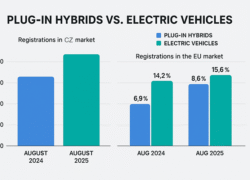
In August 2025, plug-in hybrid electric vehicles (PHEVs) overtook battery electric vehicles (BEVs) in the domestic passenger car market, according to the Association of Automobile Importers. While BEV registrations rose year-on-year from 781 to 840 units, PHEVs surged from just 47 in August 2024 to 948—a near twentyfold increase. As a result, PHEVs accounted for over five percent of new car registrations in August, while BEVs remained below that threshold.

Despite the August turnaround, BEVs maintain the upper hand for the year to date. By August 2025, EV registrations totaled approximately 8,800 units, versus around 6,800 for PHEVs. Škoda leads the PHEV segment with 1,310 units sold so far, followed by Hyundai, Toyota, Volkswagen, and Volvo, each with sales exceeding 500 units.

These domestic figures mirror broader European trends: From January to July 2025, PHEVs captured 8.6 percent of the EU market, up from 6.9 percent in 2024. BEVs held a larger share at 15.6 percent . Hybrid-electric vehicles (HEVs), which include non-plug-in hybrids, remained the most popular choice among EU consumers, commanding 34.7 percent of the market .

Historically, the EU has seen strong momentum in electrified vehicles. Hybrid and plug-in models continue to climb, while petrol and diesel car registrations have declined sharply—falling to under 38 percent combined, down from about 48 percent in the previous year . The rapid rise of EV sales has been notable too: over one million BEVs were registered across Europe by July, capturing a 15.6 percent share of the market .

In summary, while PHEVs dominated Polish dealerships in August—a reflection of shorter-term demand shifts—BEVs continue to show stronger cumulative growth, consistent with European patterns of gradual electrification. The marketplace remains fluid, with hybrids and fully electric models each playing a significant role in the transition.

Nearly half of ice cream and ice samples in Czech inspections fail hygiene tests

The Czech Agriculture and Food Inspection Authority (SZPI) reports that hygiene problems among ice cream sellers remain widespread, with nearly half of samples failing to meet safety standards. So far in 2025, 46 percent of tested scoop and draught ice creams have been rated unsatisfactory, continuing a trend observed in previous years.

Out of 146 ice cream samples inspected this year, 67 exceeded acceptable hygienic limits, according to SZPI spokesperson Pavel Kopřiva. Laboratory analyses found high levels of bacterial colonies, which can cause gastrointestinal problems. Inspectors noted recurring issues such as insufficient cleaning of machines, poor adherence to production processes, and inadequate staff training. A common malpractice involves sellers returning leftover ice cream to machines the following day instead of discarding it, leading to bacterial contamination.

The situation was no better for ice used in drinks. Of 53 samples examined, 30—57 percent—failed to meet standards. The main causes were poor hygiene practices and irregular disinfection of ice makers. Kopřiva emphasized that these problems have persisted over the long term without signs of improvement.

Inspectors typically target higher-risk establishments, though routine checks are also carried out at compliant businesses. Where violations are detected, authorities can ban equipment use, halt production, and require thorough sanitation followed by microbiological testing before sales may resume. Administrative proceedings for fines are also initiated against non-compliant operators.

Food safety concerns with ice cream are not unique to the Czech Republic. Similar issues have been reported across Europe. In Slovakia, the State Veterinary and Food Administration (ŠVPS SR) has also found high rates of hygiene violations in draught ice cream, with over 40 percent of samples failing in some regions in recent years. The European Food Safety Authority (EFSA) has repeatedly warned that inadequate cleaning of dispensing machines is one of the most common risk factors for bacterial contamination in frozen desserts and ice products.

While the SZPI stresses that its results are based on targeted, risk-based inspections rather than random sampling, the consistently high proportion of unsatisfactory findings suggests that many operators continue to underestimate the risks of poor hygiene in production, storage, and sales. According to food safety experts, maintaining strict sanitation routines and proper staff training remain essential for protecting consumer health.

Short-term rentals in Slovakia: Profitable but heavily regulated

Short-term rental of apartments through platforms such as Airbnb or Booking.com is becoming increasingly popular in Slovakia, offering significantly higher returns than traditional long-term leases. Yet, alongside the potential profits come administrative obligations, tax liabilities, and legal risks that many owners may underestimate.

Legal experts stress that tourist rentals are classified as business activities. “Short-term rental of real estate is considered a business and therefore requires a trade license or operation through a legal entity, most commonly a limited liability company,” said Erik Schwarcz of Fairsquare. Property owners are obliged to notify their local authority, register with the tax office, and comply with sector-specific regulations. Failure to do so may result in fines or, in cases of unauthorized business activity, even criminal proceedings.

Tax compliance is a particular focus of authorities. Since January 2023, platforms such as Airbnb and Booking.com have been obliged under EU’s DAC7 directive to share host revenue data with tax administrations across the European Union, including Slovakia. This measure was introduced to curb tax evasion in the short-term rental sector, which in cities like Bratislava and Košice has grown rapidly in recent years. Anyone offering short-term accommodation must file a tax return and pay income tax. In addition, accommodation tax is levied on each overnight stay, with rates set by municipalities. In Bratislava’s Old Town, for example, the fee is €3.50 per night, one of the highest in the country.

The issue of regulating short-term rentals is not unique to Slovakia. Across Europe, cities such as Amsterdam, Barcelona, and Berlin have introduced strict caps or permit systems to control the expansion of short-term lets, citing impacts on housing affordability and community cohesion. The European Commission has also implemented new rules (Regulation (EU) 2022/2065, the Digital Services Act) requiring platforms to ensure greater transparency for users and regulators.

In Slovakia, the debate continues between those who see short-term rentals as a “gold mine” and others who stress the risks and administrative demands. While higher yields are tempting, experts caution that proper licensing, tax compliance, and awareness of municipal rules are essential to avoid costly penalties.

Source: SITA

Brno issues final permit for second stage of Kamenný vrch housing project

The city of Brno has obtained a final building permit for the second stage of the cooperative housing development at Kamenný vrch II. Together with the previously approved first stage, this allows the city to launch the tender process for a contractor to build the entire project, which is budgeted at around CZK 2.3 billion. The development will deliver 334 apartments, and demand for the units remains strong, according to city officials.

Kamenný vrch is the city’s pilot site for cooperative housing, designed to provide a more affordable alternative to commercial residential projects. The scheme has faced delays of several years, but the current steps clear the way for construction. A public procurement process is already underway to secure technical supervision and occupational safety oversight, with bids accepted until 15 September. The contract for the general contractor will follow. Construction is scheduled to begin in spring 2026, with completion expected in 2029.

Interest in the project has been steady since applications opened in 2018. Of the initial 800 applicants, 206 remained active candidates earlier this year. A new application round, held between May and June 2025, attracted additional interest, and the city has confirmed there are now sufficient applicants to allocate the units, though registration remains open.

Brno is also preparing cooperative housing in other parts of the city. Planned sites include Aleja, Přízřenice, and the area bordered by Francouzská, Hvězdová, Bratislavská, and Stará streets. In addition, cooperative apartments are planned as part of a reconstruction project at Mostecká Street 16.

Source: CTK

front page info
LATEST NEWS