Polish enterprises report net profit of PLN 125.9 billion in first half of 2025

Enterprises in Poland employing at least 10 people recorded total revenues of PLN 2,998.1 billion in the first half of 2025, according to preliminary data released by Statistics Poland. Total costs reached PLN 2,845.7 billion, resulting in a net financial result of PLN 125.9 billion.

The survey covered 48,229 enterprises, of which nearly 63 percent were small businesses with 10–49 employees. Large enterprises, representing just over 8 percent of the total, accounted for 61.9 percent of revenues, generating PLN 1,856.7 billion. Medium-sized enterprises contributed 25.3 percent of revenues, while small enterprises made up 12.8 percent.

Employment among the surveyed entities stood at 5.6 million people as of June 2025, with large enterprises employing over 60 percent of this workforce. On average, a large entity employed 861 workers, compared to 109 in medium-sized firms and 23 in small enterprises.

The composition of revenues showed that 57.8 percent came from the sale of products, goods, and services, and 38.6 percent from goods for resale and materials. Financial revenues represented 2.0 percent. Costs were dominated by products and materials sold, accounting for 96.7 percent of total expenditure.

Gross financial results for the half-year amounted to PLN 152.4 billion, while obligatory charges totaled PLN 26.5 billion. Investment outlays reached PLN 99.5 billion, with large enterprises responsible for more than 70 percent of these expenditures.

Enterprises with majority foreign ownership, representing 16.5 percent of the surveyed population, played a significant role in the economy. These firms generated PLN 1,232.8 billion in revenues, equivalent to 41.1 percent of the total, and recorded a net profit of PLN 46.1 billion. They also accounted for 37.7 percent of all investment spending, with large foreign-owned entities driving most of these outlays.

The results underscore the continued dominance of large enterprises in Poland’s corporate landscape, both in terms of revenues and employment. At the same time, the data highlight the strong role of foreign-owned firms in revenues, investment, and profitability.

Czechia: Producer prices for business services rise in second quarter of 2025

Producer prices for business services in Poland rose by 0.5 percent in the second quarter of 2025 compared with the previous quarter, according to preliminary figures from Statistics Poland. On an annual basis, service prices increased by 3.6 percent compared with the second quarter of 2024.

The strongest quarterly increases were observed in security and investigation activities, where prices rose by 1.6 percent, and in employment services, which recorded a 1.1 percent increase. Real estate services, information services, management consultancy, and rental and leasing activities also saw price growth of 0.7 to 0.8 percent. By contrast, declines were recorded in travel agency and related services (down 1.0 percent), programming and broadcasting (down 0.5 percent), publishing (down 0.2 percent), and computer programming and consultancy (down 0.1 percent).

Year-on-year comparisons showed more significant changes. Prices for security and investigation services increased by 8.2 percent, while motion picture, video, and television production, along with sound recording and music publishing, saw growth of 6.1 percent. Services to buildings and landscaping rose by 5.2 percent. Smaller increases were recorded in rental and leasing activities (0.2 percent), architectural and engineering services including technical testing and analysis (2.5 percent), and advertising and market research (2.8 percent). Prices fell compared with a year earlier in programming and broadcasting services, which dropped by 4.5 percent, and in travel agency and tour operator services, which fell by 0.8 percent.

The data illustrate ongoing divergence between sectors, with demand pressures pushing up prices in areas such as security, media production, and building-related services, while tourism-related activities and broadcasting continue to face weaker conditions.

Stokado secures PLN 80 million financing to expand Polish self-storage portfolio

Stokado, the second-largest operator in Poland’s self-storage market, has secured PLN 80 million in debt financing from Bank Pekao S.A. The funding will partially refinance invested equity and support the company’s development projects in Kraków and Warsaw. Stokado is jointly owned by Redefine Properties (JSE: RDF), Griffin Capital Partners, and its founders.

Since its acquisition by Griffin Capital Partners and Redefine Properties in 2023, Stokado has expanded its operations through both acquisitions and new developments. Construction is already underway on two facilities in Kraków and one in Warsaw, with three additional projects scheduled to begin this year. The company has also built up a land bank for future developments.

“Developing our own facilities allows us to implement the standards and level of quality of which we are particularly proud,” said Pieter Prinsloo, CEO of Redefine Europe BV. “Our first development, launched in July 2024, will be the first self-storage building in Poland to receive BREEAM certification. Stokado’s goal is to become the market leader within the next five years, with a focus on Warsaw, Kraków, Wrocław, and the Tricity.”

Dieter Lobnig, Head of Investment Banking and Real Estate Financing at Bank Pekao S.A., highlighted the sector’s growth potential: “Our support reflects confidence in both Stokado’s strategy and in the self-storage segment, which continues to expand in response to customer needs. We are pleased to see the financing directed toward new projects in Kraków and Warsaw, in line with our strategy to back innovative and forward-looking investments.”

Stokado’s current projects emphasize sustainability and customer convenience. All facilities are designed to meet BREEAM standards and will offer 24/7 access, with fully contactless service and mobile app functionality.

“Capital providers are increasingly open to financing this asset class,” added Piotr Fijołek, Co-Managing Partner at Griffin Capital Partners. “Europe already has around 16.5 million sqm of self-storage space, while Poland has fewer than 200 facilities. This gap represents significant growth potential, and we are pleased to contribute to the sector’s development.”

Sonar Real Estate sells Cologne office building to Ashtrom Properties Germany

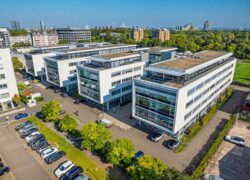
Sonar Real Estate has completed the sale of an office building in Cologne-Deutz to Ashtrom Properties Germany. The transaction was carried out on behalf of a pan-European property investment manager under an asset management mandate. The purchase price has not been disclosed.

The property, located at Siegburger Strasse 229c, was built in 2008 on a site of around 6,300 square metres. It offers approximately 8,500 square metres of rental space, of which 88 percent is offices and 12 percent warehouse space. The building is fully let to tenants including Omya GmbH, Grobecker engineering, and Vössing Ingenieure.

Advisors on the transaction included Clifford Chance and PwC for the seller, with K+L Gates acting for the buyer. Technical advice for Ashtrom Properties Germany was provided by ImoExperts Dr Kühne & Böker GbR, while Colliers served as the broker.

Garbe Industrial leases logistics space to shoe start-up Dieseo in Lensahn

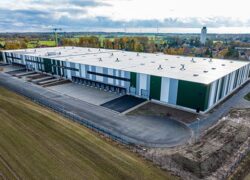
Garbe Industrial has leased approximately 11,600 square metres of logistics space in Lensahn, East Holstein, to the Kiel-based e-commerce start-up Dieseo. The company, known for its shoe brand Pammys, will use the facility for storage and distribution as it expands its product range and customer base, which now exceeds 700,000.

The logistics centre, completed at the end of 2023, provides a total of 23,400 square metres divided into two units. Dieseo has taken one unit on a long-term lease, while the remaining space is still available. The property is located near the A1 motorway, with connections north to the Fehmarn Sound Bridge and south to Hamburg, Bremen, and the Ruhr area. Future infrastructure developments, including the planned Fehmarnbelt tunnel to Denmark, are expected to further strengthen the site’s appeal.

The facility is equipped with 20 dock levellers, six ground-level sectional doors, 44 parking spaces, and sustainability features such as a 2.9 MWp rooftop photovoltaic system and a heat pump-based heating system. The building has been certified to the German Sustainable Building Council’s Gold Standard.

ProOptimum leases space at MLP Czeladź logistics park

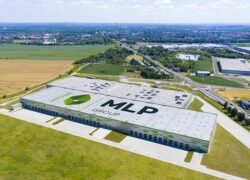
ProOptimum, a company active in logistics, warehousing, transportation, and visual identity design, has signed a lease agreement for more than 5,000 sqm of space at the MLP Czeladź logistics park. The deal was facilitated by advisory firm Rock Estate.

The lease will be delivered in phases. The first warehouse unit of just over 2,400 sqm is scheduled for handover in February 2026, with a second unit of similar size to follow a year later. An office area of 165 sqm is expected to be ready by mid-2026.

Located near major road connections, including the A4 motorway and the S1 and S86 expressways, MLP Czeladź is part of MLP Group’s development strategy to retain and manage logistics parks after completion. Once fully built, the site will include four Class A buildings providing more than 75,000 sqm of warehouse and production space on a 15.5-hectare site.

ProOptimum selected the location after reviewing multiple options, citing its accessibility and the ability to adapt the space to the company’s requirements. Rock Estate advised the tenant throughout the process.

Photovoltaics approved for unused industrial land in the Czech Republic

Beginning 1 January 2026, unused areas within industrial and logistics zones in the Czech Republic will be eligible for photovoltaic power installations under an amendment to the Building Act signed by the President this week. The change removes long-standing legal barriers that prevented the use of undeveloped plots in such zones for renewable energy projects.

If half of the identified potential is utilized, photovoltaic systems with a combined output of up to 1,000 megawatts could be installed—roughly equivalent to the capacity of one unit at the Temelín nuclear power plant. The measure is expected to contribute to the country’s decarbonization targets and aligns with EU policy on renewable energy acceleration zones, which encourage development within urbanized areas close to consumption points.

The amendment follows an initiative launched by Panattoni, supported by a study with Rota Group on agrovoltaics, which demonstrated that vegetation can be preserved under solar installations. Until now, one of the main barriers was uncertainty over whether photovoltaic panels should be counted as built-up area or green space, which created difficulties with zoning regulations. The new law clarifies that ground-mounted solar systems in industrial areas do not reduce the required share of greenery, provided vegetation is maintained beneath them.

Alongside open land, the law also explicitly allows the placement of photovoltaic systems on existing structures unless prohibited by local regulatory plans. These provisions bring Czech legislation into closer alignment with the EU’s RES Regulation and the RED III Directive, which highlight renewable energy as a matter of overriding public interest.

The changes are expected to strengthen the role of industrial zones in renewable energy production, enhance energy security, and reduce dependence on fossil fuels. They also form part of the largest push in recent years to unlock renewable capacity within already urbanized areas while preserving agricultural land.

Energy-efficient systems installed at Via Beroun school campus

The new Via Beroun campus, a private nursery and primary school scheduled to open in September, has been equipped with energy-efficient systems designed to reduce consumption and support sustainable operations.

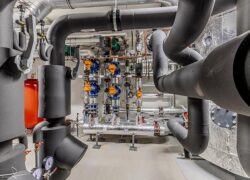
As part of the Central Bohemian Region’s largest energy performance contracting (EPC) project, the campus incorporates 33 circulation pumps from Wilo’s Stratos MAXO and GIGA series. These units manage water circulation for both heating and cooling via ceiling mats and adjust output according to the building’s current needs. The system is expected to contribute to lower energy use and reduced emissions.

The facility also includes Wilo’s rainwater management system, which supplies irrigation for green areas on the grounds, reducing reliance on drinking water. The campus is one of 162 regional buildings covered by the EPC project, which aims to achieve up to CZK 470 million in energy cost savings over ten years without direct budgetary investment.

Alongside its technical infrastructure, the Via Beroun school will feature classrooms, a multifunctional hall, canteen, and outdoor spaces, with the overall design intended to serve as a reference for future educational developments in the Czech Republic.

Analysis highlights price disparities in Poland’s commercial property market

Commercial property prices in Poland show significant variation depending on location, according to a new study by Dwell Properties. The analysis, based on nearly 1,000 listings, indicates that location, visibility, permitted business activities, and property size are among the key factors shaping values.

The study found that ground-floor high-street premises in central Warsaw, particularly in the Śródmieście district, can reach as much as PLN 35,000 per square meter, while in Bydgoszcz prices begin at around PLN 6,000. Average prices in Warsaw and Gdańsk are between PLN 13,000 and PLN 16,000 per square meter, compared to Kraków and Wrocław at PLN 12,000 to PLN 14,000. Mid-sized cities such as Poznań, Katowice, Szczecin, and Łódź recorded lower averages of PLN 9,000 to PLN 12,000.

The report also examined the difference between completed properties and those under construction. In Warsaw, Gdańsk, and Kraków, units under construction are priced slightly higher than completed ones, suggesting that upcoming projects in central or prestigious areas carry a premium. Conversely, in Wrocław and Łódź, completed units are more expensive, indicating that new supply is more often being developed on the outskirts at lower prices.

Location within the city remains the primary driver of value. In Warsaw, premises in Śródmieście command median prices of PLN 35,000 per square meter, compared with PLN 13,000–15,000 in outer districts. Gdańsk’s central properties range from PLN 12,000 to PLN 36,000, while the most exposed retail streets in Warsaw and Kraków can reach above PLN 50,000.

Visibility also plays a role: premises on street corners with double-sided display windows achieved around 3% higher prices than standard units. Properties suitable for catering businesses, with ventilation and required permits, were valued on average 10–15% higher than other commercial premises.

Proximity to major transport routes was another factor, with units on main thoroughfares priced 5–10% higher per square meter than those on smaller residential streets. The analysis also showed a negative correlation between size and unit price: smaller premises of 30–50 sqm tend to be more expensive per square meter than larger units, which are harder to lease to single tenants.

Rental trends mirror sales prices. Prime city-center locations in Warsaw can command rents of PLN 100–150 per square meter monthly, compared to PLN 20–50 in suburban areas.

According to Dwell Properties, these findings highlight the importance of location, exposure, and permitted uses in determining commercial property values, while also underlining the disparities between Poland’s largest cities and regional markets.

Photo: Marcin Kubik, CEO – Dwell Properties

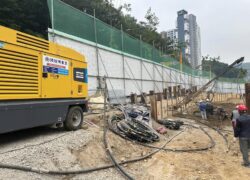
SamBaek construction deploys Atlas Copco X28 compressor for slope reinforcement in Gyeonggi Province

SamBaek Construction is using Atlas Copco’s X28 Stage V portable air compressor to support slope reinforcement and seismic retrofitting at a residential construction site in the Gosan 2 District of Gwangju, Gyeonggi Province. The project, which began in May 2025, involves building retaining walls to stabilize steep terrain ahead of new housing development.

The X28 model offers a pressure range of 16–30 bar (232–435 psi), making it suitable for applications such as earth anchors, nailing, rock bolts, micropiling, shotcrete, and groundwater development. According to the contractor, this versatility has allowed the company to carry out multiple phases of slope reinforcement with a single unit.

SamBaek Construction previously relied on rental compressors, typically with a capacity of 17–21 bar (247–305 psi) and a flow rate of 900 cfm (25.5 m³/min). These units often struggled with the granite-rich terrain in the area. The company purchased the X28 earlier this year after working with rented Atlas Copco equipment on earlier projects.

The unit is designed with noise-reduction features and a Stage V compliant engine, which make it suitable for use in urban and residential zones where environmental and regulatory requirements are strict. Fuel efficiency is supported by an ECO mode that reduces consumption during idle periods, which can account for several hours each working day.

Atlas Copco Korea’s Portable Air Division and Power Technique Service teams provided on-site training to SamBaek Construction staff, covering fuel-saving functions such as ECO mode and AirXpert. The company expects these features to help reduce overall operating costs while maintaining the pressure and flow required for slope reinforcement and seismic retrofitting.

front page info
LATEST NEWS