Sunday, 4 October 2026
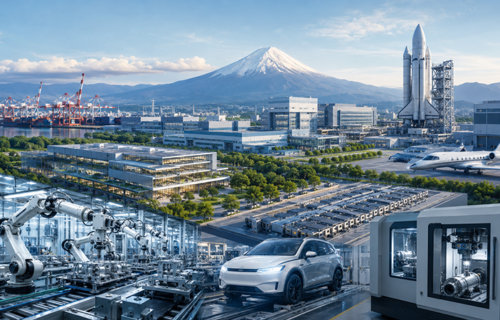
Japan’s manufacturing sector is entering a new phase of development as the country seeks to strengthen its position in advanced industry while responding to changing global supply chains and growing geopolitical uncertainty. Rather than relying solely on its traditional industrial strengths, Japan is reshaping its manufacturing corridors around high-value industries such as robotics, electric vehicle components, aerospace and precision engineering.
The objective extends beyond increasing factory output. Government policy is increasingly focused on creating integrated industrial ecosystems that combine manufacturing, research and development, skilled labour, universities and supporting infrastructure. These corridors are designed to improve innovation, strengthen supply chain resilience and attract long-term private investment into strategic industries.
This transformation forms part of Japan’s broader economic strategy, which aims to encourage investment across a range of priority sectors while supporting sustainable industrial growth over the coming decades.
Manufacturing Corridors Are Becoming Innovation Clusters
Japan’s industrial corridors have traditionally been developed around efficient transport networks, ports and logistics infrastructure. While these advantages remain important, the emphasis is shifting towards creating specialised clusters where manufacturers, research institutions and technology companies operate alongside one another.
These industrial ecosystems encourage collaboration between businesses and universities, accelerate technology development and allow companies to share highly skilled talent and specialised suppliers. As a result, manufacturing corridors are evolving into centres for innovation rather than simply locations for production.
For the real estate sector, this creates demand not only for industrial facilities but also for research campuses, technology parks, logistics centres, office space and residential developments that support a growing skilled workforce.
Robotics Is Supporting the Next Generation of Manufacturing
Robotics remains one of Japan’s greatest industrial strengths and is becoming an even more important part of its manufacturing strategy.
With one of the world’s oldest populations and a shrinking workforce, Japan faces increasing labour shortages across manufacturing and logistics. Automation is therefore becoming essential to maintaining industrial competitiveness while reducing dependence on manual labour.
Government policy increasingly supports the development of advanced robotics and artificial intelligence capable of performing both routine and highly specialised industrial tasks. These technologies are expected to improve productivity, enhance quality control and allow manufacturers to maintain production despite demographic pressures.
As robotics companies expand research and manufacturing activities, demand is growing for specialised industrial facilities and research environments capable of supporting advanced engineering and product development.
Strengthening the Electric Vehicle Supply Chain
Japan is also rebuilding its electric vehicle supply chain as global competition for battery production and critical minerals intensifies.
Rather than relying heavily on imported components, policymakers are encouraging greater domestic production of batteries and related technologies. The Ministry of Economy, Trade and Industry updated its Battery Industry Strategy in 2026, setting ambitious targets to expand domestic battery manufacturing capacity while significantly increasing the global competitiveness of Japanese battery producers over the next decade.
Government support includes financial incentives for battery manufacturing projects and continued efforts to strengthen domestic supply chains for strategically important components.
This investment is creating new opportunities for industrial real estate, particularly in regions capable of supporting battery production, advanced materials manufacturing and specialised logistics infrastructure.
Aerospace Is Emerging as a Strategic Industry
Japan is also expanding its ambitions in aerospace, recognising the sector’s importance for advanced manufacturing, precision engineering and future economic growth.
The government’s long-term industrial strategy identifies aircraft manufacturing, unmanned aerial systems, rockets, satellites and space technologies as priority industries. Growing international interest in commercial space activities and next-generation aviation is encouraging Japanese companies to strengthen domestic manufacturing capabilities across these sectors.
Recent partnerships between aerospace manufacturers and precision engineering companies illustrate the country’s efforts to develop highly specialised production capabilities while supporting innovation throughout the supply chain.
The expansion of aerospace manufacturing is expected to generate demand for advanced industrial facilities, testing centres, research laboratories and engineering campuses, further strengthening manufacturing clusters across Japan.
Industrial Growth Is Driving Regional Development
The reinvention of Japan’s manufacturing corridors extends well beyond factory construction. Large industrial projects create demand for transport infrastructure, utilities, housing, commercial property and community services, supporting broader regional economic development.
As companies establish research centres and advanced manufacturing facilities, surrounding areas benefit from increased employment, higher demand for residential property and the expansion of retail and service sectors. These developments also encourage further private investment, reinforcing the long-term competitiveness of regional industrial clusters.
This integrated approach reflects Japan’s objective of creating sustainable manufacturing ecosystems rather than isolated industrial estates.
A New Model for Industrial Competitiveness
Japan’s manufacturing strategy is no longer centred on competing through production volume alone. Instead, the country is focusing on industries where advanced technology, engineering expertise and innovation provide long-term competitive advantages.
By combining robotics, electric vehicle technologies, aerospace, precision engineering and research-driven manufacturing within integrated industrial corridors, Japan is creating a new model for industrial development that places equal emphasis on resilience, innovation and supply chain security.
For the real estate sector, this transformation represents a significant opportunity. Industrial land, research facilities, logistics infrastructure and technology campuses are becoming increasingly important as Japan builds the next generation of manufacturing clusters designed to support economic growth well into the future.
Source: © CIJ.World Japan Research & Analysis Team