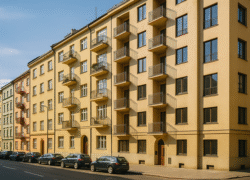
Geosan Development begins construction of Benkova Rezidence in Prague’s Chodov district

Geosan Development has commenced construction of the Benkova Rezidence project, a new residential development in the Chodov district of Prague. The project consists of two four-storey villa-style buildings that will offer a total of 40 apartments, ranging from one-room to four-room units. Nearly 75% of the apartments have already been sold ahead of the project’s completion, which is scheduled for spring 2027.

Benkova Rezidence is designed to integrate into the existing residential area in a quiet part of Prague 4. The development combines low-rise architecture with modern living standards, featuring a significant number of two-room and three-room apartments. Ground-floor units will include private gardens, while upper floors will offer balconies. The top floor will have terraces of up to 80 square metres, providing views of the surrounding greenery.

The architectural design focuses on simple, modern aesthetics, with building facades blending anthracite and light tones to harmonise with nearby structures. Green roofs are planned to enhance the local microclimate and contribute to environmental sustainability.

The apartments will feature vinyl flooring, large-format tiles, and energy-efficient windows and doors measuring 210 cm in height. Buyers will also have the option to customise their units through the developer’s client centre.

Located in an area with comprehensive amenities, Benkova Rezidence is close to schools, kindergartens, sports facilities, and Chodovská tvrz park. The Chodov metro station provides direct access to Prague’s city centre, and residents will have nearby access to supermarkets, bakeries, and cafés.

Jiří Baloun, Head of Sales and Marketing at Geosan Development, stated that the high level of pre-sales indicates continued demand for well-designed housing in accessible and attractive locations. He expressed satisfaction that the project aligns with the company’s vision of creating a harmonious and functional living environment.

International retailers select SES shopping centers for market entry

International retail brands are increasingly choosing shopping centers managed by SES Spar European Shopping Centers for their market launches in Central and Southeastern Europe. Recent developments in Austria and Slovenia illustrate this trend, with several prominent brands opting for SES locations due to their high footfall, accessibility, and diverse retail offerings.

In Slovenia, KIKO Milano and Fashion&Friends are set to open their first stores exclusively in SES-managed shopping centers. KIKO Milano will debut at EUROPARK Maribor in July and expand to CITYPARK Ljubljana in the autumn. Fashion&Friends, operated by Fashion Company, a leading fashion retailer in Southeast Europe, will open its first Slovenian store in CITYPARK Ljubljana later this year.

In Austria, the international retail concept HIGGINS is preparing to launch its first store globally at HUMA ELEVEN in Vienna. The new 500 square meter store, opening at the end of August, will offer a range of streetwear, sneakers, accessories, and lifestyle products for all ages, featuring brands such as Puma, Under Armour, Levi’s, JDY, and the HIGGINS private label.

Christoph Andexlinger, CEO of SES Spar European Shopping Centers, noted that the company’s shopping centers continue to attract international retailers seeking strong market entry points. He emphasized that SES focuses on high-quality standards and customer needs, creating conditions that support successful retail operations.

SES operates as a developer, builder, and manager of shopping centers in six Central European countries: Austria, Slovenia, Italy, Hungary, Croatia, and the Czech Republic. The company manages 31 shopping centers with a total leasable area exceeding 855,000 square meters. In 2024, SES shopping centers recorded more than 117 million visitors, generating a total sales turnover of €3.54 billion. The company also offers development, construction, leasing, and management services to external shopping center owners and has received numerous national and international awards for architecture, sustainability, and innovative marketing. SES is part of the SPAR Austria Group.

Photo: Christoph Andexlinger, CEO SES Spar European Shopping Centers

NEPI Rockcastle expands renewable energy capacity with 54.1 MW solar park in Romania

NEPI Rockcastle plans to increase the share of self-generated renewable energy supplying its shopping centres and tenants in Romania to 48% of their electricity demand by the end of 2026, up from 6% at the end of 2024. The company is constructing a new 54.1 MW solar park in western Romania as part of a €110 million investment programme, which represents the largest green energy commitment to date by a non-energy corporate across Central and Eastern Europe.

The solar park, located in Chișineu-Criș in Arad County, began construction in January 2025 and is expected to be connected to the grid in the fourth quarter of the year. Once operational, the facility will account for roughly a third of NEPI Rockcastle’s planned total photovoltaic capacity of 159 MW, encompassing rooftop and ground-mounted installations across 28 properties and various greenfield projects.

LONGi Solar, a major global manufacturer of photovoltaic panels, supplied 84,000 Hi-MO 9 back contact (BC) modules for the project. These panels, with a module efficiency of 24.8% and enhanced thermal performance, are designed for high energy yield and low maintenance, suited to Romania’s climate conditions.

Andrei Radu, Group Development Director at NEPI Rockcastle, stated that the company’s renewable energy programme is progressing in stages as part of its broader sustainability and decarbonisation strategy. He explained that the €110 million investment includes photovoltaic installations across 23 properties in Central and Eastern Europe and greenfield developments in Romania. Radu noted that partnering with LONGi for the Chișineu-Criș solar park supports NEPI Rockcastle’s goal of increasing renewable energy use and energy autonomy across its retail portfolio.

The project is being delivered through SOLPOWER Energy, with engineering and construction services provided by Enevo Group. It represents the largest utility-scale solar development in Romania focused on retail infrastructure.

The Chișineu-Criș solar park is expected to generate approximately 70,171 MWh of electricity annually, sufficient to supply power to around 29,300 Romanian households and offset an estimated 21,100 tonnes of CO₂ emissions each year.

Mirel Jarnea, Country Manager Utility Scale Business Unit at LONGi, highlighted the role of BC technology in improving performance and ensuring energy stability for large-scale projects like NEPI Rockcastle’s operations in Romania. Eduard Meiloiu, Executive Director Renewables BU at Enevo, emphasised the benefits of the technology, citing higher efficiency, improved thermal performance, and long-term reliability, all of which contributed to delivering a project tailored to local conditions and aligned with Romania’s sustainability targets.

In addition to its environmental benefits, the Chișineu-Criș project has contributed to the local economy in Arad County by creating over 100 jobs and involving regional contractors during the construction phase, demonstrating the broader socio-economic impact of renewable energy investments.

Central Point office building in Warsaw secures renewable energy agreement

CP Development has signed a physical Power Purchase Agreement (PPA) for renewable energy supply for its Warsaw office building, Central Point, with advisory support from Colliers. Colliers provided services including market analysis, selection of the appropriate purchase model, and assistance with negotiation and implementation of the PPA contracts. The energy will be supplied and balanced by e.ON Polska.

The green energy for Central Point will come from two photovoltaic farms with capacities of 868 kWp and 998 kWp. This initiative places CP Development among a growing number of investors committed to reducing carbon emissions from their assets.

Mariusz Szymoński, manager of Central Point at Colliers, noted that PPAs are gaining traction in the real estate sector due to their ability to generate operational cost savings, support compliance with environmental reporting requirements, and enhance property value.

Beyond PPAs, property owners have several options for reducing carbon emissions, such as installing LED lighting, sealing ventilation ducts, implementing photovoltaic systems and heat recovery solutions, or undertaking comprehensive HVAC and thermal upgrades. Colliers conducts audits and analyses to identify which measures are suitable for specific properties.

Dariusz Chrzanowski, Director of Energy Services at Colliers, explained that the decarbonisation process involves multiple stages, including audits, strategic planning, and implementation. He also highlighted the availability of public funding, which can cover up to 75% of eligible costs, as an incentive for investors to pursue comprehensive sustainability improvements. Colliers provides guidance to property owners and managers throughout each stage of this process.

Central Point is a 21-storey building offering 18,000 square metres of office space and over 1,000 square metres of retail and service areas. Situated in the city centre at the intersection of Świętokrzyska and Marszałkowska streets, it is surrounded by significant landmarks such as the Palace of Culture and Science and the PAST building, as well as restaurants, hotels, and various cultural and sports facilities. The location benefits from extensive public transportation links, including the metro, trams, buses, and proximity to the Central Station and Warszawa Śródmieście suburban railway station.

The building was developed to high sustainability standards, earning a BREEAM Excellent certificate. It includes features such as electric vehicle charging stations, bicycle facilities with parking, changing rooms and showers, and optimised natural light access to support comfortable working conditions.

Hebe to open store in SOHO by Yareal Development in Warsaw

Yareal Polska has announced that Hebe, the retail chain owned by Jeronimo Martins, will become a tenant in the SOHO by Yareal mixed-use development currently under construction in Warsaw’s Kamionek district. The new Hebe store, covering over 320 square metres, will be located on the ground floor of the SOHO 10 building and is scheduled to open in the first quarter of 2026.

Hebe, present in Poland since 2011, offers a broad range of cosmetics and personal care products, including exclusive brands and an extensive selection of natural, Korean, Japanese, and professional cosmetics. The brand operates more than 370 stores nationwide, in both large cities and smaller towns, as well as online. The new location at SOHO by Yareal will expand Hebe’s presence in Warsaw’s Praga-Południe district.

The SOHO 10 building, situated on Żupnicza Street, is designed as part of the broader SOHO by Yareal project. The building will feature contemporary architecture with references to Kamionek’s industrial heritage, including a white façade with geometric patterns and corten steel accents in the ground-floor arcade areas. SOHO 10 is a residential building arranged in an inverted L-shaped layout, ranging from four to nine storeys, and forms part of an urban block alongside the NEFRYT apartment building, creating an internal courtyard landscaped with greenery. The building also adjoins a tree-lined square connected to a linear park, a central feature of the SOHO by Yareal master plan. Patrycja Włodarczyk of Homest participated in facilitating the lease transaction for Hebe’s new premises.

Paulina Petynka, Commercial Leasing Director at Yareal Polska, noted that the inclusion of Hebe aligns with the project’s strategy to provide a comprehensive range of services and retail offerings for residents and the surrounding community. She highlighted the balance between unique local concepts and well-known retail chains that SOHO by Yareal aims to deliver.

SOHO by Yareal is conceived as a modern local hub, integrating residential, commercial, recreational, and office spaces, all designed according to the principles of the 15-minute city concept. The development combines renovated post-industrial buildings with new construction, aiming to create a cohesive urban environment. Features such as a linear park, landscaped courtyards, terraces, and pedestrian-friendly areas promote community engagement and limit car traffic.

The project will ultimately provide over 11,300 square metres of retail and service space across multiple locations, including ground floors of residential buildings and renovated historic structures. Existing tenants and planned additions to the complex include a kindergarten, a playroom, a Carrefour store in the ‘300’ format, cafés, beauty salons, a flower shop, a bakery, and an architectural studio. Following Hebe’s opening in early 2026, Green Caffè Nero is expected to open in May 2026, and later that year, a food hub will launch in the historic building No. B.56, featuring food concepts such as Bułkę przez Bibułkę, Pollypizza Neopolitan, and Baken.

The development is progressing with ongoing renovations of historic structures and the completion of the final residential phase, including SOHO 10 and the NEFRYT building, which is expected to be finished by the end of 2025.

Services production declines slightly in April across Euro area and EU

Services production in both the euro area and the European Union decreased by 0.3% in April 2025 compared with March, according to preliminary estimates from Eurostat, the statistical office of the European Union. This decline follows growth in March, when services production rose by 0.8% in the euro area and by 0.7% in the EU.

Despite the monthly decline, services output in April 2025 remained higher than a year earlier. Compared with April 2024, production increased by 0.7% in the euro area and by 1.1% in the EU.

Within the euro area, month-on-month results varied by sector. Transportation and storage grew by 0.4%, and accommodation and food services rose by 1.1%. However, production fell in information and communication by 1.9%, in real estate activities by 0.5%, and in administrative and support services by 0.4%. Professional, scientific, and technical activities saw a modest increase of 0.2%.

In the wider EU, transportation and storage grew by 0.4%, while accommodation and food services rose by 1.0%. Declines were recorded in information and communication, down 1.5%, and real estate activities, down 0.1%. Professional, scientific, and technical activities rose by 0.5%, while administrative and support services decreased by 0.2%.

Among EU member states, the sharpest monthly declines were reported in Denmark, where services production fell by 2.1%, Slovenia with a 1.3% decrease, and Hungary with a 1.2% drop. Conversely, the strongest gains were recorded in Greece, up 4.6%, Luxembourg, up 3.9%, and Slovakia, up 2.2%.

Over the year, results were more positive. In the euro area, production remained stable for transportation and storage but increased in accommodation and food services by 2.8%, information and communication by 2.1%, real estate activities by 1.3%, and professional, scientific, and technical activities by 0.1%. Administrative and support services experienced a slight decrease of 0.2%.

Across the EU, annual figures showed increases in transportation and storage by 1.5%, accommodation and food services by 2.6%, information and communication by 2.0%, real estate activities by 0.9%, professional, scientific, and technical activities by 0.6%, and administrative and support services by 0.1%.

On an annual basis, Greece reported the strongest growth among member states with an 11.9% increase in services production, followed by Denmark at 8.1% and Lithuania at 7.9%. The largest declines were recorded in Malta, down 2.9%, Slovenia, down 2.0%, and both Bulgaria and Austria, which saw decreases of 0.8%.

Source: eurostat

Media Expert leases space at MLP Poznań logistics centre

Media Expert, Poland’s largest retailer of consumer electronics and household appliances, has leased more than 4,200 square metres of space at the MLP Poznań logistics centre. The company is set to begin operations at the new location in early July 2025. Cushman & Wakefield advised Media Expert during the leasing process.

The leased area includes approximately 4,000 square metres designated for warehousing and 180 square metres allocated for office and staff facilities. The warehouse, built a few years ago, meets high technical standards and features a practical layout and numerous loading docks on both sides of the building, supporting efficient cross-docking operations and reduced delivery times.

Media Expert operates over 600 physical stores across Poland and maintains a significant online presence through its website. Michał Mystkowski, spokesperson for Media Expert, stated that the new facility at MLP Poznań will enhance the company’s logistics capabilities, enabling faster and consolidated deliveries and improving customer service in Poznań and the Greater Poland region. He emphasised the importance of efficient logistics in supporting the company’s omnichannel strategy and maintaining competitiveness.

Tomasz Pietrzak, Leasing Director Poland at MLP Group S.A., noted that Media Expert’s decision to lease space at the MLP Poznań centre reflects the strategic advantages of the location, which is situated near the S11 expressway and approximately four kilometres from the A2 motorway, offering strong access to major transport routes across Poland.

Paulina Machałowska, Associate in the Industrial & Logistics Agency at Cushman & Wakefield, highlighted the successful collaboration between MLP Group and Media Expert, resulting in a lease agreement tailored to support transshipment operations.

Upon completion, the MLP Poznań development will offer around 90,000 square metres of warehouse and production space on a 19.2-hectare site. The project is part of MLP Group’s long-term “build & hold” strategy, ensuring that developments remain in the company’s portfolio and are managed directly, providing tenants with stable, high-quality infrastructure and ongoing operational support.

Alnatura to open Germany’s largest organic supermarket in Tübingen’s Depot Areal

Catella Investment Management GmbH (CIM) and its AIFM platform Catella Real Estate AG have concluded a long-term lease agreement with Alnatura for approximately 2,000 square meters of retail space in the Depot Areal retail park in Tübingen. The new Alnatura store, expected to open in early 2026, will become the largest organic food supermarket in Germany by floor area. The Depot site, which encompasses around 10,279 square meters of lettable space, was acquired in 2020 for the open-ended real estate special fund “IWS II – Wirtschaftsregion Süddeutschland.” The lease agreement has a 15-year term.

Alnatura, already operating in the retail park, will relocate to the new premises, effectively doubling its space. This expansion will enable the retailer to broaden its range of organic products available to customers in Tübingen. The planned supermarket will include larger sales areas, an open façade, and both indoor and outdoor seating. Sustainable features will include heating and cooling provided by a heat pump system and energy-efficient LED lighting. Additionally, Alnatura stores are powered entirely by green electricity sourced from wind and solar energy in Germany.

Michael Keune, Managing Director of Catella Investment Management, stated that Alnatura’s decision to lease a larger space underscores the attractiveness of the Depot location and contributes significantly to the continued development of the site. He added that the project aligns well with Tübingen’s focus on ecological and sustainable urban development.

Lucas Trenciansky and Valentin Fuchs, who oversee expansion and real estate at Alnatura, expressed enthusiasm for the project, noting that the new store at the Depot Areal will mark a significant milestone for the company and support its ongoing growth.

German logistics property market returns to pre-pandemic levels in early 2025

The German logistics real estate market recorded approximately 1.7 million square metres of new construction in the first half of 2025, marking its lowest half-year result in five years, according to figures released by consultancy Logivest. The data reflects projects as measured from the date of their ground-breaking ceremonies.

In the first quarter, new logistics space reached around 850,000 square metres, with the second quarter contributing just under 830,000 square metres. Logivest noted that while recent years saw half-year volumes exceeding two million square metres, the current level aligns with figures last observed before the COVID-19 pandemic. “We have simply returned to pre-coronavirus levels,” said Kuno Neumeier of Logivest, adding that the market is facing significant competitive pressure due to approximately three million square metres of grey market supply and more than eight million square metres of vacancies in existing properties.

Swabia emerged as the leading logistics region for the first half of 2025, a notable change from its usual position in the lower tier. The region recorded around 210,000 square metres of new space, already more than double its result for all of 2024. A significant driver was Dietz AG’s built-to-suit project in Langenau, delivering about 63,000 square metres for the winkler group. Additionally, Frasers Property Industrial’s speculative development in Günzburg, comprising around 50,000 square metres across several halls, contributed to Swabia’s rise.

Berlin ranked second among logistics regions, reporting approximately 190,000 square metres of new space, nearly doubling its 2024 figure. Major projects include the Panattoni Park Berlin Ost II in Grünheide, offering around 55,000 square metres, and MLP Group’s speculative development in Spreenhagen with nearly 35,000 square metres. Duisburg/Lower Rhine placed third with about 175,000 square metres, featuring the MLP Business Park Schalke as the largest single development in both the region and the country, covering nearly 72,000 square metres.

While Munich and Mitte D fell out of the top ten, the Upper Rhine region maintained its position in the upper tier, driven by Logad GmbH’s project in Neuenburg for Swiss online retailer Galaxus, adding around 65,000 square metres and expanding Galaxus’s total site to approximately 90,000 square metres.

The light industrial sector showed notable growth, reaching approximately 310,000 square metres in the first half of 2025, an increase compared to the previous year. The largest light industrial project is a 50,000 square metre facility developed by Körber Technologies in Hamburg. Logivest began tracking the light industrial segment in 2024 to reflect its growing significance in the market.

Neumeier observed that the rise in light industrial developments indicates Germany’s sustained attractiveness as a production location. However, future trends will depend on global economic conditions and policy decisions at both national and European levels.

Historic Brno Building undergoing transformation into Rezidence Korngold

A historic building near Moravské náměstí in Brno is being redeveloped into Rezidence Korngold, a project led by Brode Capital. The renovation of the structure, which dates from the turn of the 19th and 20th centuries, will create modern residential units and a retail space. The development is named after composer Erich Wolfgang Korngold, a Brno native who was born in the building in 1897.

Located at the corner of Koliště and Lidická streets, the building is being comprehensively renovated to include 37 apartments ranging from studios to three-room units, with sizes between 27 and 98 square metres. Each apartment will feature air conditioning and a storage unit. The project also includes a commercial unit and three duplex apartments added in newly constructed upper floors, offering views of Brno’s historic centre. More than half of the units have already been sold.

Erich Wolfgang Korngold, born in this building, was recognised early for his musical talent and later became a significant figure in film music in Hollywood, earning an Academy Award for his work. A commemorative plaque by sculptor Milivoj Husák marks the building at Koliště 1. The decision to name the development after Korngold was supported by his granddaughter as a way to preserve his legacy in Brno.

Brode Capital, the developer behind the project, has experience with residential developments in Brno, including the award-winning Rezidence U Vaňkovky. Zdeněk Lust, a member of the board at Brode Capital, stated that the aim was to create a project that respects the building’s history while providing functional urban housing.

The architectural design by Michal Kristen focuses on preserving original historical details while integrating modern technology and comfort. Construction is being carried out by JB Stavební, part of the Swietelsky group, with the total investment estimated in the low hundreds of millions of Czech crowns.

Rezidence Korngold is situated in an area with convenient access to cultural venues, public amenities, and key urban infrastructure, including the Janáček Theatre and St. Thomas Church. Construction began in September 2024, with completion and occupancy scheduled for April 2026. The development will offer modern living in central Brno for individuals, couples, and families seeking quality housing in a location with historical significance.

front page info
LATEST NEWS