Saturday, 19 September 2026
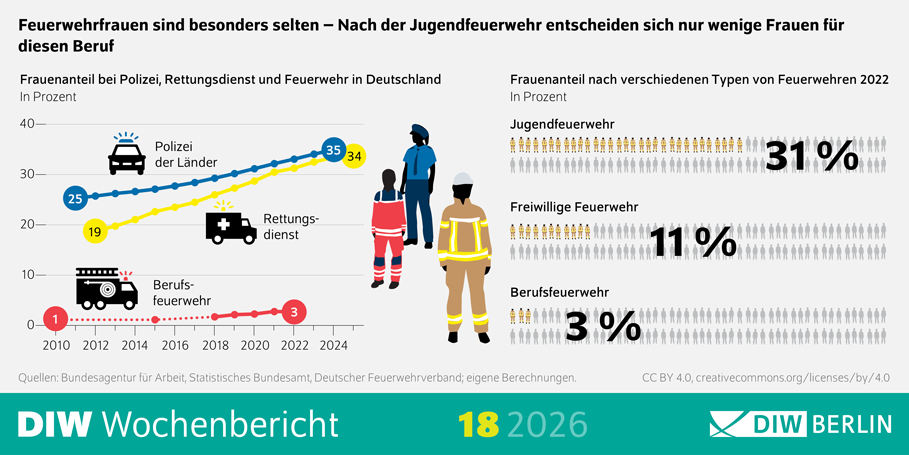
Women remain underrepresented across first responder professions in Germany, particularly in the fire service, according to research by German Institute for Economic Research (DIW Berlin). Data analysed by the institute shows that female participation typically does not exceed one-third of the workforce in police and emergency medical services, and is significantly lower in firefighting roles.
Recent figures indicate that women account for around 34 percent of ambulance service personnel, approximately 28 percent in the Federal Police, and about 35 percent across state police forces. In contrast, the proportion in the professional fire service is around three percent, with volunteer fire services reaching roughly 11 percent.
The study highlights a notable gap between early engagement and long-term participation. While girls represent about 30 percent of youth fire service members, this share declines sharply in adult and professional ranks. According to the authors, this suggests the presence of structural or institutional barriers affecting career progression within the sector.
The research identifies several contributing factors. Entry requirements, including technical qualifications or academic backgrounds, may limit access, particularly given the lower share of women in relevant fields of study. Recruitment processes, such as standardised aptitude testing, are also cited as potential constraints. In addition, equipment and working conditions have been identified as areas that may not be adequately adapted.
The report also considers workplace risks and job demands, noting that while first responder roles generally involve exposure to stress and risk, these factors alone do not explain the variation in female participation across different services.
Beyond equality considerations, the findings are linked to labour market pressures. First responder professions in Germany face ongoing staffing challenges, and the report points to the low participation of women as a potential source of untapped labour supply.
The authors suggest that reviewing entry pathways, addressing structural barriers and improving outreach could support broader participation. Measures such as targeted information campaigns and initiatives aimed at increasing visibility are also identified as potential steps to encourage more women to enter these professions.