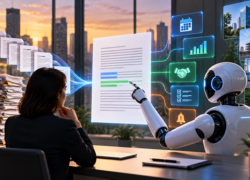
Artificial intelligence is beginning to transform contracts from documents that are signed and stored into active sources of business intelligence. For decades, the digitalisation of agreements concentrated primarily on making them easier to create, send and sign. The next phase is increasingly focused on what happens before and after the signature, with AI being used to interpret contractual language, identify obligations, compare terms, monitor renewals and support decisions throughout the life of an agreement.
That transition was at the centre of a discussion at AI4 2026 with Docusign Vice President of AI Tabriz Mohammed. Docusign is moving beyond the electronic-signature business for which it became widely known and towards intelligent agreement management, where AI can help organisations understand what their contracts contain and act on that information.
The opportunity is significant because contracts contain some of the most commercially important information within a business. Pricing, commitments, renewal dates, service requirements, termination conditions, liabilities and other obligations are frequently contained within agreements that become difficult to analyse once they have been signed. Large organisations can hold thousands of supplier, customer, employment, financing and property-related contracts while still depending on employees to open individual documents to determine what they contain.
AI could change this by converting contractual language into information that can be searched, compared and connected with other business systems. Instead of becoming dormant after signature, an agreement could remain part of an active information system throughout its commercial life.
A supplier contract provides a straightforward example. A company may need to know when an agreement renews, whether particular service commitments have been fulfilled, whether the agreed pricing remains competitive and whether the supplier’s performance justifies extending the relationship. Answering those questions traditionally requires employees to combine information from the contract with procurement systems, emails and operational records.
An AI-based agreement platform could increasingly perform much of that preparatory work. As a renewal approaches, it could identify the relevant contractual provisions, connect them with information about the commercial relationship and prepare an assessment for the person responsible for renegotiating the agreement. Contract management consequently starts moving towards continuous commercial monitoring rather than periodic document review.
The same approach can be applied before contracts are signed. A company considering a new agreement may want to understand how its clauses compare with previous contracts, whether particular provisions create additional risk or whether the proposed terms depart from established company policies. AI makes it possible to perform these comparisons across much larger collections of documents than could realistically be reviewed manually.
The objective is therefore becoming much more sophisticated than simply summarising a lengthy contract. An AI system could potentially compare a new document with hundreds or thousands of agreements already held by the organisation and identify differences that deserve attention. This gives individual clauses a broader commercial context.
That context is important because contractual language cannot always be interpreted in isolation. The significance of a provision depends on the company signing the agreement, its previous negotiations, existing obligations and the commercial relationship involved. A general-purpose AI model may understand the language of a contract without automatically understanding those organisational circumstances.
This is where specialised enterprise AI platforms could develop an advantage. Many companies can access similar foundation models, but competitive differentiation increasingly comes from the proprietary information connected to those models, the quality of the underlying workflows and the reliability with which AI can operate on the data.
For Docusign, its position within agreement workflows provides access to a particularly valuable domain. It also creates substantial responsibilities because contracts are among the most sensitive documents held by companies. They can contain confidential pricing, customer information, employment details, strategic commitments and commercially sensitive legal provisions.
Data protection therefore becomes central to the development of agreement intelligence. During the AI4 discussion, Mohammed described a multi-layer process for removing identifying information from contracts while retaining enough of their structure to make the resulting information useful for model development. The challenge is to protect sensitive information without eliminating the context that gives the data its value.
Accuracy is equally important. Legal and commercial agreements are particularly unforgiving environments for generative AI. An inaccurate consumer recommendation may be inconvenient. An AI system that invents a contractual provision, overlooks an obligation or incorrectly interprets a termination clause can create significant financial or legal consequences.
Docusign’s approach consequently combines large language models with other machine-learning and information-extraction techniques rather than treating every contract as an unrestricted generative AI problem. Information can be extracted and checked before being used by a model for broader analysis.
The company is also placing emphasis on citations and verification. This could become particularly important as AI agents begin performing more complex work. Producing an answer is relatively easy; allowing the user to understand how the system reached that answer is considerably harder.
If an AI agent analyses hundreds of pages of agreements and recommends whether a contract should be renewed, an employee may need to see which documents were examined, what information was extracted and which contractual provisions support the recommendation. Enterprise AI therefore increasingly requires something resembling an audit trail.
This may become one of the fundamental differences between consumer and enterprise AI. Consumers can sometimes tolerate probabilistic answers because the consequences of occasional mistakes are limited. Businesses frequently need conclusions that can be reviewed, challenged and defended, particularly when financial or legal obligations are involved.
The requirement becomes even more important as AI moves from providing information towards taking action. Docusign has deliberately constrained the authority available to its agents during the early development of its platform. Higher-risk actions continue to require human involvement rather than allowing agents unrestricted authority over customer environments.
The principle is that an AI agent should generally operate within the permissions available to the user directing it. This limits the potential consequences if the agent makes an error or is manipulated. Instead of giving the AI broad system-level authority, its ability to access information and perform actions can be restricted to what the relevant employee would ordinarily be permitted to do.
Agentic AI therefore introduces a new dimension to enterprise security. Traditional cybersecurity controls what users and applications can access. AI agents add another problem because software can independently decide which actions to take within those permissions.
Companies consequently need to manage both access and autonomy. An agent could be permitted to read a contract without being able to change it. It could prepare a renewal recommendation while requiring human approval before initiating negotiations. It could draft an agreement without having permission to send or sign it.
These distinctions will become increasingly important as AI progresses from interactive assistants towards semi-autonomous systems. Docusign is already seeing customers move beyond simple conversational interactions towards workflows in which agents can be activated by events occurring elsewhere within the organisation.
The progression towards autonomy is likely to be gradual. AI may initially help employees understand an agreement, then prepare a proposed action and eventually execute selected parts of a workflow with approval. Some lower-risk activities could ultimately operate with limited human involvement, while consequential contractual decisions are likely to retain human oversight for considerably longer.
Another important lesson from Docusign’s development process concerns the technology architecture behind agent platforms. Mohammed explained that the company initially used existing agent frameworks and foundation models rather than attempting to build every component internally. Components could then be modified or replaced when problems involving accuracy, information loss or cost became apparent.
This modular approach is increasingly important because AI technology is evolving exceptionally quickly. A model or framework selected today may no longer be the best choice several months later. Companies that build their systems around interchangeable components may therefore have greater flexibility than organisations that become dependent on a single model or provider.
Model selection also has significant financial consequences. Using the largest and most powerful model for every task can make an AI platform unnecessarily expensive. Complex reasoning may require a sophisticated model, while simpler extraction or classification tasks can potentially be handled by smaller and cheaper systems.
Docusign therefore uses different models depending on the work being performed. This reflects a wider change taking place across enterprise AI, where optimisation increasingly means matching the cost and capability of a model to the specific task rather than automatically using the most powerful system available.
The economics are particularly important for agentic applications because their costs can behave differently from conventional software. Traditional software expenses are relatively predictable through licences, infrastructure and employee costs. An AI agent can generate variable expenses according to how frequently it operates, how many model calls it makes, how much information it processes and how long individual tasks continue.
A highly successful AI product could therefore become unexpectedly expensive if usage expands faster than its underlying architecture can economically support. Monitoring the cost of individual AI actions becomes part of product engineering rather than simply a financial exercise.
Docusign says it analyses model consumption at both the individual tool level and across complete user sessions. The company is also using prompt optimisation and different model sizes to reduce inference expenses. The precise savings discussed during the AI4 presentation are company-reported results, but the broader principle is increasingly relevant across the industry.
AI economics are becoming part of product design. Companies building agent platforms need to determine not only whether an application works but whether it can operate reliably and profitably at scale.
This could create substantial differences between enterprise AI providers. Two products may appear almost identical to users while having very different economics underneath because one platform requires significantly more model processing to deliver the same result.
Companies with large proprietary datasets and clearly defined specialist applications may have an advantage. Domain knowledge can allow smaller or more specialised systems to perform tasks that might otherwise require expensive general-purpose models. Specialisation therefore has the potential to improve both accuracy and economics.
The larger opportunity surrounding agreement intelligence is relatively straightforward. Contracts can effectively be viewed as databases written in prose. They contain enormous quantities of operational information, but historically that information has required people to interpret it manually.
Once AI can reliably convert contractual language into usable information, agreements can begin interacting directly with the rest of an enterprise. A renewal date can trigger a workflow. A pricing provision can feed financial planning. A supplier obligation can be compared with operational performance. A termination clause can generate an alert. A proposed agreement can be automatically compared with established corporate standards.
Contract management then stops being primarily a document-storage problem and starts becoming part of the company’s operational infrastructure.
The implications extend well beyond Docusign and the legal profession. Commercial property businesses, for example, operate through large volumes of leases, construction contracts, financing agreements, facility-management contracts, acquisition documents and supplier agreements. Large property portfolios can contain thousands of contractual obligations distributed across different assets, systems and jurisdictions.
Continuous AI analysis could eventually change how investors and asset managers monitor lease expiries, break options, rent indexation, service obligations, contractual deadlines and counterparty risks. Instead of employees periodically searching individual agreements, information could increasingly be surfaced automatically when it becomes commercially relevant.
Similar opportunities exist across procurement, banking, insurance, employment and supply chains. In each case, the challenge is no longer simply teaching AI to read documents. It is creating systems that understand information within organisational context, connect it with other enterprise data, operate within clearly defined permissions and provide evidence supporting their recommendations.
The combination of intelligence, governance and auditability will ultimately determine how much autonomy businesses are prepared to give AI agents. The most successful enterprise agents may therefore not be systems given unrestricted authority to run corporate processes. They are more likely to be carefully constrained digital workers that understand organisational context, operate within defined boundaries and can demonstrate why they reached a particular conclusion.
Contracts provide an unusually demanding environment in which to develop this model because they are complex, sensitive and financially consequential. If agentic AI can operate reliably within agreement management, many of the same principles could eventually spread across other parts of enterprise software.
The result could fundamentally change the role of business documents. Instead of simply recording decisions after they have been made, contracts could become active sources of information influencing decisions throughout their entire lifecycle.
For Docusign, this represents a much larger opportunity than electronic signatures alone. For the broader enterprise technology market, it offers an early indication of how AI agents could transform static corporate information into continuously usable business infrastructure.
Source: CIJ.World Research & Analysis Team