Czech Inflation Near Target Keeps Property Financing Outlook Cautious

Czech inflation remained close to the central bank’s target in August, but persistent underlying price pressures suggest property investors and developers should not expect significantly cheaper financing in the near term. Consumer prices increased 1.9% year-on-year, compared with 1.7% in July, while prices rose 0.3% month-on-month.

The August result leaves headline inflation slightly below the Czech National Bank’s 2% target. The increase was driven mainly by fuel prices, while falling food prices partly offset the upward pressure. Preliminary estimates also indicate that core inflation eased marginally to 2.9%, from 3% a month earlier.

For the Czech property market, however, subdued headline inflation does not automatically translate into lower borrowing costs. The CNB kept its two-week repo rate unchanged at 3.75% in August, with all seven members of the Bank Board supporting the decision. The central bank continues to view domestic inflation risks as elevated, pointing particularly to services prices, wage growth, expanding credit and property-price increases.

The central bank’s latest forecast reinforces the prospect of relatively stable financing conditions rather than another immediate easing cycle. It expects average inflation of 2% in 2026 and 2.5% in 2027, while three-month PRIBOR is forecast at 3.7% this year and 3.9% next year. The CNB says its projections are consistent with broad stability in short-term market rates.

That outlook has direct consequences for commercial real estate. Developers considering new projects must continue to assess construction and land costs against financing expenses that may remain relatively elevated. Investors using debt face similar constraints when calculating acquisition returns, while owners approaching refinancing cannot assume that substantially cheaper capital will arrive quickly.

The residential sector is particularly sensitive to the interest-rate environment. Stable rather than falling benchmark rates could limit the pace at which mortgage affordability improves, even as relatively low headline inflation supports household purchasing power. For developers, the result is a market where demand may strengthen without receiving the additional stimulus that a renewed cycle of interest-rate reductions could provide.

Commercial property investment faces a more complicated relationship. Lower rates could eventually support higher transaction activity and make leveraged acquisitions more attractive, but the CNB’s current position suggests investors will need to base valuations on prevailing financing conditions rather than anticipate rapid monetary easing. Rental growth, vacancy, asset quality and individual financing margins will remain important determinants of pricing.

Higher fuel costs introduce another consideration for logistics and industrial occupiers. While the effect has not been sufficient to push overall inflation above the central bank’s target, more expensive transport can increase operating expenses for businesses with large distribution networks and could eventually influence occupancy costs and location decisions.

The central bank itself expects inflation to move higher again, forecasting 2.2% in September and slightly above its 2% target through much of the subsequent forecast period. It has also stressed that core inflation remains elevated and that maintaining sufficiently restrictive monetary conditions is currently necessary to contain domestic price pressures.

For Czech real estate, August’s inflation figure is therefore reassuring without providing a clear signal of cheaper debt ahead. Headline inflation is under control, but the underlying pressures being watched by the CNB remain strong enough to keep monetary policy cautious. For investors, developers and homebuyers, the financing environment may consequently remain relatively stable rather than becoming substantially cheaper in the immediate future.

Italy’s Search for Student Beds Is Transforming the Market for Old Buildings

Italy’s shortage of student accommodation is beginning to influence a different part of the property market. As international investors, developers and specialist operators compete to expand their portfolios, attention is shifting from completed student residences towards the land and existing buildings from which the next generation of accommodation can be created. The scale of the imbalance explains the interest. Italy has roughly two million university students, but only a small proportion can obtain places in dedicated student residences. At the same time, investment in the sector has accelerated, with capital increasingly entering projects before completion rather than waiting to acquire established properties.

This changes the nature of the investment opportunity. When relatively few completed residences are available for sale, investors seeking exposure to the sector have to move earlier in the property cycle. That means acquiring development sites, financing projects, partnering with developers or purchasing buildings that can be converted into student accommodation. As a result, Italy’s student-housing shortage is beginning to affect the value of properties that were never designed for students. An ageing office building, redundant hotel, former institutional property or residential block can potentially become the starting point for a new residence, particularly in cities where suitable development land is scarce.

Conversion, however, is considerably more complicated than changing the purpose of a building on paper. A successful student residence needs enough bedrooms to generate income while also providing kitchens, communal areas, study space, circulation, technical facilities and other services. The efficiency with which these uses fit into an existing structure can determine whether a project works financially. Former offices illustrate the problem. Large floorplates can initially appear ideal because they provide substantial amounts of space under one roof, yet excessive building depth can make it difficult to create bedrooms with adequate daylight. Structural columns may interfere with room layouts, while converting areas originally designed for desks into hundreds of bedrooms can require extensive plumbing and mechanical work.

Hotels can offer a more natural configuration because they already contain individual rooms, bathrooms and circulation corridors. Even then, room sizes, common areas, fire protection, kitchens and operational requirements may require significant reconstruction. Historic and institutional buildings present another category of opportunity. Italy contains numerous former schools, hospitals, administrative properties, religious buildings and other structures that could potentially accommodate residential uses. Their locations can be attractive, but protected architectural features, complicated layouts and restrictions on structural alteration can make redevelopment expensive.

The real investment question is therefore not how many obsolete properties Italy possesses, but how many can be acquired cheaply enough and converted efficiently enough to produce student accommodation at a viable total cost. That calculation varies considerably between cities. Milan remains the country’s most competitive institutional market. Its universities attract a large domestic and international student population, while high housing costs strengthen demand for professionally managed accommodation. Those same characteristics make development difficult because land is expensive and student-housing investors compete with residential, office, hotel and mixed-use developers.

This can make existing Milan buildings particularly valuable. A secondary office that no longer satisfies corporate occupiers may have greater potential as student accommodation, provided its structure and location allow conversion. However, Milan’s high property values also mean investors can quickly overpay for the redevelopment opportunity. Strong student rents do not automatically compensate for an excessive acquisition price and expensive construction programme.

Rome offers enormous underlying demand but presents different obstacles. Its universities generate a large potential customer base, yet the city’s historic fabric, planning complexity and fragmented property stock can make the delivery of large schemes difficult. Finding buildings with sufficient scale, appropriate configuration and a realistic path through redevelopment can therefore be as important as identifying neighbourhoods with student demand. Older offices and institutional buildings could provide potential supply, particularly outside the most constrained historic locations, but the difference between an attractive redevelopment opportunity and an expensive problem can be narrow.

Bologna provides another model. The university plays an unusually important role in the city’s housing market, creating persistent competition between students and conventional residents. Limited availability and strong demand make purpose-built accommodation attractive, but they also increase the price of properties that could be converted. Transport connections could consequently become increasingly important. Student accommodation does not necessarily need to occupy the most expensive streets close to university buildings if residents can reach campuses quickly by public transport or bicycle, potentially expanding the investment map towards regeneration areas and less central sites where larger projects can be delivered.

Florence presents a different form of competition. Buildings suitable for student accommodation can also be attractive to hotel investors, serviced-apartment operators and residential developers. Tourism gives many centrally located properties substantial alternative value, meaning a technically suitable student conversion may still fail financially because another use can support a higher acquisition price. Investors therefore cannot assess a potential residence only according to expected student rents. They have to consider what competing buyers might pay for the same building and whether student housing can generate enough income to justify matching that price.

Turin potentially offers more favourable acquisition economics. Its large university population, established educational institutions and extensive urban fabric create opportunities for projects at a lower entry cost than Milan. Former commercial and industrial properties associated with regeneration areas may also provide larger sites capable of supporting accommodation at institutional scale. Padua demonstrates why the opportunity is spreading beyond Italy’s largest investment markets. A significant university population creates structural demand, while lower property values than Milan can improve development economics. For institutional investors, cities such as Padua can become attractive where student numbers, rental pressure and limited existing accommodation combine with realistic land and construction costs.

The growing interest in these cities is also changing how projects are financed and sold. Investors increasingly do not need to wait until a residence is operating before committing capital. Agreements can be reached while projects are being developed, allowing an investor to secure future supply and a developer to establish an exit before construction is completed. Partnerships can take the process further by combining institutional capital with local development expertise, particularly where acquiring and converting property requires detailed knowledge of planning, construction and local demand.

This could gradually create a separate market for properties with student-housing potential. An obsolete office may no longer be valued only according to the rent it can generate as an office. Its price may also reflect what a residential, hotel or student-housing developer believes can be created from it. The same applies to land. Sites near universities and transport infrastructure can attract competition from several residential uses, forcing student-housing developers to determine how much they can pay while still delivering acceptable returns. Where land becomes too expensive, attention naturally moves towards conversion and regeneration opportunities.

Yet conversion has a financial limit. Acquisition cost is only the beginning. Investors must account for demolition, structural work, energy improvements, fire safety, mechanical systems, bathrooms, kitchens, communal areas, professional fees, financing and the period during which the building generates no income. Unexpected problems discovered after construction begins can quickly erode the advantage of buying an existing property. New construction can therefore sometimes be cheaper than conversion despite requiring land and a longer development process. A purpose-designed residence allows bedrooms, circulation and common areas to be arranged efficiently from the beginning, while modern energy performance can be incorporated directly rather than retrofitted into an older structure.

The decision between conversion and redevelopment will consequently become one of the most important calculations in Italy’s expanding student-housing market. Some buildings will justify preservation because their structure, location and acquisition price create a clear advantage. Others may be better demolished and rebuilt, while a third group will prove unsuitable for student housing altogether. Environmental performance adds another dimension because investors typically intend to own or finance these properties for long periods. A cheap older building can become considerably less attractive if bringing it to an acceptable standard requires extensive additional expenditure.

Scale also matters. Institutional investors generally need projects large enough to justify acquisition, operating and management costs. A small building close to a university may have excellent demand but still be unsuitable for a large investment platform. This favours properties and sites capable of accommodating hundreds rather than dozens of beds. As competition increases, the ability to identify those opportunities early could become increasingly valuable. The obvious buildings near major universities will attract multiple buyers, meaning future development margins may depend on finding less obvious properties in regeneration districts, emerging transport corridors and secondary university cities before their alternative-use potential is fully reflected in land values.

Italy’s student-housing shortage is consequently becoming more than an accommodation problem. It is beginning to influence investment decisions across offices, hotels, residential property, institutional buildings and development land. For investors, the next phase will not simply be a race to acquire existing student residences. It will be a search for the buildings and sites capable of becoming them.

Milan, Rome, Bologna, Florence, Turin and Padua each offer different combinations of student demand, property prices, planning constraints and redevelopment opportunities. There will be no single conversion model that works across all six markets. The most successful investors may therefore be those that understand not only student demand but the economics of the underlying real estate. As competition for beds intensifies, the decisive question will increasingly be asked long before the first student moves in: what is this building worth today, what will it cost to transform, and does enough value remain once the conversion is complete?

Source: CIJ.World Research & Analysis Team

Ready-Built Space and Workforce Access Drive Mozano’s 4,600 sqm Łódź Lease

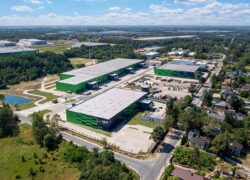
Household appliance manufacturer Mozano has leased nearly 4,600 sqm at MLP Business Park Łódź, selecting an already completed building as it expands its operations. The company will receive early access to the property in September, with the fully fitted space scheduled for handover during the fourth quarter of 2026.

The agreement covers approximately 4,500 sqm of warehouse space and almost 100 sqm of offices and employee facilities. AXI IMMO represented Mozano during the leasing process.

The move follows growth in Mozano’s sales and product range, which includes kitchen appliances, electric grills, steamers and air-treatment equipment. The company said its existing operations required additional capacity and a more efficient logistics configuration.

“Moving to a new warehouse is a natural consequence of Mozano’s growth. Our growing sales volumes and an increasingly broad product portfolio require us to have larger, better-organised logistics space,” said Łukasz Ściślewski, founder of Mozano. He added that the new facility would provide additional capacity while improving working conditions for employees.

One of the deciding factors was the availability of completed space. Early access will allow Mozano to begin preparing the facility before the fit-out is finished, reducing the time required to transfer operations compared with waiting for a new building to be developed.

Location was another important consideration. Mozano wanted to remain in Łódź’s Widzew district, close to its existing headquarters, partly to retain its current workforce and minimise disruption during the relocation.

“The location in the Widzew district was one of the key criteria throughout the entire process,” said Piotr Pacyna, Advisor in the Industrial and Logistics Space Department at AXI IMMO. “Our client wanted to remain in close proximity to its existing headquarters, primarily in order to retain its current staff and maintain business continuity.”

MLP Business Park Łódź is being developed on a 14.4-hectare site and is planned to provide 28,200 sqm of space when completed. The park is approximately 10 km from central Łódź and around 4 km from the Łódź Wschód junction of the A1 motorway. The A2 motorway can be reached through the Łódź Północ junction approximately 25 km away, while the S14 expressway is around 15 km from the development.

“We are pleased that Mozano is joining the group of tenants at MLP Business Park Łódź,” said Agnieszka Góźdź, Member of the Management Board and Chief Development Officer at MLP Group. She said the availability of an existing building would allow the tenant to prepare its operations without waiting for additional development to be completed.

The buildings are planned for BREEAM New Construction certification at Excellent level. The development also incorporates green roofs, photovoltaic-ready infrastructure, water-saving installations and covered bicycle parking. More than half of the site has been allocated to green areas.

The Mozano transaction demonstrates how factors beyond motorway access are influencing industrial and logistics leasing decisions in major Polish cities. For expanding businesses, the combination of immediately available space, proximity to existing employees and the ability to relocate without interrupting operations can be as important as regional transport connections.

In Mozano’s case, the completed building in Widzew provides the additional warehouse capacity required for expansion while allowing the manufacturer to remain close to its established workforce and existing operations.

FACTORY Poznań Reaches BREEAM Outstanding as Polish Retail Assets Improve ESG Performance

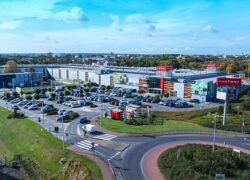
Three FACTORY outlet centres in Poland have renewed their BREEAM In-Use certifications, with the Poznań property achieving the highest Outstanding rating for management performance. The results accompany a wider programme aimed at reducing energy, water and waste consumption across the portfolio.

FACTORY Poznań received Outstanding for management performance and Excellent for asset performance. FACTORY Annopol and FACTORY Ursus in Warsaw were both rated Excellent in the two categories. The remaining Polish centres will undergo reassessment according to their individual certification schedules.

The results highlight the increasing emphasis on improving the environmental performance of existing retail property rather than concentrating sustainability investment exclusively on new developments. BREEAM In-Use evaluates both the physical performance of an operating building and how effectively it is managed, including areas such as energy consumption and resource efficiency.

“BREEAM In-Use recertification shows that sustainability is a process of continuous improvement for us,” said Maciej Zacharewicz, International Facility Manager at NEINVER. “We focus on consistently implementing changes that deliver measurable effects across many areas of our day-to-day operations. BREEAM In-Use allows us to verify our progress while identifying further areas for improvement. We see the certification as an important part of the long-term management of our assets.”

Electricity used across the Polish centres comes entirely from renewable sources, while energy audits have been carried out across the portfolio during 2026 to identify further opportunities to reduce consumption and operating costs.

Water consumption across the properties decreased by an average of 8% in 2026 compared with 2025. Measures contributing to the reduction include water-saving equipment and the collection of rainwater for irrigating landscaped areas.

Waste management represents another part of the programme. FACTORY centres hold Zero Waste certifications and report an average 92% waste recovery rate, with the longer-term objective of minimising the amount of material ultimately sent to landfill.

These measures form part of the company’s wider European Building Tomorrow ESG programme, which focuses on reducing the environmental impact of its operations while improving the efficiency of existing properties.

For retail property owners, the growing emphasis on buildings already in operation is particularly significant. Much of Europe’s shopping-centre and outlet stock will remain in use for decades, making reductions in energy consumption, water use and waste increasingly relevant to operating costs, regulatory requirements and long-term asset competitiveness.

The latest FACTORY results therefore provide more than another certification milestone. Combined with measurable reductions in resource consumption and continuing investment in operating efficiency, they illustrate how environmental improvements are becoming embedded in the day-to-day management of established Polish retail properties.

Stronger Summer Demand Tests Investor Appetite for Poland’s Regional Hotels

Poland’s accommodation market recorded a stronger summer season in 2026, adding to evidence of improving hospitality demand while hotel investors remain selective about acquisitions. Preliminary data from Statistics Poland show that tourist accommodation establishments generated 29.4 million overnight stays in July and August, an increase of 3.7% compared with the same period last year.

Around 10 million tourists used accommodation establishments during the two summer months, 2.5% more than a year earlier. With overnight stays increasing faster than visitor numbers, the figures indicate a modest increase in the average length of stay. The statistics cover the wider accommodation sector rather than hotels alone, but they provide a positive demand indicator for hospitality properties during Poland’s most important leisure period.

The improvement follows a positive first half for hotel operators. Cushman & Wakefield data show that revenue per available room in Poland increased 4.6% year-on-year in H1 2026. Growth was slower than the 8.2% recorded across the CEE-6 markets but exceeded the 3% increase reported across Europe.

Investment activity has been moving in the opposite direction. Four Polish hotels comprising 445 rooms changed ownership during the first half of 2026, generating approximately €59 million of transactions. This was 24% below the corresponding period of 2025, suggesting that improving hotel performance has yet to produce a broad acceleration in property investment.

The geographical spread of recent deals nevertheless indicates that investors are looking beyond Warsaw. Transactions included the 173-room Hampton by Hilton Krakow Airport, the 89-room IBB Hotel Gdańsk and the 133-room Havet Hotel Resort & Spa in Dźwirzyno. The acquisitions span an airport location, a major regional city and a Baltic leisure destination, demonstrating the different demand profiles available outside the capital.

This could become increasingly important as investors assess whether Poland’s tourism growth can support a wider range of regional hotel markets. Kraków and Gdańsk combine international tourism with domestic and business demand, while Baltic destinations offer exposure to Poland’s expanding leisure market but carry greater seasonal risk.

Warsaw faces a different investment equation. Hotel room supply in the capital is forecast to increase 7.2% during 2026, the fastest expansion among the CEE-6 capitals. Despite the growing pipeline, Warsaw has maintained strong occupancy, suggesting that demand has so far been capable of absorbing additional capacity.

For investors, stronger visitor numbers alone are not sufficient to justify acquisitions or new developments. The ability of individual hotels to maintain occupancy and room rates throughout the year, together with operating costs, financing conditions, competition and new supply, will ultimately determine investment returns. Regional markets therefore need to demonstrate that summer demand can translate into sustainable annual revenues rather than simply stronger peak-season performance.

The contrast between improving operating indicators and lower transaction volumes is becoming one of the more important features of Poland’s hotel market in 2026. Investors are still buying, but capital is concentrating on properties where location, operating performance and demand provide sufficient protection against higher financing and operating costs.

Poland’s stronger summer season consequently provides another positive signal for hospitality property without yet establishing a broad investment recovery. If tourism demand continues to expand and regional hotels demonstrate stronger year-round performance, the next stage of the investment cycle could extend further beyond Warsaw into Poland’s established regional cities and leisure destinations.

Germany’s Property Repricing Is Putting Regional Cities Back on the Investment Map

Germany’s real estate recovery is developing along two different tracks. Institutional investors are returning to the country’s largest property markets, attracted by liquidity, transparency and the availability of high-quality assets. At the same time, considerably higher yields and lower acquisition prices in regional cities are beginning to attract investors prepared to accept greater location and exit risk. The result is creating a new investment question. The choice is no longer simply between prime and secondary property. Investors increasingly have to decide how much they are willing to pay for the liquidity associated with Germany’s largest cities.

During the first half of 2026, the country’s seven principal investment markets increased their share of transaction activity. Berlin, Düsseldorf, Frankfurt, Hamburg, Cologne, Munich and Stuttgart continue to dominate institutional allocations, particularly for investors seeking large assets that can eventually be sold to another institutional buyer. That concentration is significant because it demonstrates that Germany’s regional cities have not suddenly replaced the established investment centres. If anything, the initial stages of the property-market recovery have reinforced the value investors place on liquidity.

But beneath those headline figures, another trend is developing. Investment activity outside the largest cities is beginning to improve, particularly among buyers pursuing higher income returns or strategies involving refurbishment, repositioning and active asset management. Residential investors are also showing greater willingness to deploy capital outside the traditional metropolitan markets when sufficient scale is available. The difference in pricing explains much of that interest.

Leipzig provides one of the clearest examples. Around €278 million of property changed hands there during the first half of 2026, representing the city’s strongest first-half investment performance since 2022. A major shopping-centre transaction contributed substantially to the total, meaning the figure should not be interpreted as evidence of uniformly deep liquidity. Nevertheless, the recovery demonstrates that meaningful institutional transactions are again possible in the city.

The more interesting comparison is pricing. Prime Leipzig offices were offering yields of approximately 5.6% around the middle of 2026. Equivalent yields in Germany’s largest cities were considerably lower, ranging from around 4.2% in Munich to approximately 4.5% in Berlin and Frankfurt and around 4.65% in Düsseldorf and Stuttgart. An investor purchasing a prime Leipzig office could therefore receive approximately 100 to 140 basis points more initial income than one acquiring a comparable asset in several of Germany’s largest markets.

That difference is substantial, but it is not free money. Munich, Frankfurt or Berlin offer deeper pools of corporate occupiers, larger rental markets and significantly more potential buyers when an owner eventually decides to sell. Leipzig has a smaller investment market and fewer institutional purchasers capable of absorbing large assets. The higher yield therefore represents compensation for genuine risks.

This is where the German investment debate becomes more interesting. The relevant question is not whether Leipzig is cheaper than Munich. It clearly is. The question is whether the additional return is sufficient to compensate an investor for lower liquidity. That calculation could increasingly favour selected regional markets.

Germany’s property correction has repriced assets across the country, but the impact has not been uniform. Institutional investors seeking safety have concentrated on prime assets in major cities. Properties outside those locations have often required larger price adjustments to attract capital. That can create opportunities when the difference in pricing becomes greater than the difference in underlying economic performance.

Leipzig illustrates the potential but also the risks. Its office market remains relatively small, and leasing activity during the first half of 2026 was subdued. Vacancy has increased, while occupiers continue to favour modern buildings over older stock. At the same time, demand for higher-quality offices has remained comparatively resilient. For investors, this means that buying simply because the city offers a higher yield would be dangerous. The building itself matters enormously.

A modern, energy-efficient office with strong public transport access and diversified tenants can have a very different investment profile from an ageing building on the edge of the city, even when both technically belong to the same market. This distinction may become even more important in regional cities than in Germany’s largest centres because the pool of tenants available to rescue an incorrectly positioned asset is smaller.

Dresden presents a different investment proposition. The city’s strongest argument increasingly comes from its industrial and technology economy. Large semiconductor investments are expanding an already established microelectronics cluster and creating additional demand from suppliers, engineering companies and specialist service providers. Major industrial investment can have effects extending far beyond the factory itself. New production capacity creates employment, attracts suppliers and generates requirements for housing, logistics, offices, laboratories and technical facilities.

This gives Dresden an economic-growth story that differs substantially from a regional city relying primarily on traditional office employment. It also illustrates why investors should avoid treating Germany’s secondary markets as one category. Leipzig, Dresden, Nuremberg, Hanover, Bremen, Essen and Dortmund have very different economic structures, occupier markets and investment characteristics. Their main common feature is that they sit outside the country’s traditional seven largest institutional property markets.

Nuremberg combines advanced manufacturing, technology, services and a substantial metropolitan population. It also offers significantly lower property costs than Munich, making it potentially attractive to both occupiers and investors seeking exposure to southern Germany without paying Munich prices. Residential investors already appear to recognise some of that potential. Investor surveys conducted during 2026 placed Leipzig, Dresden and Nuremberg immediately behind the largest German cities among preferred residential investment locations. The gap in institutional conviction remains considerable, but these cities are no longer peripheral to the investment conversation.

Hanover has a different set of advantages. Its position between the Rhine-Ruhr region, Hamburg and Berlin gives it strategic importance for logistics and distribution. It also has a diversified economy, major transport infrastructure and one of Germany’s most important exhibition and trade-fair centres. For industrial and logistics investors, those characteristics can be more important than whether the city appears on the traditional list of major investment markets.

The challenge is liquidity. A well-leased logistics property in Hanover may generate attractive income and have excellent transport connections, but the number of investors competing to buy it at exit will generally be smaller than for a comparable property in Hamburg or Frankfurt. That can be an advantage when acquiring the property and a disadvantage when selling it.

Bremen offers another example where sector selection matters more than the city’s ranking. Its ports, automotive operations, aerospace industry and connections with Bremerhaven make industrial and logistics property particularly relevant. An investor acquiring a warehouse linked to port activity or an industrial building occupied by an established manufacturer is underwriting a very different risk from one purchasing a speculative regional office. This is why a broad regional-city investment strategy is unlikely to work. The opportunity is asset-specific.

Essen and Dortmund require yet another approach because both form part of the much larger Rhine-Ruhr economy. Looking at either city solely through municipal boundaries understates the scale of the surrounding labour and consumer market. The Ruhr has spent decades transforming from a heavy-industrial economy toward services, universities, logistics, technology and advanced manufacturing. The restructuring of German industry could accelerate that transformation as former industrial sites are redeveloped for new economic uses.

Dortmund’s office market showed reasonable resilience during the first half of 2026, while the wider region continues to attract logistics and industrial investment because of its population density and extensive transport network. Property can also be acquired at substantially lower prices than in nearby Düsseldorf. That creates a potentially attractive relative-value trade. An investor may be able to purchase a well-located property in Dortmund or Essen at a significantly higher yield than a comparable building in Düsseldorf while still gaining exposure to the same wider Rhine-Ruhr economy. But again, the difference in exit liquidity must be incorporated into the price.

This is the central issue confronting investors considering Germany’s regional markets. Liquidity has value. A property that can be sold relatively quickly to dozens of potential buyers deserves to trade differently from one where only a handful of institutions are likely to bid. The mistake would be to assume that higher regional yields automatically represent better value.

A 5.6% yield in Leipzig is not necessarily more attractive than 4.2% in Munich simply because the initial return is greater. Munich’s stronger rental market, larger international investor base and deeper corporate economy may justify a substantial part of the difference. The investment opportunity appears when that difference becomes too large.

If two properties have similar tenant quality, lease duration and building specifications, but one trades at a considerably higher yield simply because it is located outside the traditional institutional markets, investors can begin asking whether they are being adequately rewarded for accepting that location. The answer will vary enormously by asset class.

Offices probably require the largest regional-city premium because their value depends heavily on local occupier depth. A large office losing its principal tenant in Munich or Frankfurt can still draw from a broad corporate market. The same event in a smaller city can create a much more difficult leasing problem.

Logistics behaves differently. Distribution networks are determined by motorways, ports, labour availability and proximity to consumers rather than by the prestige of a city centre. A logistics property outside Hanover, Bremen or Leipzig can therefore be just as strategically important to an occupier as one inside a Top 7 market.

That helps explain why the pricing difference between major and regional logistics markets is substantially smaller than for offices. By mid-2026, prime logistics yields in Germany’s major markets were around the mid-4% range, while Leipzig was closer to the upper-4% range. The relatively narrow difference suggests investors already treat logistics as a more national asset class.

Residential property could provide the strongest route for institutional capital into regional cities. Housing has one fundamental advantage over offices: tenant risk is distributed across hundreds of households rather than concentrated in a small number of companies. A residential portfolio containing several hundred apartments in Leipzig or Dresden therefore presents a different liquidity and income profile from a large office occupied by one or two tenants.

Institutional residential activity outside Germany’s largest cities strengthened during the first half of 2026, including significant portfolio transactions in regional markets. This could be an early indication of how institutional capital expands geographically. Investors may become comfortable with regional residential markets before taking equivalent risk in offices because housing demand is easier to diversify and the entry prices are significantly lower.

Affordability also matters. Munich, Frankfurt, Berlin and Hamburg have become extremely expensive residential markets. Regional cities offer substantially lower rents and purchase prices, which can provide greater affordability for residents while still allowing investors to capture rental growth. Cities with expanding employment bases become particularly interesting.

Dresden’s semiconductor industry is a good example. Leipzig benefits from logistics, manufacturing and a growing service economy. Nuremberg has a diversified industrial and technology base. Where employment and population growth are supported by identifiable economic drivers, lower property prices can create attractive long-term residential investment conditions.

Infrastructure can strengthen these markets, but investors need to distinguish between infrastructure spending and genuine economic transformation. A new road or railway station does not automatically create an investment opportunity. Infrastructure becomes valuable when it supports occupier demand.

Dresden’s technology investments create supply-chain and employment effects. Leipzig/Halle’s transport infrastructure supports one of Germany’s important logistics clusters. Bremen’s ports underpin industrial and distribution activity. Hanover’s motorway and rail position strengthens its logistics role. These connections between infrastructure and economic activity matter much more than the amount of public investment alone.

The same principle applies to Germany’s industrial restructuring. Automotive plant closures, defence expansion, semiconductor investment and the arrival of new international manufacturers could redistribute industrial demand across the country. Regional cities may benefit disproportionately because they often possess available industrial land, existing factories, skilled labour and lower property costs. This could gradually increase institutional interest in industrial property outside the traditional investment centres.

Yet the first half of 2026 sends an important warning against getting ahead of the market. Capital continued concentrating in Germany’s largest cities. Institutional investors emerging from several years of uncertainty generally preferred assets they understood, in locations where financing and eventual resale were easier. That behaviour is rational. When markets are uncertain, liquidity becomes more valuable rather than less.

The regional-city opportunity therefore depends partly on investors becoming more confident. As transaction volumes recover and financing conditions stabilise, buyers may gradually move farther along the risk spectrum in search of higher returns. That process appears to have started, but it remains selective.

The next German property trade may therefore not be a wholesale shift from Berlin, Munich and Frankfurt into Leipzig, Dresden and Dortmund. It is more likely to involve investors identifying individual regional assets where the pricing discount is greater than the underlying economic disadvantage.

That distinction is critical. A strong building in a growing regional economy can potentially offer better risk-adjusted value than a mediocre property in a major city. Conversely, a high-yielding regional asset can become extremely expensive if vacancy rises and there are few buyers when the owner wants to exit.

Investors consequently need to analyse regional markets from the bottom up. Employment growth, population trends, infrastructure, tenant diversity, building quality and future supply matter more than the label attached to the city. Exit liquidity should then be priced explicitly rather than treated as an abstract risk.

Germany’s property correction has created unusually wide differences between assets and locations. That dispersion is precisely what creates opportunities for active investors. The Top 7 will remain the country’s principal institutional property markets. Their liquidity, occupier depth and international recognition are unlikely to be challenged soon. But that does not mean they always offer the best value.

As capital returns to German property, competition for prime assets in the largest cities could compress returns faster than in regional markets. If that happens, the yield advantage available in cities such as Leipzig, Dresden, Nuremberg, Hanover, Bremen, Essen and Dortmund will become increasingly difficult to ignore.

The next phase of Germany’s investment recovery may therefore be less about choosing between major and regional cities and more about determining the correct price for liquidity. For investors capable of accepting a smaller pool of future buyers, selected regional markets can offer higher income, lower entry costs and exposure to economic growth that is not fully reflected in institutional pricing.

Germany’s regional cities do not need to replace Berlin, Munich or Frankfurt to become an important investment trade. They only need to offer enough additional return to make investors question how much the security of a major-market address is really worth.

Source: CIJ.World Research & Analysis Team

The AI Investment Boom Has a P&L Problem

Corporate enthusiasm for artificial intelligence has reached extraordinary levels, but the financial returns inside many established companies remain much less dramatic. That disconnect is becoming one of the most important questions confronting chief information officers, technology executives and investors as businesses move from AI demonstrations towards large-scale deployment. At AI4 2026, Shadman Zafar, CEO of Vibrant Capital and a technology executive whose career has included senior roles at major financial and telecommunications companies, argued that the biggest obstacle to AI value is increasingly not the capability of the models themselves. It is the ability of companies to redesign their technology architecture, governance and organisations around them.

The starting point for the presentation was a striking contradiction. Technology companies increasingly describe AI as a transformational force capable of changing entire industries, yet a large proportion of businesses have still not translated adoption into clear financial gains. PwC’s 2026 Global CEO Survey supports that concern. Among 4,454 CEOs across 95 countries and territories, 56% reported that AI had produced neither higher revenue nor lower costs during the previous year, while only 12% said it had delivered improvements on both sides. At the same time, companies that have embedded AI more deeply appear considerably more likely to report financial benefits, suggesting the issue may be less about whether the technology works and more about how effectively organisations are implementing it.

That distinction matters because corporate AI spending is entering a different phase. The first years of generative AI were dominated by experimentation, pilots and individual productivity tools. Boards and finance departments are increasingly asking what those investments have actually changed in the income statement. Faster document summarisation or better coding assistance can clearly save time, but unless those gains change operating costs, increase capacity, improve revenue or allow the organisation to work differently, productivity improvements may never become meaningful financial returns.

Zafar argued that much of this gap can be traced to the technology architecture companies assembled during the first wave of generative AI. Many organisations moved quickly, connecting applications to large language models, adding retrieval systems and introducing new agent tools as they became available. The resulting environment can work for individual demonstrations but becomes increasingly difficult to operate as models, applications and suppliers change.

The problem is particularly visible in the constant turnover of AI tools. Companies can spend months introducing one coding assistant, training employees and redesigning workflows only to discover that another product has suddenly become more capable. Repeating that cycle each time a new model or tool appears can prevent employees from becoming proficient with any of them and can turn AI adoption into a permanent technology migration programme.

The alternative is to design the architecture so that individual models can change without forcing the organisation to rebuild everything around them. Rather than selecting a single AI model for every task, businesses can operate a portfolio of models and route different workloads according to their requirements. Routine, high-volume tasks can be directed towards smaller and cheaper models, while complex problems are escalated to more capable systems. This could become particularly important as the cost of AI increases with usage. Using the most powerful available model for every request may be technically simple but economically inefficient, because a large proportion of enterprise tasks do not require maximum reasoning capability.

The wider implication is that enterprises may need to treat AI models increasingly as interchangeable computing resources rather than permanent strategic platforms. The competitive advantage would then move away from access to a particular model and towards the architecture that decides how models are selected, how data reaches them and how their output is governed.

Data represents another part of this problem. Generative AI is only as useful as the organisational context surrounding it. If information is outdated, inconsistent or disconnected across multiple systems, an AI application can produce an apparently convincing answer based on the wrong underlying facts. That creates a different type of risk from the hallucination problem usually associated with generative AI. Zafar argued during the presentation that poor enterprise context can be more dangerous than a model simply inventing information because the answer may appear entirely reasonable while being based on outdated or inconsistent company data. The numerical comparisons he presented on this point were based on his own analysis rather than an independently established industry benchmark, but the underlying problem is important: better models cannot compensate indefinitely for badly managed corporate information.

For large companies, this increases the importance of connecting operational and analytical data more effectively. Traditional enterprises often have information distributed across transaction systems, data warehouses, analytics platforms, document stores and more recently retrieval systems built specifically for AI. If those sources update independently, different versions of the organisation’s reality can emerge. An AI-ready data architecture therefore needs to keep business context current as underlying information changes.

Governance requires a similar redesign. Traditional technology governance relies heavily on policies, approvals and reviews performed before software enters production. Autonomous agents introduce a different challenge because they can make decisions and take actions continuously after deployment. As the number of agents grows, organisations may increasingly need to govern them in a way that resembles workforce management. Each agent needs an identity, a defined role, specific permissions, operating boundaries and an auditable record of what it has done. Policies therefore increasingly have to be enforced directly by the technology rather than existing only in compliance documents.

This principle connects closely with the emerging enterprise agent environment. If AI systems become responsible for performing recurring operational work, companies will need to know exactly which information they can access, what systems they can modify and when approval from a human is required. AI governance consequently becomes part of the operating architecture rather than a separate compliance function.

The organisational implications may be even more significant. Much of the debate around AI and employment assumes that companies will automate routine work and simply remove the employees who previously performed it. Zafar argued that such an approach risks weakening the organisation over time by removing the mechanism through which future expertise is created. Traditional companies frequently operate through a pyramid, with senior employees making the most complex decisions, middle management coordinating activity and larger numbers of junior employees performing much of the detailed work. AI could reduce the amount of routine execution required at the middle and lower levels, but eliminating junior recruitment entirely would create another problem: there would eventually be nobody developing the experience required to become the next generation of senior employees.

The alternative proposed during the presentation was closer to an hourglass. Experienced professionals at the top use AI to multiply their capabilities, many routine middle-layer activities become automated, but organisations continue bringing in younger employees at the bottom and train them for a different set of responsibilities. Those responsibilities could increasingly include evaluating models, supervising automated workflows, controlling data quality, testing AI systems and managing the lifecycle of intelligent applications rather than performing the repetitive work that traditionally occupied the first years of a corporate career.

This relates to a deeper risk from excessive dependence on external AI. Companies learn partly because employees perform work, make mistakes, receive feedback and gradually improve. If increasing amounts of cognitive work are simply sent to external models without companies capturing the lessons generated in the process, some institutional learning could disappear. An organisation may therefore become more productive in the short term while becoming less capable of developing its own expertise.

The challenge is to create internal feedback systems that capture outcomes, errors and corrections so that organisational knowledge continues to improve even as machines perform more of the execution. This is particularly relevant because many companies deliberately prevent external AI providers from using proprietary corporate information to train their general models. That is sensible from a data-security perspective, but it also means improvements generated through internal experience will not automatically return to the company unless it builds its own learning mechanisms around those systems.

The emerging concept of AI lifecycle management therefore extends beyond selecting a model and deploying an application. Companies need systems for monitoring performance, evaluating errors, improving prompts and workflows, maintaining data quality, controlling permissions and learning from how employees and agents perform tasks over time.

The financial argument behind this approach is becoming stronger because the companies producing the most visible AI returns appear to be those moving beyond isolated applications. PwC’s research found that organisations with stronger AI foundations were more likely to report financial gains. This suggests that the next divide in corporate AI may not be between adopters and non-adopters. Most large organisations are already adopting the technology in some form. The more important division could be between businesses that simply add AI tools to existing processes and those that redesign the underlying operating system of the company.

For investors, this also changes how AI exposure should be assessed. A company announcing dozens of pilots or purchasing licences for the latest models may provide little evidence that artificial intelligence is changing its economics. More important questions concern whether processes have actually been redesigned, whether data is accessible and reliable, whether AI usage can scale without uncontrolled costs and whether measurable productivity gains eventually reach margins or revenue.

The same distinction applies to technology vendors. Enterprises are becoming increasingly crowded with AI products competing for limited implementation capacity. Products that generate impressive demonstrations but require companies to rebuild architecture continuously may struggle as corporate buyers become more selective. Systems that integrate into durable operating frameworks and produce measurable outcomes are likely to become more valuable.

The most important phase of enterprise AI may therefore have little to do with which model wins the technology race. Foundation models are advancing rapidly and will increasingly be available to many competitors simultaneously. The harder problem is building companies capable of absorbing that intelligence efficiently. That requires architecture able to survive changing models, data systems that maintain accurate context, governance that follows agents into production, employees capable of supervising increasingly automated work and management systems that convert productivity improvements into genuine financial performance.

The AI revolution inside established companies will ultimately be judged less by how impressive the technology appears than by what reaches the bottom line. On that measure, the race is only beginning.

Source: CIJ.World Research & Analysis Team

Refield Advances 11,200 sqm Retail Park in Łańcut with 90% of Space Committed

Refield has started development of Pasaż Łańcucki, an 11,200 sqm retail park in Łańcut in south-eastern Poland, with approximately 90% of the planned space already committed to tenants. The project is being delivered for local investor BISPOL INVEST and is scheduled to open in September 2027.

The development is taking shape on a 3.5-hectare site at Przemysłowa Street, alongside provincial road 877 and approximately 20 km from Rzeszów. The location beside a roundabout and an important regional road is intended to attract customers from both Łańcut and surrounding municipalities.

Lidl will anchor the grocery offer, with construction of its building already underway. Other retailers that have committed to the scheme include CCC, Shock Price, Rossmann, Action, Martes Sport, Sinsay, Tedi, Smyk and Hebe, together with FlyPark. According to Refield, agreements covering approximately 90% of the project have already been secured.

The high level of leasing well ahead of the planned opening provides another indication of retailer interest in smaller Polish cities where individual projects can draw customers from substantially larger surrounding areas. Łańcut has approximately 18,000 residents and the wider Łańcut county around 80,000, but the potential customer base extends considerably further.

Refield estimates that approximately 23,600 people live within a ten-minute drive of the development and 44,200 within 15 minutes. Expanding the journey time to 30 minutes increases the potential catchment to almost 370,000 people, bringing parts of the wider Rzeszów metropolitan area within reach of the property.

The development will provide more than 430 parking spaces and three separate vehicle entrances. This combination of road accessibility, parking capacity and a wider regional catchment reflects the development model that has supported the expansion of retail parks across smaller Polish markets.

“We wanted to create a place that would complement the city’s existing offer with a broad selection of recognisable brands and services responding to residents’ everyday needs,” said Fabian Eryk Barbarowicz, CEO of Refield. He added that the project’s advanced leasing level demonstrates tenant interest in the location, while its road connections allow it to serve customers beyond Łańcut itself.

Refield is responsible for delivering the project on a turnkey basis for BISPOL INVEST. Its mandate covers design and administrative procedures, leasing, coordination of construction and preparation of the property for opening. JT Konkurent has been appointed general contractor.

Pasaż Łańcucki also demonstrates why population figures within municipal boundaries provide only part of the investment case for regional retail property. For schemes positioned beside major roads, accessibility and the population within a realistic driving distance can be more important than the size of the host city itself.

With most of the space already committed and Lidl’s building under construction, the Łańcut development provides further evidence that Poland’s retail park pipeline continues to extend into smaller regional markets where developers can combine relatively limited local populations with considerably larger surrounding catchments.

Africa’s Next Property Investment Map Is Expanding Beyond Its Established Hubs

Africa’s commercial real estate investment market has traditionally been dominated by a relatively small group of countries. South Africa offers the continent’s deepest institutional property market, Egypt combines enormous urban development with substantial domestic capital, and Morocco has established itself as an increasingly important manufacturing, logistics and investment gateway between Africa and Europe. These markets will remain important, but the next phase of African property investment could increasingly involve a wider group of countries where infrastructure, urbanisation and economic development are beginning to create institutional-quality assets.

The distinction between economic growth and property investability is critical. A country can attract billions of dollars of foreign investment without creating commercial real estate that international property investors can acquire. Large infrastructure projects, mining operations and energy developments can generate substantial capital inflows while producing relatively few stabilised offices, warehouses, apartments or shopping centres available for institutional ownership.

For property investors, the more relevant question is whether a market is developing assets that can be financed, leased, professionally managed and eventually sold. That requires more than economic growth. Investors need credible occupiers, functioning land markets, dependable infrastructure, professional developers, financing and sufficient transaction activity to provide confidence that capital can ultimately exit.

Several African markets are beginning to move closer to that threshold.

Côte d’Ivoire is emerging as one of the strongest candidates. Abidjan has developed into an increasingly important commercial centre for Francophone West Africa, supported by population growth, infrastructure investment, international companies and the country’s position within regional trade.

Its port provides an important foundation for industrial and logistics development. Improvements to transport infrastructure and the longer-term development of the Abidjan-Lagos economic corridor could strengthen the city’s role as a distribution gateway serving markets across coastal West Africa.

This creates opportunities beyond traditional office development. Modern warehouses, industrial parks, cold storage and distribution facilities could become increasingly important as regional trade expands. Consumer growth also supports retail, hospitality and residential development, giving Abidjan a more diversified property proposition than many smaller African capitals.

The investment challenge is creating sufficient institutional stock. International capital generally requires larger assets with professional management, reliable tenant income and clear ownership structures. As Abidjan’s development market matures, the number of properties capable of meeting those requirements could increase.

Tanzania offers another increasingly important proposition. Dar es Salaam combines a rapidly growing urban economy with one of East Africa’s most strategically important ports. Its significance extends beyond Tanzania because transport routes from the coast provide access to several landlocked economies in the region.

Investment in railways and the Central Corridor could gradually strengthen the city’s role as a regional logistics and industrial gateway. For commercial property investors, this means the opportunity may not be confined to warehouses surrounding the port. Industrial development could spread along transport corridors towards inland logistics nodes and manufacturing locations.

Dar es Salaam’s long-term advantage is therefore geographic. A distribution centre positioned within Tanzania can potentially serve domestic demand while also participating in trade with neighbouring markets. As transport infrastructure improves, this regional role could increase the amount of modern logistics and industrial property required.

Ghana remains one of West Africa’s more established commercial markets, although recent economic volatility has demonstrated the risks associated with currency movements, inflation and financing conditions. Accra nevertheless has a meaningful stock of modern offices, retail developments, hotels and residential property, while Tema provides a potentially stronger industrial and logistics growth story.

Tema’s combination of port infrastructure, manufacturing and established industrial areas creates a foundation for modern logistics development. As occupiers demand larger and more efficient warehouses, opportunities could emerge to replace fragmented or ageing industrial stock with professionally developed facilities.

Ghana’s property outlook will depend heavily on continued macroeconomic stability. International investors assessing rental income in local currency must consider exchange-rate risk alongside conventional property fundamentals. Improving economic conditions could therefore have an important influence on whether institutional capital becomes more comfortable increasing exposure.

Kenya occupies a different position because Nairobi is already one of Africa’s more developed commercial property markets. The next investment opportunity is not simply the emergence of Nairobi but the increasing sophistication of the assets being developed there.

The Kenyan capital already contains substantial office, retail and residential stock, alongside an expanding modern logistics market. Data centres have added another institutional property and infrastructure sector, while professionally managed rental housing could become increasingly relevant as developers search for alternatives to conventional build-to-sell residential projects.

The wider Nairobi-Naivasha corridor could also become increasingly important. Transport infrastructure, industrial land and geothermal power around Naivasha create the potential for manufacturing and logistics development outside the capital. If these elements continue to converge, Kenya’s next property cycle may become less concentrated exclusively within Nairobi.

This makes Kenya different from many emerging African markets. The question is not whether a recognisable commercial property industry will develop; it already exists. The question is whether the market can develop greater institutional depth, larger investment transactions and a broader range of income-producing asset classes.

Senegal provides another interesting West African proposition. Dakar has long served as an important Francophone business centre, but infrastructure investment and urban expansion are beginning to alter the geography of the metropolitan area.

New transport connections and development outside the traditional city centre can create additional locations for housing, logistics, industrial property and commercial development. Dakar’s position on Atlantic trade routes and its role as a regional corporate centre provide a foundation for further investment.

The logistics opportunity could become particularly important as companies seek modern distribution facilities capable of serving Dakar’s expanding population and regional markets. Hospitality also remains relevant because Senegal’s international profile and business connections support hotel demand alongside leisure tourism.

As with Abidjan, however, the transition from development opportunity to institutional property market requires sufficient transaction scale. Building attractive projects is only the first stage. Investors also need a functioning secondary market through which completed assets can eventually change ownership.

Zambia represents a different type of emerging property opportunity. Its strongest investment story may increasingly be connected with infrastructure, mining and industrial development rather than conventional office or retail expansion.

The Lobito Corridor has the potential to alter the logistics geography of the Copperbelt by improving connections between mineral-producing regions in Zambia and the Democratic Republic of Congo and Angola’s Atlantic coast. If transport investment increases the amount of processing and manufacturing undertaken closer to mineral resources, demand for industrial land and logistics property could expand.

This could create opportunities for warehouses, processing facilities, industrial parks, maintenance operations and supporting accommodation. The property market would therefore grow alongside the industrial economy rather than primarily through conventional urban development.

For investors, this represents a different risk profile from buying a stabilised office in Johannesburg or Nairobi. Corridor-related development depends on infrastructure delivery, commodity industries and the successful attraction of manufacturers. The potential returns may be attractive, but development and occupier risks can also be substantially higher.

Rwanda offers almost the opposite proposition. Kigali is a relatively small market, limiting the scale of transactions available to major international investors, but the country’s organised approach to development and investment has created an interesting environment for commercial property.

Kigali Special Economic Zone demonstrates how serviced industrial land and infrastructure can help concentrate manufacturing and logistics activity. The city also has modern offices, hospitality and residential development, although the limited size of the domestic economy places a natural ceiling on market depth.

Rwanda’s investment case therefore rests less on scale and more on execution. If projects can be developed within a predictable environment and supported by reliable infrastructure, smaller markets can still attract specialised investors. Kigali could consequently provide a useful example of how investability does not always correlate directly with population or economic size.

Mauritius occupies a unique position in this emerging investment map. Its domestic commercial property market includes offices, hospitality, residential and mixed-use development, but its larger significance comes from its role as a financial and investment platform connecting international capital with opportunities elsewhere in Africa.

Its regulatory framework, financial services sector and international investment structures have made Mauritius an important base through which funds and companies organise African investments. This means the country should not necessarily be compared directly with Abidjan, Dar es Salaam or Nairobi as a large emerging property market.

Instead, Mauritius can be viewed as part of the financial infrastructure supporting African real estate investment. As institutional capital expands across the continent, platforms capable of structuring and managing cross-border investments will remain important alongside the physical markets where buildings are located.

This highlights why conventional rankings of Africa’s most attractive investment destinations can be misleading for commercial property investors. Strong governance and an attractive business environment matter, but they do not automatically produce sufficient real estate opportunities. Seychelles, for example, can offer an attractive investment environment and high-value hospitality opportunities while remaining far too small to develop the breadth of institutional property available in larger African economies.

The same caution applies to foreign direct investment figures. Large headline inflows can be generated by energy, mining, infrastructure or individual megaprojects without creating a corresponding increase in investible commercial real estate. Property capital needs to understand what sits underneath the national number.

The more useful measure is whether economic investment produces occupiers.

A new manufacturing plant can attract suppliers and logistics companies. Port investment can generate warehouse demand. A data centre cluster can require energy infrastructure and supporting development. New transport links can create industrial land opportunities. Growing corporate activity can support offices and hotels.

When these activities accumulate in the same location, a deeper property market begins to form.

That process is already visible at different stages across Africa. Abidjan is strengthening its role as a Francophone West African commercial and logistics centre. Dar es Salaam could benefit from regional transport investment and its position on the Central Corridor. Accra and Tema combine established commercial development with an emerging logistics opportunity. Nairobi is progressing towards a more sophisticated institutional market, while Dakar is benefiting from infrastructure-led metropolitan expansion.

Zambia’s opportunity is increasingly connected with mineral processing and transport corridors, while Kigali demonstrates how a smaller market can use organised development and infrastructure to attract investment. Mauritius, meanwhile, remains important as a platform through which international capital can access opportunities across the continent.

These markets will not develop at the same speed, nor will every promising development story become an institutional investment market.

Currency volatility remains one of the largest risks. Property may produce attractive local-currency rental returns while generating much weaker performance when income is converted into dollars or euros. High domestic interest rates can make development financing difficult, while shallow debt markets can restrict both acquisitions and construction.

Political and regulatory uncertainty also remains important in several countries. Property is a long-duration investment, meaning investors require confidence not simply in current conditions but in the rules that will govern ownership, taxation, leases and capital flows many years into the future.

Liquidity may ultimately be the greatest challenge. Institutional investors need to understand how they will eventually exit an investment. A high-quality warehouse can be profitable while occupied, but if there are only a handful of potential buyers in the country, the investor may struggle to realise its value.

The development of domestic institutional capital could help address this problem. Pension funds, insurance companies, REITs and other local investors can create a secondary market for stabilised assets, allowing developers and international investors to recycle capital into new projects.

This is one reason South Africa remains so far ahead of most African property markets. Its listed property sector and established institutional investor base create liquidity that is difficult to reproduce quickly elsewhere.

The next African investment hotspots will therefore not simply be the countries growing fastest. They will be the markets where economic expansion is converted into occupier demand, occupier demand into modern buildings and those buildings into assets that institutional investors can confidently own and trade.

Infrastructure will play a central role in that transition. Ports, railways, electricity, roads and digital networks determine where businesses can operate efficiently. Industrial parks and special economic zones can concentrate investment, while urban growth creates demand for offices, housing, retail and hospitality.

For property investors looking beyond Africa’s established markets, the opportunity is becoming increasingly diverse. It is also becoming more specialised. The strongest investment case in Abidjan may not be the same as in Nairobi, Dar es Salaam or Lusaka.

The winners will therefore be identified less by broad country rankings and more by understanding the individual cities, corridors and property sectors where institutional demand is beginning to emerge.

Africa’s next property investment map is already taking shape. It extends through the ports and industrial districts of Abidjan and Tema, the transport corridors surrounding Dar es Salaam and Nairobi, the expanding metropolitan geography of Dakar, the mineral routes of Zambia and the organised development environment of Kigali.

South Africa, Egypt and Morocco will remain major destinations for real estate capital. But they are unlikely to define the continent’s investment story alone.

The next phase will be about identifying which secondary markets can make the difficult transition from promising development destinations into functioning institutional property markets. Those that succeed could provide some of Africa’s most interesting commercial real estate opportunities during the remainder of the decade.

Source: © CIJ.World Africa Research & Analysis Team

Union Investment Converts Historic Helsinki Office into Hotel in €11.5 Million Repositioning

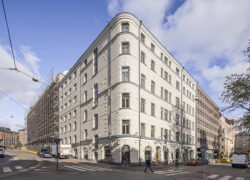
Union Investment is moving ahead with the conversion of a historic office property in central Helsinki into a hotel after receiving planning approval for the project. The investment manager will commit approximately €11.5 million to the transformation of the Proffa building, with completion targeted for late 2027.

Around 3,160 sqm of existing office accommodation will be converted into 84 hotel rooms. Ruby Group has agreed to operate the property under a 30-year lease, giving Union Investment a long-term hospitality tenant before construction work is completed. Parts of the ground-floor commercial accommodation will remain, while other areas will be adapted as part of the wider repositioning.

The project reflects a growing challenge facing owners of older European office buildings. Proffa’s internal configuration, including numerous structural walls and irregular spaces, makes the introduction of contemporary office layouts difficult. Heritage restrictions affecting parts of the property create additional limitations. Rather than undertaking an extensive office refurbishment within those constraints, Union Investment concluded that hospitality offered a more suitable long-term use.

“The transformation in Helsinki is a current example of our active asset management approach,” said Bastian Stuhke, Senior Asset Manager Hospitality at Union Investment. He said the building’s structural characteristics made modern office concepts considerably more difficult to implement, prompting the company to assess alternative uses. Analysis of the location, hotel market, financial potential and physical characteristics of the property ultimately supported the decision to proceed with hospitality.

The conversion represents another stage in the unusually varied history of the building. Designed by architect Theodor Höijer and completed in 1900 as residential property, Proffa was subsequently expanded before being converted into offices during the 1970s. Its most recent major modernisation took place in 2008.

Union Investment has held the property since 2019 through its DIFA-Fonds Nr. 3 open-ended real estate special fund. The new hotel lease is intended to provide the fund with predictable long-term income while improving the overall quality and commercial prospects of the property.

The complexity of converting a historic building has also influenced the selection of the project team. Union Investment chose Ruby partly because of the hotel operator’s previous experience adapting older properties in prime urban locations. A general contractor with experience in higher-quality hotel refurbishment has also been appointed.

“The complexity of the building’s structure requires specialized expertise in the design phase,” said Thomas Stancel, technical project manager at Union Investment. He added that several hotel concepts were examined before Ruby was selected, with its experience converting historic properties contributing to the decision.

Proffa occupies a prominent corner location in central Helsinki, within walking distance of Kamppi Center and with access to the city’s public transport network. These characteristics, combined with the building’s historic architecture, supported the decision to pursue hospitality rather than continue with a predominantly office-led strategy.

The project demonstrates how the changing European office market is encouraging investors to reconsider the future of buildings that remain attractive from a location perspective but struggle to meet modern workplace requirements. In such cases, structural characteristics that restrict efficient office layouts can potentially become less problematic when a property is converted for hospitality use.

For Union Investment, the Helsinki project is therefore less about abandoning an office asset than finding a new economic purpose for a well-located but physically constrained building. By combining an €11.5 million conversion with an 84-room hotel and a 30-year operating commitment, the investor is seeking to extend the useful life of a 126-year-old property while establishing a new long-term income stream.

front page info
LATEST NEWS