Thursday, 24 September 2026
A powerful earthquake that struck off Japan’s northeastern coast on 25 June once again demonstrated why earthquake resilience remains at the centre of the country’s urban development strategy. While the magnitude 7.2 offshore tremor caused transport disruptions and prompted safety inspections, there were no immediate reports of significant structural damage or a tsunami, highlighting the effectiveness of decades of investment in resilient buildings and infrastructure.
For Japan’s construction industry, earthquakes are not exceptional events but an essential design consideration. Rather than attempting to prevent buildings from moving altogether, engineers increasingly design them to move in a controlled manner, allowing structures to absorb seismic energy while protecting occupants and limiting damage.
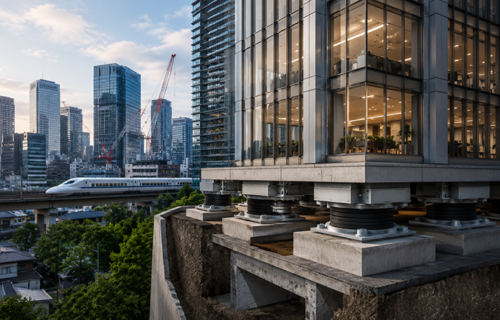
This approach has become a defining feature of Tokyo’s latest redevelopment projects. Across districts including Yaesu, Toranomon, Azabudai, Shinagawa and Nihonbashi, new mixed-use developments combine offices, hotels, retail, residential space and public amenities with advanced seismic engineering. These projects are intended not only to withstand major earthquakes but also to remain operational afterwards, supporting business continuity in one of the world’s busiest metropolitan areas.
Modern high-rise buildings achieve this resilience through a combination of technologies. Many are constructed on specialised foundation systems that reduce the transmission of ground movement into the structure. Others incorporate energy-dissipating devices that function similarly to shock absorbers, reducing vibrations during prolonged shaking. Some towers also include large counterweight systems installed near the upper floors that move independently from the building itself, helping to minimise swaying caused by earthquakes or strong winds.
The result is a counterintuitive experience for occupants. During a significant earthquake, a modern tower may gently sway from side to side rather than remain rigid. While this movement can feel unusual, it is an intentional engineering solution designed to reduce stress on the building’s structural frame.
Tokyo’s redevelopment boom has accelerated the adoption of these technologies. Many of the city’s newest commercial projects include additional resilience measures such as emergency power generation, water storage, reinforced communications infrastructure and facilities that allow businesses to continue operating even after a major seismic event.
One of the best-known examples is Tokyo Skytree, where engineers developed a structural system that allows the central core and the outer steel framework to move independently during earthquakes. By controlling how these elements interact, the tower significantly reduces vibration while maintaining structural stability. The concept draws inspiration from traditional Japanese pagodas, whose central timber columns have helped them survive earthquakes for centuries.
Japan’s building regulations have also evolved continuously following major earthquakes over the past several decades. Each significant event has led to stricter engineering standards and wider adoption of new technologies, particularly for high-rise developments and critical infrastructure. Today’s building codes place strong emphasis not only on preventing collapse but also on ensuring that buildings remain safe and functional after seismic events.
The latest earthquake serves as another reminder that resilient construction is no longer simply about protecting individual buildings. In Japan, it has become a key element of long-term urban planning, influencing everything from commercial redevelopment and infrastructure investment to public safety and economic resilience.
As cities worldwide face increasing exposure to natural hazards, Japan’s experience demonstrates how engineering innovation and sustained investment can transform earthquake risk into an opportunity to build more resilient urban environments.
Source: © CIJ.World Japan Research & Analysis Team