Thursday, 10 September 2026
Germany’s economic recovery has lost momentum following a sharp rise in energy prices triggered by the conflict involving Iran, prompting the German Institute for Economic Research (DIW Berlin) to significantly lower its growth outlook for the country.
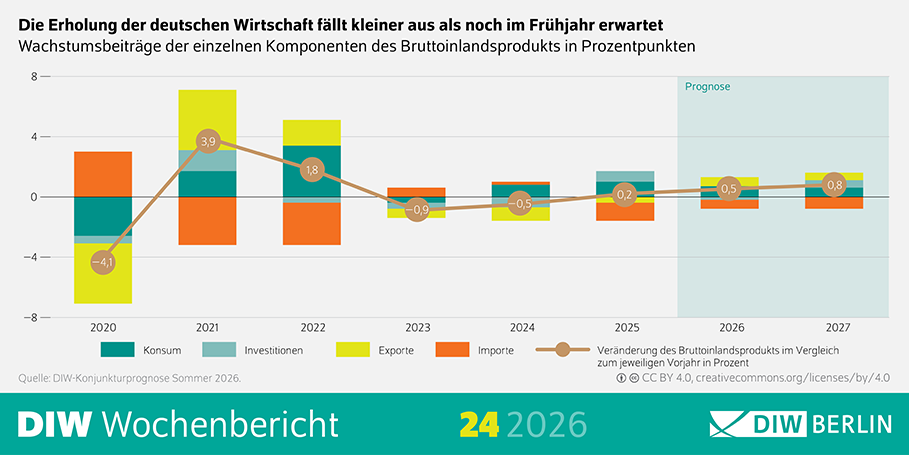
In its Summer Economic Forecast 2026, DIW Berlin reduced its projection for German GDP growth this year to 0.5%, down by around half a percentage point from its spring forecast. Growth is expected to reach 0.8% in 2027.
According to the institute, higher oil and gas prices are driving inflation, reducing household purchasing power and increasing economic uncertainty. As a result, Germany is expected to experience slight contractions in both the second and third quarters of 2026, meeting the technical definition of a recession before stabilising towards the end of the year.
“The energy price shock is noticeably slowing the recovery, but we are not experiencing a repeat of 2022 or 2023,” said Geraldine Dany-Knedlik, Head of Forecasting at DIW Berlin. “The shock is smaller, energy supplies remain secure, and Germany is less dependent on fossil fuel imports than it was after the outbreak of the war in Ukraine.”
DIW forecasts inflation of 2.9% in 2026 and 3.0% in 2027, remaining above the European Central Bank’s target. The unemployment rate is expected to rise slightly from 6.3% in 2025 to 6.4% this year before easing to 6.2% in 2027.
The institute expects government spending to remain the primary driver of economic growth. Increased defence expenditure and investment from Germany’s infrastructure and climate transition funds are projected to support activity over the forecast period. However, private consumption is expected to recover only gradually, while export-oriented industries continue to face structural challenges and external uncertainties.
DIW estimates that the fiscal stimulus will push Germany’s public sector deficit to 3.9% of GDP in 2026 and 4.3% in 2027.
Beyond the immediate impact of higher energy prices, the institute highlights longer-term challenges including declining industrial competitiveness, elevated production costs and demographic pressures, all of which continue to weigh on Germany’s growth potential.
DIW President Marcel Fratzscher urged policymakers to focus on targeted support measures for low-income households rather than broad fuel subsidies.
“An energy cost allowance similar to the scheme introduced in 2022 would be the right instrument,” Fratzscher said. “The fuel discount is expensive, poorly targeted and also benefits oil companies. The government should not repeat that mistake.”
Despite the weaker outlook, DIW noted that structural reforms and accelerated public investment could improve business confidence and stimulate private-sector investment.
Global growth outlook remains resilient
The institute also revised down its global growth forecast, citing the impact of higher energy prices on inflation and consumer spending. Nevertheless, the world economy is expected to continue expanding at a moderate pace.
Global GDP growth is forecast at 3.1% in 2026 and 3.3% in 2027, representing a reduction of 0.2 percentage points compared with DIW’s spring forecast.
The United States is expected to maintain growth rates above 2%, supported by its position as a major energy producer. The eurozone, however, is projected to grow by only 0.3% this year, reflecting its continued reliance on energy imports and exposure to price shocks.
China is expected to continue expanding at a moderate pace despite challenges in its property sector, supported by exports and investment in future technologies.
According to DIW, risks to the outlook remain tilted to the downside, including a potential escalation of geopolitical tensions, persistently high energy and food prices, tighter monetary policy in response to inflationary pressures and labour market disruptions associated with the growing adoption of artificial intelligence.
Source: DIW Berlin