From Drones to 3D Concrete: HSF Pushes Digital Construction

HSF System, part of the PURPOSIA Group, argues that digital tools—drones, total stations, BIM-driven workflows and 3D concrete printing—are no longer a promise but standard kit on its Czech and Slovak jobs. The company has moved most project controls into digital environments, extended that to tendering and subcontractor onboarding, and now leans on UAV surveys, thermal inspections and precise set-out to compress schedules and avoid costly rework. That broad direction tracks with the Czech market’s push on BIM and digitization, but it also mirrors what’s happening in Europe’s most advanced construction economies. Germany’s federal BIM centre (BIM Deutschland) sits inside two ministries and underpins nationwide digital uptake on public works—evidence that “digital by default” is policy, not just a contractor slogan.

HSF’s heaviest bet is on concrete printing. Through a partnership linking HSF System with ICE Industrial Services (MTX Group), the spin-off Coral Construction Technologies is commercializing a Czech-patented printhead and process geared to use standard ready-mix rather than the dry mixes common in early-stage 3DCP—an engineering choice aimed at scalability on real sites. ICE is already printing the upper station of a cable-car project in Kopřivná, combining hall-made prefab with on-site printing, which shows the technology moving beyond “demo benches” toward complex, occupiable structures.

If the question is whether the world outside Czechia is going the same way, the Netherlands remains the benchmark for 3D-printed concrete in Europe. The first 3D-printed concrete bicycle bridge opened in Gemert in 2017 (TUE/BAM/Witteveen+Bos), and Dutch teams have since delivered larger printed spans and even fully printed dwellings under Project Milestone—proof that permitting and engineering cultures can absorb the method at scale.

On drones, HSF’s claims about time and cost gains are consistent with what transport and infrastructure agencies are formalizing elsewhere. In the United States, federal rules under FAA Part 107 now allow routine operations over people, moving vehicles and at night (with conditions), which is why contractors widely use UAVs for stockpiles, façade/roof thermography, and progress checks. The U.S. highway authority has even issued guidance on using small UAS for earthworks quantity estimation—codifying photogrammetry-to-BIM workflows that mirror HSF’s drone-to-Revit terrain models.

Thermal-camera inspections that HSF runs on roofs and façades are also a maturing market rather than a novelty. Industry analyses point to rapid growth in drone-based thermal inspection because it cuts man-hours and scaffolding costs while catching heat-loss and moisture problems earlier; case studies show thermal anomalies like bridges and air-leaks being detected reliably enough to plan remedial works before defects become visible.

Germany and the Netherlands aren’t outliers in digitization, either. Analysts repeatedly note that European mandates and client demands are pushing BIM deeper into private work, with Germany explicitly tying digitization to equipment and remote-monitoring adoption in its construction sector. That macro environment helps explain why a mid-sized regional contractor like HSF can insist on digital tendering and still bring subcontractors along.

Where HSF’s narrative holds up—and what to watch. Independent signals back the idea that drones, BIM and 3DCP are past the pilot stage in leading markets, and ICE/Coral’s live cable-car station is a concrete (literally) Czech example. The bolder claim is that the “old world” is ending quickly. In practice, adoption tends to be uneven: regulation and client capacity drive leaders ahead, while permitting, workforce training and supply-chain readiness can slow everyone else. For 3DCP, the frontier questions remain code acceptance, durability data and cost parity outside showpiece projects; Coral’s patented printhead and use of transport concrete could matter here if it lowers materials friction and speeds approvals.

Bottom line: HSF System is moving in lockstep with Europe’s digitization curve and, through Coral/ICE, is helping push Czech 3D printing from lab to live projects. The global picture supports their thesis: drones, data and automated concrete printing are no longer curiosities. The gap to watch is execution at scale—whether the savings and quality gains HSF cites on selected projects consistently survive the realities of codes, weather, labor and supply chains across an entire portfolio.


From Drones to 3D Concrete: HSF Pushes Digital Construction

HSF System, part of the PURPOSIA Group, argues that digital tools—drones, total stations, BIM-driven workflows and 3D concrete printing—are no longer a promise but standard kit on its Czech and Slovak jobs. The company has moved most project controls into digital environments, extended that to tendering and subcontractor onboarding, and now leans on UAV surveys, thermal inspections and precise set-out to compress schedules and avoid costly rework. That broad direction tracks with the Czech market’s push on BIM and digitization, but it also mirrors what’s happening in Europe’s most advanced construction economies. Germany’s federal BIM centre (BIM Deutschland) sits inside two ministries and underpins nationwide digital uptake on public works—evidence that “digital by default” is policy, not just a contractor slogan.

HSF’s heaviest bet is on concrete printing. Through a partnership linking HSF System with ICE Industrial Services (MTX Group), the spin-off Coral Construction Technologies is commercializing a Czech-patented printhead and process geared to use standard ready-mix rather than the dry mixes common in early-stage 3DCP—an engineering choice aimed at scalability on real sites. ICE is already printing the upper station of a cable-car project in Kopřivná, combining hall-made prefab with on-site printing, which shows the technology moving beyond “demo benches” toward complex, occupiable structures.

If the question is whether the world outside Czechia is going the same way, the Netherlands remains the benchmark for 3D-printed concrete in Europe. The first 3D-printed concrete bicycle bridge opened in Gemert in 2017 (TUE/BAM/Witteveen+Bos), and Dutch teams have since delivered larger printed spans and even fully printed dwellings under Project Milestone—proof that permitting and engineering cultures can absorb the method at scale.

On drones, HSF’s claims about time and cost gains are consistent with what transport and infrastructure agencies are formalizing elsewhere. In the United States, federal rules under FAA Part 107 now allow routine operations over people, moving vehicles and at night (with conditions), which is why contractors widely use UAVs for stockpiles, façade/roof thermography, and progress checks. The U.S. highway authority has even issued guidance on using small UAS for earthworks quantity estimation—codifying photogrammetry-to-BIM workflows that mirror HSF’s drone-to-Revit terrain models.

Thermal-camera inspections that HSF runs on roofs and façades are also a maturing market rather than a novelty. Industry analyses point to rapid growth in drone-based thermal inspection because it cuts man-hours and scaffolding costs while catching heat-loss and moisture problems earlier; case studies show thermal anomalies like bridges and air-leaks being detected reliably enough to plan remedial works before defects become visible.

Germany and the Netherlands aren’t outliers in digitization, either. Analysts repeatedly note that European mandates and client demands are pushing BIM deeper into private work, with Germany explicitly tying digitization to equipment and remote-monitoring adoption in its construction sector. That macro environment helps explain why a mid-sized regional contractor like HSF can insist on digital tendering and still bring subcontractors along.

Where HSF’s narrative holds up—and what to watch. Independent signals back the idea that drones, BIM and 3DCP are past the pilot stage in leading markets, and ICE/Coral’s live cable-car station is a concrete (literally) Czech example. The bolder claim is that the “old world” is ending quickly. In practice, adoption tends to be uneven: regulation and client capacity drive leaders ahead, while permitting, workforce training and supply-chain readiness can slow everyone else. For 3DCP, the frontier questions remain code acceptance, durability data and cost parity outside showpiece projects; Coral’s patented printhead and use of transport concrete could matter here if it lowers materials friction and speeds approvals.

Bottom line: HSF System is moving in lockstep with Europe’s digitization curve and, through Coral/ICE, is helping push Czech 3D printing from lab to live projects. The global picture supports their thesis: drones, data and automated concrete printing are no longer curiosities. The gap to watch is execution at scale—whether the savings and quality gains HSF cites on selected projects consistently survive the realities of codes, weather, labor and supply chains across an entire portfolio.

Mitzilinka – Warsaw’s Domestic Violence Support System: Now With More Red Tape Than Protection

Warsaw’s social welfare system is under fire after a father reported that trying to get help at Mokotów’s Centre for Counteracting Domestic Violence felt less like an emergency service and more like lining up for a badly organized comedy show-except no one was laughing.

According to the father, after bringing his daughter in following an assault by her mother, the assigned specialist told them to “come back tomorrow” because, apparently, protecting children has office hours. If domestic violence doesn’t respect business hours, that’s your fault, not the bureaucracy’s.

The next day, the daughter bravely detailed years of abuse. The specialist responded by requesting a full written account, kindly offering his email. Unfortunately, the email bounced back-possibly because even Outlook decided it couldn’t handle the workload. Further attempts to reach the centre went unanswered, as though the inbox had been placed under protective custody.

Ten days later, the family returned, only to learn that the caseworker was on a two-week holiday and, naturally, nobody was checking his emails in his absence. Because in Warsaw, nothing says “crisis management” like an out-of-office reply. The daughter meanwhile was terrified to return home and even thought about running away. Luckily, her father secured alternative housing. Not every victim, of course, has the luxury of a spare apartment and, apparently, an endless supply of patience.

OPS Mokotów proudly states on its website that its mission is to “respond to violence.” To be fair, they do respond. It’s just that their response usually involves a calendar reminder and an incorrect email address. With 332 official contact points in Warsaw, one might expect at least one to be useful, but the father claims none could provide effective assistance. Statistically, that’s impressive inefficiency.

The law defines domestic violence as physical, psychological, or economic harm that violates dignity and safety. But judging from this case, the system appears to have added a new category: administrative abuse, inflicted via bounced emails and unanswered phones.

While Poland’s government insists OPS centres are designed to protect victims, this episode suggests the only thing being protected is vacation schedules. The father summed it up best: OPS should stand for Office of Paperwork and Shrugs. Or, in his own words, “a start-up running on trial and error-while victims’ safety is at stake.”

Author: Mitzilinka (Turning grim reality into comic relief-without losing the truth)

Mitzilinka – Warsaw Roadworks: Where GPS Goes to Die

Warsaw has officially claimed its place as one of Europe’s great theme parks, except the rides are all traffic jams and the entry fee is your sanity. According to INRIX data, drivers in the Polish capital spent an average of 70 hours staring at the bumper in front of them in 2024, making Warsaw the sixth most congested city in Europe and the 20th worldwide. That’s nearly three full days a year spent practicing deep breathing and wondering why you didn’t just take up cycling.

The situation gets even more entertaining around construction sites. Here, detours are less “planned” and more “choose your own adventure.” One minute you’re in the correct lane, the next you’re funneled into a mysterious side street that your GPS swears doesn’t exist. Signage often looks like it was drawn by an abstract artist, and traffic marshals, when they appear at all, seem as confused as the drivers they’re supposed to guide.

Służewiec, the business district nicknamed “Mordor” by long-suffering commuters, is leading the charge in testing human patience. Nearly 100,000 workers pour in daily, jamming streets designed back when owning a horse was more common than owning a hatchback. Parking is scarcer than an honest politician, and the new road layouts seem to change more often than the weather.

Meanwhile, Warsaw is trying to fix things. A shiny new bike path is rising on Solidarności, complete with crossings and greenery that drivers can admire while stuck at a standstill. The Wilanów tram extension is open, but the associated road and drainage works still look like they’ve been designed as a long-term psychological experiment. And with 2025 and 2026 set to be peak years for construction, contractors and supply chains are already sweating harder than drivers with broken air conditioning.

The goal, officials insist, is a modern, mobile, stress-free Warsaw. The current reality? Gridlock, endless U-turns, and road users wondering if their great-grandchildren will finally enjoy the benefits of today’s chaos. Until then, Warsaw drivers might want to pack a snack, a podcast, and perhaps a tent for their next “short drive” across the city.

Author: Mitzilinka (Turning grim reality into comic relief-without losing the truth)

Mitzilinka – LOT Short-Haul Business Class: Champagne Dreams, Apple Juice Reality

LOT Polish Airlines’ short-haul business class continues to be the aviation equivalent of buying a ticket to a Michelin restaurant and then discovering it’s a very polite cafeteria with yogurt on the menu. Yes, there are some nice touches, but the overall package leaves passengers wondering if “business” is just a branding exercise rather than an actual upgrade.

On Embraer routes like Warsaw to Bucharest, Prague, or Vilnius, business class is essentially economy class with the middle seat blocked. It’s the airborne version of someone politely saying, “Don’t worry, I won’t sit next to you.” Comfort is marginally improved, but the beige upholstery has seen better decades, and the cabin still looks like it’s been hosting family reunions since the 1990s.

Pre-departure service is where optimism meets reality. Expect apple juice or water if you’re lucky, and if you’re really lucky, both at the same time. Champagne? Only if you smuggle it onboard yourself. Ask about the contents of the wet wipes and you might be told they’re alcohol-based, bleach-based, or powered by sheer mystery. Follow-up questions are usually met with the kind of stressed facial expressions you’d expect from someone trying to assemble IKEA furniture without instructions.

The catering, however, occasionally redeems the experience. A fig-and-cheese hors d’oeuvre here, a fish entrée there—every so often you’re reminded that you did, in fact, buy a business class ticket. Pair it with a glass of wine and for a fleeting moment you could almost believe you’re on Lufthansa. Almost.

Cabin cleanliness is… variable. Washrooms are usually tidy, but the cabin itself shows heavy use. Think “student rental apartment that someone tried to tidy five minutes before a landlord visit.” Snacks like sweet chili pistachios with tea have been noted, though some meals look so weary they could use a nap themselves.

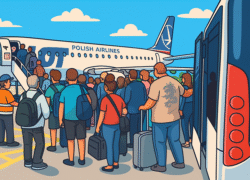
Then comes ground handling. Business-class passengers are promised priority baggage and faster boarding. In practice, your bag might come out first, or it might come out halfway through, depending on whether the baggage handlers had coffee that morning. Boarding priority is often more theoretical than real, and at Warsaw Chopin, business passengers frequently find themselves squeezed onto buses alongside everyone else, clutching carry-ons like contestants in a game show called Who Gets the Overhead Space?

In fairness, LOT keeps fares competitive, and when the catering team is on form, the food is genuinely impressive for a short flight. Lounge access and a blocked seat add some value, especially on busy routes. But it’s clear that this isn’t a premium product—it’s economy with a garnish.

In the end, LOT’s short-haul business class is worth it if the price is right and you appreciate the occasional yogurt or fish entrée with wine. If you’re expecting seamless comfort, though, prepare for a journey that delivers apple juice dreams and economy-class realities.

Author: Mitzilinka (Turning grim reality into comic relief-without losing the truth)

EU weighs “drone wall” on eastern border, leaning on Ukrainian know-how as Nato plugs near-term gaps

The EU is moving to harden its eastern frontier against low-cost unmanned threats after a wave of drones violated Polish airspace this month, prompting Warsaw to trigger Nato consultations under Article 4. The European Commission has signalled support for a common “drone wall” built on interoperable systems and jointly financed procurement, with Brussels also preparing a “drone alliance” with Kyiv to industrialise battlefield-tested Ukrainian technologies. While full details are still being shaped, the initiative dovetails with new EU defence financing tools and Nato’s rapid reinforcement of air defences along the eastern flank.

The sense of urgency sharpened after Poland reported that 19–23 drones entered its airspace on 9–10 September; allied jets intercepted some of the UAVs and several airports temporarily restricted operations. Warsaw invoked Article 4 the following day, saying the incursions posed a direct threat to national and alliance security.

To cover the near term, Nato has launched Operation Eastern Sentry, deploying fighter aircraft, ships and sensors from multiple allies from Finland to Bulgaria to deter and defeat further incursions. French Rafales have already operated over Poland under the mission, according to official and open-source briefings.

At EU level, the Commission has encouraged capitals to co-buy counter-UAS kits proven in Ukraine and to standardise command-and-control so that border states do not field incompatible solutions. The effort aligns with Security Action for Europe (SAFE)—a proposed €150 billion loans facility backed by the EU budget—through which nearly €100 billion could be channelled to the eastern flank for defence investments if governments opt in.

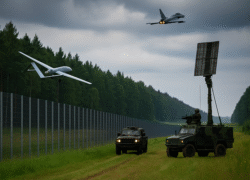
Ukrainian experience is shaping the concept of operations. Because small, low-flying Shahed-type drones can be hard to spot on conventional radar, Kyiv’s industry and military built a nationwide mesh of acoustic sensors, cueing mobile teams with anti-aircraft cannon or heavy machine guns—a far cheaper way to defeat mass drone attacks than expending premium interceptor missiles. Baltic states have begun adapting similar methods, officials say.

Commission officials have also discussed a “drone alliance” with Ukraine, paired with EU financing to scale manufacturing of counter-UAS, detection, and electronic warfare systems, though precise budget lines and instruments are still being refined. The initiative would sit alongside existing EU measures to accelerate joint procurement and strengthen the defence industrial base.

Taken together, the “drone wall” concept, SAFE loans and Eastern Sentry represent a two-track response: Nato provides immediate air-defence cover, while the EU works to stand up a cost-effective, interoperable perimeter built around rapidly scalable tech—much of it proven over Ukraine—so member states can blunt future low-cost aerial threats without burning through expensive missile stocks.

EU weighs “drone wall” on eastern border, leaning on Ukrainian know-how as Nato plugs near-term gaps

The EU is moving to harden its eastern frontier against low-cost unmanned threats after a wave of drones violated Polish airspace this month, prompting Warsaw to trigger Nato consultations under Article 4. The European Commission has signalled support for a common “drone wall” built on interoperable systems and jointly financed procurement, with Brussels also preparing a “drone alliance” with Kyiv to industrialise battlefield-tested Ukrainian technologies. While full details are still being shaped, the initiative dovetails with new EU defence financing tools and Nato’s rapid reinforcement of air defences along the eastern flank.

The sense of urgency sharpened after Poland reported that 19–23 drones entered its airspace on 9–10 September; allied jets intercepted some of the UAVs and several airports temporarily restricted operations. Warsaw invoked Article 4 the following day, saying the incursions posed a direct threat to national and alliance security.

To cover the near term, Nato has launched Operation Eastern Sentry, deploying fighter aircraft, ships and sensors from multiple allies from Finland to Bulgaria to deter and defeat further incursions. French Rafales have already operated over Poland under the mission, according to official and open-source briefings.

At EU level, the Commission has encouraged capitals to co-buy counter-UAS kits proven in Ukraine and to standardise command-and-control so that border states do not field incompatible solutions. The effort aligns with Security Action for Europe (SAFE)—a proposed €150 billion loans facility backed by the EU budget—through which nearly €100 billion could be channelled to the eastern flank for defence investments if governments opt in.

Ukrainian experience is shaping the concept of operations. Because small, low-flying Shahed-type drones can be hard to spot on conventional radar, Kyiv’s industry and military built a nationwide mesh of acoustic sensors, cueing mobile teams with anti-aircraft cannon or heavy machine guns—a far cheaper way to defeat mass drone attacks than expending premium interceptor missiles. Baltic states have begun adapting similar methods, officials say.

Commission officials have also discussed a “drone alliance” with Ukraine, paired with EU financing to scale manufacturing of counter-UAS, detection, and electronic warfare systems, though precise budget lines and instruments are still being refined. The initiative would sit alongside existing EU measures to accelerate joint procurement and strengthen the defence industrial base.

Taken together, the “drone wall” concept, SAFE loans and Eastern Sentry represent a two-track response: Nato provides immediate air-defence cover, while the EU works to stand up a cost-effective, interoperable perimeter built around rapidly scalable tech—much of it proven over Ukraine—so member states can blunt future low-cost aerial threats without burning through expensive missile stocks.

English Proficiency Rises in Central Europe, But Service Gaps Still Frustrate Foreigners

Young Central Europeans are entering the workforce with stronger English skills than ever before, yet gaps in service industries continue to frustrate tourists, expatriates, and business visitors when it comes to ordering food or accessing everyday services.

The EF English Proficiency Index 2025 places Romania at 12th globally, Poland 15th, Hungary 17th, Slovakia 18th and Czechia 25th. All five countries sit in the “high proficiency” band, though Czechia trails its neighbours. Capital cities consistently outperform national averages, with Warsaw, Budapest, Bratislava, Bucharest and Prague recording the strongest levels. This explains why foreigners generally find communication smooth in corporate offices, airports and international hotels.

Inside multinational companies, English has become the working language of choice. In Poland, the business services sector employed nearly half a million people in the first quarter of 2025, with fluency seen as a basic requirement. Romania’s IT and shared services industry has similarly integrated English into daily operations in Bucharest and Cluj, while Budapest and Bratislava have established themselves as reliable hubs for English-speaking professionals.

Outside these internationalised sectors, however, the picture is less consistent. Smaller hospitality businesses often rely on seasonal or lower-qualified staff, where language training is less common. Tourists and residents alike still encounter difficulties in smaller shops, cafés, or public offices, particularly outside the main urban centres. Everyday tasks can involve pointing, translation apps, or patient guesswork.

Healthcare presents one of the more challenging areas. Foreign residents and visitors in Czechia and Hungary often report difficulties communicating in clinics, where English is not always available and interpretation is limited. Slovakia faces similar hurdles, with language barriers affecting access to services and integration for newcomers. Romania, while performing best in regional rankings, still shows uneven English availability beyond its largest cities, particularly in smaller hotels and regional services.

Despite these shortcomings, the overall trajectory is positive. Each year, new graduates enter the workforce after more than two decades of mandatory English education, raising proficiency levels across both professional and customer-facing roles. Employers are also expanding language training to improve client service, especially in industries tied to tourism and international trade.

Central Europe’s headline scores in English proficiency continue to rise, but the reality on the ground remains uneven. For international business, corporate settings and hotels present few obstacles. Yet the daily experience of ordering lunch, seeing a doctor, or arranging basic services in smaller towns still highlights the gap between professional fluency and everyday communication.

English Proficiency Rises in Central Europe, But Service Gaps Still Frustrate Foreigners

Young Central Europeans are entering the workforce with stronger English skills than ever before, yet gaps in service industries continue to frustrate tourists, expatriates, and business visitors when it comes to ordering food or accessing everyday services.

The EF English Proficiency Index 2025 places Romania at 12th globally, Poland 15th, Hungary 17th, Slovakia 18th and Czechia 25th. All five countries sit in the “high proficiency” band, though Czechia trails its neighbours. Capital cities consistently outperform national averages, with Warsaw, Budapest, Bratislava, Bucharest and Prague recording the strongest levels. This explains why foreigners generally find communication smooth in corporate offices, airports and international hotels.

Inside multinational companies, English has become the working language of choice. In Poland, the business services sector employed nearly half a million people in the first quarter of 2025, with fluency seen as a basic requirement. Romania’s IT and shared services industry has similarly integrated English into daily operations in Bucharest and Cluj, while Budapest and Bratislava have established themselves as reliable hubs for English-speaking professionals.

Outside these internationalised sectors, however, the picture is less consistent. Smaller hospitality businesses often rely on seasonal or lower-qualified staff, where language training is less common. Tourists and residents alike still encounter difficulties in smaller shops, cafés, or public offices, particularly outside the main urban centres. Everyday tasks can involve pointing, translation apps, or patient guesswork.

Healthcare presents one of the more challenging areas. Foreign residents and visitors in Czechia and Hungary often report difficulties communicating in clinics, where English is not always available and interpretation is limited. Slovakia faces similar hurdles, with language barriers affecting access to services and integration for newcomers. Romania, while performing best in regional rankings, still shows uneven English availability beyond its largest cities, particularly in smaller hotels and regional services.

Despite these shortcomings, the overall trajectory is positive. Each year, new graduates enter the workforce after more than two decades of mandatory English education, raising proficiency levels across both professional and customer-facing roles. Employers are also expanding language training to improve client service, especially in industries tied to tourism and international trade.

Central Europe’s headline scores in English proficiency continue to rise, but the reality on the ground remains uneven. For international business, corporate settings and hotels present few obstacles. Yet the daily experience of ordering lunch, seeing a doctor, or arranging basic services in smaller towns still highlights the gap between professional fluency and everyday communication.

Czech Pensions to Rise in January 2026 as Social Security Finances Show Mixed Picture

The Ministry of Labour and Social Affairs has confirmed that pensions in the Czech Republic will increase again from January 2026. Old-age, disability and survivors’ pensions will all be adjusted upward in line with statutory valorization rules, based on inflation in pensioner households.

The average old-age pension will grow by 668 crowns per month, reaching 21,839 crowns. The adjustment will consist of a 240-crown rise in the basic pension and a 2.6 percent increase in the percentage-based component. Labour and Social Affairs Minister Marian Jurečka (KDU-ČSL) emphasized the long-term gains for retirees, noting that just ten years ago the average pension was little more than half of what it will be in 2026. He added that overall, during the current government, pensions have risen by 28 percent. According to ministry estimates, pensions since 2016 have risen by about 18 percent more than prices, meaning real purchasing power for retirees has improved significantly over the past decade.

Jurečka said the government’s pension reform is designed to ensure sustainability of the system, guaranteeing that decent pensions can be paid not only to today’s pensioners but also to future generations. He pointed out that the reform will help protect financing as demographic changes increasingly affect the system.

Financial results from the Czech Social Security Administration underline the challenges. From January to August 2025, social security revenues reached 502 billion crowns while expenditures amounted to 500 billion crowns, leaving a surplus of 2.14 billion crowns. Revenues rose by 7.5 percent year-on-year, while expenditures grew by only 0.6 percent. Within the system, however, results were uneven. Pension insurance recorded a deficit of 5.6 billion crowns by August, according to ministry data, while a more detailed breakdown from the Ministry of Finance showed a larger cumulative deficit of about 9.16 billion crowns at the end of August and 10.18 billion crowns by September.

Sickness insurance presented a different picture, ending the January to August period with a surplus of 7.7 billion crowns. This was largely the result of new employee contribution rates, which boosted revenues by 45 percent compared with 2023. Officials highlighted that the overall success rate of insurance payments remains at 99 percent, which they say demonstrates the stability of the system despite uneven performance across its components.

With pensions at their highest level in the country’s history and reforms underway to strengthen long-term sustainability, the January 2026 increase is being presented as both financial relief for pensioners and evidence that the social security system can withstand the pressures of an aging population.

front page info
LATEST NEWS