Sunday, 20 September 2026
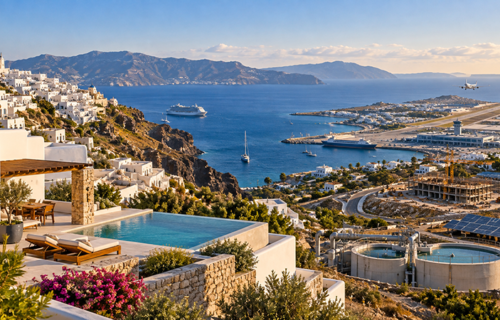
Greece’s islands remain among the country’s most attractive real estate markets, supported by international tourism, hotel investment and continuing demand for holiday homes. Yet the ability of some destinations to accommodate further property development is becoming increasingly connected to something that rising visitor numbers cannot provide: infrastructure. Water supply, electricity networks, wastewater treatment, roads, airports, ports and housing for tourism workers are becoming increasingly important considerations for developers and property owners. The issue is particularly significant on islands, where geography limits the ability to expand infrastructure and where demand can increase dramatically during the summer months.
This creates a different way of looking at Greek island property. Tourism demand can support hotel revenues, residential prices and land values, but it does not necessarily mean that another hotel, villa development or resort can be accommodated easily. Investors increasingly need to consider not only whether customers will come, but whether the destination has the physical capacity to support additional development.
Water is one of the clearest examples. During 2026, Greece continued investing in island water infrastructure as drought and increasing consumption placed pressure on existing systems. A national programme approved dozens of water-supply projects worth more than €75 million, including new and expanded desalination facilities serving island communities. The investment reflects a structural challenge. Tourism demand reaches its highest point during summer, when rainfall is limited and temperatures are high. Hotels, swimming pools, restaurants, landscaping and holiday homes can substantially increase consumption compared with the requirements of the permanent population.
Desalination can provide additional supply, but it does not remove the infrastructure issue. Plants require investment and energy, while water still has to be stored and distributed through local networks. Improving supply therefore frequently requires a combination of desalination, network modernisation, storage and more efficient management. For property investors, these systems exist outside the boundaries of an individual hotel or residential development but can directly affect how reliably the property operates. A project with secure access to sufficient water carries a different development and operating profile from one dependent on future infrastructure improvements.
Electricity creates a similar consideration. Modern hotels consume substantial amounts of power through cooling, kitchens, pools, wellness facilities, lighting and other services. As resorts become more sophisticated and buildings increasingly electrify their operations, electricity requirements can rise even without substantial increases in room numbers. Renewable generation can reduce part of that pressure, particularly given the potential for solar energy across Greece. But generating electricity and delivering it reliably through an island network are different challenges. Connection capacity and local distribution infrastructure remain relevant when evaluating major developments.
Wastewater and solid waste add another dimension. Island systems must accommodate populations that can increase dramatically during the tourism season. Expanding hotel and residential capacity therefore creates continuing requirements beyond the properties themselves, increasing the importance of municipal and regional infrastructure investment. This makes environmental performance unusually practical in island real estate. Sustainability is not simply about obtaining certification for an individual building. Water consumption, energy efficiency, wastewater management and the pressure a development places on local services can influence both operating costs and the long-term acceptability of further construction.
Transport investment illustrates another side of the story. Greece has invested heavily in regional aviation infrastructure. The 14 airports operated by Fraport Greece have undergone extensive modernisation, improving the country’s ability to accommodate international tourism. Additional investment is planned at several airports, including Mykonos and Santorini, as passenger volumes place increasing pressure on existing capacity. Improved airports strengthen property markets by making destinations easier to reach and supporting larger visitor flows. But additional aviation capacity can also increase demands on infrastructure elsewhere on an island. More visitors require transportation, water, electricity, waste services and accommodation, both for tourists and the people employed to serve them.
Crete provides an important comparison with the smaller islands. Construction of the new international airport at Kastelli represents one of Greece’s largest transport infrastructure projects and is intended to replace the existing Heraklion airport. Together with new road connections, the airport will substantially change the aviation infrastructure serving the country’s largest island. Crete’s scale also gives it a different development profile. It contains several important population centres, a broad tourism economy and considerably more land than destinations such as Mykonos or Santorini. That does not mean Crete is free from infrastructure constraints. Water resources, road capacity, environmental considerations and planning remain important across the island. However, the scale and geography of the infrastructure challenge are fundamentally different.
Smaller islands have fewer options for absorbing growth. Mykonos and Santorini demonstrate the relationship particularly clearly. Their limited geography is one reason property scarcity is so valuable, but the same physical limitations make continual expansion difficult. Roads, water networks, waste systems and other infrastructure must accommodate intense seasonal activity within relatively small areas. Paros presents another version of the issue. Rapid tourism and residential growth can increase demand for utilities and public infrastructure considerably faster than permanent population statistics alone would suggest. For investors, understanding seasonal capacity can therefore be more useful than looking only at the number of permanent residents.
These constraints do not necessarily have the same effect on every type of property. For an established hotel, limits on additional construction can potentially become an advantage. If tourism demand remains strong while creating competing hotel supply becomes more difficult, existing high-quality properties may benefit from greater scarcity. Development land faces a different calculation. A site can occupy an exceptional location and still require substantial investment before development becomes possible. Water connections, electricity capacity, wastewater solutions, road access and planning requirements can influence both the cost and timing of a project.
Investors purchasing development land therefore need to distinguish between theoretical development potential and realistically deliverable property. Infrastructure availability can become part of that assessment even when it is not separately reflected in the advertised price of the site. The same distinction applies to operating assets. An existing resort with secure utilities, adequate wastewater infrastructure, established road access and sufficient operational capacity can have a different risk profile from a property requiring major future infrastructure expenditure. It is too early to argue that Greek island property valuations consistently contain a measurable infrastructure premium, but the economics suggest that infrastructure certainty can increasingly influence development risk, operating expenditure and ultimately investment returns.
Labour availability introduces another constraint. Successful tourism destinations require large seasonal workforces, while some of the country’s strongest island property markets also have high housing costs and limited rental availability. Hotels and other tourism businesses can consequently face difficulties accommodating employees during peak periods. Some operators respond by arranging or providing staff accommodation. For property investors, this can become another operating requirement to consider alongside utilities and transport. A resort’s ability to accommodate its workforce can affect recruitment, costs and the practical operation of the asset.
Employee housing should not yet be treated as a standard component of Greek hotel valuation, but it is increasingly relevant to the economics of operating tourism property in expensive island markets. Residential development also interacts with the problem. Holiday homes and tourism accommodation compete for land and infrastructure, while increased demand for residential property can place additional pressure on housing available to permanent residents and seasonal workers.
The result is that investors need to examine island property beyond the boundaries of the individual site. A development may have excellent architecture, an exceptional beachfront location and strong projected demand, but its long-term performance can still depend on infrastructure controlled by municipalities, utility providers and national authorities. That changes the traditional definition of a prime location. Sea views, beach access, proximity to attractive towns and international recognition will remain fundamental to Greek island property values, but access to reliable infrastructure may increasingly differentiate properties within the same destination.
A site with secure water, adequate electricity capacity, established road access and workable wastewater arrangements can present less development uncertainty than an apparently superior location dependent on substantial future infrastructure improvements. For Greece, this does not mean island development must stop. Infrastructure investment can itself create additional real estate capacity. Improvements to water systems, airports, roads, energy networks and waste treatment can allow destinations to accommodate economic growth more efficiently.
The strongest long-term property markets may therefore be those where tourism demand and infrastructure investment advance at broadly compatible speeds. Where infrastructure improves alongside tourism, developers can potentially create additional accommodation while maintaining the quality and environmental characteristics that make the destination attractive. Where property growth substantially outruns infrastructure, development can become more expensive, complicated and politically sensitive.
This creates a different risk map for investors. Larger destinations such as Crete and Rhodes have different infrastructure options from small Cycladic islands. Highly constrained markets such as Mykonos and Santorini may benefit from exceptional scarcity but simultaneously present greater challenges for new development. Rapidly growing islands such as Paros require infrastructure investment to accompany their expanding tourism and residential markets. There is therefore no single Greek island property story.
The investment case depends increasingly on the relationship between demand and physical capacity. Strong tourism can support income and property values, but it cannot by itself expand water supplies, electricity networks, roads or wastewater systems. For existing properties, secure infrastructure may become an increasingly important competitive advantage. For development sites, uncertainty surrounding essential services can add cost, delay and risk.
Greek island real estate has traditionally been valued through scarcity, location and tourism demand. Those factors remain fundamental. But as the country’s most successful destinations accommodate ever greater levels of activity, investors have another question to answer before deciding what a property is worth: not simply how many people want to be there, but how much additional growth the island can actually support.
Source: CIJ.World Research & Analysis Team