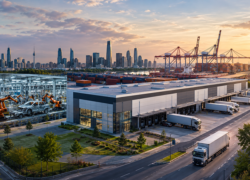
Germany’s industrial and logistics property market is gaining a new group of occupiers. Asian companies, particularly businesses connected to Chinese e-commerce and distribution networks, are taking a growing amount of warehouse and industrial space as they establish larger operations inside Europe. The shift is becoming large enough to influence Germany’s principal logistics markets. During the first half of 2026, Asian occupiers accounted for approximately 11% of industrial and logistics take-up nationally. Their presence was considerably greater in some cities, reaching around 24% in Cologne, 11% in Düsseldorf and 9% in Hamburg.
Several of the largest German industrial transactions completed during the period involved Asian companies, including facilities of more than 50,000 square metres. The numbers indicate that what was previously a relatively small source of international occupier demand is becoming a meaningful component of the market. For property investors and developers, however, the more important question is what happens next.
The current expansion is being led mainly by distribution, logistics and online retail rather than by a wave of new Asian factories. But the warehouses appearing today could represent the first stage of a much deeper physical presence in Germany. Companies entering a new market typically establish distribution infrastructure before committing to manufacturing. Products are initially imported, stored locally and delivered to customers. As sales increase, businesses add spare-parts operations, technical support, repair centres, product preparation and regional management. Assembly and manufacturing can follow once the European business reaches sufficient scale.
Germany is particularly well positioned for this progression. It is Europe’s largest consumer economy, sits at the centre of the continent’s transport network and borders nine countries. A distribution centre in western or central Germany can serve not only German customers but also markets across Benelux, France, Austria, Switzerland, Poland and the Czech Republic.
Germany also offers something especially important to Asian industrial companies: an enormous manufacturing ecosystem. Its automotive, machinery, electronics and chemical industries have created extensive networks of engineers, component suppliers, industrial contractors and logistics providers. Companies entering Europe do not therefore need to construct an entire supply chain from the beginning.
This could become particularly relevant for Chinese electric-vehicle manufacturers. Chinese automotive groups are increasing their European presence as they compete for market share with established European manufacturers. While Germany has not yet experienced a broad wave of Chinese vehicle factories, expanding sales will require more physical infrastructure.
Imported vehicles need storage, preparation and distribution. Dealers require spare parts. Customers need servicing. Batteries need specialist handling and replacement, while software and electronic systems require technical support. Each of those activities consumes property. A company can therefore build a substantial German industrial footprint without manufacturing a complete vehicle in the country.
Initially, this demand is likely to appear through vehicle logistics centres, parts warehouses, technical facilities, repair operations and regional offices. Over time, some of these operations could evolve into component assembly or production.
Battery businesses could follow a similar path. Battery manufacturing itself requires specialised facilities and very large amounts of power, making it difficult to place in conventional logistics buildings. But the battery supply chain includes many less specialised functions, including storage, testing, recycling, servicing, component distribution and engineering. These activities can occupy industrial properties that sit somewhere between a warehouse and a factory.
Electronics companies create similar requirements. Businesses selling telecommunications equipment, consumer electronics, energy systems and industrial technology increasingly need European inventories together with facilities for testing, configuration, repair and technical support. This could increase demand for modern light-industrial property.
Instead of a conventional warehouse containing little more than storage racks, developers may increasingly encounter international occupiers requiring a mixture of distribution, workshop, laboratory, office and assembly space within the same building. That has implications for how future industrial parks are designed. Greater electricity capacity may be necessary. Buildings may need larger office or technical areas, stronger floors, more flexible loading arrangements and the ability to divide space between storage and production.
Developers that understand these requirements could gain an advantage as Asian occupiers expand. The geography of demand is already providing clues. Cologne and Düsseldorf are benefiting from access to Germany’s largest population concentration and excellent motorway connections toward Belgium and the Netherlands. The wider Rhine-Ruhr region also provides access to inland ports and established logistics infrastructure.
Hamburg offers another strategic gateway because of its port and long-standing trading connections with Asia. Frankfurt combines one of Europe’s largest airfreight hubs with a central location on Germany’s motorway network, allowing goods to reach a large portion of the country’s population within a relatively short period. These characteristics help explain why Asian occupiers are becoming increasingly visible in these markets.
But their search is starting to extend beyond Germany’s traditional logistics centres. Limited availability in established markets is forcing some international companies to consider secondary locations. Chinese occupiers that initially concentrated heavily on North Rhine-Westphalia are increasingly examining opportunities elsewhere.
That could benefit cities located along major motorway corridors outside the country’s most expensive logistics markets. For developers controlling suitable land in those areas, Asian demand could provide an additional source of occupiers.
The opportunity may be particularly significant where projects can be delivered quickly. International companies establishing European operations frequently work with shorter expansion timetables than Germany’s planning system comfortably accommodates. An occupier may decide that it requires a distribution facility within months, while obtaining planning approval and constructing a completely new building can take several years.
Sites where planning and infrastructure are already established therefore become more valuable. This could connect Asian occupier growth with another important change occurring in German industrial property: the increasing reuse of former manufacturing land.
Automotive restructuring and changes across traditional German manufacturing could release factories and industrial sites during the coming years. Many already contain electricity connections, loading infrastructure, offices and access to skilled workers. These properties could be attractive to Asian businesses seeking rapid entry into Germany.
A former automotive supplier facility, for example, could potentially accommodate an electronics company, vehicle-parts distributor or light manufacturer with substantially less preparation than undeveloped land. This creates an unusual interaction between Germany’s old and new industrial economies.
Some Asian companies are competing directly with German manufacturers in global markets, particularly in electric vehicles and electronics. At the same time, those companies could become future tenants or buyers of industrial properties released by German businesses undergoing restructuring. The companies challenging parts of Germany’s manufacturing economy may therefore also help create demand for its industrial real estate.
Brownfield redevelopment could accelerate this process. Developers acquiring former factories could reposition them for international occupiers by creating combinations of logistics, light manufacturing and technical space. Sites with existing power capacity and established industrial planning could be particularly attractive.
Build-to-suit development may also become more important. The current shortage of suitable logistics space means some occupiers cannot find buildings matching their requirements in their preferred locations. If Asian companies continue expanding, developers may increasingly construct facilities specifically for them rather than waiting for suitable existing buildings to become available.
Such projects could range from conventional distribution centres to hybrid properties combining warehousing, assembly and technical operations. For investors, however, this creates a different underwriting challenge.
Many Asian businesses are major companies in their domestic markets but have relatively short European operating histories. Their German subsidiaries may have been established only recently and therefore provide less financial information than traditional German occupiers. Institutional landlords may consequently require stronger guarantees, larger deposits or support from parent companies before committing to long leases.
This could create opportunities for developers willing to accept more leasing risk. A developer could secure an international occupier, construct or refurbish the property and establish several years of rental history before selling the stabilised asset to institutional capital.
The ability to design flexible buildings will be particularly important. A highly specialised property created for one occupier can become difficult to re-let if that company later changes strategy. Developers should therefore attempt to accommodate technical requirements without making buildings unusable for future logistics or manufacturing tenants.
That distinction becomes increasingly important as Asian demand moves beyond warehousing. A conventional distribution centre can generally be occupied by another logistics company. A customised vehicle assembly or battery facility has a much smaller pool of replacement users. Investors will therefore need to balance the attraction of long leases with the future adaptability of the property.
The broader German logistics market provides a supportive backdrop for this expansion. Industrial and logistics take-up strengthened during the first half of 2026, with the major property advisers reporting increases compared with the previous year despite differences in their market definitions. Large transactions also returned after a relatively quiet period.
This matters because Asian demand is arriving in a market where suitable modern buildings are already limited in many locations. The result could be greater competition for well-positioned industrial sites.
Asian occupiers will not be the only companies seeking them. Logistics operators, German manufacturers, defence businesses, data-centre developers and energy-related companies are increasingly competing for similar land. Electricity capacity could become one of the deciding factors.
Modern e-commerce operations use increasingly sophisticated automation, while electronics, battery and advanced-manufacturing businesses require substantially greater power than traditional warehouses. A site with a large existing grid connection may therefore appeal to several different types of occupiers. This could push developers toward former industrial locations where substantial infrastructure already exists.
The long-term significance of Asian occupier growth consequently extends beyond the amount of warehouse space leased in 2026. Germany may be moving toward a different relationship with Asian industry.
Historically, much of the property impact of Asian trade was indirect. Goods arrived through ports and were handled by European logistics companies. Increasingly, Asian businesses are establishing their own operational infrastructure inside Europe. That means warehouses, offices, technical centres and potentially manufacturing facilities carrying the names of Asian companies rather than simply handling their products.
The transition could accelerate as supply chains become more regional. Companies facing tariffs, geopolitical uncertainty and changing European regulations have incentives to establish more operations inside the markets they serve. Local inventory reduces delivery times and supply-chain risk, while European assembly or production can potentially provide strategic advantages.
Germany will compete with Poland, Hungary, the Czech Republic and other European countries for these investments. It will not necessarily win every manufacturing project. Central and Eastern European markets can offer lower labour and land costs, while some governments provide aggressive incentives for large industrial investments.
Germany’s advantage lies elsewhere. Its enormous consumer market, established supplier networks, skilled engineering workforce and central location make it particularly attractive for European headquarters, distribution, servicing and higher-value manufacturing functions.
This could produce a network rather than a single concentration of Asian investment. Large distribution centres may locate in western Germany. Technical and engineering operations could favour established manufacturing regions. Port-related businesses may concentrate around Hamburg, while Central European supply chains could support locations farther east.
For industrial property developers, understanding these different requirements will become increasingly important. The occupier profile of Germany’s logistics market is changing.
Domestic manufacturers and traditional third-party logistics companies will remain important, but they are being joined by businesses whose European expansion strategies are being decided thousands of kilometres away. That introduces new sources of capital, demand and competition for industrial land.
It also creates uncertainty. International expansion can move rapidly in both directions. A company entering Germany aggressively may change strategy if trade policy, tariffs or European demand deteriorate. Developers therefore need to distinguish between short-term logistics requirements and companies building permanent European operations.
The most attractive occupiers will be those gradually adding functions to their German businesses. A company that begins with a warehouse and subsequently adds repair, engineering, assembly and management functions becomes much more deeply embedded in the market.
That progression will be one of the most important indicators to watch over the next several years. The question is therefore no longer simply how much German warehouse space Asian companies are leasing. It is whether Germany is becoming part of their permanent European operating infrastructure.
The first half of 2026 provides growing evidence that this process has begun. Asian companies already account for a meaningful share of German industrial and logistics demand, particularly in some of the country’s largest markets.
If the next stage brings technical operations, assembly and manufacturing alongside distribution, the consequences for commercial real estate could be substantial. Germany could find that one of the most important new sources of demand for its industrial property comes from companies that, until recently, mainly served the European market from the other side of the world.
Source: CIJ.World Research & Analysis Team