Villa Bogoria Reaches Topping Out Stage in Warsaw

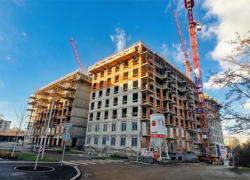
A topping out ceremony has been held for Villa Bogoria, a residential development located at the intersection of Długa and Stara Nalewka streets, near the Krasiński Garden. The milestone marks the completion of the building’s structural works and moves the project into the next phase of construction.

Work on Villa Bogoria began in mid-2024. The development consists of six above-ground floors and two underground levels, with a total height of 21 metres. The scheme will contain 35 apartments averaging 160 square metres, each with a net room height of three metres. In total, the building offers over 15,000 square metres of floor space, of which around 6,500 square metres will be usable.

The architectural concept, prepared by Juvenes-Projekt, draws on the historical context of Długa Street and pre-war Nalewki Street. The façade is being finished in Piedra Paloma limestone imported from Spain, with large-format windows integrated into the design.

Future residents will have access to a wellness area including a 20-metre swimming pool, sauna, steam room, cooling pool and gym, as well as a lobby and atrium. Apartments will be equipped with a home management system designed to control temperature, humidity, air quality, lighting and shading.

Sales of the apartments are being managed by Villa Bogoria’s development team. STRABAG is acting as the general contractor, with MJL responsible for investment supervision. Interior design for the shared areas is by artist Jacek Synkiewicz, known for his work on Foksal Residence.

According to the construction schedule, façade installation and interior installations are currently underway, with finishing works to follow. The project is expected to be completed in the second half of 2026.

MDC2 Expands Partnership to Support Next Phase of Growth

Polish logistics developer MDC2 has expanded its leadership team by inviting nine senior members of staff to join the partnership, a move the company says strengthens its ability to deliver sustainable and transparent warehouse projects across the country.

The new partners are drawn from all areas of the business, covering development, construction, operations and marketing. They include Development Directors Andrzej Lasocki, Adrian Winiarek and Katarzyna Dudzik; Head of Development Ewa Zawadzka; Head of Development Wojciech Kosiór; Project Director Bartłomiej Kazirod; Head of Construction Jonathan Cohen; Head of Marketing Magda Cieliczko; and Operations Manager Paula Piątkowska-Teter.

Founder Hadley Dean described the expansion of the partnership as an important step for the company. “The appointment of these nine exceptional individuals to Partner is a pivotal moment for us. It is a powerful affirmation of our strategy, the strength of our team, and our confidence in the future of the Polish logistics market. By welcoming nine new partners, we are deepening the expertise and commitment at the very heart of our business. This expanded leadership team will be instrumental in driving our ambitious growth plans and ensuring we continue to lead the market in delivering sustainable, transparent, and class-leading logistics properties for our clients.”

The newly appointed partners join the existing management team of Dean, Jeremy Cordery (Founder and COO), Maciej Madejak (Founder and CDO) and Peter Love (Financial Director, Head of Asset Management).

Ewa Zawadzka said the decision reflects MDC2’s focus on integrating expertise across disciplines into its leadership model. “Joining the partnership is not just a personal honour; it’s a powerful validation and commitment to a ‘one team’ culture. This move embeds expertise from all areas of the business—development, construction, operations and marketing—into the leadership fabric of the company. It ensures we are well positioned to grow our market share in the next phase of development.”

Founded in 2021, MDC2 is focused on modern, environmentally sustainable logistics and industrial developments in Poland. Its current portfolio includes MDC2 Park Gliwice (59,000 sqm), completed in 2023 and rated among Europe’s ten highest BREEAM-certified new construction projects at the Outstanding level, as well as projects in Łódź, Kraków and Gdańsk backed by institutional investors including Invesco, Fortress and Generali Real Estate.

The company places ESG at the core of its operations, having established an ESG committee on its Board of Directors, and emphasises the principle of “building for good” in its approach to development.

From Poor Data Management to Billions in Losses: Construction Industry Under Pressure

The construction sector faces mounting losses from flawed data and fragmented communication. A 2021 study by Autodesk and FMI surveyed more than 3,900 industry professionals and estimated that in 2020, “bad data” cost the global construction industry around US$1.85 trillion. The same study attributes 14 % of construction rework—about US$88 billion—to inaccuracies, inconsistencies, or missing information.

In the Czech context, the local construction market in 2024 reportedly handled projects worth nearly CZK 700 billion—meaning even minor data inefficiencies could translate into losses amounting to billions of crowns.

PlanRadar, a digital construction documentation and management software provider, published an eBook linking those global trends to operational realities. It claims that 90 % of construction projects fail to meet their original timelines due to information flow breakdowns—a figure presented as part of its research-based marketing narrative. It also cites that 38 % of construction firms have experienced data breaches, with average damages around US$3 million.

PlanRadar’s own materials describe how delays and disputes often arise when information is stored in paper forms or scattered across emails, versioned files, and disconnected systems. One page states that many project participants spend hours weekly seeking missing data, slowing decisions and driving cost overruns.

In response, PlanRadar emphasizes digital document management tools like timestamped logs, centralized data platforms, and unified communication workflows as methods to reduce rework, dispute risk, and inefficiency.

The broader construction technology and consulting landscape generally supports the view that data quality and coordination are serious performance levers. However, while some of the precise figures in the PlanRadar report are traceable to its own publications, they should be viewed as illustrative or aspirational rather than independently validated.

35 Years After Reunification, East–West Divide Fades as Rich–Poor Gap Widens

Thirty-five years after German reunification, the country’s economic landscape no longer follows the traditional East–West fault line. According to new research by the German Institute for Economic Research (DIW Berlin), eastern states have caught up with the weaker western states, but the richest regions are extending their lead. The study warns that without continued support through Germany’s fiscal equalisation system, the divide between rich and poor areas could deepen further.

Bavaria, Baden-Württemberg, Hesse and Hamburg remain net contributors, while most eastern states are still recipients, joined by weaker western regions such as Saarland and parts of Lower Saxony. Demographic decline and shrinking tax bases are expected to weigh more heavily on these poorer states. DIW argues that maintaining comparable living conditions across Germany will depend on wealthier states supporting financial transfers, even as they voice concerns over the scale of their contributions.

On productivity, the East has made remarkable progress since reunification. Labour productivity, which in 1991 stood at around half the national average, has risen to roughly 90 percent. Much of this convergence came in public services such as education, health and administration, where eastern productivity now surpasses western levels. Yet while the East–West divide has narrowed, a new pattern is emerging. The most significant gap today lies between urban and rural areas. Output per worker in major cities far outpaces that of rural districts, leaving many non-urban regions increasingly behind.

DIW notes that the spread in productivity across Germany’s 400 districts has grown by more than 70 percent since 2014, largely because metropolitan areas have pulled ahead of rural counterparts. The institute recommends that regional policy shift its focus toward structurally weak regions in both East and West. Suggested measures include strengthening digital infrastructure, improving the supply of skilled labour outside metropolitan centres, and targeted support for small and mid-sized firms.

The conclusions echo findings in the federal government’s annual unity reports, which have also highlighted that the challenges of balanced development can no longer be understood simply as an East–West issue. Instead, the future of Germany’s cohesion will depend on addressing the widening divide between its strongest and weakest regions, regardless of geography.

Source: DIW Berlin

DRFG Enters Hungarian Market with Acquisition of Bartók Ház in Budapest

DRFG Investment Group has expanded into Hungary’s commercial real estate market, acquiring the Bartók Ház office building in central Budapest from CA Immo. The property offers over 17,600 sqm of leasable space. This transaction aligns with DRFG’s strategy of expanding its real estate portfolio across Central & Eastern Europe.

The move follows DRFG’s earlier acquisition of TriGranit in 2024. In July–August 2024, DRFG purchased 100 percent of shares in the regional developer TriGranit, which continues to operate under its brand. The TriGranit platform brings a portfolio of development expertise that supports DRFG’s expressed ambition in the CEE region.

In a statement, Jan Pelíšek, Director of Real Estate at DRFG, commented that Bartók Ház is DRFG’s first commercial property in Hungary and represents a platform for future opportunities in the market.

The building, completed in 2003 and located in a central district, classifies as Class A office space and enjoys good connectivity. Among its tenants are international and domestic firms such as DXC Technology, Lidl, Novartis, Sandoz, Mandiner Novum and Mathias Corvinus Collegium Alapítvány. The building holds a BREEAM “Very Good” environmental certification and includes above-standard parking facilities.

Christoph Buchgraber of CA Immo stated that he is pleased DRFG is a long-term investor for Bartók Ház and expressed confidence in TriGranit’s management of the asset. Legal, technical, and advisory teams supported the deal: CBRE advised DRFG, Bird & Bird handled legal counsel, Sentient provided technical advice, and ESTON advised the seller.

The building’s asset management and ESG enhancement, as well as leasing operations, will be handled by TriGranit, which was fully acquired by DRFG in 2024 and now serves as the group’s local platform in Hungary.

Tomasz Lisiecki, CEO of TriGranit, said that Budapest and Hungary are viewed as promising markets. He described Bartók Ház as a stable asset with a dependable tenant base, offering a solid foundation for value growth and further expansion in the region.

Urban Partners Completes Rebranding, Retires Nrep and Velo Capital

European real estate group Urban Partners has announced the completion of its rebranding process, bringing its activities under a single name and phasing out the former brands Nrep and Velo Capital. The change will not affect the company’s ownership structure, business strategy, or existing agreements with partners.

The rebranding process began in 2023, when Urban Partners was introduced as the umbrella brand for the group. Over the coming months, Nrep and Velo Capital will be gradually replaced, with the process scheduled for completion in the first quarter of 2026. The group’s venture capital arm, 2150, will continue to operate under its own brand, focusing on investments in sustainable urban technologies.

Founded in 2005 as Nrep, the group has grown into one of Europe’s largest private investors in urban real estate. Today, Urban Partners manages assets worth more than €22 billion across Denmark, Sweden, Finland, Norway, Germany and Poland.

“Our focus remains on real estate as the foundation of our business,” said Jens Stender, Co-CEO of Urban Partners. “What changes is the way we present ourselves globally. Operating under a single brand reflects our urban focus and long-term commitment to investing in projects that address the needs of cities, residents and businesses.”

Photo 1: Jens Stender, Co-CEO Urban Partners
Photo 2: North Harbour Copenhagen, Urban Partners

Habyt to Operate Flexible Living Units at Berlin’s DOXS NKLN

Flexible housing operator Habyt will manage residential units within DOXS NKLN, a mixed-use development planned on the Neukölln Ship Canal. The project, developed by Trockland in partnership with architecture studio GRAFT, is scheduled to be completed in 2028 and will include around 317 flexible living units operated by Habyt.

The scheme is designed to redevelop a former recycling yard into an urban quarter with more than 30,000 square metres of gross floor area. It combines residential accommodation with office and retail space, gastronomy, and public amenities. Plans also include a canalside promenade and an urban square, intended to integrate the site into the wider Neukölln district.

The design preserves two historic cranes as part of the area’s industrial heritage and incorporates sustainability features such as green roofs, modular construction, solar power and the reuse of building materials.

Habyt’s units will be furnished for both short- and long-term stays, with layouts including a sleeping area, kitchenette and bathroom. Shared amenities such as coworking areas, a fitness centre and communal spaces are also planned.

“DOXS NKLN is an important project for Habyt, reflecting our approach to combining design, sustainability and flexible housing models,” said Patrick Breuer, Managing Director Germany, Austria and Netherlands at Habyt.

Barbara Sellwig, Senior Project Manager at Trockland, noted that maintaining elements of the site’s industrial past while opening the waterfront to the public had been a central goal of the development.

Union Investment Sells Berlin Hotel to German Civil Service Association

Union Investment has completed the sale of the Park Plaza “Wallstreet” Hotel in Berlin to the German Civil Service Association for approximately €36 million, a figure notably above the property’s most recent expert valuation. The price premium is linked to the expiring lease, which offers new value-add opportunities for the buyer.

“Berlin is an attractive location for national and international investors and, at the same time, a market with expansion potential for many hotel operators. Following refurbishment, the Park Plaza offers the opportunity for re-letting or can be operated as an owner-operator,” said Madeleine Groß, Head of Investment Management Hotel at Union Investment.

The sale is part of a broader strategy to rejuvenate the portfolio of UniImmo: Deutschland, the open-ended real estate fund that has held the asset since 1992. Originally built in 1910 as a commercial property, the building was converted and expanded for office use in 1995 before being redeveloped into a hotel in 2005. Today, it comprises 169 rooms and is situated in Berlin-Mitte, a central office and business district.

Union Investment was advised on the transaction by BNP Paribas Real Estate, Willkie, Farr & Gallagher, Alber & Schulze, and Heuking.

Swiss Life Asset Managers UK Announces New Co-CEOs

Swiss Life Asset Managers has announced a leadership change in its UK business. Tim Munn and Eduardo Illitsch will take over as Co-Chief Executive Officers on 1 January 2026, succeeding Giles King, who is retiring after leading the company through a period of integration and growth.

Tim Munn, who joined Swiss Life Asset Managers UK in 2020, has served as Chief Investment Officer for the past five years. With 27 years of experience in real estate investment management, including more than two decades at CBRE Investment Management, he will continue to hold the CIO position alongside his new role as Co-CEO. His appointment ensures continuity, deep market knowledge, and the preservation of long-standing client relationships.

Eduardo Illitsch brings over three decades of international financial industry experience. He joined Swiss Life Asset Managers in 2018 and has been Head of International Sales since 2020. Before that, he held senior positions at J.P. Morgan Asset Management and Credit Suisse. As Co-CEO, he will focus on sales, joint ventures, and developing new growth areas in the UK market, while maintaining his current role as Head of International Sales for the wider group.

Jan Plückhahn, Head of Real Estate at Swiss Life Asset Managers, thanked outgoing CEO Giles King for his contribution, noting his pivotal role in integrating and rebranding Mayfair Capital into the group. “His leadership and profound industry experience were crucial to the development of the platform we have today. The UK market has very strong growth potential. As co-CEOs of the UK office, Tim and Eduardo can leverage their extensive experience in real estate and solid background as client representatives to drive successful results and lasting partnerships,” Plückhahn said.

Swiss Life Asset Managers sees the UK as a key growth market within its European real estate platform, and the dual leadership is expected to provide both stability and renewed momentum as the company enters its next phase.

Photo: Tim Munn and Eduardo Illitsch, Co-CEOs Swiss Life Asset Managers UK

Warsaw Parking Controversy: APCOA Caught Between Fraud, Fines, and Frustration

Drivers in the Polish capital have been drawn into a parking dispute that highlights both fraud by third parties and simmering consumer resentment toward private parking enforcement. At the centre of the row is APCOA Parking Polska, a subsidiary of Europe’s largest parking operator, which has been forced to defend its practices after a year of conflicting headlines.

In April 2024, APCOA issued a warning that fraudulent charge notices were being left on cars at its Warsaw sites. The company stressed that these slips, which included a non-APCOA bank account number, were not issued by its staff and had been reported to the police. Real notices, the operator explained, can be identified by a QR code that links directly to APCOA’s website, where drivers can see photos of their car, the alleged violation, and the option to pay or appeal. Inspectors never collect cash, and payments are processed electronically through APCOA’s systems.

Despite this clarification, confusion has persisted. Drivers encountering both real and fake notices say the experience has left them questioning whether private parking is designed more to manage spaces or to generate revenue at shoppers’ expense. One Warsaw motorist described receiving a charge after parking at a strip mall at seven o’clock for 5 minutes to collect medicine for his daughters illness in late September 2025. When they returned later to check, they found that the front of the mall allowed free parking while signs on the side and back now required payment. “Three months ago this was not the case,” the driver said. “This fast cash income I find shocking and disrespectful to shoppers. It will only discourage people from coming to these shops.”

Such frustrations echo a wider perception that signage is fragmented, rules change suddenly, and shoppers are given little time to register new conditions. For many, the result is an unexpected penalty that feels more like a trap than fair enforcement.

Polish law does allow private parking operators to issue so-called “opłaty dodatkowe,” or additional charges, if drivers breach posted terms. Courts treat these charges as contractual penalties, enforceable so long as signage is visible and conditions are clear. The Office of Competition and Consumer Protection, UOKiK, has intervened in past cases where operators misled drivers, but it has not banned private parking fees altogether. In 2023, however, UOKiK fined APCOA Parking Polska approximately 822,850 złoty, not for issuing charges, but for restricting how customers could file complaints. At the time, APCOA accepted only web form or postal submissions and allowed longer response times than permitted by law. The company has appealed, insisting the decision is not final, and has since expanded its official complaints portal with a promise to respond within 14 days.

A comparable case against another operator, WEIP, demonstrates the risks of poor practices. After complaints that drivers were fined despite having valid tickets, UOKiK ordered WEIP to refund affected motorists. That precedent suggests regulators will act decisively if they find enforcement is applied unfairly.

The controversy coincides with ambitious growth plans in Poland. In June 2024, managing director Maciej Zawadzki told Retailnet that APCOA now generates more revenue from ancillary sources than from parking fees themselves. He said the company operates about 1,400 facilities nationwide, half of them in retail, and is acquiring as many as 350 new sites per year. At the group level, APCOA also underwent a leadership change when long-time chief executive Philippe Op de Beeck stepped down in July 2024. He was credited with modernising APCOA’s digital platforms and expanding EV charging networks across Europe, but his departure came at a time when scrutiny of the industry’s image was intensifying.

The coexistence of fake notices and real but unpopular charges has blurred public perception. APCOA insists it is tackling fraud through QR-code verification and police cooperation, yet many consumers remain sceptical, arguing that confusing rules and shifting signage undermine trust. Retailers are also at risk, since frustrated shoppers may avoid locations where parking feels like a gamble.

For APCOA, the Warsaw situation underscores the broader European challenge of reconciling its legal right to enforce parking rules with the need to retain public confidence. While the company continues to defend its procedures and expand its network, shoppers continue to question whether the balance has tipped too far toward revenue. As one disgruntled driver put it: “The signs change overnight, and the only thing that stays constant is the sound of money being collected.”

front page info
LATEST NEWS