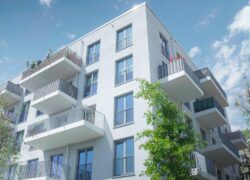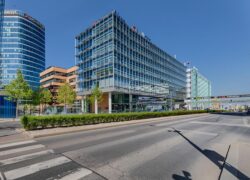
Brumlovka office building in Prague undergoes major renovation

The complete reconstruction of Administrative Building B in the Brumlovka complex has resulted in a remarkable reduction in energy consumption, achieving more than a 50% decrease since its renovation. Originally built in 1999 by Passerinvest Group, a.s., the revitalized building was completed in 2020 and now boasts upgraded energy-efficient technologies and a new facade.

The nine-storey building, which encompasses 14,600 square meters of leasable office space and 1,250 square meters of commercial area, underwent extensive renovations that included the complete overhaul of its exterior and roofing. These updates not only improved the building’s aesthetics but also enhanced the quality of the indoor environment. As a result, Building B now meets the energy label category B, indicating efficient and economical operation.

According to measurements taken before and after the renovation, electricity consumption has plummeted from approximately 3.6 MWh in 2018 to around 1.7 MWh in 2022, representing a reduction of over 50%. Additionally, the carbon footprint associated with electricity and heat consumption has been cut by 65% compared to the building’s original state.

Martin Unger, Technical Director of Passerinvest Group, emphasized the importance of energy efficiency in the decision to renovate. “One of the main reasons for the renovation was the need to enhance energy efficiency, which the building no longer met. Our goal was a comprehensive revitalization that would reduce energy consumption, lessen environmental impact, and improve tenant comfort,” he explained.

Following the renovation, Passerinvest further optimized the operation of ventilation, heating, and cooling technologies in 2022 to maximize energy efficiency. As a result, additional reductions in energy consumption and CO2 emissions were achieved in 2023. “The optimization involved modifying the building’s measurement and control systems, implementing algorithms for HVAC units based on occupancy, and adjusting central temperature settings according to seasonal changes,” Unger noted.

One notable initiative was the introduction of a hygienic material press, which significantly reduced the volume of hygienic paper waste. An analysis conducted in May 2023 revealed that monthly waste included a substantial amount of paper towels, which was subsequently reduced by 17 containers of 1,100 liters each.

The renovation also incorporated blue-green infrastructure features, such as roof gardens and a high-capacity rainwater catchment tank, contributing to sustainable water management around the building.

With a total investment of CZK 470 million (approximately €19 million), the renovation of Building B underscores Passerinvest’s commitment to sustainable practices and enhanced tenant experiences in the evolving landscape of modern office spaces.
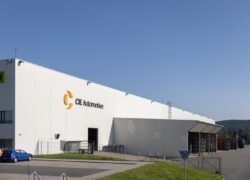

CIE Metal CZ expands again at CTPark Hranice, doubling tts space since 2021

CIE Metal CZ, part of the CIE Automotive Group, is set to double its footprint at CTPark Hranice with a second major expansion since 2021. CTP, the park’s developer, announced that an additional 5,200 square meters will be added to CIE Metal CZ’s existing facilities, with completion expected in the first half of 2025.

CIE Metal CZ, which designs and manufactures components for the global automotive industry, first leased space in CTPark Hranice in 2021. Located strategically near key transport routes, the park provides direct access to motorways connecting to Olomouc, Ostrava, and Poland, making it an ideal hub for automotive and high-tech supply chains.

The decision to expand at CTPark Hranice aligns with the trend of nearshoring, where companies move production closer to their customers in response to shifting geopolitical dynamics. The proximity of the park to CIE Metal CZ’s existing plant in Valašské Meziříčí and its end customers was a crucial factor in the expansion. CIE’s total production capacity in the park will now exceed 13,000 square meters, reflecting growing demand for its services.

The new expansion, located in warehouse HR5, will allow for seamless integration between production and storage, improving operational efficiency. The site is designed to meet CIE’s advanced manufacturing needs, focusing on electromobility and robotics, with facilities optimized for automation.

“Our cooperation with CTP is proving crucial to our long-term goals and development. With each new expansion at CTPark Hranice, we have been able to efficiently increase production capacity while optimising logistics processes. CTPark Hranice has thus become an ideal location for our production and logistics operations, especially thanks to its strategic location and high quality. We are convinced that this new expansion will bring further opportunities for the development of our innovative projects.” explained Michal Curylo, CIE Metal CZ.

“The long-term cooperation with CIE Metal CZ is a great pleasure for us and proves how efficiently the client’s expansion and growth can take place thanks to the flexibility of the premises and quality facilities. The second expansion of the premises in CTPark Hranice beautifully demonstrates that it is possible to grow gradually, adapt to demand and respond to market developments, which is key for us and our clients,” said Vojtěch Peřka, Senior Business Developer at CTP in the Czech Republic.

PTEC: Decarbonising Poland’s heating sector could cost up to PLN 466 billion by 2050

The decarbonisation of Poland’s heating sector will require significant investment, with costs projected between PLN 299 billion and PLN 466 billion by 2050, according to a report by the Polish Society of Thermal Energy (PTEC), formerly known as the Polish Society for Thermal Power Plants (PTEZ). The report emphasizes that achieving these goals will require collaboration among all participants in the heat market.

PTEC has also rebranded to reflect its new mission of promoting sustainable heating solutions in line with European Union climate and energy policies. “Today, district heating in Poland provides thermal comfort for over 15 million people. However, most of the heat still comes from coal,” said Dariusz Marzec, President of PGE Polska Grupa Energetyczna and PTEC. He highlighted that nearly PLN 500 billion is needed for the sector’s transformation, underscoring the importance of creating a supportive legal and regulatory environment, fostering cooperation, and developing financial tools to meet climate neutrality milestones.

The report identifies key technologies that will drive the decarbonisation of Poland’s heating systems, including:

• Gas sources
• Biomass
• Geothermal energy
• Large-scale heat pumps
• Electrode boilers powered by renewable electricity
• Waste heat recovery
• Decarbonized gases

PTEC’s analysis shows that implementing the EU’s “Fit for 55” climate package will require substantial spending across multiple areas:

• PLN 102-211 billion on production infrastructure
• PLN 82-106 billion on transmission and distribution networks
• PLN 115-149 billion on modernizing collection systems

The total investment needed by 2050 ranges from PLN 299 billion to PLN 466 billion, depending on the scenario. The report stresses that effective decarbonization will depend on the involvement of all heat market participants, as their actions are interdependent.

Among its recommendations, PTEC suggests regulatory changes to accelerate the transformation, including:

• Compensating key units for availability in the national power system
• Introducing support mechanisms for Power-to-Heat technologies
• Qualifying heat from renewable sources for energy efficiency metrics
• Expanding the market for trading guarantees of renewable heat origin

Krzysztof Zamasz, Vice President of Veolia Energia Polska, emphasized the importance of financial support for energy companies, as well as the need to adjust heat tariffs to accommodate the sector’s decarbonization. “Investment-backed companies need broad access to financial resources to achieve these goals,” Zamasz stated, noting that simplifying administrative procedures will be essential to accelerating the transformation.

The report concludes that speeding up the investment process, especially regarding environmental impact assessments and heating network upgrades, is critical for Poland to meet its decarbonization targets.

Source: PTEC and ISBnews
Photo: Dariusz Marzec, President of the Management Board of PGE Polska Grupa Energetyczna

World on the brink of a new age of electricity, says International Energy Agency

The International Energy Agency (IEA) has declared that the world stands at the threshold of a new era of electricity, as demand for fossil fuels is projected to peak by the end of the decade. In its newly released World Energy Outlook, the IEA suggests that a surplus in oil and gas supplies could pave the way for significant investment in green energy. However, the agency warns of substantial uncertainty due to ongoing geopolitical conflicts in the Middle East and Russia, both key oil and gas producers. Additionally, this year’s elections in countries responsible for half of the world’s energy consumption add to the unpredictability.

“In the second half of this decade, we could be facing a new energy landscape where sufficient—or even excess—oil and gas supplies exist, depending on how geopolitical tensions evolve,” said Fatih Birol, the IEA’s Executive Director. Birol explained that such a scenario could lower fossil fuel prices and provide countries with the resources to accelerate the transition to clean energy, marking the dawn of what he called the “age of electricity.”

The IEA reported that 2023 saw a record 560 gigawatts (GW) of renewable energy capacity commissioned globally. Looking ahead, an estimated $2 trillion will be invested in clean energy this year, nearly double the investment in fossil fuels. This shift underscores the world’s movement toward decarbonization.

Under current government policies, global oil demand is forecasted to peak at nearly 102 million barrels per day before 2030, before falling back to 99 million barrels per day by 2035, driven primarily by the increasing use of electric vehicles in the transport sector.

The IEA also pointed to rising energy demand from air conditioning as a significant factor in the future. With increasing global temperatures and growing incomes, the demand for air conditioning is expected to surge by 280% by 2050. This will require an additional 697 terawatt hours (TWh) of electricity by 2030, more than three times the demand from computer data centers. Electric vehicles will require even more energy, with an additional 854 TWh needed by the end of the decade.

Oil prices are projected to decline from $82 per barrel in 2023 to $75 per barrel by 2050 under the IEA’s current scenario. However, if governments commit to aggressive emissions reductions in line with net-zero targets, oil prices could drop as low as $25 per barrel by 2050.

This forecast signals a pivotal shift in the global energy landscape, with the potential for cleaner and more sustainable energy sources to take center stage in the coming decades.

The full reporter can be found on the link below:

Source: IEA and CTK

HIH renews lease with Instant Offices at Budapest’s White House complex

HIH Invest Real Estate (HIH Invest) has successfully extended its lease agreement with Instant Offices for 6,116 square metres at the White House office complex in Budapest. The renewal secures the UK-based co-working provider’s presence in the building for another five years, with the space exclusively allocated to a British carmaker.

The White House, completed in 2018, offers a gross lettable area of 22,300 square metres and was acquired by HIH Invest in 2019 for an institutional fund. With nearly full occupancy, the office complex hosts prominent tenants such as fund manager BlackRock and co-working provider Spaces, in addition to Instant Offices. Located on Váci út in Budapest’s 13th district, the property is well-connected to the city’s core via rail, underground, tram, and bus routes.

Oliver Scholtz, Senior Fund Manager at HIH Invest, expressed satisfaction with the lease renewal, citing the active asset management strategy and tenant-focused approach that persuaded Instant Offices to remain. “Our excellent property specifications and responsiveness to tenant needs played a significant role in retaining this valuable client,” said Scholtz.

In terms of sustainability, the White House recently achieved a LEED O+M (Operations and Maintenance) Gold certificate, enhancing its existing LEED Platinum status. This makes it Hungary’s highest-rated building under the LEED system. The LEED O+M certification focuses on the operational efficiency and maintenance practices of the property, underscoring HIH’s commitment to environmental sustainability and tenant wellbeing.

“We place great importance on the environmental aspects of building operation and maintenance, as they contribute to long-term cost savings and enhance indoor environment quality,” explained Malte Wallschläger, Head of Asset Management International at HIH Real Estate. He also highlighted the recent refurbishment of the on-site cafeteria as part of ongoing efforts to improve tenant amenities.

With its prime location and robust sustainability credentials, the White House office scheme continues to attract major international tenants, solidifying its reputation in Budapest’s competitive office market.

PATRIZIA Report: European residential sector expands, offering strong investment opportunities

The European living sector is more expansive and diverse than ever, presenting solid fundamentals for investment, according to PATRIZIA’s newly released European Residential Insights 2024/2025 report. The report, a comprehensive analysis of Europe’s housing markets, highlights stabilizing trends and new opportunities, particularly in the student housing and co-living sectors.

Key insights from the report, which has provided annual analysis of the European residential market for over a decade, show that the housing market remains robust, supported by structural tailwinds. The report emphasizes that despite evolving regulatory challenges, housing markets across Europe are stabilizing, making it an attractive sector for investors with moderate risk appetites.

Positive Outlook for Residential Market

Mahdi Mokrane, PATRIZIA’s Head of Investment Strategy & Research, Co-Head Fund Management, and Head of Fund Management Real Estate, remarked, “PATRIZIA has been successfully investing in residential real estate for 40 years, and the expanding living sector will continue to be a key growth area for the company as we aim to become a EUR 100bn global real assets manager.” Mokrane added that the report offers crucial insights into the residential sector’s underlying drivers and highlights niche sub-sectors, like co-living and student housing, which are becoming increasingly attractive due to ongoing socio-demographic shifts.

The report underlines that the European residential sector remains resilient and continues to grow, driven by strong demand in the occupational market. With the “living” opportunity expanding, the sector is becoming larger and more diverse for institutional investors.

Stabilizing Market Conditions

PATRIZIA’s Chief Urban Economist, Dr. Marcus Cieleback, who leads the report, noted that despite challenges posed by regulatory changes, the market’s fundamentals remain strong. “The market is stabilizing, with trends in prices, valuations, and transaction activity suggesting that we are approaching a bottoming out of the market,” Cieleback said. Improvements in credit markets, driven by increased debt availability and easing credit standards, are further bolstering market conditions. He added, “As interest rates begin to decline and mortgage rates improve, we expect more people will be able to purchase homes, alleviating pressure on the rental market.”

Opportunities in Green Housing and Purpose-Built Student Accommodation

The report also examines the evolution of housing policy over the decades, highlighting the growing importance of “brown-to-green” strategies aimed at upgrading older housing stock for energy efficiency. Many of Europe’s residential buildings were constructed between the 1960s and 1980s, often prioritizing speed over quality due to housing shortages at the time. These older buildings now represent a significant opportunity for green retrofitting.

Additionally, the report underscores the growing demand for affordable housing and purpose-built student accommodation (PBSA). Dr. Cieleback explained, “There is a shortage of affordable housing today, partly due to past regulations that opened social housing stock to the free market. Meanwhile, the student housing market is experiencing a surge in demand, particularly as traditional rental markets struggle to keep up with supply. PBSA represents a strong growth opportunity, as education remains a priority in economically challenging times.”

Voltfang secures over €8 Million in Series A funding to boost green energy storage growth

German green energy storage pioneer Voltfang has raised over €8 million in a successful Series A funding round, which includes €800,000 in secured grants. The oversubscribed round was led by Dutch venture capital firm FORWARD.one, specializing in deeptech investments, with significant backing from Interzero. Existing investors such as PT1, AENU, Helen Ventures, Daphni, Aurum Impact (the family office of Goldbeck), and Maximilian Viessmann also participated.

The new capital injection will enable Voltfang to expand its product portfolio and invest further in its cutting-edge Energy Management System, enhancing the efficiency of its battery storage solutions. The funds will also support the company’s efforts to penetrate both commercial/industrial and grid-scale markets, solidifying its position as a leader in sustainable energy infrastructure and the circular economy.

“We are thrilled to welcome FORWARD.one and Interzero as partners. Their financial support, along with their expertise in hardware, climate tech, and the circular economy, perfectly aligns with our mission,” said David Oudsandji, CEO and co-founder of Voltfang. “Their backing will be invaluable as we continue to innovate and lead in the sustainable energy storage sector.”

Lead investor FORWARD.one expressed enthusiasm for Voltfang’s vision. “Voltfang’s green energy storage solution exemplifies our commitment to supporting companies that address major challenges through advanced hardware and software technologies,” said Beau-Anne Chilla, who oversees climate tech investments at FORWARD.one. “We see their storage systems as critical to Europe’s energy transition and resource independence, and we are excited to support their growth.”

Interzero, which promotes a zero-waste future, also highlighted the alignment between its mission and Voltfang’s approach to energy storage using requalified electric vehicle batteries. Interzero will provide strategic insights on circular economy practices, as well as access to its extensive network, helping Voltfang scale its operations.

Fabian Heilemann of AENU, an existing investor, commented on the critical role of energy storage in Europe’s renewable energy future. “The European power grid is under pressure due to the rapid rise of renewables. Expanding storage capacity is a faster, more cost-effective solution to stabilizing the grid, and Voltfang’s high-performance green storage systems are at the heart of that effort.”

Voltfang CFO Dr. Gerrit Janke underscored the significance of the funding round, noting that some existing investors increased their stakes. “The quick closure of this round in just three months, despite a challenging market for growth capital, reflects strong confidence in our strategy and team,” he said.

Voltfang’s energy storage systems, built from requalified electric vehicle batteries, offer a sustainable solution to the rising energy demands in Europe. The company plans to deploy an additional 40 MWh of battery capacity by 2025, further contributing to the continent’s shift towards renewable energy and efficient power management.

Czech Republic ranks 22nd in Global Economic Freedom Index, slips four places

The Czech Republic has been ranked the 22nd most economically free country in the world out of 165 nations, according to the Economic Freedom of the World Index released by the Canadian Fraser Institute. The report, shared by the Institute of Liberal Studies, indicates a decline for the country, which dropped four spots compared to last year. The overall level of economic freedom in the Czech Republic has also diminished in absolute terms, reflecting a broader global trend.

The index, published annually since 1996, is based on data from 2022 and evaluates countries across five key areas: government size, rule of law, international trade, regulation, and monetary and inflationary environments. This year, Hong Kong retained its position as the world’s most economically free country, while Venezuela ranked last.

According to the report, the Czech Republic saw slight improvements in four of the five assessed categories but suffered significant setbacks in its inflation environment. Inflation surged in 2022, with the country recording an annual average of 15.7%, contributing to its lower ranking.

“Since 2016, economic freedom in the Czech Republic has been steadily declining, with the exception of 2021, the second year of the pandemic, when there was a slight increase in freedom compared to the first pandemic year. This trend is concerning,” said Martin Pánek, director of the Institute of Liberal Studies, in a statement about the latest results.

Despite the slip, the Czech Republic remains one of the more economically free countries in Central Europe. Germany leads the region, ranking 16th globally, while Austria follows closely behind the Czech Republic in 23rd place. Other regional neighbors include Slovakia (45th), Hungary (55th), and Poland (70th).

The Economic Freedom of the World Index underscores the link between economic freedom and prosperity. According to the Institute of Liberal Studies, countries with higher levels of economic freedom enjoy greater prosperity, higher life expectancy, and broader civil liberties. In nations ranked in the top quarter of the index, only 1% of the population lives in extreme poverty (on less than $1.90 per day), compared to 30% in countries in the lowest quarter. Life expectancy also differs dramatically, with a 15-year gap between the most and least economically free countries.

“Where people are empowered to make their own choices and pursue their own happiness, they tend to live longer, healthier, and more prosperous lives,” Pánek added.

Source: CTK

PORR begins construction on “Neue Kohlgärten” residential complex in Leipzig’s Reudnitz District

In Leipzig’s rapidly evolving Reudnitz district, PORR Hochbau Region Ost is set to build a new residential complex named “Neue Kohlgärten,” designed to offer modern and versatile living spaces. The development, commissioned by PROPOS Projektentwicklung GmbH, will feature 28 two- to four-room apartments and 84 rental units. Construction will begin in April 2025, with the first residents expected to move in by November 2026.

The new complex, located at Kohlgartenstraße 63 and Bergstraße 2a and 2b, will cover 2,830 sqm and provide 5,752 sqm of living space. Built to the standards of a KfW Efficiency House 55, the project emphasizes sustainability, urban greenery, and a vibrant community atmosphere. Situated near Leipzig’s city center, Reudnitz has become a highly desirable neighborhood, especially among students and young professionals, thanks to its excellent infrastructure and a growing number of cafés, restaurants, and beer gardens.

The architectural design of “Neue Kohlgärten” is inspired by the historical Gründerzeit style, which once defined the area. Modern features such as balconies, bay windows, and updated color schemes will integrate seamlessly with contemporary living needs. The development at Bergstraße will offer spacious apartments, while the adjacent building on Kohlgartenstraße is designed to cater to the increasing demand for smaller units.

“Neue Kohlgärten” marks the latest collaboration between PORR and PROPOS Projektentwicklung GmbH. The two companies previously partnered on the construction of the Cospuden residential quarter near Leipzig, where PORR’s efficient, high-quality work and cooperative approach earned praise. This strong working relationship continues with the development of the “Neue Kohlgärten.”

As Leipzig’s Reudnitz district grows in popularity, the “Neue Kohlgärten” residential complex is set to provide much-needed housing in a central and up-and-coming area of the city.

Photo: © Renderings Propos BH

Brno court clears Office of misconduct in cancelled construction digitalisation contracts

The Regional Court in Brno has ruled in favor of the Office for the Protection of Competition (ÚOHS), finding no procedural errors in its cancellation of the Ministry of Regional Development’s (MMR) tender for the digitisation of the construction process. The court’s decision, announced today, confirms the OPC’s actions were justified, following a complaint lodged by System Servis, a company that had challenged the contract.

System Servis claimed its exclusion from the tender process was unjust, despite the MMR arguing otherwise. The court ruled that System Servis was indeed eligible to submit its proposal, stating that it was “at least theoretically possible” for the company to participate in the contract. System Servis, often referred to by former Regional Development Minister Ivan Bartoš as a “printer supplier,” had been criticized for not participating in the tender initially. However, the court emphasized that the company is a legitimate IT contractor with a portfolio of relevant experience.

The court’s decision revealed several issues in the MMR’s handling of the tender. Among the most critical were the unclear conditions surrounding the use of software for the project, as well as vague deadlines. These uncertainties, the court ruled, made it difficult for contractors to fully assess their ability to meet the requirements of the tender. Additionally, the ministry’s failure to launch the procurement process early enough was flagged as a contributing factor to the time constraints placed on potential bidders.

The tender in question, titled “Ensuring the Digitisation of the Construction Procedure,” was announced in March 2023 by the Ministry of Industry and Trade. System Servis had filed its complaint after raising multiple objections to the tender process. The company, despite not being directly involved in the original contract, argued that the unclear terms and conditions effectively prevented fair competition.

According to the ÚOHS, the Ministry of Regional Development failed to provide contractors with essential information necessary for completing the contract. For instance, specific delivery deadlines were never set, leaving contractors unsure of how to meet the required timeline. Moreover, the MMR placed conditions on the software that could be used but did not disclose whether it would be compatible with the contract until after it was signed—a key criterion for potential bidders. Despite suggestions from contractors, the ministry refused to amend these conditions.

The court also highlighted the ministry’s delays in initiating the procurement process, pointing out that although the need for a new information system had been known since at least 2021, the tender was not announced until 2023. The court attributed these delays to time constraints that affected the contract, a situation exacerbated by the ministry’s failure to act sooner under the leadership of former Minister Klára Dostálová. A previous contract for digitising construction proceedings was cancelled by Bartoš, who initiated a new tender.

The court’s findings included feedback from 23 suppliers in the sector, many of whom cited the contract’s terms and conditions as reasons for not participating in the tender. The ÚOHS’s survey of these suppliers was found to be sufficiently representative by the court.

The ruling comes as the government prepares to address the future of the construction digitisation process. Transport Minister Martin Kupka is set to present an analysis to the government on Wednesday, outlining options for either continuing the development of the existing system or starting over with a new tender. Kupka has taken on the responsibility for overseeing the project following Prime Minister Petr Fiala’s recommendation to dismiss Bartoš due to ongoing issues with the digitisation system.

Kupka, along with new Regional Development Minister Petr Kulhánek, is also working on legislative changes that could allow both the current and any new systems to operate concurrently. This would enable construction documentation to remain in digital form, streamlining the process.

Meanwhile, the opposition Pirates Party, led by Jakub Michálek, has called for a pragmatic approach. Michálek stressed the importance of completing the digitisation process without further delay, warning that starting from scratch could push the project’s completion to 2028. “We advocate for a ‘partial bypass,’ allowing both systems to function side by side temporarily. This would ensure that construction documentation remains digital, avoiding the slow and cumbersome process of manual transfers between authorities,” Michálek said in a press release.

The government’s decision on how to proceed with the digitisation project is expected to be a pivotal moment in determining the future efficiency of the Czech Republic’s construction processes.

Source: CTK

front page info
LATEST NEWS