Harden Construction begins vertical works on first Czech project in Most

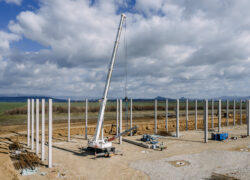
Harden Construction has reached an early construction milestone on its first project in the Czech Republic, with the erection of the first column at a site in the Joseph industrial zone near Most.

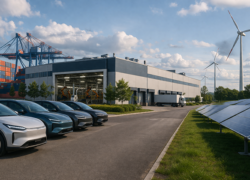
The development involves a new industrial hall that will be used as a distribution centre for an international toy manufacturer. Once completed, the facility is expected to provide approximately 52,000 sqm of warehouse and logistics space.

The installation of the first column marks the transition from initial groundwork to above-ground construction. The project began during the winter period, with weather conditions affecting early-stage earthworks. According to the contractor, coordination between project teams allowed works to continue despite these challenges.

“Erecting the first column is a powerful and very important moment for us. It is not only a technical milestone but also confirmation that we were able to successfully launch the project even under challenging conditions. This is our first project in the Czech Republic, which is why we place even greater emphasis on quality, safety, and the smooth progress of construction,” said Marek Čepela, Executive Director of Harden Construction CZ.

The scheme includes deep foundation works to support the prefabricated structure. Construction is being carried out with the use of digital tools, including bulldozers equipped with 3D control systems that operate based on terrain models to improve accuracy and efficiency.

“This technology enables faster progress, reduced material consumption, and greater precision, but it also places high demands on the team’s coordination. Thus, in addition to heavy machinery, digital planning and coordination of individual steps play an important role on the construction site. It is precisely the combination of modern technology and an experienced team that has made it possible to move the project forward despite the complicated start of the winter season,” added Čepela.

The project is targeting BREEAM New Construction certification at the “Excellent” level, reflecting a focus on environmental standards. Further structural works are scheduled in the coming months as the building progresses.

Germany inflation rises in March, driven by energy prices

Consumer prices in Germany increased more quickly in March, according to preliminary figures from Destatis, signalling a shift after several months of more moderate inflation.

Annual inflation reached 2.7 percent, up from 1.9 percent in February, while prices rose by 1.1 percent compared with the previous month. Using the EU’s harmonised measure, inflation was estimated at 2.8 percent, reflecting a similar upward trend.

The increase was largely linked to higher energy costs, which rose sharply compared with the same period last year, reversing earlier declines. Food prices continued to grow at a slower pace, while services remained one of the more persistent sources of price pressure. Excluding energy and food, underlying inflation held steady, indicating that broader price dynamics have not yet accelerated significantly.

The latest data comes against a backdrop of renewed volatility in global energy markets, with supply disruptions affecting key transport routes such as the Strait of Hormuz. These developments have contributed to rising fuel costs, which are beginning to feed into the wider economy.

Economists expect the impact to continue in the coming months. Analysts at ZEW Mannheim noted that price growth in services had already remained elevated prior to the recent energy developments, suggesting inflation could move higher in the near term.

At Commerzbank, economists pointed to the risk that higher energy costs will gradually be reflected across supply chains, increasing production expenses for businesses. Researchers at Pantheon Macroeconomics also highlighted potential delayed effects on food prices, linked to disruptions in fertiliser supply and transport.

Germany’s recent inflation trends follow a period of sharp price increases after the Russian invasion of Ukraine, when energy costs pushed inflation close to record levels. Although inflation eased significantly over the past two years, the latest data suggests that external shocks can still influence price stability.

As Europe’s largest economy, Germany’s inflation outlook remains closely watched across the region, particularly by neighbouring markets that are closely linked through trade and industrial supply chains.

Cancom leases 4,800 sqm in Garbe Industrial project in Norderstedt

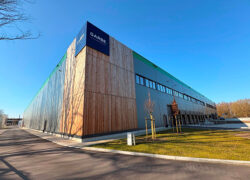
IT service provider Cancom has leased approximately 4,800 sqm of space in a newly developed Garbe Industrial property in Norderstedt, near Hamburg. The facility will be used as a logistics and service centre, referred to by the company as a Service Factory.

The leased area includes around 4,100 sqm of hall space, 400 sqm of office and social areas, and close to 300 sqm of warehouse space. The lease term is 15 years.

The site will support a range of services, including procurement, storage, processing and delivery of hardware, as well as software installation and refurbishment of returned equipment. Cancom expects to begin operations in the third quarter of 2026 and plans to create up to 100 jobs across logistics, services and technical roles.

“With Cancom, we are welcoming the first tenant to our new building,” said Julia Schoer, Regional Manager North at Garbe Industrial. “We developed and constructed the property with a view to the future because we are convinced of the attractiveness of the location. The fast leasing success proves us right. And it shows that modern logistics properties are evolving into multifunctional properties that can be used for much more than storage, handling and distribution.”

Cancom, headquartered in Munich, is expanding its logistics network in Germany through this lease. “With this lease, we are not only expanding our network of locations but also establishing a state-of-the-art Service Factory in northern Germany for the first time. We are planning to create up to 100 new jobs in Norderstedt in the areas of logistics, services, project management and service technology,” said Markus Konhäuser, Service Factory Director at Cancom.

Local authorities also highlighted the significance of the transaction. “This contract and the resulting relocation show how attractive Norderstedt is as a business location,” said Marc-Mario Bertermann, Managing Director of the Norderstedt Development Corporation.

The property is located in the Schützenwall industrial area on a 29,500 sqm site and has been developed to meet sustainability standards, including connection to district heating and certification under the German Sustainable Building Council’s Gold standard.

BlueRock Group AG extends leases at Duisburg-Ruhrort complex

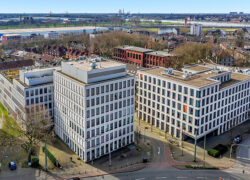
BlueRock Group AG has agreed two long-term lease extensions covering approximately 7,600 sqm of space within its office and healthcare complex in Duisburg.

The property, located in the Ruhrort district, includes the Medical Centre Ruhrort at Ruhrorter Strasse 195 and the Business Centre Ruhrort at Dr Hammacher Strasse 49.

At the Medical Centre Ruhrort, the Public Health Department of the City of Duisburg has extended its lease for around 4,000 sqm, which it has occupied since 2011. The building, completed in 2007, also accommodates a private clinic, a diabetology centre, an orthopaedics practice and a wound care facility.

At the Business Centre Ruhrort, HGK Shipping GmbH has renewed its leases for approximately 3,600 sqm. The company has been based in the building since 2017. The property was completed in 2004.

BlueRock acquired the complex in 2016. The asset comprises around 12,350 sqm of lettable space and is currently 93 percent occupied. It is located within walking distance of Port of Duisburg and is served by local public transport connections.

HEUSSEN Rechtsanwaltsgesellschaft advised on the legal aspects of the lease extensions, while Völkel Real Estate continues to act as property manager.

European Commission urges Slovakia to end dual diesel pricing as government defends policy

The European Commission has called on Slovakia to withdraw measures introducing different diesel prices, warning that the approach may breach EU law. The Slovak government has indicated it may maintain or extend the policy and has criticised the Commission’s position.

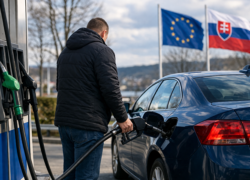
The measures were introduced following disruptions to oil supplies linked to the Druzhba pipeline, which halted deliveries to Slovakia and Hungary in January. In response, Bratislava declared a state of oil emergency and imposed temporary restrictions on diesel sales, including higher prices for vehicles with foreign licence plates.

According to the European Commission, the pricing structure is discriminatory and incompatible with EU rules. It has warned that infringement proceedings could be launched if the measures are not withdrawn.

Slovak Prime Minister Robert Fico criticised the Commission’s intervention, stating: “I consider the letter to be absolutely inappropriate, incorrect to the Slovak Republic.” He added that any legal action could result in financial penalties imposed by an EU court. Fico also suggested the government may extend the current measures, arguing they are intended to protect domestic consumers from rising fuel costs.

The policy was introduced after supply disruptions along the Druzhba pipeline, which Slovakia and Hungary say have been affected by developments linked to the war in Ukraine. Kyiv has indicated that damage to infrastructure caused by Russian attacks has affected the pipeline’s operation.

Slovakia’s Minister of Economy Denisa Saková said the Bratislava refinery Slovnaft had drawn on state oil reserves following the disruption and has begun returning the volumes used. The government has argued that this justifies its approach to managing fuel distribution.

Fico also criticised the European Commission for what he described as insufficient engagement in restoring oil flows via Ukraine and commented on relations between EU leadership and Volodymyr Zelensky. “The European Commission has decided to put the interests of Ukraine, a non-member country, over the interests of a member country, the Slovak Republic,” he said.

Slovakia and Hungary have maintained energy imports from Russia during the ongoing conflict in Ukraine, while other countries in the region, including Czech Republic, have reduced or eliminated dependence on Russian oil.

The dispute comes amid broader volatility in global energy markets following the escalation of conflict in the Middle East in late February. Oil prices have increased, although fuel price growth in Slovakia has been more moderate compared with some other EU countries.

Source: CTK

Hungary’s youth surge challenges long-standing political order ahead of April vote

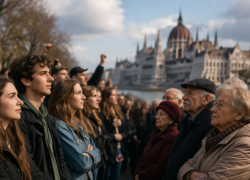
Hungary’s upcoming parliamentary election is increasingly being shaped by a clear divide between generations, as younger voters show growing support for a political alternative to the country’s long-serving leadership, while older citizens largely remain aligned with the current government.

In the weeks leading up to the 12 April vote, grassroots campaigning by younger supporters has become more visible across smaller towns and regional centres. Many in their twenties, having grown up entirely under the same political leadership, are now actively engaging in efforts to encourage change, reflecting a broader shift in political participation among younger Hungarians.

At the centre of this momentum is Péter Magyar, a former insider of the governing political structure who has repositioned himself as a challenger. His political platform has gained rapid traction, particularly among voters who had previously remained disengaged from public life. Surveys conducted in recent months suggest that younger demographics are significantly more inclined to support his movement, while backing for the ruling party remains strongest among pensioners and in rural areas.

Analysts point to a deeper structural transition underway. A generation that once defined Hungary’s political direction following the end of communism is now being confronted by a younger cohort shaped by different priorities, including economic prospects, transparency in governance and the country’s broader international alignment. This shift is not only ideological but also reflects changing expectations about the role of institutions and public accountability.

Recent political developments have further intensified engagement, particularly among younger voters. A high-profile controversy in 2024 involving a presidential pardon triggered widespread public reaction and is widely seen as a catalyst for renewed interest in political participation. In its aftermath, new political forces have emerged, reshaping the electoral landscape and narrowing what was once a dominant lead for the governing party.

Despite these changes, the outcome of the election remains uncertain. The incumbent leadership continues to benefit from established support networks, particularly outside major cities, as well as policies that resonate with older voters, including pension measures and family-related incentives. The campaign has also increasingly emphasised stability and continuity, framing the election as a choice between experience and risk.

The contest has grown more polarised in recent weeks, with disputes over institutional fairness, media conditions and campaign practices adding to an already tense political environment. While opposition forces appear to have gained momentum, Hungary’s electoral dynamics suggest that turnout and regional voting patterns will play a decisive role.

As the country approaches election day, the balance between continuity and change may ultimately rest on whether the emerging political engagement among younger voters translates into a sustained shift at the ballot box.

GIOŚ relocates headquarters to HOP office building in Warsaw

Chief Inspectorate for Environmental Protection (GIOŚ) has leased 4,600 sqm of office space in the HOP building at 132/134 Chmielna Street in Warsaw. The institution has been operating from the new location since January 2026 under a long-term lease agreement.

GIOŚ is a public administration body responsible for overseeing compliance with environmental regulations in Poland. Its responsibilities include inspections, environmental monitoring across air, water, soil and noise, as well as oversight of waste management and cooperation with other public services.

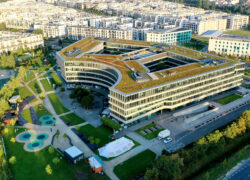
The HOP office building, owned by Syrena Real Estate, has undergone refurbishment in recent years with backing from PineBridge Benson Elliot. The upgrade included changes to the building’s façade and the creation of a public square of approximately 600 sqm in front of the property. Interior updates include co-working space, conference facilities totalling around 1,000 sqm, bicycle infrastructure and electric vehicle charging points in the underground car park.

The building provides more than 14,000 sqm of leasable space across six above-ground floors and one underground level. It holds BREEAM In-Use Excellent and WELL Health and Safety certifications, as well as a “Barrier-Free Facility” designation.

Other tenants at HOP include YOPE, Aplikacje Krytyczne, BNP Paribas Bank Polska, ERM Polska, Evergreen and Żabka. Syrena Real Estate also has its headquarters in the building. A LUPO Pasta Fresca restaurant operates on the ground floor.

Bel-Pol leases 5,600 sqm at Panattoni Park Warsaw North III

Bel-Pol has leased more than 5,600 sqm of warehouse and office space at Panattoni Park Warsaw North III, a logistics development in the north-eastern part of the Warsaw market. AXI IMMO advised the tenant.

The company, which operates a nationwide network of around 100 showrooms, continues to develop its logistics infrastructure alongside its retail and e-commerce operations. Its product range includes flooring and door solutions for private clients, architects and contractors.

Zdzisław Strumidło, Vice-President of the Management Board at Bel-Pol, said: “We have decided to launch a new Bel-Pol warehouse in Kobyłka, which will significantly strengthen our logistical and operational capabilities in the Warsaw region. This is an important stage in the further growth of our company and a response to the increasing demands of the market and our business partners. This investment marks another step in delivering Bel-Pol’s long-term development strategy, aimed at improving operational efficiency, enhancing the quality of customer service and consistently strengthening our market position. As part of the transaction, the company will occupy more than 5,150 sqm of modern warehouse space, supplemented by approximately 500 sqm of functional office and staff facilities. The new location has also been designed to provide employees with comfortable, safe and modern working conditions that meet the highest organisational and technological standards. The opening of the Kobyłka warehouse also confirms our ongoing commitment to supporting the local economy and maintaining our long-term presence in the region.”

Klaudia Markowska, Associate Director, Industrial & Logistics Agency at AXI IMMO, said: “After many years of operating in its previous location, the client decided to relocate and expand, choosing the north-eastern part of Warsaw as the new direction for development. Excellent transport accessibility – the immediate proximity of the ring road of Warsaw and the location right next to a major road junction – was a key factor, ensuring smooth logistics and distribution operations. Equally important were the greater possibilities for future expansion and flexible scaling of the business, which in today’s market conditions constitute an essential element of long-term operational strategy. Finalizing this transaction also marked the completion of the commercialisation process for the entire park.”

Sylwia Robakiewicz-Mokwińska, Asset Management Director at Panattoni, added: “We are pleased to welcome Bel-Pol as a tenant at Panattoni Park Warsaw North III. The high standard of the facility and its excellent location will provide the tenant with stable conditions for further growth. Another lease agreement confirms the attractiveness of this project for the business community. Panattoni’s developments combine technical quality, flexibility and long-term value for tenants, supporting the growth of both local companies and businesses operating on international markets.”

Panattoni Park Warsaw North III is located in Kobyłka, near the S8 expressway. The project is planned to comprise three warehouse buildings with a total area of approximately 75,000 sqm and is expected to obtain BREEAM certification at the Excellent level.

Chinese capital in Europe’s EV sector: will Poland attract investment or remain a sales market?

EU tariffs on Chinese electric vehicles were introduced to support European manufacturers, but they are also contributing to a shift in strategy among Chinese companies. Rather than relying solely on exports, several manufacturers are increasing their focus on establishing production capacity within Europe, reflecting a broader “local for local” approach.

This trend is visible across the automotive and battery sectors, where Chinese firms are exploring or developing projects in multiple European countries. The outcome for individual markets, including Poland, will depend on investment conditions, regulatory frameworks and geopolitical considerations.

When selecting locations for large-scale manufacturing projects such as battery plants, investors typically assess energy costs, labour availability, logistics, incentive schemes and regulatory stability. Within Europe, Hungary and Spain are often cited alongside Poland as competing destinations, reflecting their differing cost structures and policy approaches.

Chinese automotive brands have expanded their presence in several European markets, including Poland. However, claims of “double-digit” market share in Poland in 2025 should be treated with caution. While registrations of Chinese brands have increased rapidly, publicly available industry data suggests their overall market share remains below 10 percent, albeit growing. In the plug-in hybrid segment, Chinese manufacturers have gained share, but statements that they account for over half of new registrations are likely overstated. The broader trend remains that demand for electric and hybrid vehicles in Europe continues to grow, while affordability constraints persist, creating opportunities for new entrants.

Poland’s industrial and logistics sector continues to show stable demand. Annual gross take-up has exceeded 6 million sqm in recent years, although this varies depending on methodology and timing. New supply has slowed compared with peak levels, and vacancy rates in the range of 7–8 percent are broadly consistent with market reports. A high share of lease renegotiations reflects tenant retention rather than a clear expansion in new demand.

Comments from market participants highlight differences in how Chinese investors perceive European markets. Jan Kamoji-Czapiński of Colliers said: “In China, investors are accustomed to a model where the administration acts as a comprehensive service centre, supporting the investor at every stage – from permits to recruitment. In Europe, they encounter a fragmented system of institutions, which can be a source of uncertainty… they are increasingly turning to professional consultants in tax, legal and property matters.” Tammy Tang, Managing Director of Colliers in China, added: “Chinese investors are familiar with Western Europe and appreciate its mature industrial structure. At the same time, interest in Poland has been growing significantly over the last five years… investors analyse the stability of the business environment, the availability of workers and openness to foreign capital.”

Energy costs remain a key factor in battery production. Spain has generally reported lower industrial electricity prices than Poland and Hungary in recent periods, although exact figures vary depending on contracts, subsidies and market conditions. Poland’s electricity grid is widely considered reliable, though precise comparative uptime figures are difficult to verify across countries. Labour costs in Hungary are typically lower than in Poland and Spain, while Poland benefits from a relatively large workforce, including foreign labour. Spain offers access to a broader labour pool but is often seen as more regulated.

From a logistics perspective, Poland’s proximity to Germany and major EU manufacturing hubs is a recognised advantage, particularly for automotive supply chains. Access to Baltic ports such as Gdańsk and Gdynia supports trade flows. Hungary, as a landlocked country, relies on overland transport, while Spain’s logistics strengths are more regionally focused.

In terms of incentives, Hungary has actively used state aid to attract industrial investment, often through individually negotiated packages. Poland’s system is more standardised, based on instruments such as the Polish Investment Zone, offering tax incentives with regional variations. While Poland is generally seen as a stable regulatory environment, investor perception can be influenced by political signals and broader geopolitical positioning.

Geopolitical considerations are playing a growing role in investment decisions. Poland’s alignment with the United States and its cautious stance towards China may be viewed differently by investors compared with countries that pursue a more open approach to Chinese capital. There is evidence that some investment projects in Europe have been reassessed or relocated between countries, although such decisions are typically driven by a combination of economic, regulatory and political factors rather than geopolitics alone.

The expansion of Chinese manufacturing capacity in Europe is progressing, although unevenly across markets. For Poland, the outcome will depend on how it balances competitiveness, regulatory clarity and geopolitical positioning. The question is not only whether Chinese capital will enter Europe, but how individual countries position themselves within this evolving industrial landscape.

Source: Colliers

Royal Wilanów changes ownership in Warsaw transaction exceeding €100 million

Capital Park Group has sold the Royal Wilanów complex in Warsaw to Czech real estate fund WOOD & Company in a transaction valued at over €100 million. The property provides 37,000 sqm of lettable space and is fully leased.

Located in the Wilanów district of Warsaw, the mixed-use scheme includes approximately 25,000 sqm of office space within a five-storey Class A building. The remainder is allocated to retail and service functions, including dining, shops, a kindergarten, fitness facilities and medical services. The complex also provides 908 underground parking spaces. Tenants include Hilti Polska, Erbud, Carrefour Polska, MJM Holdings, Benefit Systems, Lindt & Sprüngli Polska, Medicover and LUXMED.

“Royal Wilanów is much more than just a building for us. It has also been the headquarters of our company for many years. Since its opening in 2015, we have been consistently developing this place and taking care of its day-to-day operations, watching with pride as it became an integral part of the Wilanów district and a popular destination for the local community. We are pleased that the project is now in very good hands and we remain involved as the property manager, ensuring continuity for our tenants and partners,” said Marcin Juszczyk, Managing Partner and Vice President of the Management Board at Capital Park Group.

Following the acquisition, WOOD & Company has increased its exposure to the Polish office market. The transaction represents its fifth investment in Poland and its third office asset in Warsaw, after Astrum Business Park and Concept Tower.

“Royal Wilanów is a unique complex that combines offices with retail, services and leisure areas, creating a vibrant environment for both tenants and the local community. A diversified base of more than 80 tenants and the building’s historically high occupancy perfectly reflect our investment strategy focused on high-quality assets with attractive long-term returns,” said Jan Kolb, Investment Manager at WOOD Real Estate.

“The acquisition of the Royal Wilanów project is fully aligned with our long-term investment strategy, which aims to strengthen exposure in key Central European markets, particularly Poland, one of the largest and most liquid real estate markets in the region. The transaction contributes to the further geographical diversification of the Office and Retail sub-funds’ portfolios and supports the stability of long-term returns,” added Jiří Hrbáček, Portfolio Manager at WOOD Real Estate.

CBRE, MDDP and Greenberg Traurig advised Capital Park Group on the sale, while WOOD & Company was advised by Avison Young, CMS and Koda.

front page info
LATEST NEWS