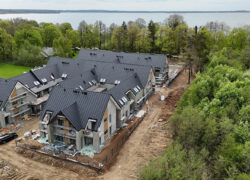
Housing completions in Poland expected to rise modestly in 2026

The number of newly completed apartments delivered by residential developers in Poland is expected to increase in 2026, following a recovery that began last year after a period of declining output. Industry estimates suggest that completions could reach around 140,000 units this year, compared with approximately 134,000 units delivered in 2025.

The improvement comes after two weaker years, as development activity slowed in response to rising interest rates and shifting demand conditions. The higher number of apartments completed in 2025 reflected projects that were launched roughly two years earlier, when market conditions were more favourable. Last year’s outcome therefore marked a turning point, with completions rising by around eight percent compared with the previous year.

The outlook for 2026 is linked mainly to the strong level of construction starts recorded in 2024, when developers initiated a large number of projects. Given typical construction timelines, these schemes are now moving toward completion, supporting expectations of a further increase in housing supply. If realised, the projected volume would bring the market closer to the levels seen during the peak years earlier in the decade.

In 2025, developers began construction on nearly 130,000 apartments. This result was achieved despite relatively high borrowing costs and an unusually large stock of homes already available for sale, factors that encouraged a more cautious approach among investors. Compared with the previous year, the number of new projects launched declined, reflecting the absence of extraordinary demand stimuli and a more balanced, market-driven pace of activity.

Recent months have brought some easing of financing conditions and signs of renewed buyer interest, which may help sustain development activity in the near term. However, maintaining such high levels of output over a longer period could prove challenging, given the still-elevated supply of unsold units in some markets.

Looking further ahead, industry representatives expect the number of newly launched residential projects to stabilise rather than grow sharply, with annual figures likely to remain broadly in line with current levels. This reflects a balance between gradually improving demand and the need to absorb the existing housing stock.

At the same time, the number of building permits issued last year declined compared with 2024, pointing to a more measured pipeline of future projects. Developers have increasingly focused on selling completed or near-complete apartments rather than expanding aggressively into new schemes, a trend particularly visible among smaller companies and in cities where supply has risen rapidly.

Overall, the residential market is entering 2026 with signs of stabilisation rather than rapid expansion. While the expected increase in completed apartments indicates a healthier development cycle, the sector remains shaped by cautious planning, selective investment and close attention to demand conditions.

Improving liquidity in Poland’s tourism sector ahead of winter holidays

Poland’s tourism industry is entering the winter holiday season with signs of improving financial stability, as overdue debts among hotels and travel agents continue to decline. According to the latest data from BIG InfoMonitor and the BIK, the total outstanding liabilities of hotels and tourist agencies remain close to PLN 1 billion, but the overall trend points to a gradual reduction. At the same time, consumer sentiment remains cautious, with households increasingly prioritising savings over discretionary spending.

Data from the registries show that overdue debt in the hotel sector declined by around seven percent year on year, while liabilities among travel agents fell by approximately 3.5 percent. Hotels are entering the winter season with outstanding obligations totalling PLN 842.4 million, a level that reflects continued improvement compared with previous years. Despite this progress, the sector still faces challenges related to payment discipline, as the share of companies struggling with timely settlement of liabilities remains higher than the economy-wide average.

An analysis of developments over the past three years highlights a gradual stabilisation of the tourism sector’s financial position. At the end of November 2023, overdue hotel debt stood at PLN 938.2 million. A year later, the total declined to PLN 905.1 million, although the number of indebted entities increased. The most recent data from November 2025 show a clearer improvement, with arrears falling to PLN 842.4 million and the number of indebted hotels decreasing. Even so, between 7.5 and 8 percent of hospitality companies continue to face payment difficulties, compared with around 4.5 to 5 percent across the broader economy.

Regional data indicate uneven conditions across the country. In regions closely associated with winter tourism, such as Silesia and Lower Silesia, the tourism sector’s outstanding debt remains relatively high, at PLN 92.5 million and PLN 84.2 million respectively. However, the downward trend seen in recent years has allowed businesses in these areas to enter the season with greater confidence. In Małopolska and Podkarpacie, regions popular with winter sports enthusiasts, outstanding liabilities are lower, amounting to PLN 37.3 million and PLN 18.7 million respectively. Although Podkarpacie still records a relatively high share of companies with arrears, the situation has improved compared with previous years, suggesting a gradual rebuilding of financial stability even in more challenged areas.

A similar pattern can be observed among travel agents and tour operators. While demand for travel is spread more evenly throughout the year, peak periods such as winter holidays still translate into higher booking volumes and improved cash flow. After a difficult 2024, when the number of agencies with overdue liabilities increased, the latest figures show a recovery. Outstanding debt among travel agents now totals PLN 71.7 million, and the number of indebted entities has fallen, pointing to a gradual improvement in the sector’s financial position.

According to Paweł Szarkowski, President of the Management Board of BIG InfoMonitor, the data suggest that the tourism industry has moved beyond a survival phase and entered a period of gradual stabilisation. He noted that companies have increasingly been able to use the recovery in demand to strengthen their balance sheets, rather than merely financing day-to-day operations, and that the simultaneous reduction of debt in both hotels and travel agencies indicates that restructuring measures introduced after the difficult year of 2024 have had a lasting effect.

On the demand side, however, consumer behaviour remains cautious. Research commissioned by BIG InfoMonitor shows that many households are weighing travel plans against the need to build financial reserves. Around one in three respondents plans to save money for potential future difficulties, while 30 percent intend to travel this year and a further quarter have yet to make a decision. Savings have become a central theme for 2026, with more than one fifth of respondents planning to set aside larger sums than last year, often by cutting everyday expenses. For many households, winter trips and short holidays are increasingly seen as discretionary spending that can be reduced or postponed in favour of building a financial buffer.

This cautious approach reflects broader expectations about personal finances. A significant share of respondents expects their financial situation to remain unchanged in 2026, which directly influences decisions on travel and leisure. As a result, consumers are more likely to opt for cheaper accommodation, limit additional attractions or shorten trips.

Waldemar Rogowski, chief analyst at BIG InfoMonitor, said that today’s tourists are increasingly analysing costs and planning travel with greater care. In his view, the lack of expectations for a significant improvement in household finances means that while travel remains an important part of lifestyle choices, financial security is taking precedence. This, he added, poses a challenge for the tourism industry, which must respond not only with attractive offers but also with greater cost transparency and predictability.

Czech business and consumer confidence in January broadly stable, consumer sentiment declines

Confidence in the Czech economy remained largely unchanged in January 2026, with the composite economic sentiment indicator holding at the same level recorded in December, according to the Czech Statistical Office release based on the latest Business Cycle Surveys. The overall confidence indicator stayed at 100.2 points, slightly above its long-term average, reflecting a balance between modest gains in business sentiment and weaker consumer confidence.

The business confidence indicator increased marginally in January, rising by 0.6 points to 98.6, while the consumer confidence indicator declined by 2.8 points to 108.2. Among business sectors, sentiment improved in selected services, industry and trade, but fell in construction.

Specifically, confidence among service providers strengthened modestly in January, while industry and trade recorded smaller increases. In contrast, businesses in the construction sector reported a decline in confidence compared with December. The data suggest that firms in some sectors are more optimistic about near-term conditions, even as challenges persist in others.

Consumer confidence weakened during the month, with a larger share of households expressing expectations that the overall economic situation in the Czech Republic would deteriorate over the next year. At the same time, there was a slight increase in the share of households expecting an improvement in their own financial situation over the coming 12 months and a small rise in the proportion who view their current finances as worse than a year earlier. The number of consumers planning to forgo major purchases in the next year also increased.

The January survey results reflect data collected in mid-January and form part of the Czech Statistical Office’s ongoing monitoring of business and consumer attitudes. The surveys are used to gauge short-term economic trends and contribute to broader assessments of economic conditions in the Czech Republic.

The release also notes a change in the base period used to calculate the long-term average of the confidence indices. For 2026, the long-term average is calculated from January 2003 through December 2025, and this adjustment will be maintained in future January releases.

The next Business Cycle Surveys release is scheduled for 24 February 2026.

Source: CSO

Prague office completions fall to lowest level since records began

Developers in Prague completed just 26,600 sq m of new office space in 2025, marking the lowest annual volume since systematic monitoring began in 1993. Despite the limited supply, demand for office leasing last year exceeded the five-year average by eight percent, according to data compiled by the Prague Research Forum, which aggregates market information from leading real estate consultancies. By comparison, 72,800 sq m of office space was delivered in the Czech capital in 2024.

Only two office projects were completed in Prague during the final quarter of 2025. These included the PernerKarlín development, which delivered 9,300 sq m of space, and the reconstruction of the Panorama Airport Building, adding a further 2,000 sq m. In total, five office projects were completed during the year, compared with eight in 2024.

At the end of 2025, Prague’s total modern office stock stood at approximately 3.94 million sq m. A further 36,700 sq m of new office space is expected to be completed in 2026.

Construction activity is set to increase in the coming years, with around 263,300 sq m of office space currently under development and scheduled for completion between 2026 and 2028. Although this represents the highest volume of office construction since 2019, more than 60 percent of the space under construction has already been pre-let or occupied.

According to Petr Kareš, Head of Tenant Representation at iO Partners, the market currently offers only a limited amount of newly available office space. At the same time, some tenant companies are streamlining their operations and returning surplus space to the market. He added that several new development projects are in preparation and are expected to become available towards the end of 2027 and in the first half of 2028.

Construction started on two office schemes in Prague during the final quarter of last year. Passerinvest Group began work on the Orion building in Prague 4, which will provide 19,300 sq m of office space. Meanwhile, Mount Capital launched another phase of the E Factory redevelopment in Prague 9, where an additional 5,200 sq m of office space is planned.

Although overall leasing activity in 2025 was above average, demand weakened towards the end of the year. In the fourth quarter, office leasing volumes fell by 19 percent compared with the previous quarter and by 24 percent year-on-year. Tenant demand was concentrated primarily in Prague 5, followed by Prague 2 and Prague 1. Manufacturing companies accounted for more than 20 percent of the total leased area in the final quarter, ahead of pharmaceutical and healthcare occupiers.

Prime office rents in Prague remained unchanged in the last quarter of 2025. In the city centre, headline rents for new office space ranged between €29 and €30 per sq m per month. In inner-city locations, rents stood at €19.50 to €20.50 per sq m, while offices on the outskirts of Prague were offered at €15.50 to €16.50 per sq m.

Source: CTK

Prague tops Eastern Europe in cost of living ranking

Prague has been identified as the most expensive city in Eastern Europe in terms of overall cost of living, according to data from the Numbeo. The ranking combines everyday household expenses with housing and rental costs, offering a broader view of the long-term financial demands of living in individual cities. Bratislava and Warsaw followed Prague in the regional comparison, while Budapest ranked noticeably lower.

The combined index reflects prices of food, services, transport, restaurants and energy, while also factoring in rent levels. By linking daily expenses with housing costs, the index aims to show how financially demanding it is to live in a city over time, rather than focusing solely on short-term consumer spending.

According to analysts, housing plays a decisive role in Prague’s position at the top of the ranking. David Eim, analyst at Cheetah Finance, pointed to the long-term shortage of new residential construction in Prague and other large cities, which has failed to keep pace with demand. This imbalance, he said, has driven up both property prices and rents, increasing pressure on household budgets.

While the differences in basic living costs across the region’s cities are relatively moderate, the inclusion of housing costs clearly pushes Prague ahead of its peers. Lukáš Raška, an analyst at Port, said that expensive housing and related costs account for a substantial share of household expenditure in the Czech capital. In his view, rents and property prices in Prague have risen faster than wages for a prolonged period, while the supply of new apartments remains limited. As a result, even households with comparatively higher incomes spend an above-average share of their budgets on housing.

Other Czech cities such as Brno, Ostrava and Plzeň ranked significantly lower than Prague in the combined index, suggesting that high living costs are concentrated primarily in the capital rather than across the country as a whole. Daniel Horňák, analyst at Bidli, noted that Prague has long been the most expensive city in the region in terms of both owner-occupied and rental housing. He also highlighted that four Czech cities appear among the twelve most expensive in Eastern Europe, underlining the strong concentration of price pressures in larger urban centres.

At the same time, Horňák added that the rental market in Prague may be approaching its limits for further growth, while other regions could still see room for increases.

Numbeo operates as a global database on the cost of living and quality of life, drawing on millions of price observations submitted by contributors worldwide. Its datasets cover housing prices, consumer costs, transport, healthcare and other indicators, allowing for international and regional comparisons.

Source: CTK

Czech apartment rents rise 16% year-on-year in the fourth quarter

Rents in the Czech Republic rose by 16 percent year-on-year to an average of CZK 19,529 in the fourth quarter of 2025, according to an analysis by UlovDomov.cz. Compared with the third quarter, rents increased by a further four percent. The data also show that, in many cases, monthly mortgage payments for purchasing an apartment remain almost twice as high as the cost of renting.

According to Michal Hrbatý, director of UlovDomov.cz, the figures confirm continued upward pressure on rents in larger cities, particularly for smaller apartments with layouts of 1+kk and 2+kk. These units are most in demand among individuals, couples and students. The strongest percentage increases were recorded in Brno, Ostrava and Olomouc, especially for newer and smaller apartments.

In Prague, rents increased by between seven and 13 percent compared with the fourth quarter of 2024. On a quarter-on-quarter basis, however, rents in the capital were mostly lower. A similar pattern was observed in Brno, where rents rose by one to 17 percent year-on-year, while prices remained largely stable compared with the previous quarter.

Ostrava saw a more differentiated development. Rents for modern and smaller apartments increased markedly on a quarter-on-quarter basis, with 2+kk and 3+kk units rising by around 14 percent. In contrast, rents for layouts such as 1+1, 2+1 and 3+1 declined by between two and seven percent.

At the end of 2025, the average rent for a 2+kk apartment stood at around CZK 23,800 in Prague and approximately CZK 20,000 in Brno. In Ostrava, such an apartment rented for about CZK 15,290, while average rents reached CZK 16,510 in Olomouc and CZK 14,370 in Plzeň. For 1+kk apartments, average rents ranged from roughly CZK 9,860 in Ostrava to about CZK 17,700 in Prague. Larger 3+kk apartments were rented for around CZK 20,000 in Olomouc and Plzeň, while in Prague the average reached approximately CZK 34,000.

Despite rising rents, purchasing an apartment remains significantly more expensive on a monthly basis. According to the analysis, mortgage payments were still between 1.2 and 1.9 times higher than monthly rent. The average price per square metre of a renovated apartment in good condition was around CZK 151,100 in Prague and approximately CZK 118,000 in Brno. Repayment of a mortgage covering 90 percent of the purchase price over 30 years, at an average interest rate of 5.32 percent, would amount to about CZK 45,400 per month in Prague and roughly CZK 35,500 in Brno.

The smallest gap between rental and ownership costs was recorded in Ostrava, where monthly mortgage payments exceeded rents by around 20 to 30 percent.

Source: CTK

Czech consumer confidence declines in January as business sentiment edges higher

Confidence in the Czech economy remained broadly unchanged in January, with the overall confidence indicator holding at 100.2 points, the same level as in December, according to the Czech Statistical Office (ČSÚ). A modest improvement in business confidence was offset by a decline in consumer sentiment. Overall confidence remains slightly above its long-term average.

Analysts said the latest figures are consistent with expectations of continued economic growth in 2026 at a pace similar to last year.

“The aggregate confidence indicator does not suggest any reversal of the positive trend in individual sectors,” said Petr Dufek, chief economist at Creditas Bank. At the same time, he added, the data do not point to a surge in demand or inflationary pressures. “The January results are in line with economic growth of just over two percent expected this year.”

The business confidence indicator rose by 0.6 points month-on-month to 98.6 points in January, while consumer confidence fell by 2.8 points to 108.2 points.

Among businesses, confidence declined only in the construction sector, where it dropped by 4.7 points compared to December. In contrast, confidence increased in selected services by 1.3 points, in industry by 0.5 points and in trade by 0.3 points. According to Jiří Obst, head of the ČSÚ’s short-term surveys department, the slight improvement was supported by lower inventories in industry, a more positive assessment of the economic situation in retail, and higher demand in selected services.

Despite the improvement in business sentiment, analysts noted that the industrial sector continues to lag behind other parts of the economy. “Manufacturing companies are still struggling with weak demand,” said Miroslav Novák, chief analyst at Citfin. “While business confidence in construction and market services has generally increased over the past two years, confidence in industry has effectively stagnated.”

Consumer confidence weakened at the start of 2026, mainly due to growing concerns among households about the overall economic situation in the Czech Republic over the next 12 months. At the same time, a slightly higher share of households expects an improvement in their own financial situation. The proportion of respondents who assessed their current financial position as worse than a year ago also rose marginally. In addition, more households reported that they do not plan to make major purchases in the coming year.

The month-on-month decline in consumer confidence was stronger than expected, according to Vít Hradil, chief economist at Investika. He suggested that concerns about potential international trade tensions, including statements by US President Donald Trump on import tariffs, may have influenced respondents during the survey period.

Compared with January 2025, the overall confidence indicator, as well as both the business and consumer indicators, remain at higher levels.

Source: CTK

Industrial zone planned near Starý Sedlo in cooperation between SUAS GROUP and Accolade

A new industrial zone is planned near Starý Sedlo in the Sokolov region, following the signing of a joint venture agreement between landowner SUAS GROUP and investment group Accolade Holding. The project is expected to cover 38.4 hectares and focus on the development of low-emission industrial halls. If permitting proceeds as planned, construction could begin in early 2027.

The project is intended to support the economic transformation of the Sokolov region, which has been affected by the decline of brown coal mining. According to the partners, the site is aimed at attracting companies from manufacturing, research and development, logistics and technology sectors, with the objective of diversifying the regional economy and creating skilled employment.

Under the joint venture, SUAS GROUP and Accolade will jointly prepare the site and seek tenants for the planned facilities. The first phase is expected to deliver approximately 170,000 sq m of gross leasable area.

Accolade has an established presence in the Karlovy Vary Region, having developed industrial zones in Cheb, Ostrov and Karlovy Vary. The group has also expressed interest in participating in the planned Strategic Business Zone in Cheb, although the city ultimately decided to continue preparations in cooperation with the state.

“The joint venture with SUAS GROUP allows us to move forward with the first project in this location, with a total rentable area of around 170,000 sq m,” said Milan Kratina, Executive Director of Accolade. “Our aim is to develop a modern industrial complex that contributes to the local and regional economy.”

David Chládek, Managing Director of SUAS Real Estate, said that the agreement enables the start of project design and permitting, alongside negotiations with potential tenants.

The area between Sokolov and Starý Sedlo could ultimately offer up to 170 hectares for industrial development. While the site was previously considered by the government for inclusion among strategic industrial locations, priority was eventually given to the Cheb industrial park, with Starý Sedlo remaining as a reserve option for future investors.

The land, currently used for agricultural purposes, is owned by Sokolovská uhelná and its affiliated company SUAS GROUP. The project was previously listed as a strategic initiative of the Karlovy Vary Region under the Fair Transformation programme, but SUAS GROUP later withdrew from the subsidy scheme, citing restrictive conditions.

The planned industrial zone, known as Staré Sedlo North, is located northeast of Sokolov near the E49 European road. Karlovy Vary lies approximately 20 km away, Cheb around 30 km, Plzeň about 80 km and Prague roughly 150 km. The proximity to the German border is also considered a logistical advantage.

Brno court to reassess ministry’s procurement in building permit digitalisation

The Regional Court in Brno will again review whether the Ministry for Regional Development acted lawfully when awarding one of the contracts linked to the digitalisation of the building permit process. The reassessment follows a ruling by the Supreme Administrative Court (NSS), which upheld appeals filed by the ministry during the previous electoral term and returned the case to the lower court for further examination.

According to the current leadership of the ministry, the NSS decision concerns procedural aspects of how the case was handled by the courts and administrative bodies, rather than responsibility for the technical or organisational problems that accompanied the launch of the digital system.

The dispute centres on a March 2024 decision by the Office for the Protection of Competition (ÚOHS), which prohibited the ministry from fulfilling a contract for a software environment intended to enable data and information sharing within the digital building permit system. ÚOHS concluded that the contract had been awarded through a negotiated procedure without prior publication, an exceptional method permitted only under narrowly defined conditions.

While the antimonopoly authority acknowledged that the ministry faced extremely urgent circumstances, it determined that these were largely self-inflicted. According to ÚOHS, the ministry had previously set unlawful conditions in an open tender, which contributed to subsequent delays and forced it into a time-pressured procurement process. The Regional Court initially dismissed the ministry’s lawsuit against the ÚOHS decision but must now reassess the case in light of the NSS ruling.

In its decision, the NSS stated that the ministry could not be regarded solely as a passive party responding to external pressures. The Regional Court is expected to examine whether the ministry acted as a reasonable and informed contracting authority, whether changes to the digital building permit architecture resulted from its own initiative or external influences, how legislative changes affected the process, and whether any administrative shortcomings played a role.

The disputed contract was awarded while the ministry was led by Ivan Bartoš (Pirates). The appeal to the NSS was filed during the tenure of his successor, Petr Kulhánek (STAN). The ministry is currently headed by Zuzana Mrázová (ANO).

In a statement issued following the ruling, the Ministry for Regional Development said the NSS decision should not be interpreted as questioning the existence of problems in the digitalisation of the building permit process. According to the ministry, those problems stem from decisions and procedures adopted by previous leaderships, which it says undermined system functionality and created legal uncertainty.

The digital building permit system was launched in 2024 and was accompanied by significant operational difficulties, drawing criticism from local authorities, developers and opposition parties. The controversy ultimately led to Bartoš’s dismissal from government and the departure of the Pirate Party from the governing coalition. The ÚOHS has also examined other contracts related to the digitalisation project in separate proceedings.

Source: CTK

Teta drugstore opens new store in Filadelfie shopping arcade

Teta drugstore has opened a new store in the shopping arcade of the Filadelfie building in the Brumlovka district of Prague 4. The unit occupies approximately 290 sq m and expands the range of everyday retail services available to employees working in the building as well as residents in the surrounding area.

The store offers a standard selection of drugstore goods, cosmetics, perfumes and household care products. It also provides photo printing services through CEWE, which are available in selected Teta locations.

Teta is one of the largest drugstore chains in the Czech Republic, operating a nationwide network of stores focused on everyday consumer needs. According to the company, the new location aligns with its strategy of placing outlets in modern office and mixed-use developments.

“The Filadelfie shopping arcade is an attractive location for us, which fits well with Teta’s strategy of developing stores in modern administrative centres. We want to be as close as possible to our customers and offer them a convenient shopping experience with a high-quality range of drugstore products,” said Martin Linhart, Director of Expansion at Teta drugstores.

The Filadelfie office building forms part of the wider Brumlovka development and combines office space with a ground-floor shopping arcade offering services for tenants and the public.

front page info
LATEST NEWS