Czech Residential Buildings Face Growing Need to Modernise Ageing Access Infrastructure

The refurbishment of older apartment buildings in the Czech Republic is increasingly raising questions about the condition of infrastructure beyond heating, insulation and energy consumption. Entrance systems, internal communication equipment and building access controls are among the installations that may require attention as residential properties age. While these improvements are not directly required by European building energy legislation, they can form part of broader renovation programmes intended to extend the operational life of existing properties.

A substantial proportion of Czech residential accommodation was constructed several decades ago, and many buildings continue to operate with electrical and communication systems installed during earlier periods of occupation. Equipment that was originally designed for basic voice communication between entrances and apartments may no longer meet current management requirements. Older installations can also present maintenance difficulties when replacement components become unavailable or when technical faults affect several apartments simultaneously.

The implementation of the European Union’s revised Energy Performance of Buildings Directive is expected to influence renovation activity across the Czech property market. Although the legislation concentrates on reducing energy consumption and improving building performance, refurbishment projects can also provide opportunities to examine other infrastructure. For apartment owners’ associations and property managers, the decision involves determining which existing systems remain functional and where replacement would be justified by maintenance costs, operational requirements or equipment condition.

Michal Kratochvíl, CEO of Czech building access technology company 2N, believes that refurbishment decisions should be based on a technical assessment rather than automatically replacing existing infrastructure. “Renovating a building should not mean discarding everything that is already there. A successful retrofit begins by identifying which parts of the infrastructure can continue serving the building and which need to be modernised,” he said. This approach requires installers to examine the condition of existing wiring and assess whether it can accommodate newer communication equipment.

An example from Prague involves an apartment building approximately 50 years old, where the existing vertical wiring was retained during the installation of a replacement entrance communication system. New entrance panels and apartment devices were connected to the available infrastructure, while additional software enabled communication through mobile telephones and remote administration. The project illustrates one possible approach to refurbishment, although the suitability of retaining older cables depends on their technical condition and the requirements of the replacement equipment.

Where existing wiring cannot be reused, alternative systems may allow entrance calls to be transferred through mobile networks or wireless connections. Some buildings may require a combination of conventional cabling and newer communication technologies, particularly where different sections have undergone renovation at different times. These arrangements can reduce the need for extensive construction work, but their reliability depends on network availability, equipment compatibility and the continued operation of supporting services.

For residential property owners, the cost of replacing entrance systems extends beyond the equipment itself. Installing new cables may require work in stairwells, corridors and occupied apartments, creating additional expenses and temporary disruption. Maintenance requirements, software updates and equipment replacement cycles also affect long-term costs. According to 2N, its equipment is supported by a five-year warranty, with repair services and software maintenance available under the company’s applicable support arrangements. Property managers must assess these conditions alongside the initial installation costs.

The introduction of network-connected access equipment also creates responsibilities involving cybersecurity, resident information and administrative control. Building managers need procedures for granting and withdrawing access permissions, maintaining software and responding to technical problems. Remote administration can reduce the need for some maintenance visits, but it also requires appropriate safeguards against unauthorised access. As renovation activity continues across the Czech residential sector, decisions about communication and entrance infrastructure are likely to become part of wider discussions about maintenance expenditure, building management and the continued use of older housing stock.

Trinity Bank Completes Acquisition of CA Immo’s Five Prague Office Buildings

CA Immo has completed the sale of its remaining Czech office portfolio to Trinity Bank, bringing its presence in the country’s property market to an end. The transaction covers five office buildings in Prague’s Karlín district, providing approximately 85,000 sqm of lettable accommodation. Czech competition authorities approved the acquisition in September 2026, while earlier market reports estimated the transaction at approximately €300 million, equivalent to CZK 7.3 billion. The final purchase price has not been publicly confirmed, although CA Immo reported that the disposal was completed above the portfolio’s carrying value.

The transaction covers the Riverside Karlín office complex in Prague 8, comprising Nile House, Amazon Court, Danube House, Mississippi House and Missouri Park. The buildings form an established office campus close to Prague’s city centre. Alongside the properties, the purchaser has taken over CA Immo’s Czech team, allowing the existing local management arrangements to continue under the new ownership structure.

The disposal follows CA Immo’s earlier sales of the Visionary and Kavčí Hory office buildings, which had already reduced its exposure to the Czech market. The company decided to complete its withdrawal as refurbishment work at Danube House approached completion. The announcement does not provide details of the remaining construction expenditure, occupancy levels or lease arrangements across the five properties.

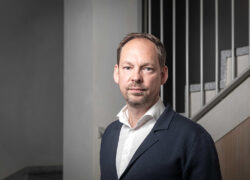
Keegan Viscius, CEO of CA Immo, said the transaction represented the final stage of the company’s withdrawal from Prague. “I am pleased that the campus will remain intact, and also that our local Czech team will continue to look after the portfolio under the stewardship of the new owner,” he said. Viscius added that the disposal would allow CA Immo to concentrate more of its property investments in Germany.

The sale forms part of a broader change in CA Immo’s investment strategy, which increasingly concentrates on office properties in Berlin and Munich. The company has been reducing its exposure to markets and buildings that no longer correspond with its preferred portfolio composition. This includes disposing of properties in locations where it does not intend to maintain a substantial long-term presence, as well as buildings requiring investment that may not meet its financial objectives.

Since 2018, CA Immo has withdrawn from several Central and Eastern European markets, including Romania, Serbia, Slovenia, Slovakia, Bulgaria, Russia and Croatia. It has also reduced its presence in secondary cities in Hungary, Austria and Poland. The completion of the Czech disposal represents another stage in this geographical restructuring, leaving the company with a more concentrated property portfolio and a greater dependence on the performance of the German office market.

CA Immo indicated that the proceeds could be allocated to several purposes, including debt reduction, investment in retained properties, share repurchases and dividend payments. The company may also consider acquisitions where suitable opportunities arise. No specific allocation of the proceeds from the Prague transaction has been announced. CBRE acted as the seller’s property adviser, while Dentons provided legal advice.

The transaction removes a substantial office portfolio from CA Immo’s holdings and transfers an established group of Prague commercial properties to a new investor. Karlín has developed into one of the capital’s principal office districts, accommodating international companies and domestic occupiers. The sale also illustrates the continuing restructuring of European commercial property portfolios, as some international investors reduce their geographical exposure while others acquire established income-producing assets. Further information about the purchaser, transaction value and future plans for the Riverside Karlín buildings has not yet been disclosed.

Polish Property Holdings Drive INVESTIKA Fund Beyond CZK 30 Billion

Czech investment manager INVESTIKA has reported that the net asset value of its property fund has exceeded CZK 30 billion for the first time. Established in September 2015, the fund now holds 65 properties across six European countries, with Poland accounting for the largest share of its investments. The increase reflects additional investor contributions and changes in the value of existing assets.

Poland represents 59% of the property portfolio, followed by the Czech Republic at 23% and Germany at 10%. Smaller allocations are held in Croatia, Austria and Spain, accounting for 4%, 3% and 1%, respectively. This geographical distribution means the fund remains particularly exposed to developments in the Polish commercial property market, despite its investments in several other European economies.

Office buildings account for 49% of the portfolio, followed by logistics properties at 22% and retail accommodation at 18%. Other property types represent the remaining 11%. The fund reports 565 tenants across its holdings, with a weighted average remaining lease term of 4.2 years. Its rental agreements include provisions for inflation-related adjustments, although the timing and financial effect depend on individual contractual arrangements.

Among the fund’s Polish investments is the P180 office building in Warsaw, providing approximately 32,000 sqm of accommodation. Its logistics holdings include properties with a combined area of 211,000 sqm in Bydgoszcz, Poznań, Kraków, Gdańsk and Kielce. During 2026, the fund also entered the German market through the acquisition of Höfe am Brühl, a shopping centre in Leipzig with approximately 55,000 sqm. In Austria, its investments include an aviation training facility in Schwechat, near Vienna International Airport.

Jaroslav Kysela, a member of INVESTIKA’s board, attributed the fund’s growth to continued investor participation and the performance of its existing properties. “Exceeding the CZK 30 billion threshold is, for us, evidence of our investors’ long-term trust,” Kysela said. He also pointed to the distribution of investments across different countries and property sectors as an important element of the fund’s approach to managing risk.

For the 12 months ending 30 September 2026, the fund reported a return of 5.41% for its Czech koruna investment class. Its cumulative return over five years reached 35.25%, while the reported increase in investment value since establishment was 77.01%. INVESTIKA calculated its average annual return over that period at 5.37%, compared with a stated target range of 4% to 6%. These historical figures exclude entry charges and do not provide an indication of guaranteed future performance.

The fund accepts investments from CZK 100 or €4 and recommends a holding period of at least five years. It is classified in the second-lowest category on the seven-point Summary Risk Indicator scale. Nevertheless, investors remain exposed to changes in commercial property valuations, tenant demand, rental income and financing conditions. The reported CZK 30 billion figure represents net assets after liabilities rather than the gross market value of the properties owned by the fund.

INVESTIKA intends to continue acquiring commercial real estate in Central and Western Europe, although it has not announced specific forthcoming transactions or investment budgets. The fund’s existing portfolio illustrates the participation of individual investors in commercial property ownership through collective investment structures. With Poland accounting for almost three-fifths of its holdings, conditions in the country’s office, logistics and retail markets will remain particularly important to the fund’s future financial performance.

Czech Residential Property Market Shows Signs of Stabilisation as House Prices Decline

The Czech residential property market showed signs of slower price growth during the third quarter of 2026, with older apartments recording modest increases and family houses experiencing a decline in average asking prices compared with the previous quarter. According to an analysis by property platform Bezrealitky, the national average asking price for older apartments reached CZK 123,895 per sqm, representing an increase of 1% quarter-on-quarter and 5% compared with the same period in 2025. Older family houses averaged CZK 66,408 per sqm, down 3% from the second quarter, although prices remained approximately 1% higher than a year earlier.

Prague continued to record the highest apartment prices in the country, with older residential units advertised at an average of CZK 163,043 per sqm. This represented quarterly growth of 2% and an annual increase of 6%. However, the pace of annual growth was lower than the 9% recorded in the previous quarter, suggesting some moderation in the capital’s residential market. In South Moravia, which includes Brno, apartment asking prices reached CZK 122,751 per sqm, increasing by 1% during the quarter and 10% year-on-year.

Regional apartment markets showed considerable differences in performance. Central Bohemia recorded an average of CZK 102,785 per sqm, up 5% quarter-on-quarter, while South Bohemia experienced a 7% quarterly increase to CZK 83,736 per sqm. By contrast, asking prices declined by 5% in the Ústí Region and 4% in Moravia-Silesia. Despite these quarterly reductions, both regions remained considerably more expensive than a year earlier, with annual increases of 17% and 12%, respectively. The figures suggest that local market conditions are influencing prices differently across the country.

The market for older family houses was generally weaker than the apartment segment. In Prague, average asking prices remained unchanged during the quarter at CZK 119,030 per sqm, representing a 2% annual decline. South Moravia recorded a quarterly reduction of 4% to CZK 63,418 per sqm, while the Vysočina Region experienced a 5% decline to CZK 43,723 per sqm. The Ústí and Karlovy Vary regions recorded quarterly increases of 6%, although both remained 6% below their levels from the previous year.

Rental accommodation continued to become more expensive, although the rate of increase differed between locations. Across the Czech Republic, average advertised rents reached CZK 400 per sqm per month, representing growth of 2% compared with the second quarter and 8% year-on-year. Prague and its surrounding metropolitan area recorded average rents of CZK 460 per sqm, up 1% during the quarter and 4% annually. The figures indicate that rental costs are continuing to rise even as the purchase market shows signs of stabilisation.

Brno experienced stronger rental growth during the quarter, with average asking rents increasing by approximately 6% to CZK 383 per sqm per month. The increase coincided with seasonal demand from students seeking accommodation before the start of the academic year. Central Bohemia also recorded a quarterly increase of approximately 4% to CZK 340 per sqm, while rents in Hradec Králové rose by 13% compared with the previous year. Other regional cities, including Liberec and Zlín, recorded annual rental increases of 10%, illustrating continued differences in local housing demand.

Hendrik Meyer, head of EEC Group, which includes Bezrealitky, indicated that the current market conditions bear some similarities to the period following the sharp increase in mortgage costs in 2022. However, he suggested that the present slowdown could develop into a more sustained period of price stability. The future direction of the market will depend partly on mortgage financing conditions, interest rates, the availability of newly completed housing and developments in the rental sector. Changes in household purchasing power and the volume of properties offered for sale may also influence price movements.

The third-quarter figures indicate that the Czech housing market is becoming increasingly differentiated by property type and location. Apartment asking prices continue to rise in several major urban markets, while older family houses are experiencing weaker demand and, in some regions, declining prices. Rental accommodation remains under upward pressure, particularly in cities with substantial student populations and employment opportunities. Although the latest data suggest that residential price growth is moderating, the figures relate to advertised prices rather than completed transactions and do not establish whether the market has entered a prolonged period of stability.

Mindspace Takes 4,500 sqm in Warsaw’s Skyliner II for New Flexible Office Centre

Flexible office operator Mindspace is expanding its Warsaw operations with a new 4,500 sqm location in Skyliner II, the second office tower within the Skyliner complex near Rondo Daszyńskiego. The company will occupy four floors of the building, providing more than 650 workstations when the premises open in mid-2027. The agreement will increase Mindspace’s combined capacity across the two Skyliner towers to more than 1,200 workstations.

The new centre will occupy floors eight to eleven of Skyliner II, with each level providing more than 1,000 sqm of accommodation. It will become Mindspace’s third location in Warsaw, following its first Polish centre at Koszyki, which opened in 2017, and its existing premises in the original Skyliner tower, which began operating in 2023. The expansion adds further capacity to the company’s Polish portfolio after almost a decade of activity in the market.

Skyliner II is located near Rondo Daszyńskiego, an established office district in Warsaw’s Wola area. The location provides access to the city’s second metro line and other public transport services, while the surrounding neighbourhood contains restaurants, retail premises and other commercial facilities. The district has experienced substantial office development over recent years, attracting both conventional corporate occupiers and operators providing shorter-term workspace arrangements.

Mindspace intends to divide the new premises into private offices, shared working areas, meeting rooms and facilities for individual work. The accommodation will be furnished and equipped with video conferencing technology, telephone booths and other office equipment. The operator will also provide administrative and technical services, cleaning and access to meeting facilities through its booking system. The premises will be accessible to members throughout the day and night.

According to Michał Kwinta, General Manager CEE at Mindspace, the expansion reflects demand from businesses seeking office arrangements that can accommodate changes in staffing and space requirements. The company serves individual professionals, smaller businesses and larger organisations that prefer to obtain serviced office accommodation rather than undertake conventional office fit-outs and manage premises directly. Kwinta also pointed to the limited availability of newly completed offices in Warsaw’s central business locations as a factor influencing the decision.

Skyliner II will contain approximately 24,000 sqm of leasable office space within a 130-metre tower comprising 28 storeys. The building is planned to include a rooftop garden and landscaped terraces on upper levels. It will be connected to the existing Skyliner tower through a 4,500 sqm shared structure containing facilities accessible to building occupants and the public. According to the project information, Skyliner II has received a BREEAM Excellent certification and is intended to operate using electricity sourced entirely from renewable energy.

The agreement reflects the continuing role of flexible office operators within Warsaw’s commercial property market. Companies using serviced workspace can obtain furnished accommodation and supporting services without taking responsibility for all aspects of conventional office management. For property owners, agreements with flexible workspace providers can secure substantial areas within office developments, although the financial arrangements and lease duration associated with Mindspace’s occupation of Skyliner II have not been disclosed.

Mindspace operates close to 50 locations internationally, including offices in Germany, the United Kingdom, the Netherlands and the United States. Its Warsaw expansion will add more than 650 workstations to the company’s existing Polish operations and increase its presence within the Skyliner complex. The new premises are scheduled to begin operating in mid-2027, although the announcement does not specify the investment required for the interior fit-out or the commercial terms agreed with the building owner.

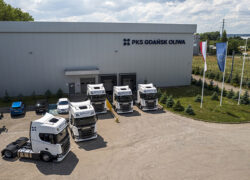
PKS Gdańsk Oliwa Increases Focus on Warehouse Operations for Smaller Businesses

Polish transport company PKS Gdańsk Oliwa is extending its warehousing and distribution activities, with a particular focus on small and medium-sized enterprises and family-owned businesses. The company is seeking to increase the proportion of its operations involving the storage, handling and distribution of goods for manufacturers, importers and exporters. The decision reflects a gradual diversification of its activities beyond road freight transport, as businesses assess the costs of maintaining their own logistics infrastructure.

Founded in 1966, PKS Gdańsk Oliwa has operated in the Polish transport sector for six decades. Its current plans involve taking responsibility for a wider range of warehouse activities, including inventory handling, distribution arrangements and the management of goods moving between suppliers and customers. The company is also investing in software used to organise warehouse operations, although it has not disclosed the financial value of these investments or provided a timetable for their implementation.

PKS Gdańsk Oliwa operates warehouses in Gdańsk and Pruszcz Gdański and uses additional facilities belonging to logistics partners in the Tri-City metropolitan area and other regions of Poland. The company reports access to approximately 70,000 sqm of warehouse space through its own operations and external arrangements, with additional locations concentrated mainly in central and southern Poland. The announcement does not specify how much of this space is owned or leased directly by the company, nor does it provide occupancy or utilisation figures.

The company’s activities include receiving imported goods, completing customs procedures, unloading containers, separating shipments, organising storage and arranging deliveries. Particular attention is being given to smaller consignments transported together in shipping containers, where goods belonging to several importers must be separated before storage or distribution. This type of operation is relevant to businesses importing quantities that do not require an entire container, allowing their shipments to be handled alongside those of other customers.

Another area of activity involves managing warehouse operations within facilities already occupied by customers. PKS Gdańsk Oliwa intends to undertake assessments of existing procedures, reorganise warehouse workflows and assume responsibility for selected operational functions. Depending on the agreement, these services may cover individual activities or broader warehouse management responsibilities. Such arrangements allow manufacturers and distributors to retain their existing premises while transferring some operational tasks to an external company.

The operator is also developing its warehouse management system to coordinate stock records, storage locations and the movement of goods. The technology is intended for use both in facilities managed directly by PKS Gdańsk Oliwa and in warehouses operated on behalf of customers. The company has not provided details of the system’s implementation costs, current level of deployment or expected effect on operating expenses.

Warehousing and distribution activities are being developed alongside the company’s existing domestic and international road transport operations. PKS Gdańsk Oliwa handles full-truckload and smaller freight consignments using its own vehicles and subcontracted carriers. The combination of transport and warehouse services allows the company to undertake several stages of goods movement, from collection and customs processing to storage and delivery. However, no information has been released concerning the number of existing warehouse customers, the revenue generated by these activities or the proportion of the company’s business represented by outsourced logistics.

The development of these services is relevant to Poland’s industrial property market because smaller businesses may increasingly use warehouse space operated by logistics companies rather than lease or develop facilities independently. External warehouse management can also change how existing industrial buildings are used, particularly where several customers share storage and distribution infrastructure. PKS Gdańsk Oliwa has not announced any new warehouse construction, property acquisitions or additional leased facilities as part of its current plans. Its expansion therefore concerns the range of services provided and the management of existing infrastructure rather than a confirmed increase in warehouse floor space.

German Businesses Reduce Sustainability Spending as Financial Constraints Intensify

Financial pressures are prompting a growing number of German companies to reconsider expenditure on environmental improvements and sustainability programmes. Research published by credit insurer Atradius on 22 October 2026 indicates that 46% of surveyed businesses have delayed some or all of their planned sustainability investments because of financial constraints. The findings come amid weak industrial activity, pressure on company finances and uncertainty surrounding European corporate reporting requirements.

The survey, conducted among approximately 300 German companies in September 2026, found that sustainability continues to feature in business planning despite the reduction in spending. Around 33% of respondents regarded it as an important priority, while another 40% considered it moderately important. The remaining 27% assigned it limited importance or had temporarily suspended related activities. Financial considerations were the main reason given for investment delays, with 12% postponing planned expenditure entirely and 34% delaying selected projects. The other 54% reported no changes to their investment schedules.

Administrative requirements associated with environmental, social and corporate governance disclosures were another major concern. Some 58% of respondents considered the work involved excessive, while 32% believed it was substantially greater than necessary. Only 11% regarded the reporting requirements as proportionate. The responses indicate widespread dissatisfaction with the resources businesses must allocate to collecting, processing and presenting sustainability information, particularly when operating budgets are already under pressure.

Questions about the practical value of these disclosures produced similarly critical responses. Approximately 77% of companies believed the reporting process involved more administrative work than measurable business benefits. Another 18% considered the advantages and disadvantages broadly equal, while only 5% believed the benefits justified the resources required. These findings are relevant to ongoing discussions within the European Union concerning the extent of corporate sustainability reporting and efforts to simplify compliance obligations for businesses.

External demands for sustainability information appear less widespread than the concerns surrounding regulatory compliance. Only 7% of surveyed companies reported substantial pressure from customers or investors to provide additional environmental or social performance data. Approximately 31% observed some increase in such requests, while 62% experienced little or no additional pressure. The difference suggests that reporting responsibilities may be driven more strongly by regulatory expectations than by immediate commercial requirements for many businesses in the survey.

The research also examined how companies perceive changing expectations concerning responsible business practices. Sustainability was identified by 28% of respondents as the area experiencing the greatest increase in public attention, followed by data protection and information security at 26% and fair employment conditions at 24%. Regional responsibility accounted for 11%, corporate transparency for 5% and diversity for 2%. The responses indicate that environmental considerations are competing with several other operational and social priorities for management attention and financial resources.

For the construction and commercial property industries, reduced sustainability expenditure could affect the timing of investments in building energy performance, equipment replacement and operational improvements. Property owners and developers must consider these projects alongside financing expenses, maintenance requirements and other capital commitments. However, the Atradius research does not provide separate findings for real estate businesses, making it impossible to determine whether construction and property companies are delaying environmental investments at the same rate as the wider group of respondents.

The survey covered businesses operating in automotive manufacturing, construction, building materials, chemicals, electronics, financial services, information technology, agriculture, food production, machinery, metals, textiles and transport. Participating companies ranged from smaller businesses with annual revenue below €5 million to organisations generating more than €1 billion. The results indicate that financial limitations and concerns about administrative costs are influencing corporate sustainability decisions, although they do not establish whether postponed investments will be cancelled permanently or resumed when financial conditions improve.

Passerinvest Adds Offices and 134 Rental Apartments to Prague’s Brumlovka District

Passerinvest Group is developing a 28,000 sqm building in Prague’s Brumlovka district, combining office premises, rental apartments and ground-floor commercial space. The project, named Orion, is located at the intersection of Vyskočilova and Michelská streets in Prague 4 and is scheduled for completion in the first quarter of 2029. The development follows the company’s Hila project and forms part of the gradual introduction of more residential accommodation into an area previously dominated by office buildings.

Orion will rise to a maximum of nine storeys and contain 134 furnished rental apartments, ranging from studios to three-room units. The remaining accommodation will comprise offices and commercial premises intended for shops and services. Passerinvest has not disclosed how the total floor area will be divided between the different uses, nor has it provided information about anticipated residential rents, office leasing arrangements or the overall construction budget.

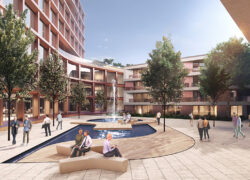
The development will include more than 2,300 sqm of roof terraces, of which approximately 800 sqm will be available for shared use by building occupants. The terraces will contain planted areas and seating facilities. Four underground floors will provide 475 parking spaces, including provision for electric vehicle charging. The number of parking spaces reflects the building’s combination of residential and commercial uses, although the developer has not specified how they will be allocated between apartment tenants, office occupiers and visitors.

Changes to the surrounding public space are also planned. A pedestrian staircase will connect different levels of the site, improving access between Vyskočilova Street, Michelská Street and nearby parts of Brumlovka. A new square will contain planting, seating and a water feature, while the building itself will provide some separation from traffic noise. Commercial premises at street level are expected to include a café, although no occupiers have been announced.

The architectural plans were prepared by Aulík Fišer Zalabák architekti, which has worked on several buildings in Brumlovka. Orion will consist of connected office and residential sections with different building heights and forms. The design responds to the contrast between the larger office properties along Vyskočilova Street and the smaller residential buildings around Michelská Street. Pedestrian access through the development will also provide another connection towards Brumlovka Park.

The building is planned to incorporate heat pumps, geothermal boreholes, photovoltaic panels and ceiling-based heating and cooling systems. Passerinvest is targeting LEED Platinum certification and an A rating under the Czech building energy performance classification system. The company also intends the development to meet relevant EU taxonomy criteria. These objectives have been announced at the development stage and will require assessment against the applicable standards once the building is completed.

Orion is being constructed on land previously occupied by tennis facilities used by LTC 1927 Tennis Club Prague–Michle. Passerinvest arranged the development of replacement courts near the former Michelské pekárny bakery complex, with the new sports facilities completed in spring 2026. The relocation made the original site available for redevelopment. The company has not disclosed the financial arrangements associated with the relocation or the value of the land.

The project continues the changes taking place in Brumlovka as residential buildings and local services are added to the district’s existing office accommodation. The introduction of 134 rental apartments will increase the number of permanent residents in the area, while additional commercial premises and pedestrian connections will alter the use of surrounding public spaces. With completion planned for early 2029, Orion represents another stage in Passerinvest’s development programme in Prague 4, although the investment value and commercial leasing arrangements remain undisclosed.

Futureal Purchases Premier Outlet Budapest as It Shifts Towards Existing Commercial Properties

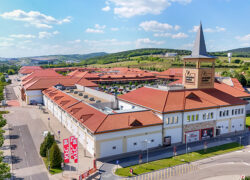
Futureal has acquired Premier Outlet Budapest, a retail complex in Biatorbágy, as part of a change in its investment activities in Hungary. The transaction, completed in October 2026, reflects the company’s decision to increase its ownership of existing commercial properties that generate rental income. Futureal, which has historically concentrated on residential and commercial development, has indicated that further acquisitions could follow. The purchase also adds another retail property to its Hungarian holdings alongside Etele Plaza in Budapest.

Premier Outlet Budapest opened in 2004 and is situated near the junction of the M1 and M0 motorways, west of the Hungarian capital. The centre comprises approximately 23,000 sqm of leasable space and accommodates more than 90 retail units. According to information provided by Futureal, the property had an occupancy rate of 99.7% at the time of the acquisition. Its location provides road access from Budapest and other parts of Hungary, although no visitor numbers or annual turnover figures were disclosed.

The tenant list includes Nike, Adidas, Hugo Boss, Tommy Hilfiger, Lacoste, GANT, GAP, Karl Lagerfeld, Samsonite and Calvin Klein. Futureal states that the centre contains Nike’s largest outlet store in Central Europe and Adidas’s largest outlet store in Eastern Europe. These claims have not been independently verified. The high reported occupancy indicates that relatively little retail space is currently unleased, although the announcement did not provide information about rental income, lease durations or the financial performance of individual tenants.

The acquisition marks a departure from Futureal’s previous emphasis on constructing new properties in Hungary. The company is now examining opportunities to purchase completed buildings where it can receive rental income and potentially improve financial performance through changes to leasing arrangements and property management. This approach may involve different risks and capital requirements from those associated with development projects, particularly because investors acquire properties with existing tenants, operating costs and contractual obligations.

Futureal’s co-founder and owner, Gábor Futó, linked the company’s revised investment approach to political and economic developments in Hungary following the April 2026 parliamentary elections. He argued that changes in investor sentiment, financial market indicators and the exchange rate had improved the outlook for property investment. However, the announcement did not provide independent evidence establishing a direct relationship between the election result and these developments. The company’s expectations regarding future international investment activity therefore remain forecasts rather than confirmed market trends.

Olivér Treiber, Futureal’s Chief Investment Officer, indicated that the company currently sees opportunities to acquire existing properties at prices that may compare favourably with the costs and risks of developing new buildings. He also expects increased participation from international investors in Hungary’s commercial property market. Futureal has stated that it intends to make further purchases, but has not identified additional properties, investment budgets or expected completion dates.

FREY will remain responsible for the outlet centre’s daily operations following the transaction, while Futureal will oversee decisions concerning the property’s ownership and financial management. The company intends to review the composition of the tenant base and possible changes to the shopping environment. Futureal also owns Etele Plaza in Budapest’s 11th district, although the two properties operate under different retail formats. The announcement did not specify whether any operational functions, leasing activities or supplier arrangements would be shared between them.

Futureal was advised by HG Business Advisory on financial matters and CMS on legal matters, while TOMLIN Kft. conducted the technical examination of the property. Neither the seller nor the acquisition price was disclosed, and no information was provided about the financing structure or valuation of the asset. The transaction increases Futureal’s exposure to Hungary’s retail property market and provides an indication of its intention to direct more investment towards completed commercial buildings. The extent of this change will become clearer as the company announces further transactions.

North Bucharest Investments Repays Over EUR 1 Million to Investors Ahead of Schedule

North Bucharest Investments (NBI) has repaid more than EUR 1 million in principal to investors on the Stock.estate platform, successfully closing three financing rounds ahead of schedule. All three repayments were completed approximately one month before their contractual maturity dates, together with interest accrued over the actual investment periods.


“Capital raised fuels growth, but capital repaid builds trust. For NBI, the early repayment of three financing rounds totalling more than EUR 1 million reflects our commitment to responsible investor relations and the financial discipline underpinning our development. Our focus remains on building a scalable business model, fostering strong partnerships, and securing access to capital to support our next phase of growth,” said Vlad Musteață, Founder & CEO of North Bucharest Investments.


As of 21 October 2026, Stock.estate reported approximately EUR 14.6 million in total invested capital, approaching the EUR 15 million milestone. The platform had attracted more than 17,400 registered users and funded 105 campaigns, while total principal repayments had reached approximately EUR 6 million and interest payments to investors had exceeded EUR 913,000.


North Bucharest Investments works with more than 80 property developers and manages a portfolio of over 100 residential projects.


front page info
LATEST NEWS