Artificial intelligence could transform employment, education and economic productivity, but three of the field’s most prominent figures remain divided over whether society is adequately prepared for the disruption ahead.
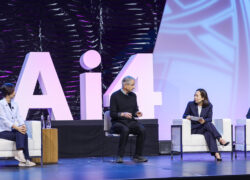
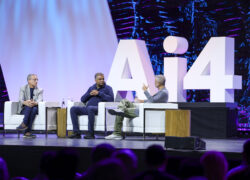
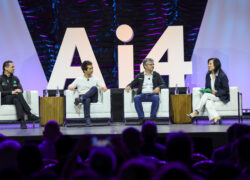
Geoffrey Hinton, Fei-Fei Li and Andrew Ng discussed the future of AI during a keynote session at the Ai4 conference at The Venetian in Las Vegas on Wednesday, 5 August 2026.
The conversation was moderated by Yun-Hee Kim, Deputy Editor of Washington Post Intelligence.
Hinton shared the 2024 Nobel Prize in Physics with John Hopfield for foundational discoveries and inventions that enabled machine learning with artificial neural networks. Li led the creation of ImageNet and is now co-founder and chief executive of World Labs, which develops spatial-intelligence technology. Ng is the founder of DeepLearning.AI, chairman and co-founder of Coursera and the founding lead of the Google Brain project.
Their discussion exposed significant differences over employment, AI safety, regulation and the release of open-weight models.
Hinton warns that routine intellectual work is vulnerable
Hinton offered the strongest warning about employment.
He argued that AI systems are likely to become better than people at many call-centre and administrative duties involving routine intellectual work. They may eventually provide more accurate answers, operate continuously and process much larger volumes of enquiries at lower cost.
The central question, he said, is not whether AI will create new occupations, but whether it will create enough of them and whether people displaced from existing work will be able to perform the new roles.
Hinton compared the change with the mechanisation of manual labour. Excavators did not eliminate all construction employment, but they significantly reduced the number of people required to dig by hand. AI could have a similar effect on standardised information-processing work.
He illustrated the point with an example involving an employee who responds to complaints for a healthcare organisation. According to Hinton, preparing a response previously took around half an hour, while a chatbot can now generate a draft that the employee checks and adjusts in several minutes.
The example demonstrated how AI can increase an individual worker’s output without necessarily removing the entire occupation. However, where the total amount of work is fixed, higher productivity may ultimately reduce the number of employees required.
Hinton contrasted this with healthcare, where additional capacity may be absorbed by unmet demand. More productive doctors and nurses could potentially provide more care rather than simply reducing staffing levels.
Ng argues that narrow roles will become broader
Ng placed greater emphasis on the ability of workers to expand their responsibilities with the assistance of AI.
He said software engineering involves much more than writing individual sections of code. Engineers also define products, speak with users, design systems, test services and coordinate with other parts of a business.
AI may automate part of the coding process without replacing the complete role.
Ng said developers who previously specialised in front-end, back-end or mobile work are increasingly able to operate across a broader range of activities. AI tools can help them complete parts of the development process faster and take greater responsibility for a product from initial design through to deployment.
He suggested that a similar development could occur in marketing. Employees who previously coordinated campaigns may use AI to assist with preliminary content, research and design, allowing them to manage a wider part of the marketing cycle.
The challenge for education is therefore not merely to show employees how to use an AI application. Training must also help them identify the more valuable responsibilities they can assume once repetitive tasks become faster.
Ng argued that people still possess a substantial contextual advantage over AI. Employees understand the history of their companies, relationships with colleagues, customer behaviour and the practical reasons why an apparently sensible proposal may not work.
An AI system may produce several useful ideas alongside others that an experienced person immediately recognises as unrealistic. Human judgement is therefore still required to distinguish between plausible output and recommendations that do not fit the business context.
Li puts motivation at the centre of education
Li concentrated on the importance of personal agency in learning.
She argued that the most important element of education is not the curriculum or the technology, but the learner’s motivation and willingness to continue developing.
AI should consequently be presented as a tool that helps people become more capable, rather than as a system so intelligent that students have little reason to build their own knowledge.
This distinction is particularly important in schools. Teachers may be concerned that students will use AI to avoid the learning process, completing assignments without acquiring the underlying skills.
Li said teachers, parents and students have not always received a sufficiently clear explanation of how AI can support education while preserving personal responsibility.
Presenting AI mainly as a system that can outperform people may discourage students. A more constructive approach would demonstrate how it can explain difficult subjects, provide feedback and help learners explore their curiosity.
Hinton also described the potential of AI tutoring. He argued that an individual tutor can respond to a pupil’s interests more effectively than a teacher who must periodically deliver the same material to an entire classroom.
He suggested that AI tutors could eventually provide personalised support for routine learning, while teachers devote more time to projects, discussion, social development and interaction between students.
This was presented as a future possibility rather than evidence that AI tutors already outperform qualified teachers.
Regulation should direct development, Hinton says
The panel also divided over the appropriate role of government.
Li argued that policy should not be understood only as regulation or restriction. Governments can encourage responsible development through investment in universities, public research, education and nonprofit institutions.
Modern artificial intelligence grew partly from academic laboratories and openly published research. Li said continued public investment would help prevent future development from being determined exclusively by the commercial priorities of a small group of companies.
She favoured examining AI at the level of individual applications. Healthcare, transport, financial services and other regulated industries already have systems intended to protect the public. Those rules may need to be updated as AI changes the products and services offered within each sector.
Hinton supported a more interventionist approach.
He rejected the common comparison between regulation and the brakes on a vehicle. Regulation, he argued, should be regarded as the steering system: its purpose is not necessarily to halt AI development but to direct it towards outcomes that benefit society.
He referred to California Senate Bill 1047, legislation concerning safety requirements for certain advanced AI models. The bill passed the California legislature in 2024 but was vetoed by Governor Gavin Newsom.
Hinton argued during the panel that developers of powerful models should conduct safety testing and provide greater transparency about the results before release.
He also called for a system through which writers, artists and other creators could determine whether their work may be used to train AI models and negotiate payment for that use.
Technology companies pay for computing chips, electricity and other infrastructure, he said, and should not automatically treat professionally produced data as a free resource.
The licensing proposal was Hinton’s policy suggestion during the discussion rather than a description of an existing legal framework.
Open-weight models expose another disagreement
Ng strongly supported the continued availability of open AI models.
He argued that accessible models reduce the danger of a limited number of technology companies becoming gatekeepers for artificial intelligence. He compared the risk with the mobile-device market, where Apple and Google exercise considerable control over the applications that can reach users through their operating systems.
Ng said the AI market should accommodate successful proprietary platforms alongside systems that businesses, universities and researchers can download, examine and adapt.
Open alternatives may provide lower-cost access and allow organisations to retain more control over their technology and information.
Hinton distinguished between conventional open-source software and open-weight AI models.
Open-source software makes its code available for inspection, allowing developers to find errors and propose improvements. Open-weight releases provide access to the numerical parameters of a trained AI model.
Hinton warned that such models can be modified at much lower cost than would be required to train a comparable foundation model from the beginning. This could make it easier to adapt them for harmful purposes.
He nevertheless acknowledged that capable open-weight models are already widely available and that reversing the development may no longer be practical.
Li rejected the idea that all AI systems must be either completely open or completely closed.
She argued that science and software have historically operated across a spectrum. Research findings may be publicly accessible, while dangerous materials, sensitive applications and commercial products remain subject to different levels of control.
AI is likely to develop in a similar manner, with access determined by the intended use, capability and risk of each system.
Productivity does not guarantee shared prosperity
Despite their differences, the speakers agreed that AI is likely to produce substantial productivity gains.
The more difficult question is how those gains will be distributed.
A business that enables one employee to complete several times more work could use the additional capacity to improve its service. It could also reduce its workforce while retaining most of the financial benefit for shareholders.
Li warned that higher productivity does not automatically produce shared prosperity. Education, government policy and corporate decisions will determine whether workers and communities participate in the economic gains.
The panel therefore presented three distinct approaches to the employment question.
Hinton believes concern about job displacement is justified, particularly for occupations dominated by routine intellectual work. Ng expects AI to broaden many roles and increase the value of employees who combine technological tools with business knowledge. Li considers motivation, education and human agency essential to ensuring that people remain active participants in the transition.
Implications for commercial property
The panel did not focus directly on real estate, but the issues it raised have clear implications for the sector.
Automation may reduce future space requirements for call centres, shared-service operations and administrative departments. Businesses that can process the same workload with fewer employees may consolidate offices or reconsider expansion plans.
At the same time, AI is increasing demand for data centres, high-capacity electricity connections, cooling systems and other digital infrastructure.
Office design may also change as employers automate more repetitive individual tasks and place greater emphasis on collaboration, customer relationships and decision-making. This could favour flexible workplaces designed around teams rather than rows of administrative workstations.
Education and retraining may create further demand for specialised training facilities, university partnerships and technology campuses in locations with access to qualified labour.
These property effects remain dependent on the speed and scale of AI adoption. They should not be treated as conclusions reached by the Ai4 speakers, but as potential market consequences of the employment and infrastructure changes discussed during the session.
The debate made clear that there is no settled view of AI’s effect on the labour market. Companies are already deciding which duties to automate, governments are considering new safeguards, and schools are determining how generative systems should be used.
AI development is unlikely to pause while those decisions are made. The more immediate challenge is whether institutions can adapt quickly enough to direct the technology towards better services, stronger education and broader economic benefits.
© 2026 cij.world