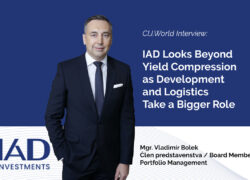
The investment environment that supported European commercial real estate for much of the previous decade has changed fundamentally. With capital no longer virtually free and yield compression unable to compensate for weaker investment decisions, real estate managers increasingly have to generate returns through the assets themselves.
For IAD Investments, that is translating into a greater emphasis on active asset management, selective development exposure and further diversification of its portfolio across Central and Eastern Europe. The company is also looking beyond the region’s most established markets for opportunities where limited supply and higher yields can compensate for lower liquidity.
In an interview with CIJ.World, Vladimír Bolek, Member of the Board at IAD Investments, explains why Croatia has emerged as an interesting logistics market, why development could account for around 10% of a fund portfolio, and why IAD wants to increase logistics exposure from its current level while reducing the relative dominance of offices.
He also discusses the reasoning behind moving Twin City C between IAD-managed funds, how higher interest rates have exposed weaknesses in highly leveraged investment strategies, and why communication with tenants has become one of the most important components of generating property returns.
CIJ.World: When does IAD buy again and when does it sell? Where has the gap between buyers and sellers become narrow enough to transact, and which CEE markets and sectors currently offer the best opportunities?
Vladimír Bolek: Central and Eastern European markets still provide a premium compared with markets further west. Part of that premium is compensation for lower liquidity, but the opportunities remain. From our perspective, it is particularly interesting when we can identify a smaller niche market such as Croatia. If you look at logistics, Slovakia has close to five million square metres of space and Poland around 40 million square metres, while Croatia has significantly less logistics stock relative to its population. You cannot compare these markets directly on a one-to-one basis because their economies, geography and service structures are different, but the difference is still a strong indication that Croatia has room to grow. There are also fewer of the largest international logistics players operating there. That creates an opportunity for us. The yield differential is another important consideration. Croatia has adopted the euro, yet logistics yields remain higher than in markets such as Slovakia. That reflects liquidity and other risks, but it also creates the potential for future yield compression if the market matures.
CIJ.World: Was there sufficient investment product available in Croatia, or did the lack of existing stock force IAD to approach the market differently?
Vladimír Bolek: We entered Croatia as a developer precisely because there was a lack of suitable investment product. If you want to enter a market like this and eventually establish meaningful scale, development can be the only practical route. The decision has worked well so far. During the summer, we signed a lease for the entire project, and that encouraged us to expand our activities in Croatia and begin looking for another potential development site. Croatia still represents only a small part of the portfolio because we have to reflect the additional risk, but it can provide additional yield at portfolio level.
CIJ.World: Following the transfer of Twin City C from the IAD Luxembourg structure to Prvý realitný fond, how does IAD decide which fund is the appropriate home for an asset while protecting the interests of investors in both vehicles?
Vladimír Bolek: Each fund has its own investment criteria and risk profile. The Luxembourg fund was taken over from HB Reavis almost three years ago and was heavily concentrated in the Slovak market, particularly Bratislava offices, with only one asset in the Czech Republic. These were generally good assets, but the portfolio was geographically and sectorally concentrated. We therefore decided that its structure should gradually change to provide investors with greater diversification and opportunities to generate additional returns from other markets. At the same time, Prvý realitný fond is primarily aimed at retail investors, particularly in Slovakia, whereas the Luxembourg fund is intended for professional investors, so the risk profiles are different. Moving an established asset such as Twin City C into Prvý realitný fond gives that fund a well-located asset with strong parameters while releasing capital within the Luxembourg structure that can be deployed into opportunities elsewhere in CEE. From our perspective, that creates benefits for both portfolios.
CIJ.World: Does IAD have an optimum holding period for assets, or is the decision to sell determined primarily by the performance of each property?
Vladimír Bolek: Prvý realitný fond is a long-term investor. If an asset continues to satisfy our criteria, we have no problem holding it for seven, eight or ten years. We usually acquire relatively new assets and can keep them for a decade if occupancy and the other fundamentals continue to work. The fund itself is around 20 years old, and buying and selling assets has become part of its normal lifecycle. When the fund was very small, we were naturally only buying. As it grew and began acquiring larger properties, we also started selling smaller parts of the portfolio. That process never really ends. We continually try to move towards somewhat larger assets and different asset classes while keeping the portfolio balanced from a risk perspective. This year, for example, we sold a relatively small asset in the Czech Republic that we had acquired around ten years ago and achieved a very strong return. There is no rule that ten years automatically means it is time to sell. Every asset has to be considered within its own investment story and market cycle.
CIJ.World: How different is that investment environment today compared with the previous decade?
Vladimír Bolek: The previous decade was exceptional because yield compression was very strong and the cost of money effectively approached zero. From my perspective, what we are experiencing now is more of a return to normality. When I began working in this sector, financing costs of around 5% were normal. Today, the cost of capital may be around 3.5%, depending on the financing, so historically it is not necessarily extreme. What has changed is that the cost of capital is again providing discipline. It creates a mirror for investment decisions. Those who made significant mistakes, particularly in capital structure and leverage, may disappear. Those who made fewer mistakes will survive, although some will have to fight harder. Investors that maintained disciplined financing and avoided excessive risk are in a much stronger position.
CIJ.World: Has active asset management therefore become more important than acquisitions? Where can IAD create the greatest value within its existing portfolio?
Vladimír Bolek: Active asset management has become crucial to achieving successful real estate investment returns. During the previous decade, if your asset management was somewhat weaker, the market could sometimes absorb those mistakes because falling yields increased capital values. Today, that is a completely different story. We have to concentrate much more closely on the quality of asset management because it directly affects what we can achieve with rents, occupancy and ultimately property values. When you ask a tenant to pay a higher rent, the tenant effectively holds up a mirror to your management. If you have looked after the building properly and provided the right environment and services, the tenant may be prepared to pay more. If you have made repeated mistakes, the opposite can happen: the tenant leaves and you are left with vacant space.
CIJ.World: What does more active asset management actually mean at building level?
Vladimír Bolek: It means constantly looking for additional value within the property and understanding what tenants actually need. There has to be a direct communication link with tenants rather than simply waiting for problems to reach the property manager. You should be looking for additional services or uses within the building that can improve the tenant experience and, where possible, create additional cash flow. That might be advertising space, additional services in the lobby or other relatively small initiatives. More importantly, tenants need to feel that the landlord is actively cooperating with them. If a tenant reports a maintenance problem, the property manager cannot wait until there is a collection of requests before responding. Expectations have changed and people want problems addressed quickly. The asset manager’s role is to make sure that happens. It requires a genuinely active approach.
CIJ.World: Has the end of widespread yield compression also made acquisitions more difficult?
Vladimír Bolek: Capital deployment is certainly more complicated because financing structures have changed and it is difficult to find buildings that fully meet our investment criteria at prices that make sense. There is almost always some difference between what a seller expects and what a buyer is prepared to pay. That has always existed; the question is how large that gap becomes. When interest rates move significantly, buyers incorporate the higher cost of capital into their calculations very quickly. Sellers naturally take longer to adjust because everybody wants to achieve the best possible price. The market therefore has to find a new balance. Until that happens, the difference between buyer and seller expectations can remain larger than it was during the previous cycle.
CIJ.World: How much development risk should a real estate fund take? As IAD increases its development exposure, including logistics in Croatia, when does developing become preferable to acquiring a completed property?
Vladimír Bolek: It depends on the type of fund, but for our larger fund we believe development can account for around 10% of the portfolio. In an environment where widespread yield compression has ended, generating a higher return inevitably means accepting some additional risk. Development is one controlled way of doing that. Investors compare our performance with alternatives such as ten-year Slovak, Czech or Polish government bonds. If a ten-year government bond provides around 4%, investors may reasonably expect a risk premium of perhaps another two to two-and-a-half percentage points from a conservative real estate fund. That means you need to find a route towards returns of roughly 6% to 6.5%. You can try to increase occupancy, but that is not always easy. You can increase leverage, but that introduces considerably more financial risk. You can move into higher-yielding asset classes, or you can introduce a controlled amount of development exposure. We have chosen the latter as one of our strategies.
CIJ.World: Why favour development rather than simply increasing leverage?
Vladimír Bolek: Development is an area where we believe we understand how to manage the risk. We are not currently large enough to make very substantial investments in areas such as major data centres, although perhaps that could change in the future. Development in countries and sectors that we know is much closer to our existing expertise. If we can manage the development process correctly, we can capture an additional premium for investors without changing the entire risk profile of the fund. That is why keeping development at around 10% of the portfolio makes sense to us. It is enough to contribute to returns without allowing development risk to dominate the fund.
CIJ.World: Looking three years ahead, what assets or sectors would you like to see added to IAD’s portfolio?
Vladimír Bolek: I think there is a good probability that we will enter at least one asset class that we do not currently have. That could potentially be a data centre, senior housing or student accommodation. At the same time, I am confident that logistics will represent a larger part of the portfolio. Today, close to half of the portfolio is in offices, while logistics and related industrial property account for around 20% to 22%. We want to increase that proportion. We are not looking only three years ahead when making that decision; we are thinking about what the region will look like over the next decade.
CIJ.World: Why are you particularly confident about logistics over that longer horizon?
Vladimír Bolek: The global supply-chain structure has been changing since the pandemic and remains under pressure. Trade tensions between the US, European Union, China and other economies are contributing to a degree of deglobalisation and forcing companies to reconsider where products and components are manufactured, stored and transported. Central and Eastern Europe has a very strong industrial base. Slovakia and the Czech Republic are among Europe’s most industrialised economies, with particularly important automotive industries and extensive supplier networks. Whatever the long-term future of individual industries, those supply chains require logistics infrastructure. The same principle applies across Poland, Romania, Hungary and Croatia. Poland illustrates the scale of what can happen: logistics stock has expanded dramatically over the past decade while occupancy has generally remained strong. There will inevitably be shorter cycles when vacancy increases because development temporarily runs ahead of demand, as happens in every property market, but over the longer term I expect the amount of logistics and industrial space in the region to continue growing.
CIJ.World: Can that logistics expansion continue without consuming increasingly large amounts of undeveloped land?
Vladimír Bolek: There is still significant capacity in brownfield locations. The development pattern is changing and becoming more similar to what we already see in more mature Western European markets. Earlier phases of logistics expansion, particularly in markets such as Poland, naturally concentrated on the easiest sites to develop. Today, municipal requirements, national planning rules and ESG considerations make development on previously undeveloped land more difficult. If you want to build a warehouse in an environmentally sensitive greenfield location, obtaining permission can be difficult. A brownfield location is a very different proposition. Redeveloping it may require more capital, but it provides a way of meeting future logistics demand while using land that has already been developed.
CIJ.World: With portfolios becoming larger and more complex, what is the part of asset growth that investors rarely see?
Vladimír Bolek: Everybody sees the benefits of asset growth, but very few people see the amount of work behind it. When I visit one of our properties and meet tenants, there is almost always something that somebody wants improved. Perhaps the water was not running properly one week, the air conditioning created a temperature problem or there is not enough bicycle parking. People rarely tell you that they have occupied the building for ten years and everything has worked perfectly. That is simply the nature of property management. The work behind maintaining an asset is largely invisible when it is being done properly, but that work is precisely what protects the value of the investment.
Source: © CIJ.World