Sunday, 4 October 2026
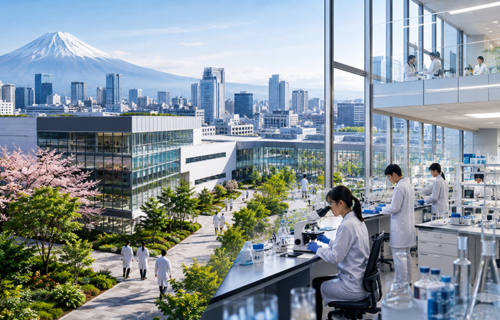
Japan’s life sciences real estate market is steadily evolving as the country strengthens its position in biotechnology, pharmaceuticals and medical research. While logistics and office assets continue to dominate commercial property investment, laboratories, research campuses and innovation districts are becoming an increasingly important part of Japan’s real estate landscape.
The sector’s growth is being driven by a combination of scientific innovation, government policy and changing research practices. Biotechnology companies, pharmaceutical firms and research institutions are increasingly seeking purpose-built laboratory facilities that encourage collaboration, accommodate advanced equipment and support flexible research environments. At the same time, Japan is investing in digital healthcare, artificial intelligence and medical data infrastructure, creating additional demand for specialised research space.
Greater Tokyo Remains the Centre of Innovation
The Greater Tokyo metropolitan area has established itself as Japan’s leading life sciences hub, bringing together universities, pharmaceutical companies, hospitals, research institutes and technology businesses. Areas including Yokohama and Kawasaki have become particularly important because of their concentration of research facilities and access to highly skilled talent.
According to CBRE, the Greater Tokyo region contains approximately 4.8 million square feet of wet laboratory space, making it the country’s largest life sciences real estate market. Demand has continued to increase as companies modernise research facilities to improve collaboration, accommodate new technologies and provide greater flexibility for research teams.
Unlike conventional office buildings, laboratory properties require specialised ventilation systems, enhanced utilities, strict safety standards and adaptable layouts capable of supporting scientific research. These technical requirements create higher barriers to entry, limiting the supply of suitable space while supporting long-term demand for high-quality laboratory facilities.
A Different Investment Profile
Life sciences real estate offers investors a different risk and return profile from traditional commercial property sectors. Pharmaceutical companies, biotechnology firms and research institutions typically require long-term occupancy because relocating laboratories involves significant cost, regulatory approvals and operational disruption.
As a result, laboratory buildings often benefit from longer lease agreements, stable tenants and rental premiums compared with conventional office space. These characteristics have attracted increasing interest from institutional investors seeking resilient income streams.
However, specialised laboratory developments also require considerably higher capital investment. Developers must install sophisticated building systems, specialised utilities and technical infrastructure that exceed the requirements of standard commercial properties. Successful projects therefore demand both significant financial resources and specialist operational expertise.
Government Policy Is Supporting Expansion
Government policy is playing an increasingly important role in accelerating the development of Japan’s life sciences sector. National strategies aimed at strengthening healthcare innovation place considerable emphasis on the use of medical data, digital technologies and artificial intelligence to improve research and patient care.
Japan has also introduced reforms to improve the use of medical information through the Next Generation Medical Infrastructure Act, supporting more efficient data utilisation while maintaining privacy protections. At the same time, policymakers continue to promote pharmaceutical innovation, biotechnology research and startup development through financial incentives, regulatory improvements and initiatives designed to accelerate the commercialisation of new medical technologies.
Efforts to shorten approval processes and encourage collaboration between universities, research institutions and private industry are helping create an environment that supports long-term investment in research facilities and scientific innovation.
Building Research Clusters
Rather than developing isolated laboratory buildings, Japan is increasingly focusing on creating integrated research ecosystems where companies, universities, hospitals and investors operate in close proximity. These innovation clusters encourage knowledge sharing, attract skilled professionals and accelerate the commercialisation of new technologies.
As research activity expands, demand extends beyond laboratory space itself. New research districts require supporting office buildings, residential developments, hotels, retail services and transport infrastructure to accommodate scientists, healthcare professionals and technology workers. This creates broader opportunities across multiple segments of the real estate market.
Institutional investors and real estate investment trusts are also showing growing interest in life sciences assets, recognising their potential to provide stable long-term returns while benefiting from structural growth in healthcare and biotechnology.
A Market With Long-Term Potential
Although Japan’s life sciences real estate sector remains smaller than those of the United States and several European markets, its long-term growth prospects are becoming increasingly attractive. Rather than competing on scale alone, Japan is positioning itself as a centre for advanced medical research, precision healthcare and biotechnology innovation.
As investment in pharmaceuticals, artificial intelligence, medical technology and scientific research continues to increase, demand for specialised laboratory facilities is expected to expand alongside it. Combined with supportive government policies and a strong research ecosystem centred on Greater Tokyo, life sciences real estate is emerging as one of the country’s most promising specialised property sectors.
For investors, developers and occupiers alike, the sector represents an opportunity to participate in a market driven not only by property fundamentals but also by the long-term growth of healthcare innovation and scientific research in Japan.
Source: © CIJ.World Japan Research & Analysis Team