Saturday, 3 October 2026
Artificial intelligence is beginning to move beyond generating text, images and video towards understanding how objects, people and machines behave in physical environments. This emerging field could have significant consequences for manufacturing and logistics, where one of the biggest barriers to more advanced automation remains the difficulty of teaching robots to cope with situations they have never encountered before.
During a fireside discussion at an AI conference in Las Vegas, Anastasis Germanidis, co-founder and co-CEO of Runway, outlined how the company is expanding beyond the generative-video market into models designed to represent and predict real-world behaviour. Runway’s premise is that the enormous amount of video available for training AI contains information not only about appearance, but also about movement, objects, interactions and aspects of physics. A system that becomes better at interpreting these relationships could potentially provide a foundation for machines operating in real environments.
This creates an important connection between generative video and robotics. Training an industrial robot through physical experience is expensive because the amount of information that can be collected depends on access to actual machinery, facilities and operating time. A robot also needs exposure to unusual situations if it is expected to function reliably outside a narrowly controlled task. Runway is investigating whether models initially trained on large quantities of video can provide much of this general knowledge before being adapted with specialised robotics data.
The objective is greater flexibility. Conventional industrial robots are extremely effective when repeating clearly defined movements in controlled environments, but performance becomes more difficult when circumstances change. A product may arrive in a different orientation, an obstacle may appear or the robot may encounter an object absent from its original training. Humans can usually adapt quickly to these variations. Developing machines capable of similar adjustment remains one of the central challenges in robotics.
Runway says its experiments indicate that a broad underlying model can subsequently be adapted to different types of robotic hardware using considerably less specialised information than would be required to train a system from the beginning. Germanidis cited internal tests in which adaptation to previously unseen hardware required only a relatively small amount of additional training data. Such results remain company-reported experiments rather than an independently established industry benchmark, but the potential commercial significance is substantial.
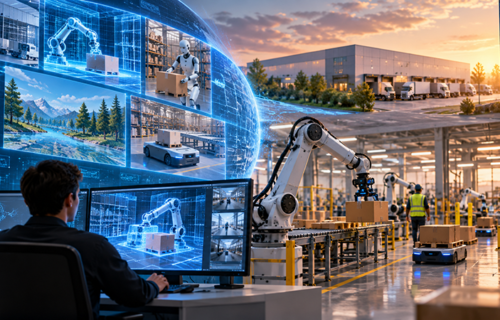
One application is the creation of synthetic training environments. Instead of requiring a physical robot to encounter every possible situation in a warehouse or factory, developers could expose the machine’s control system to large numbers of simulated situations first. Rare, dangerous or expensive scenarios could be tested repeatedly without interrupting production or damaging equipment. Physical trials would still be required, but a larger proportion of the learning process could potentially occur before a machine reaches an operating facility.
A second application goes further by using these models to help determine how a robot should act. Rather than simply creating a visual representation of a factory environment, the AI would predict the movements required to complete a task. For an industrial arm, this might involve calculating how the machine should position itself, approach an object, grasp it and move it to another location. Runway says it is exploring these applications with robotics businesses in areas including manufacturing and logistics.
The implications could eventually extend to industrial real estate. Warehouses and factories have already become more technologically intensive as occupiers introduce automated storage, conveyor systems, robotics, sensors and increasingly sophisticated warehouse-management platforms. More adaptable robots could extend automation into operations that have remained difficult to mechanise because products, layouts or workflows change too frequently.
Buildings capable of supporting that transition may require greater power availability, stronger digital connectivity, local computing infrastructure and layouts designed around interaction between people and autonomous equipment. For developers and investors, the quality of a logistics or manufacturing property could therefore become increasingly connected to its ability to accommodate successive generations of automation rather than simply its floor area, clear height and loading capacity.
Simulation could also affect how industrial facilities themselves are planned. Before installing a robotic workflow, an operator could test different equipment positions, traffic patterns or production configurations virtually. Manufacturers could explore how an automated process responds when circumstances change, while logistics companies could examine alternative layouts before committing capital to physical modifications. The result could be a closer relationship between AI simulation, digital twins and real-world facility design.
There are nevertheless significant technical obstacles. One of the largest is maintaining a stable environment over time. If an AI system creates a room containing particular objects and then moves away from it, those objects need to remain in the correct positions when the system returns. Maintaining this type of continuity over extended periods remains difficult for current generative models. Germanidis acknowledged that today’s technology is not yet capable of providing the kind of persistent, hour-long interactive experience routinely expected from established simulation or gaming systems.
Understanding physics also remains imperfect. Runway evaluates its models against different forms of physical behaviour and says performance has improved as models receive greater computing resources and better training data. But producing visually convincing movement is not the same as reproducing reality accurately enough to train industrial machinery. Small errors that are irrelevant in an entertainment video can become serious if they influence how a robot behaves around workers, equipment or valuable goods.
This makes verification against physical results essential. Simulated training may reduce the amount of real-world experimentation required, but it cannot simply eliminate it. The commercial value of these systems will ultimately depend on whether behaviour learned in synthetic environments transfers reliably to factories, warehouses and other operational settings.
Interactive entertainment is likely to provide another important proving ground. Instead of constructing every element of a game manually, future systems could generate environments dynamically while the player interacts with them. Language models could develop characters, objectives and storylines, while visual models create the surroundings and respond to the player’s actions. Current systems remain closer to demonstrations than replacements for conventional game engines, but progress in maintaining longer and more consistent environments could gradually change that.
The wider significance lies in addressing a weakness of today’s artificial intelligence. AI has advanced particularly quickly in areas such as programming and mathematics, where enormous numbers of attempts can be tested automatically and the result can be checked cheaply. The physical world does not provide the same luxury. Testing a million variations of software can be relatively straightforward; testing a million physical actions using robots, vehicles or biological systems can be prohibitively expensive, slow or dangerous.
Artificial environments could provide an intermediate layer. If an AI system can learn sufficiently accurate representations of physical situations from observations, it could potentially conduct large numbers of virtual experiments before applying the results in reality. This could be useful not only in robotics but eventually in areas such as autonomous vehicles, scientific research and life sciences, where complete mathematical representations of complex real systems are often unavailable.
The concept also explains the growing investment interest surrounding this branch of AI. Runway has raised substantial new capital as it expands beyond its original creative applications, while other technology companies and research laboratories are pursuing related approaches. The competition is increasingly about who can develop models capable of maintaining consistent environments, understanding cause and effect and translating that knowledge into useful actions.
Germanidis argues that controlling the underlying model could become particularly important. Companies that merely adapt another provider’s existing video technology may be constrained by the capabilities of the original system. Runway is therefore pursuing both the development of its own foundation technology and the applications built upon it, ranging from creative production to interactive environments and robotics.
Commercial deployment will provide the more meaningful test. Household humanoid robots capable of handling almost any domestic task remain a much more difficult proposition, while factories and logistics facilities offer comparatively structured environments where autonomous machines can be introduced gradually. Germanidis expects these industrial applications to provide some of the earlier opportunities for commercially useful systems, although the timing remains uncertain and large-scale deployment has yet to be demonstrated.
For the property and industrial sectors, the development deserves attention because it could address one of the fundamental constraints on automation. Robots have traditionally become economically attractive when a task is repetitive enough to justify the cost of programming and installing specialised equipment. If machines can instead learn broader capabilities in simulation and adapt more quickly to new tasks, the range of economically viable applications could expand.
That would not immediately create autonomous factories or warehouses without people. More likely, it would allow automation to spread gradually into additional parts of operations while changing the skills, infrastructure and buildings required to support it. The industrial facility of the future may consequently be valued not only by how efficiently goods and people move through it, but also by how easily intelligent machines can learn to operate inside it.
Runway became prominent by developing AI capable of creating convincing moving images. Its more ambitious objective is to turn what those models learn from video into an understanding of how environments behave. If that knowledge can eventually be transferred reliably from simulated worlds to physical machines, the next major impact of generative AI may be felt not on a screen, but across factory floors and logistics centres.
Source: CIJ.World Research & Analysis Team