Saturday, 3 October 2026
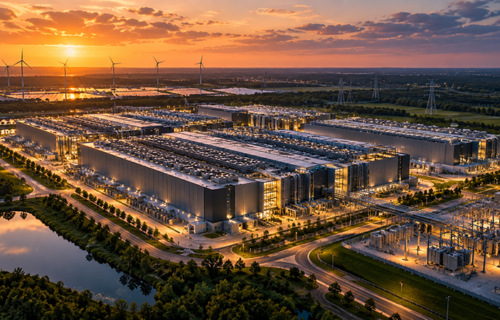
Artificial intelligence is pushing data-centre development into a new phase in which access to electricity, grid infrastructure and technology architecture are becoming as important as the property itself. With planned AI campuses now reaching several gigawatts, developers increasingly need to coordinate the building, power supply, cooling, networking and computing systems from the earliest stages of a project.
The scale of this transition was highlighted at the AI Infra Summit 2026 in Santa Clara, where NVIDIA’s Ian Buck and OpenAI’s Sachin Katti discussed the infrastructure required to support increasingly powerful AI systems. The industry has progressed from concentrating primarily on individual processors and servers toward designing entire racks, rows and data centres around the requirements of large AI workloads.
For property developers, this creates a substantially different development challenge from the conventional data-centre model. Computing equipment, networking, storage, cooling and electricity distribution increasingly influence one another. Different AI workloads can also create varying levels of power demand, making the ability to manage computing activity across a large campus increasingly important for improving the use of both installed technology and available electricity.
The growing importance of power is particularly significant for site selection. Large AI developments can require electricity capacity comparable with major industrial projects, placing greater pressure on generation and transmission networks. Suitable land therefore represents only one part of the development equation. Grid connections, future power availability, fibre infrastructure, permitting and the ability to expand a campus over time are becoming central considerations when determining whether a location can support AI investment.
Ohio’s PORTS-Pike Technology Campus illustrates the scale now being contemplated. OpenAI is set to become the customer for approximately 8 GW of IT capacity at the site, where SB Energy is developing the infrastructure and NVIDIA will provide the AI computing platform. The initial commitment covers 4.25 GW, with an option for a further 3.75 GW. SB Energy is expected to build, own and operate the data-centre facilities under a 20-year lease arrangement with OpenAI.
The energy requirements surrounding the project are equally striking. SB Energy and SoftBank plan at least 10 GW of new electricity generation to support the campus, while regional grid investment is expected to reach at least $4.2 billion through arrangements involving AEP Ohio. Capacity is scheduled to begin coming online in phases from 2028. NVIDIA has also committed $1.5 billion to SB Energy, demonstrating how technology companies are becoming financially connected to the physical infrastructure required to support future computing demand.
OpenAI expects its requirement for computing capacity to continue increasing as it develops successive generations of AI systems. Whether demand ultimately develops at the pace currently anticipated will depend on several factors, including improvements in processor efficiency, electricity availability, grid expansion, construction capacity and financing. Nevertheless, the projects already moving forward show that AI infrastructure is becoming a major new source of demand for energy-intensive real estate.
This could alter competition between established and emerging data-centre markets. Locations able to combine large development sites with reliable power, transmission capacity, fibre connectivity and predictable permitting may attract a growing share of investment. By contrast, markets where electricity networks are already constrained could find that additional land alone does little to unlock new AI development.
The result is a changing definition of the data-centre asset. Future competitiveness will increasingly depend on what can be delivered to and through the property rather than simply the size or specification of the building. As AI infrastructure expands into the multi-gigawatt range, data centres are moving closer to energy and industrial infrastructure, creating projects in which technology, electricity and real estate have to be planned together from the outset.