Wednesday, 30 September 2026
Saudi Arabia is pushing its property development programme into a part of the country that has attracted far less real estate investment than Riyadh, Jeddah or the major Red Sea destinations. Al-Khafji, an oil-linked city close to the Kuwaiti border, is being positioned for substantial expansion through a new coastal development backed by the Public Investment Fund.
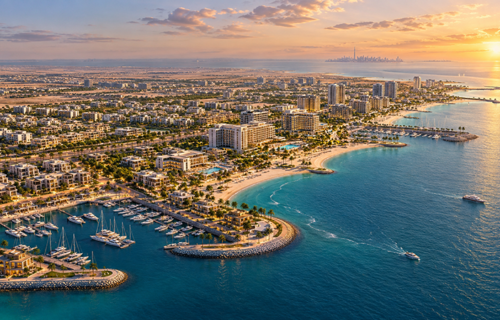
The development is being taken forward through Gulf Coast Development Company, a newly established PIF company. The masterplan encompasses roughly 20 sq km of land and about 10 km of Arabian Gulf coastline. At full development, it is planned to accommodate more than 16,000 homes distributed across eight neighbourhoods, together with approximately 1,400 hotel rooms and a range of commercial, leisure, education, public and marine facilities.
Construction is intended to progress in stages rather than bringing the entire scheme to the market simultaneously. Three neighbourhoods are expected to form the initial phase, which is targeted for completion in 2030. This approach will be important in a market where the developer will effectively be creating substantial new residential and hospitality demand alongside the physical development itself.
Housing is at the centre of the project. A pipeline exceeding 16,000 units would give Al-Khafji a sizeable new urban district rather than simply adding a tourism enclave to the existing city. The inclusion of schools, commercial uses and community infrastructure also points towards a development intended for permanent residents as well as visitors. For the property market, the central question will be how quickly household demand can grow as successive phases are delivered.
Al-Khafji has one geographic advantage that separates it from many other Saudi development locations. Kuwait City is around 130 km away, providing potential access to consumers and investors from across the border as well as demand from Saudi Arabia’s Eastern Province. PIF has itself highlighted Saudi, Kuwaiti and wider Gulf markets when discussing the development’s potential. Its location could therefore allow the project to draw on a broader regional catchment than Al-Khafji’s existing population alone.
The investment also has an economic diversification dimension at local level. Al-Khafji has long been associated with petroleum production and the Saudi-Kuwaiti oil operations in the former Neutral Zone. Building a larger housing, hospitality, leisure and services economy would give the city additional sources of activity. Unlike some of Saudi Arabia’s entirely new destinations, however, the development is being introduced alongside an established city and an existing industrial economy.
Private investment will be an important part of the next stage. PIF has indicated that Gulf Coast Development Company is expected to cooperate with private businesses and regional investors, but detailed structures for individual development opportunities have not yet been set out publicly. For developers and institutional capital, the significant milestones will therefore be the release of specific sites, partnerships, procurement programmes and operating opportunities rather than the size of the masterplan alone.
Al-Khafji could ultimately become an important test of Saudi Arabia’s ability to create new property markets beyond its largest metropolitan areas and established tourism corridors. The combination of government-backed infrastructure, a substantial residential pipeline, waterfront development and proximity to Kuwait gives the project a distinctive starting point. Its longer-term significance will depend on whether those advantages translate into sustained housing absorption, hotel demand and private investment as the first neighbourhoods move towards delivery.
Source: © CIJ.World Research & Analysis Team