Tuesday, 25 August 2026
Planned US port fees on Chinese-built ships could reduce both US imports and exports while reshaping global trade flows, according to a new study by the German Institute for Economic Research (DIW Berlin).
The study, based on global ship registry and vessel tracking data, examines the potential impact of proposed US port charges due to take effect in November. The measures are intended to reduce dependence on Chinese-built vessels and support the domestic US shipbuilding industry.
According to DIW Berlin, Chinese-built ships are now deeply integrated into global maritime trade, with around half of newly built commercial vessels worldwide constructed in China. By comparison, the European Union’s share of global shipbuilding has declined from approximately 17% three decades ago to less than 3%.
The researchers estimate that the proposed fees would reduce US imports by around 0.2% and exports by 0.3%, reflecting higher transport costs.
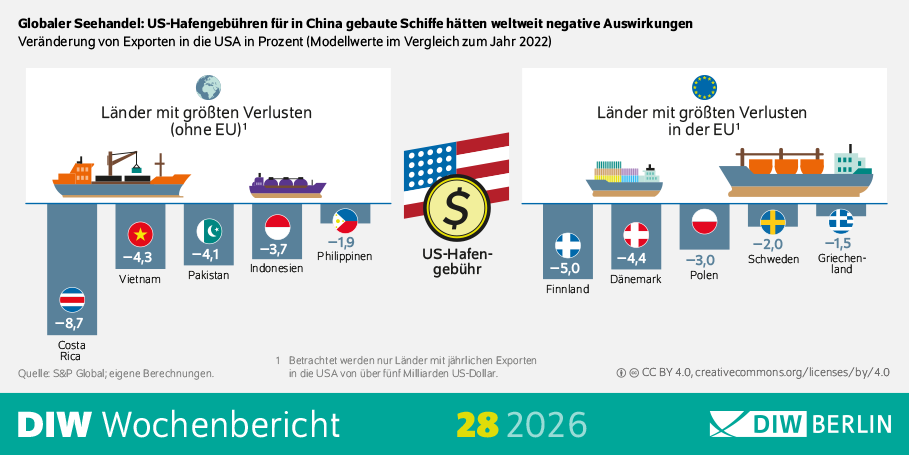
The report suggests export-oriented emerging economies would experience the largest impact. Countries including Costa Rica, Vietnam and Pakistan could see exports to the United States decline by more than 8% under the modelled scenario.
The European Union could also be affected, with around three-quarters of its external trade transported by sea. According to the study, Finland, Denmark and Poland would face the largest reductions in exports to the US, with estimated declines of 5.0%, 4.4% and 3.0%, respectively.
By contrast, the study identifies Germany and South Korea as potential beneficiaries. Their exports to the United States could increase by around 2%, reflecting lower dependence on Chinese-built vessels and an opportunity to gain market share from more heavily affected exporters.
The report also highlights broader geopolitical implications. According to the authors, competition between the United States, China and the European Union is increasingly extending beyond traded goods to include maritime transport, shipping capacity, ports and supply chain infrastructure.
The study notes that the European Commission has proposed a new alliance for maritime industrial value chains aimed at strengthening European shipbuilding, promoting investment in innovative vessel technologies and expanding export financing for low-emission shipping.
The authors argue that Germany, as one of Europe’s largest exporting economies and home to major shipping companies and ports, could play a larger role in the development of the EU’s maritime industrial strategy.