Sunday, 18 October 2026
Young buyers continue to represent an important group in Poland’s housing market, although rising apartment prices, mortgage costs, and stricter lending conditions are making purchase decisions more difficult. Developers note that buyers under 35 are increasingly cautious and often rely on mortgage financing and family support when purchasing their first home.
At the same time, expectations are changing. Younger customers are placing greater emphasis on location, functionality, energy efficiency, and long-term investment potential, while some are postponing ownership in favour of greater mobility and renting.
What share of apartment buyers are people just starting their careers? Has their number increased or declined in recent years? And what factors are shaping their decisions today? Representatives from leading development companies share their perspectives.
Tomasz Kaleta, Managing Director of Sales and Marketing at Develia
Approximately 20–30% of our clients are people under 30, buying their first apartment and often benefiting from a mortgage and financial support from family.
Poles still prefer home ownership, which is why many people choose to buy a property instead of opting for long-term rentals. Apartments are still perceived as a safe investment, especially since, despite periodic market fluctuations, their prices tend to rise in the long term. The share of investment purchases in our sales currently accounts for approximately 25%.
In our recent customer satisfaction survey (NPS), approximately 30% of our clients reported that they are buying their first apartment. Respondents also declared their intention to purchase another apartment within the next five years, and a further 30% did not rule out such a decision in the future.
Grzegorz Smoliński, Member of the Management Board of Dom Development
We are not observing a dramatic change in the customer demographic. Young customers still constitute a significant group of buyers, but their purchasing decisions are becoming more selective and more dependent on financing terms and credit availability.
Agnieszka Majkusiak, General Director of Sales and Marketing at Atal
According to market research, the actual share of people under 30 purchasing apartments in Poland does not exceed 10%. This is consistent with our observations and sales practice. The same factors influence purchasing prospects and creditworthiness across every age group: financial situation, income level, and professional stability. For young customers, the possibility of receiving family support is also more important, significantly facilitating a start in housing.
Trends noticeable in the under-30 age group include a reluctance to make long-term commitments, a focus on the “here and now,” and a preference for greater mobility and renting. However, much depends on the individual approach. Each generation includes individuals who are more or less resourceful in life, or simply have different priorities.
Mariusz Gajżewski, Head of Sales, Marketing and Communication at BPI Real Estate Poland
Young buyers are still present in the housing market, but they are making purchasing decisions more cautiously than they were just a few years ago. High housing prices and financing costs are causing some people to postpone purchases or choose smaller properties. At the same time, we are seeing a shift in attitudes towards property ownership.
Location, access to public transport, apartment functionality, and the quality of the investment environment are becoming increasingly important to the younger generation. They also pay attention to environmental aspects and building operating costs. The share of those purchasing apartments for their own needs, often with the support of a mortgage or family, is also growing within this group of buyers. This is a very conscious group that carefully analyses both the investment standard and the total cost of living.
Witold Kikolski, Member of the Management Board of MS Waryński Development S.A.
People at the beginning of their professional careers constitute a noticeable group of customers visiting sales offices, although their participation in final transactions is still limited primarily by creditworthiness and the need to raise a down payment. At the same time, we are observing a shift in attitudes; young customers increasingly perceive buying an apartment as an important financial goal and are actively exploring options for entering the market, especially given the high cost of rent.
We are also seeing greater purchasing pragmatism, with more interest in compact, functional apartments available within a reasonable budget. The trend remains stable, although the pace of purchasing decisions for this group is strongly dependent on the availability of credit and potential programmes supporting the purchase of a first apartment.
Joanna Chojecka, Sales and Marketing Director for Warsaw, Wrocław, and Łódź at Robyg Group
People starting their professional careers and young families remain a significant group of customers. At the same time, we see that young buyers are approaching purchase decisions more cautiously than they did a few years ago.
High apartment prices and mortgage costs are causing some people to postpone purchases or opt for smaller apartments. At the same time, interest in well-connected, functional apartments and investments offering additional amenities is growing. Attitudes toward home ownership are also changing. Mobility and flexibility are becoming more important to some of the younger generation. However, a very large group of Poles still consider owning a home to be the basis of security and stability.
Agnieszka Gajdzik-Wilgos, Sales Manager at Ronson Development
Today, the share of young people is significantly smaller than it was a few years ago. In the pre-pandemic period, when loans were cheaper and support programmes for young borrowers were in place, such clients were significantly more numerous. Currently, we observe that the majority of buyers are people with a stable professional and financial situation, who often decide to buy another apartment rather than their first one. Their decisions are more considered and based on stable sources of income and greater life experience.
There are relatively few young people entering the market and buying their first apartment today. This is primarily due to price levels and financing costs, which are often too high for those just starting their careers to afford a purchase on their own. Of course, there are exceptions, especially in situations where young buyers receive financial support from family.
Damian Tomasik, CEO of Alter Investment
From a market perspective, the growing role of the PRS sector is also clearly visible, helping to fill the housing gap for the younger generation. More and more people starting their professional careers do not necessarily want to buy an apartment immediately and commit to a long-term mortgage. The younger generation is now more mobile professionally and personally, so professional rentals are becoming a natural alternative for many.
Along with the professionalisation of the PRS market, perceptions of renting are also changing. Customers increasingly expect quality, predictability, a good location, and a standard of service similar to the hospitality sector. This trend will continue to grow, especially in the largest cities.
At the same time, alongside the younger generation, a crucial new market segment is emerging: the 55+ customer group. More and more active seniors are seeking well-located apartments in cities, close to services, transport, healthcare, and everyday infrastructure. For many, this is a conscious decision focused on a comfortable and convenient lifestyle. These two trends — the development of the professional rental market and the growing needs of the senior generation — will significantly influence the direction of the housing market and the design of new investments in the coming years.
Małgorzata Porzezińska, Sales Director at Archicom
In our company’s projects in the popular segment, customers under 30 accounted for approximately 15% of sales in the first quarter of 2026, compared to around 10% in 2025. We have seen a significant increase in young buyer activity in recent months, partly due to improved creditworthiness following the decline in interest rates. At the same time, these customers are highly informed and well prepared for the purchasing process. Before visiting a sales office, they often conduct a detailed market analysis, compare offers, and come with specific questions about financing, functionality, and the investment potential of the property. This is largely influenced by new technologies, easier access to data, and greater market transparency.
The approach to home ownership is also changing. For the younger generation, a home is becoming less of a lifelong decision and more of a means of building independence and financial security. Even when purchasing a property for their own needs, young customers consider its future value, rental options, and the flexibility associated with relocating. We are also seeing increased financial awareness. Young buyers are much better at understanding lending mechanisms, analysing costs, and increasingly treating real estate as an asset that can work for them in the future. Despite the growing popularity of renting and the greater mobility of young people, the desire to own a home remains very strong.
Andrzej Swoboda, Vice President of the Management Board at CTE Group
Currently, we are observing that decisions to purchase an apartment are most often made by people already in a stable professional and financial situation. Young clients just beginning their careers still visit sales offices, but their share of the buyer base is smaller today than it was a few years ago.
We are also seeing a shift in attitudes towards apartment ownership. Some young people are postponing purchase decisions, preferring renting, greater mobility, and building professional stability first.
At the same time, a noticeable and increasingly important group of customers are seniors, who seek comfortable apartments with good transport connections and homes adapted to everyday needs. These are people who want to spend their later years in modern, functional surroundings, often exchanging larger, older apartments for newer homes with a higher standard and lower maintenance costs.
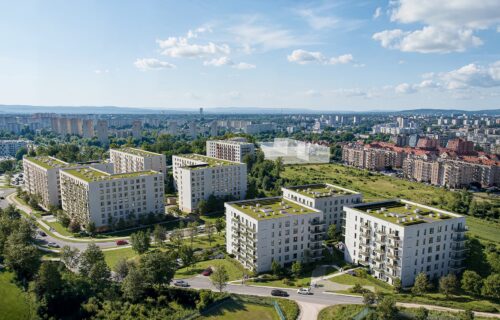
Photo: Przystanek Pradnik, Dom Development
Source: dompress.pl