Sunday, 11 October 2026
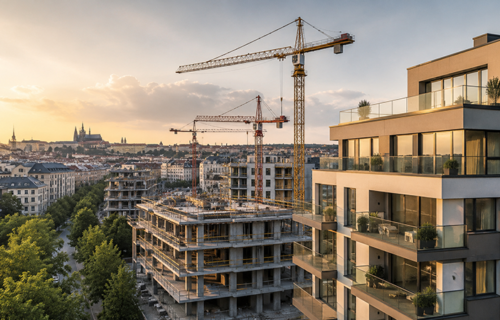
Construction activity in the Czech Republic continued to expand in May, but developers and market analysts say the pace of new housing approvals in Prague remains well below the level needed to ease long-term supply pressures.
According to the Czech Statistical Office, construction output increased 4.4% year-on-year in May, marking the nineteenth consecutive month of annual growth. Both building construction and civil engineering contributed to the increase, while the number of building permits issued nationwide also rose compared with a year earlier.
Despite the positive national figures, the situation in Prague’s residential market remains constrained by a slow permitting process. Industry participants argue that the capital continues to approve too few residential projects to keep pace with population growth and housing demand.
According to CENTRAL GROUP, only 122 apartments were approved in Prague during May. The developer estimates that the city now faces a housing shortfall of around 100,000 homes and says approximately 10,000 new apartments need to be completed annually over the long term to stabilise supply. These figures reflect industry estimates rather than official government calculations.
Official statistics support the broader trend. During the first quarter of 2026, Prague recorded the sharpest decline in new residential construction starts among all Czech regions, while the number of building permits issued in the capital also fell year-on-year, making Prague the only region to report a decline in overall permitting activity during the period.
Developers argue that the principal obstacle remains the lengthy approval process. Although a substantial pipeline of residential projects is under preparation across the city, many schemes require years to progress through planning and permitting before construction can begin.
The Czech Parliament is currently considering amendments to the Building Act intended to simplify and accelerate permitting procedures. Property developers have welcomed the proposed reforms, arguing they could help increase housing delivery over time. However, market specialists note that legislative changes alone are unlikely to resolve Prague’s housing shortage, which is also influenced by infrastructure capacity, land availability, municipal planning and the speed at which approved developments move into construction.
While national construction activity continues to improve, the contrast between rising output and limited residential approvals in Prague highlights the continuing imbalance between housing demand and supply in the Czech capital.