Friday, 16 October 2026
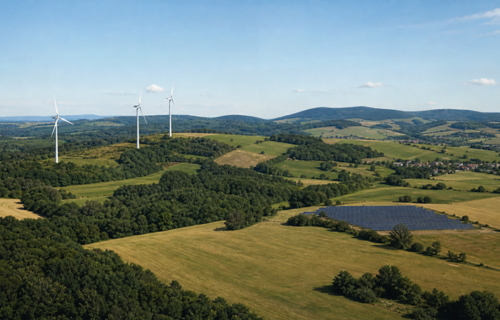
The Czech Environment Ministry has reduced the number of areas designated for accelerated wind and solar power development from an initial 110 to 61.
It has also introduced conditions intended to limit the environmental effects of projects built within the zones. These include detailed noise and shadow-flicker studies, wildlife protection, minimizing the use of agricultural land and requiring efficient, proven technologies.
The ministry said the revisions had substantially reduced the potential adverse effects of the proposed zones while preserving more than 3,000 megawatts of possible installed capacity. That would be sufficient to meet Czechia’s renewable energy commitments to the European Union.
Renewable energy acceleration zones are administratively designated areas in which the approval process for projects, particularly wind and solar power plants, is intended to be faster and simpler.
“We have now reduced the proposal by roughly half compared with the 110 acceleration areas considered at the beginning of the year,” said Filip Turek, the government commissioner for climate policy and the Green Deal.
“Forty-six areas remain, while another 15 have been reduced in size, resulting in a total of 61. Together with the additional conditions, this has significantly limited their overall impact on the Czech environment,” he added.
The ministry stressed that designating an acceleration zone does not mean wind turbines or solar farms will necessarily be built there. Renewable energy projects may also continue to be developed outside the designated areas.
The revised boundaries and construction conditions form part of a strategic environmental assessment, known as an SEA. The Ministry for Regional Development must now incorporate the requirements into a proposed amendment to the country’s Spatial Development Policy.
The ministry is expected to submit the completed proposal to the government by the end of July.
This is the second reduction in the number of proposed zones this year. The Environment Ministry previously cut the total from 110 to 94 and reduced the size of several areas.
Despite those changes, the proposal drew criticism from municipalities and members of the public. Several hundred people attended a public consultation in Prague in May, where most speakers opposed the plan.
Czechia remains one of Europe’s slowest-growing wind energy markets, according to figures from industry association WindEurope. Europe added 19.1 gigawatts of wind capacity last year, while Czechia installed only 13 megawatts, representing 0.07% of the total.
The country currently has more than 200 wind turbines with a combined capacity of approximately 372 megawatts. Wind power accounts for around 1% of Czech electricity generation.
Source: CTK