Thursday, 10 September 2026
The global commercial property market is adjusting to changing macroeconomic conditions, according to Savills’ Impacts 2026 report. Target allocations to real estate in institutional investment portfolios stand at 10.8% this year, broadly in line with levels recorded since the beginning of the decade.
The report identifies three factors influencing the sector: the need to upgrade existing buildings, the growth of artificial intelligence and changes to global supply chains. It also points to Poland as a potential beneficiary of nearshoring and a location for business-services investment.
Target real estate allocations in institutional portfolios are forecast to remain relatively stable at 10.8% in 2026. Meanwhile, New York, Tokyo, London and Seoul retained the top four positions in the Savills Resilient Cities Index, which assesses economies, innovation, environmental, social and governance factors, and property markets.
Growth in artificial intelligence is increasing investment in data centres. Savills expects the sector to generate demand for an additional 790,000 sq m of supporting warehouse space in Europe over the next three years. At the same time, construction costs have risen in many markets, putting pressure on the viability of new projects. In New York, the cost of developing new office space has exceeded $10,700 per sq m.
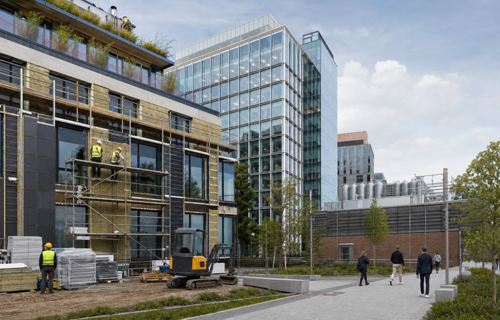
The report estimates that 80% of the buildings that will be in use in developed-market cities in 2050 have already been built. Extensive refurbishment could reduce their energy consumption by between 40% and 70%, increasing the importance of upgrading existing properties.
Savills says commercial property continues to provide diversification within investment portfolios, combining characteristics of equities and fixed-income instruments. However, the performance of individual assets remains dependent on factors including location, building quality and tenant demand.
In the US office market, some landlords are offering more flexible lease terms in response to caution among occupiers. At the same time, companies continue to favour higher-quality space. In locations where employers compete for skilled workers, some businesses are signing leases of 10 or 15 years in well-equipped buildings.
Access to skilled employees is becoming a more important factor in corporate location decisions. Demographic change and a smaller pool of available workers in some markets are encouraging companies to place operations in cities with established talent bases.
The San Francisco Bay Area, New York and the UK’s “Golden Triangle” of London, Oxford and Cambridge remain leading centres for advanced technology. These locations account for a significant share of demand from artificial-intelligence companies.
The expansion of AI is also affecting demand for data centres and related property. At the same time, rising construction costs may make it more difficult to deliver new space, further increasing the importance of upgrading existing buildings.
The Savills Nearshoring Index identifies Poland as one of the markets that could benefit as businesses move production and supply chains closer to their customers.
According to the report, Eastern European markets, including Poland, offer a relatively balanced combination of resilience, economic conditions, business environment and ESG standards. Poland’s position in the index is stronger than its GDP per capita alone would suggest.
Warsaw also appears in the Savills Talent Cities Index as a “cost-advantaged talent hub”, alongside cities including Lisbon. The category covers locations that combine access to skilled workers with lower operating costs than more expensive global business centres.
“In 2026, we expect investors to focus on rationalisation and cautious property portfolio management,” said Wioleta Wojtczak, Head of Research at Savills Poland.
She said recent macroeconomic disruption had changed the way commercial properties are planned and managed. Asset quality, location and the potential to create long-term value are therefore likely to remain central to investment decisions.
“Higher construction costs and tighter climate regulations are increasing the importance of refurbishing existing buildings to improve their operational and environmental performance,” Wojtczak said. “At the same time, investors remain interested in new projects that meet occupiers’ requirements.”
Savills therefore expects investment interest to focus both on high-quality new properties and on existing buildings that can be upgraded. Wojtczak added that real estate could continue to support portfolio diversification, provided that investment decisions were based on detailed analysis of individual locations and assets.