Friday, 18 September 2026
Czech industrial and logistics developments are increasingly being designed as places for people as well as production and distribution. Developers are putting greater emphasis on architecture, landscaping, employee facilities and transport connections as the sector adapts to changing occupier requirements and greater competition for skilled labour.
According to Colliers, the shift is bringing the Czech market closer to practices already established in more mature Western European industrial markets. Large warehouse buildings are increasingly being designed to reduce their visual impact or connect more closely with their surroundings, while landscaping and recreational areas are becoming more common within industrial parks.
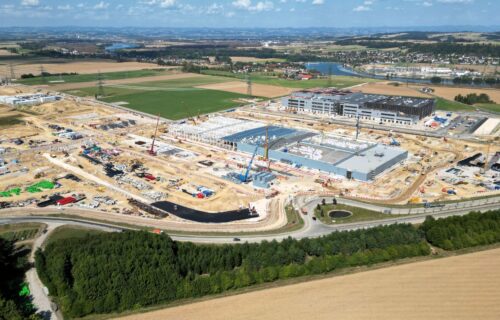
One example is Panattoni Park Cheb, where a distribution facility of more than 200,000 sqm uses architectural references to Cheb’s historic buildings across a facade stretching almost 700 metres. Other projects have incorporated artwork and local industrial heritage. In Humpolec, industrial buildings feature sgraffito, while a former textile factory has been converted into the 8smička contemporary art gallery and cultural space.
Brownfield redevelopment is another part of the trend. Older industrial structures can retain brickwork, steel structures and other original features while being adapted for modern uses. Such projects also allow developers to use existing infrastructure and previously developed land rather than expanding exclusively onto new sites.
Landscaping is becoming more prominent as well. Trees, flowering meadows and beehives are appearing within industrial complexes, while some parks are experimenting with alternative methods of maintaining green areas. At an industrial park near Ostředek on the D1 motorway, for example, sheep are used to maintain parts of the grassed landscape.
The changing nature of manufacturing is also influencing where companies locate. Increasing automation and more technologically sophisticated production mean occupiers need technicians, engineers, IT specialists and automation professionals alongside traditional production employees. This places greater importance on public transport, rail connections, cycling infrastructure and access to universities and technical education.
These requirements could support greater geographical diversification of Czech industrial development. Prague, Brno, Plzeň and Ostrava remain the principal locations, but higher land and labour costs are encouraging companies to consider other regional centres. Planned and ongoing improvements to the D3, D35, D52 and Prague’s D0 motorway network are expected to improve access to locations including České Budějovice, Olomouc, Přerov, Vysoké Mýto and Svitavy.
The rental difference can be significant. Colliers reports industrial rents of approximately €5.20–€5.80 per sqm per month in these regional locations, compared with around €7.00–€7.50 per sqm per month in the Prague area. Lower labour costs in some regional markets provide an additional consideration for manufacturers evaluating expansion.
The Czech Republic nevertheless remains more expensive to build in than neighbouring Poland, according to Colliers, reflecting differences in construction requirements, permitting, materials and labour costs. The consultancy argues that occupiers should also consider the cost of operating a facility rather than comparing headline rents alone. Czech industrial service charges are estimated at approximately €0.75–€1.00 per sqm per month, while modern buildings can reduce energy consumption and associated operating expenses.
The development pipeline remains substantial. Around 446,200 sqm of industrial and logistics space was completed during the first half of 2026, with Prague and Central Bohemia accounting for 69% of the new supply. Between approximately 1.46 million and 1.7 million sqm is under construction across more than 170 industrial parks, with 42% being developed without a tenant committed in advance. CTP accounts for 45% of space currently being built.
A further 2.7 million sqm has planning approval but has not yet entered construction, while approximately 2.5 million sqm remains in the permitting process. Together, these projects represent more than 5.2 million sqm of potential additional industrial and logistics stock.
Greater development activity has contributed to increased availability. Vacancy has reached 5.5%, equivalent to approximately 753,400 sqm of immediately available space and the highest level since the third quarter of 2015. Colliers nevertheless considers this closer to a balanced market, while the additional availability gives occupiers more options for expansion and relocation.
Demand is also changing. Manufacturing companies accounted for 41% of gross industrial demand during the second quarter of 2026, while logistics and distribution each represented 21%. The composition marks a shift from the stronger role played by e-commerce and distribution occupiers earlier in the decade and coincides with companies reconsidering the location of production and supply chains closer to their European customers.
Together, these changes are altering both the economics and physical character of Czech industrial property. As manufacturing becomes more technologically demanding and competition for employees increases, location, architecture, accessibility and the quality of the working environment are becoming more important alongside warehouse size, motorway connections and rent.