Friday, 18 September 2026
Greece contains millions of square metres of industrial and storage property, yet the logistics market continues to report shortages of suitable space. The apparent contradiction becomes easier to understand once the quality of the country’s existing buildings is considered. Greece does not simply need more warehouses. It needs more properties capable of satisfying the operational requirements of modern occupiers and the investment criteria of professional real estate owners.
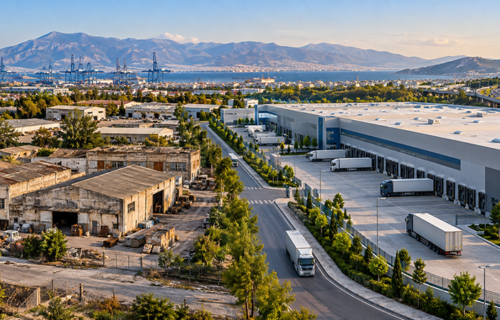
The distinction is particularly visible in Attica. The region contains a substantial stock of industrial, warehousing and distribution premises accumulated through decades of manufacturing, wholesaling and owner-occupied business activity. A significant proportion of these properties, however, belongs to an earlier generation of industrial development. Older factories and relatively basic storage buildings can remain useful to their existing occupants without necessarily competing with newly developed logistics centres.
West Attica has consequently emerged as the country’s most important concentration of modern logistics activity. Thriasio and the industrial districts around Aspropyrgos, Magoula and Mandra benefit from their relationship with Athens, the national motorway system and the wider transport infrastructure connecting the capital with the Port of Piraeus and the rest of Greece. Demand for better-quality facilities remains strong. During 2026, prime logistics rents in the Thriasio area have been reported at approximately €5.50 to €6.00 per sq m per month, while vacancy among the strongest warehouse properties has remained around 5%. Prime logistics investment yields have been reported broadly between 6.5% and 7%. Separate market research places rents for newly developed modern warehouses at similar levels.
Northern Greece faces a comparable challenge. Sindos remains one of the country’s principal industrial and distribution locations, benefiting from Thessaloniki’s position as the commercial centre of northern Greece and its connections with the Balkans. Demand for modern logistics accommodation continues to exceed the quantity of suitable space available, even though the wider Thessaloniki region contains considerable industrial property. The reason is that the word warehouse covers buildings with very different capabilities.
A small owner-occupied storage building may perform perfectly well for the company that constructed it. It may be inexpensive to operate, conveniently located for that business and fully adequate for relatively simple storage. That does not mean the same property can accommodate a national retailer, major third-party logistics operator or increasingly automated distribution operation. Modern occupiers require buildings designed around throughput rather than simply storage. Internal height determines the amount of inventory that can be accommodated vertically, while floor strength and building configuration influence racking and automated equipment. Loading facilities must allow goods to move rapidly between trucks and the warehouse, while external yards require enough space for large vehicles to circulate safely and efficiently.
Fire protection, power capacity, security, employee facilities and the physical condition of the building are also increasingly important. Large logistics operations cannot easily accept technical weaknesses that could interrupt distribution networks handling substantial quantities of goods every day. Transport access can be equally decisive. A warehouse can appear well located on a map while still suffering from poor local road connections, restricted truck access or insufficient external space. For occupiers operating large fleets, these limitations can permanently increase operating costs.
Energy performance is becoming another differentiator. Professional owners and corporate occupiers increasingly consider electricity consumption, building efficiency and the potential for renewable-energy installations when selecting logistics properties. Environmental certification can improve the attractiveness of a building, but the underlying performance and adaptability of the asset remain more important than certification alone. These requirements significantly reduce the amount of existing Greek industrial property that genuinely competes with newly developed logistics facilities.
Institutional investors also look beyond the physical specifications of the building. They need to understand whether a property can continue producing reliable rental income after the existing occupier eventually leaves. This creates a fundamental difference between many owner-occupied industrial buildings and institutional logistics property. A factory or warehouse designed around one company’s particular operations may have considerable value to that company but limited appeal to alternative occupiers. A flexible logistics facility in an established location can potentially be leased repeatedly to different businesses.
Tenant quality and lease structure therefore become part of the property itself from an investment perspective. A modern building occupied under a sufficiently long agreement by a financially strong tenant can generate predictable income. A specialised property requiring substantial future expenditure or suitable for only a narrow group of businesses carries a different risk. Greece consequently has two overlapping industrial property markets: the enormous legacy stock of factories, workshops, storage buildings and owner-occupied premises, and the considerably smaller pool of modern logistics facilities capable of attracting large occupiers and institutional investors.
Development activity is attempting to increase that second pool. Research published during 2026 identifies a pipeline of approximately 800,000 sq m of modern logistics facilities, representing investment expected to exceed €800 million. West Attica accounts for a substantial part of planned development, reinforcing its position at the centre of Greece’s logistics property market. The scale of the pipeline might initially suggest that the shortage will quickly disappear, but new logistics facilities are not competing equally with every warehouse already standing in Greece. They primarily compete with other properties capable of satisfying similar occupier requirements.
An older industrial building does not become effective alternative supply simply because it contains storage space. If it lacks adequate height, loading capacity, vehicle circulation, fire protection or efficient access, it may serve an entirely different part of the market. That distinction could increasingly determine what happens to Greece’s ageing industrial stock.
Some existing properties have the potential to be modernised. Warehouses with suitable structures, adequate plots and strong locations may justify investment in energy systems, roofs, loading facilities, fire protection and internal layouts. Refurbishment could provide additional modern space without requiring every building to be replaced. Other properties present much greater challenges. Structural limitations can make increasing warehouse height impractical, buildings occupying most of their plots may lack the external areas required for truck movements, and poor road infrastructure can be difficult for an individual property owner to solve.
In such cases, redevelopment may eventually become more attractive than continuing to invest in the existing structure. This creates a potentially important role for land consolidation. As large development plots become harder to secure in established logistics locations, investors may increasingly examine opportunities to assemble several smaller industrial sites into larger properties. Such a strategy is considerably more complicated than buying undeveloped land. Multiple ownership structures, negotiations, planning considerations and existing buildings can make consolidation expensive and slow, so it should not yet be treated as the dominant model for Greek logistics development. Nevertheless, the combination of fragmented existing property and scarcity of suitable large sites suggests that consolidation and redevelopment could become increasingly relevant as the market matures.
Land constraints may also gradually encourage development farther from today’s strongest logistics clusters. As competition increases for well-positioned sites in West Attica, developers could look farther along the motorway network for locations where larger plots remain available. This expansion will not automatically transform every peripheral industrial district into an institutional logistics market. Access to consumers, ports, motorways, employees and infrastructure will continue to determine which locations succeed.
For owners of older industrial property, the changing market creates both a challenge and an opportunity. Buildings that once competed effectively may gradually become less attractive as occupiers gain access to more efficient alternatives. At the same time, well-located properties with redevelopment potential could become valuable precisely because suitable logistics land is difficult to assemble. For institutional investors, scarcity creates another dynamic. Modern warehouses combining strong locations, appropriate technical specifications and reliable tenants remain a relatively limited part of the country’s total industrial stock. That can support rents and investment demand for the strongest assets.
But it also makes selection increasingly important. Buying a warehouse in an established industrial district does not automatically provide exposure to the most attractive part of the logistics market. Building quality, accessibility, site configuration, tenant strength and future capital requirements can produce very different investment outcomes even between properties located only a short distance apart.
This is why Greece’s logistics opportunity cannot be understood simply by measuring the amount of warehouse space already standing or the amount currently under development. The more revealing question is how much of the country’s industrial property can efficiently support the requirements of modern retailers, manufacturers, distributors and logistics operators while simultaneously generating the type of long-term income sought by institutional owners. The evidence suggests that this pool remains considerably smaller than the country’s overall industrial stock.
New development will therefore remain important, but it may represent only one part of the transformation. Refurbishment of suitable existing buildings, redevelopment of obsolete properties and potentially the consolidation of fragmented sites could all contribute to creating the next generation of Greek logistics assets. Greece already has warehouses. The investment opportunity lies in closing the much more important gap between the buildings the country inherited from its industrial past and the logistics properties its modern economy increasingly requires.
Source: CIJ.World Research & Analysis Team