Sunday, 4 October 2026
Poland’s role in shaping Ukraine’s future security architecture has come under renewed scrutiny following its exclusion from recent talks between the leaders of the United Kingdom, France, Germany and Ukraine.
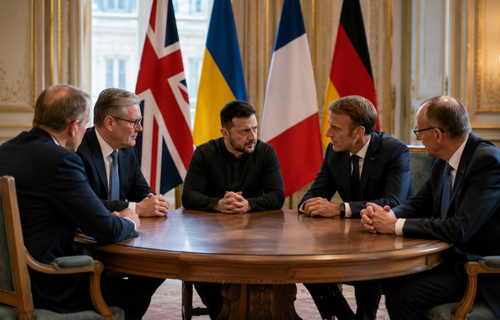
Ukrainian President Volodymyr Zelenskyy met with British Prime Minister Keir Starmer, French President Emmanuel Macron and German Chancellor Friedrich Merz in London earlier this month to discuss ongoing support for Ukraine, potential pathways toward ending the war with Russia, and future security guarantees for Kyiv. The meeting highlighted the increasingly prominent role being played by the so-called E3 countries in coordinating European policy on Ukraine.
Poland, however, was not represented at the discussions despite its position as one of Ukraine’s most important allies since the start of Russia’s full-scale invasion in 2022.
Prime Minister Donald Tusk responded by emphasizing that Poland should be involved in any discussions concerning Ukraine’s future and regional security arrangements. He stated that decisions affecting Poland’s security interests cannot be considered binding if Warsaw is excluded from the process.
The development has sparked debate within Poland over whether the country is receiving sufficient political influence in return for its substantial contribution to Ukraine’s defense effort.
Since the outbreak of the war, Poland has served as one of the principal logistical hubs for military, humanitarian and economic assistance flowing into Ukraine. The country has welcomed millions of Ukrainian refugees, provided significant military aid and facilitated the transport of equipment and supplies from NATO allies. Poland was also among the first countries to transfer heavy military equipment to Ukraine.
Despite this role, recent diplomatic initiatives concerning Ukraine’s future have often been led by larger Western European powers, particularly the United Kingdom, France and Germany. Analysts note that smaller diplomatic formats are frequently used to accelerate decision-making and coordination, although such meetings do not necessarily determine the final shape of broader European or NATO policy.
The discussion has also revived longstanding questions about Poland’s strategic priorities regarding Ukraine. Areas frequently cited by policymakers and business groups include border infrastructure, trade relations, the role of Polish companies in Ukraine’s reconstruction, transport corridors, and broader security cooperation.
At the same time, Poland remains one of Ukraine’s closest partners within both NATO and the European Union. While tensions have periodically emerged over issues such as agricultural imports, transport regulations and historical disputes, cooperation between Warsaw and Kyiv continues to be a central element of regional security policy.
The episode underscores a broader challenge facing Poland as its economic and military weight grows within Europe. The country has become one of NATO’s largest defense spenders relative to GDP and is undertaking one of the continent’s most ambitious military modernization programs. The question now facing policymakers in Warsaw is how to translate that growing strategic importance into greater influence over decisions concerning the future security architecture of Eastern Europe.
As discussions about Ukraine’s long-term security and eventual reconstruction continue, Polish officials are expected to push for a more formal role in future negotiations. Whether this leads to an expanded diplomatic format remains uncertain, but the issue has highlighted Poland’s determination to ensure its interests are represented in decisions that will have lasting implications for the region.
Source: WEI