Sunday, 4 October 2026
Institutional rental housing is taking a more prominent position in the Czech investment market as investors compete for a limited pool of large residential portfolios and increasingly look to new development as an alternative way of building exposure to the sector. The shift was particularly visible during the first half of 2026. Savills recorded almost €1.14 billion of Czech commercial property transactions during the period, with residential emerging as the country’s second-largest investment segment. The consultancy’s total differs from estimates produced by some other major property advisers because of differences in transaction coverage and methodology, but market reports broadly point to residential property playing an unusually important role in this year’s investment activity.
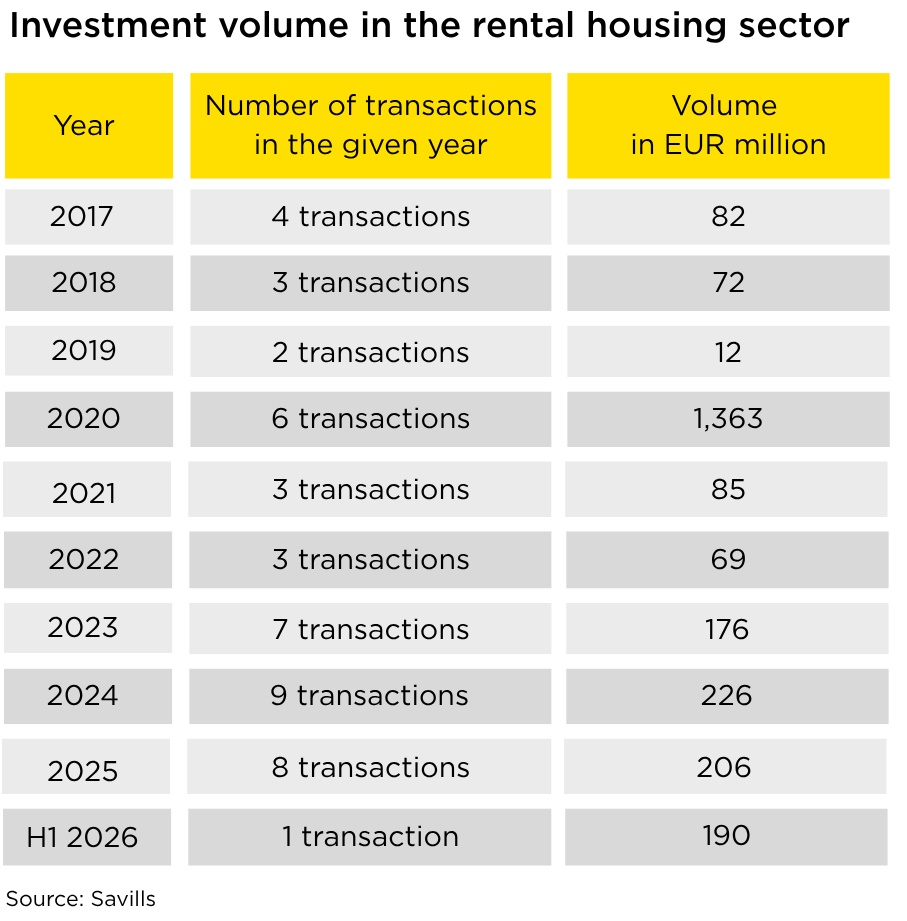
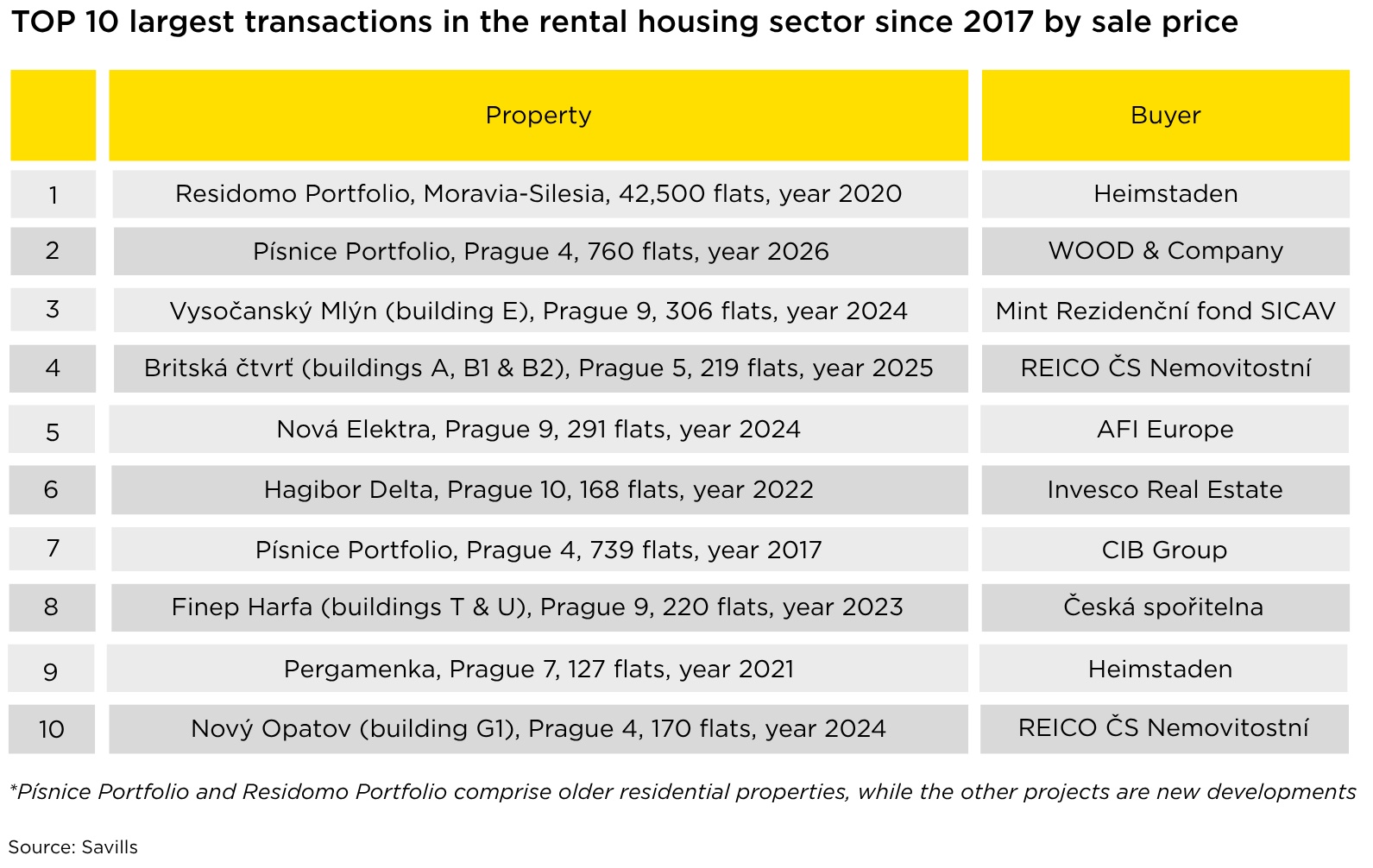
The transaction that changed the balance was Wood & Company’s acquisition of a portfolio of 760 rental apartments in Prague’s Písnice district. The properties are spread across 16 residential buildings and were acquired through the investment firm’s real estate fund. According to Savills, the Písnice acquisition was also the largest Czech real estate investment transaction across all property sectors in the first half of the year and helped residential record its strongest quarterly investment result since 2020.
The significance of the deal extends beyond its size. It illustrates one of the structural characteristics of the Czech residential investment market: genuinely large portfolios of existing rental apartments rarely become available. Unlike offices, shopping centres or logistics parks, where institutional assets are regularly brought to market, much of the Czech housing stock remains fragmented between individual owners. Large blocks of professionally managed apartments suitable for institutional acquisition therefore represent a comparatively scarce product.
Part of the existing institutional stock has unusual historical origins. Large residential portfolios were originally accumulated by state-owned industrial enterprises that provided accommodation for their employees. Following economic restructuring and privatisation, some of these housing portfolios eventually moved into private ownership. Among the most prominent examples was the approximately 42,500-unit former OKD housing portfolio in northern Moravia. Other portfolios originated with major industrial businesses including ČEZ, Třinecké železárny and Chemopetrol. Savills argues that the relatively small number of such large portfolios remaining in the market contributes to their attractiveness when they become available.
The shortage is gradually changing how institutional capital enters Czech housing. Rather than waiting for existing portfolios to be offered for sale, funds and other long-term investors are increasingly acquiring newly developed residential projects, including transactions agreed while schemes are still under construction. Once completed, the apartments can be operated directly by the investor or through specialist residential management companies.
This approach is contributing to the expansion of professionally managed rental housing, particularly in Prague. Projects involving institutional owners now include developments backed by REICO, Mint Living, Heimstaden, Invesco and insurance and banking-related investment vehicles, alongside rental platforms such as AFI Home and XPlace. Savills also identifies Fragment and Lihovar Smíchov among projects contributing to the expanding institutional market.
The development pipeline suggests that this segment will become considerably more visible. Savills has estimated that more than 1,100 institutional rental apartments could be completed in Prague during 2026, with approximately 1,900 units under construction and a further 3,400 expected to enter construction. This pipeline is gradually creating the scale required for residential property to become a more established component of institutional investment portfolios.
Underlying housing-market conditions help explain investor interest. Prague combines relatively limited residential construction with persistent demand generated by employment, education, household formation and migration. At the same time, high purchase prices and financing costs mean that part of the population is remaining in rented accommodation for longer, supporting demand for professionally managed rental housing.
This creates a different investment profile from some conventional commercial assets. Demand for individual offices or retail units can change substantially with the business cycle, while residential demand is supported by the continuing requirement for housing. That does not eliminate investment risk. Rental affordability, financing costs, regulation, operating expenses and development pricing remain important considerations, but residential portfolios can provide relatively diversified income across hundreds of individual tenants.
Earlier market analysis illustrates how residential’s position has already been changing. Rental housing accounted for only a small proportion of Czech commercial real estate investment during much of the period between 2017 and 2022, apart from the exceptional 2020 sale of the former OKD portfolio. By 2023, however, residential investment had reached approximately €167 million and represented around 13% of total property investment.
The Písnice transaction demonstrates how quickly those figures can move when a genuinely large portfolio becomes available. It also highlights a potential constraint on future investment volumes. Investor appetite alone cannot produce transactions if suitable portfolios are unavailable. The relatively limited stock of large stabilised rental assets means growth increasingly depends upon new projects being developed specifically for long-term rental ownership or developers selling multiple apartments and entire schemes to institutional buyers.
That could gradually change the relationship between residential developers and investment funds. Instead of relying exclusively on individual apartment sales, developers can potentially secure institutional buyers for complete projects or substantial phases, providing an alternative exit route and reducing sales exposure during construction.
For investors, scale brings another advantage. Hundreds of apartments concentrated within one development can be operated more efficiently than geographically dispersed individual units, allowing leasing, maintenance, tenant services and property management to be organised through a single platform. This operational efficiency is one of the factors supporting the institutionalisation of rental housing across Prague and, increasingly, other Czech cities.
The attraction nevertheless depends on pricing. Residential assets must compete for capital with offices, logistics, retail and hotels, while investors also have access to bonds and other financial instruments. Institutional rental housing therefore needs to provide an acceptable combination of income stability, rental growth and long-term capital appreciation rather than relying simply on the assumption that housing demand will remain strong.
Czech investment conditions remain broadly supportive. Although 2026 transaction volumes are below the exceptional levels recorded during 2025, market advisers continue to report healthy investor appetite. Domestic capital remains particularly important and its ability to undertake larger transactions reduces dependence on international investment cycles, giving residential sellers a wider potential buyer pool when sizeable assets become available.
For institutional rental housing, however, the principal challenge may increasingly be finding enough product. The Czech market has moved beyond the stage where professionally managed rental housing is an experimental property category. Established investment funds, insurers and specialist residential platforms are already participating, while the development pipeline is creating a larger stock of purpose-built rental accommodation.
The next stage is therefore likely to be determined less by whether investors want Czech rental housing and more by whether developers and existing owners can produce portfolios of sufficient scale and quality for them to buy. The 760 apartments in Písnice provide an unusually clear example. One transaction was large enough to materially change the sector composition of Czech property investment during the first half of 2026. In a market where portfolios of that size remain scarce, future opportunities are likely to attract similarly strong attention from institutional capital.
Source: Savills