Saturday, 19 September 2026
The recent impact of a Russian Kh-101 cruise missile on Polish territory has reinforced the strategic importance of Poland’s ongoing investment in one of Europe’s most ambitious air defence modernisation programmes. While the incident resulted in no casualties and caused only limited damage after the missile landed in an uninhabited field near Tarnawa-Kolonia in the Lublin region, it highlighted the security challenges facing countries located on NATO’s eastern flank as the war in neighbouring Ukraine continues.
Polish authorities have stated there is no evidence that the missile was intentionally directed at Poland. According to Prime Minister Donald Tusk, the projectile was identified as a Russian Kh-101 cruise missile that entered Polish airspace during a large-scale Russian missile and drone attack against Ukraine. The Polish Armed Forces detected the threat, monitored its flight path and scrambled fighter aircraft, while NATO activated allied air assets in accordance with established air policing procedures. Military officials confirmed that an F-16 pilot had been authorised to intercept the missile if operational conditions allowed, but the available response time proved too short before the missile struck the ground.
Although the incident ended without injuries, it demonstrated the operational realities of defending against modern cruise missiles travelling at low altitude and high speed close to national borders. Poland’s military surveillance network successfully identified the threat and coordinated its response with NATO partners, but the episode illustrated how limited the decision-making window can be when an incoming missile remains in national airspace for only a matter of minutes.
The government has also acknowledged that public communication procedures can be strengthened. Following the incident, Prime Minister Tusk said emergency warning systems would be reviewed after mobile alerts reached residents later than desired, despite air raid sirens being activated promptly. Improving coordination between military detection systems and civilian notification networks has subsequently become part of the broader discussion surrounding national resilience.
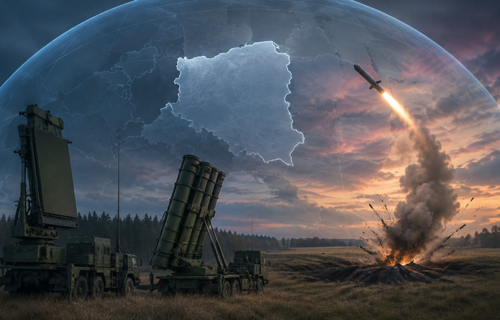
The missile incursion comes at a time when Poland is undertaking one of the most significant defence investment programmes in Europe. The country’s integrated air defence architecture is being built around the long-range Wisła programme, the medium-range Narew system and the short-range Pilica+ network, complemented by expanding counter-drone capabilities. Together, these programmes are intended to create a layered defensive shield capable of responding to a wide spectrum of aerial threats, including ballistic missiles, cruise missiles, aircraft and increasingly sophisticated unmanned systems.
Significant progress has already been made, with several systems entering operational service and additional deliveries scheduled over the coming years. Nevertheless, the latest incident demonstrates that the full capability of the integrated network will only be realised once all planned batteries, radar systems and interceptors are deployed and fully connected within Poland’s command-and-control infrastructure.
The wider strategic environment continues to reinforce the urgency of these investments. Russia’s latest attack on Ukraine involved dozens of cruise missiles and hundreds of drones, illustrating the scale and complexity of contemporary aerial warfare. For neighbouring NATO members such as Poland, maintaining credible air and missile defence has become not only a military requirement but also an important factor in protecting critical infrastructure, transport corridors, energy assets and investor confidence.
The incident should therefore be viewed less as evidence of a failure than as a demonstration of the evolving nature of regional security. Modern air defence is no longer judged solely by the ability to detect incoming threats but by the speed of decision-making, the availability of layered interception capabilities and the integration of military, civilian and allied response systems. As aerial threats become increasingly diverse, combining cruise missiles, ballistic missiles and drones in coordinated attacks, defence planning must continue evolving accordingly.
For investors and businesses operating across Central and Eastern Europe, Poland’s continued commitment to strengthening its defence infrastructure provides an additional indication of the country’s long-term strategic priorities. Large-scale investment in security, digital command systems, radar networks and critical infrastructure resilience is expected to remain a defining element of Poland’s public investment agenda for years to come, while reinforcing its role as one of NATO’s principal security anchors on the Alliance’s eastern frontier.
As the Wisła, Narew and Pilica+ programmes continue to mature, Poland will move closer to establishing one of Europe’s most comprehensive integrated air defence networks. The recent missile incident serves as a reminder that while no defence system can eliminate every risk, sustained investment, technological modernisation and close cooperation with NATO remain essential to strengthening national security in an increasingly unpredictable geopolitical environment.
Source: WEI