Sunday, 4 October 2026
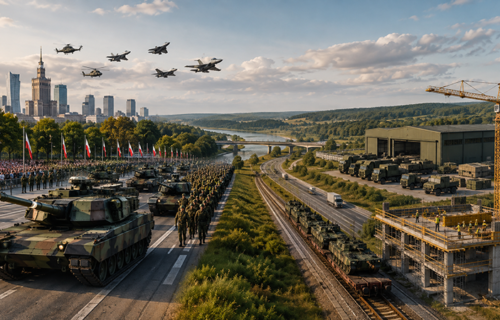
Poland’s Armed Forces Day has evolved into a public demonstration of a much broader transformation taking place across the country. The military equipment displayed in Warsaw each August represents only the most visible part of an investment programme that is reshaping defence capabilities while directing increasing amounts of capital towards industry, transport infrastructure, logistics and domestic manufacturing.
The change is taking place against a markedly different European security environment following Russia’s invasion of Ukraine. Poland’s position on NATO’s eastern flank, alongside its borders with Belarus, Russia’s Kaliningrad region and Ukraine, has pushed defence much higher up the country’s political and economic agenda. This is reflected in planned defence expenditure of around PLN 200.1 billion in 2026, equivalent to approximately 4.8% of GDP.
Such spending creates a challenge beyond acquiring weapons. The government must demonstrate to citizens what this unprecedented allocation of public resources is producing, and Armed Forces Day provides one of the clearest opportunities to do so. Rather than defence programmes remaining represented mainly by contracts, budgets and procurement announcements, the parade allows people to see equipment already entering service. Tanks, artillery, air-defence systems, helicopters and combat aircraft turn large government expenditure figures into something tangible.
The event consequently has several audiences. For Polish citizens, it demonstrates the development of the armed forces and provides direct contact with military personnel. For NATO partners, it underlines Poland’s growing role in the alliance’s eastern security architecture. For potential adversaries, the display forms part of a wider deterrence message intended to demonstrate that investment is being converted into military capability.
The importance of the domestic audience is increasing as the financial commitment grows. Poland’s defence programme competes for resources with healthcare, education, housing and other public priorities, making continued public understanding important. Military celebrations can help explain that expenditure by connecting taxpayers directly with the people, equipment and infrastructure being financed.
At the same time, Poland’s defence strategy increasingly extends beyond the armed forces themselves. Modern military capability depends upon transport networks, logistics facilities, energy systems, communications infrastructure, manufacturing capacity and secure supply chains. Heavy military equipment requires roads and bridges capable of carrying it, railways that can move it efficiently across the country, and storage, maintenance and fuel facilities positioned to support operations. This is creating a growing connection between defence policy and infrastructure investment.
Poland is expected to receive more than €43 billion through the European Union’s SAFE financing mechanism. The programme is intended to support military capabilities including air and missile defence, artillery and counter-drone systems, but Poland also plans to use funding for infrastructure that can strengthen military mobility and national resilience.
A further PLN 22.5 billion Security and Defence Fund is supporting investment involving local authorities and businesses. Part of this capital is intended for dual-use infrastructure, including roads, bridges, tunnels and rail connections capable of serving civilian communities while also allowing military equipment and personnel to move more efficiently.
This creates an increasingly important crossover with construction and real estate. Defence expenditure is generating requirements for factories, specialist industrial facilities, warehouses, maintenance centres, research facilities and secure logistics infrastructure. Some assets will remain entirely within the military estate, but others will form part of Poland’s wider industrial economy.
The expansion also has the potential to influence the geography of investment. For many years, Poland’s principal logistics and industrial markets have been concentrated around Warsaw, Upper Silesia, Poznań, Wrocław, Central Poland and the country’s western transport corridors. Increased security investment along the eastern frontier could gradually strengthen infrastructure in regions that have historically attracted less institutional property development.
The Eastern Shield programme is an example of this changing investment pattern. Poland is developing defensive infrastructure along its borders with Belarus and Russia while simultaneously creating supporting transport, storage and engineering capacity. Some of these investments can have civilian applications, particularly where upgraded infrastructure improves regional connectivity or provides resources that can also be deployed during natural disasters and other emergencies.
The larger economic opportunity may emerge from Poland’s attempt to keep a greater proportion of defence expenditure within the domestic economy. Rather than relying predominantly on imported military systems, the government is seeking to increase Polish participation in manufacturing, maintenance and defence supply chains. Its plans for EU-backed defence financing envisage a substantial proportion of spending flowing through Polish companies.
This could have consequences considerably beyond the country’s established defence manufacturers. Military production depends upon extensive supplier networks covering electronics, communications technology, software, precision engineering, metals, advanced materials, vehicle components and specialist services. Expansion of these industries requires production capacity, laboratories, offices, warehouses and logistics infrastructure. Defence policy could therefore become another source of industrial real estate demand.
The trend fits into a wider European shift in which security expenditure is increasingly being connected with industrial policy. Governments are seeking not only greater military capability but also domestic production capacity and supply chains that are less dependent on suppliers outside Europe.
For Poland, the potential economic effects are particularly significant because of the scale of its military expansion. The country is simultaneously purchasing advanced international weapons systems, developing domestic production and investing in infrastructure capable of supporting Polish and allied forces.
Facilities at locations such as Powidz illustrate the physical consequences. Investment there is increasing Poland’s ability to store equipment and support the rapid deployment of allied forces. Such projects demonstrate that military readiness depends as much on logistics and infrastructure as it does on the equipment eventually seen during public parades.
There is also a workforce dimension. Expanding armed forces and defence industries require soldiers, engineers, technicians, construction specialists, cybersecurity experts and manufacturing employees. Competition for skilled labour could therefore become another consequence of the defence investment cycle, particularly in locations where large military and industrial projects are concentrated.
The social purpose of Armed Forces Day should also be viewed against this background. Allowing people to encounter soldiers and equipment directly helps reduce the distance between the military and civilian population. It can support recruitment and public understanding while reinforcing the idea that national security extends beyond professional armed forces.
Poland’s emerging security model increasingly includes civilian resilience, energy security, cybersecurity, transport capacity and protection against disinformation alongside conventional defence. The distinction between military preparedness and the resilience of the wider economy is consequently becoming less clear.
This also has implications for investors. Security has traditionally been treated as an external condition affecting property investment rather than as a source of investment itself. Poland’s current defence programme is beginning to change that relationship. Transport upgrades, industrial expansion, logistics requirements and domestic defence manufacturing are generating capital expenditure that intersects directly with commercial property and infrastructure markets.
Not every military investment will create an opportunity for private capital, and defence expenditure should not automatically be interpreted as commercial real estate growth. However, the secondary effects of sustained spending approaching 5% of GDP could become increasingly visible through manufacturing investment, infrastructure upgrades and supporting supply chains.
There is a wider economic argument behind the strategy. Businesses invest and property markets develop partly because companies expect infrastructure to function and the political and security environment to remain stable. Defence spending is therefore increasingly connected with maintaining the conditions required for longer-term economic activity.
This makes Poland an important example of a broader transformation underway across Europe. As governments increase defence budgets, the effects are likely to spread beyond military procurement into construction, manufacturing, logistics, technology and infrastructure.
The equipment appearing on Warsaw’s streets during Armed Forces Day provides the public face of that transformation. Behind it sits a considerably larger programme involving factories, transport corridors, military facilities, logistics networks and industrial supply chains. Poland’s military expansion is therefore becoming more than a defence story. It is developing into an industrial and infrastructure story as well, one whose impact on investment, regional development and the built environment could continue long after the parade has left the streets.
Source: WEI and CIJ EUROPE Analysis Team